 AI
AIAI reconstruction created with Nano Banana 2 · 1K, grounded in the profile’s documented taxonomy, habitat, natural-history sources, and an open-license visual reference when available. It is an interpretive image, not documentary evidence. Image policy →
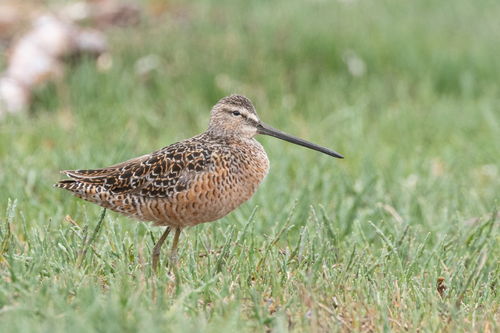
Long-billed Dowitcher
Agujeta Piquilarga
Limnodromus scolopaceus
The long-billed dowitcher (Limnodromus scolopaceus) is a medium-sized shorebird with a relatively long bill belonging to the sandpiper family, Scolopacidae. In breeding plumage, adults are characterized by a rufous head and underparts with a darker mottled back and a large white upper rump only seen in flight. They feed in various freshwater habitats with their bill underwater in a "sewing machine" motion and have a mating display where males chase females in flight. The genus, Limnodromus is Ancient Greek from limne, "marsh" and dromos, "racer". The specific scolopaceus is Neo-Latin for "snipe-like", from Latin scolopax, scolopacis, a snipe or woodcock. The English name is from Iroquois and was first recorded in 1841. The long-billed dowitcher is similar in appearance to the short-billed dowitcher and was only recognized as a separate species in 1950. Between the two, the best distinguishing field mark is their flight call, especially in winter, when the two species' plumage can be nearly identical. However, the two species differ ecologically in their habitat preferences and breeding locations. Long-billed dowitchers generally prefer freshwater habitats, and breed in northern Alaska and Siberia; their short-billed counterparts favor saltwater habitats and breed farther east, from southern Alaska across Canada to the maritime provinces.
Sound archive
Hear its voice
Explore real songs and calls. The spectrogram turns each sound into a visual trace of time and frequency.

Play: call by Christiana Fattorelli
Choose another recording
Sound recorded by Christiana Fattorelli · XC1055893 · CC BY-NC-SA 4.0. Visualization by Stichting Xeno-canto voor Natuurgeluiden.
Every recording retains the creator, catalogue number, and license published by Xeno-canto. Metadata via GBIF ↗
Island profile
About the Long-billed Dowitcher
This atlas includes Long-billed Dowitcher (Limnodromus scolopaceus) with atlas status “Accidental / vagrant” within scope “Avibase inferred core 380.” Global trait data associate it primarily with wetland; consult the linked records to resolve its Puerto Rico habitat use.
Conservation
Near Threatened
IUCN NT
- Global IUCN
- NT
- Puerto Rico DNER
- No current listing in source crosswalk
- Federal ESA
- No current listing in source crosswalk
- Critical habitat
- Not identified in source crosswalk
Natural history
How it lives
- Habitat
- wetlands
- Elevation
- 0–1600 m
- Nest
- Shrub / bush / vine
- Clutch
- 3–4 eggs
- Social behavior
- Not resolved
Keep exploring
This bird belongs to 6 paths through the atlas.
Related in the atlas
Where to fly next
Connected by taxonomy, habitat, occurrence, and conservation.
 AI
AI AI
AI AI
AI AI
AI AI
AI AI
AI

Evidence trail