 AI
AIThe forest kingbird
What bird is the clérigo?
Darker, heavier-billed, and less urban than the Gray Kingbird. Its Puerto Rico population may be a species of its own.
Reviewed:The clérigo is a forest kingbird.
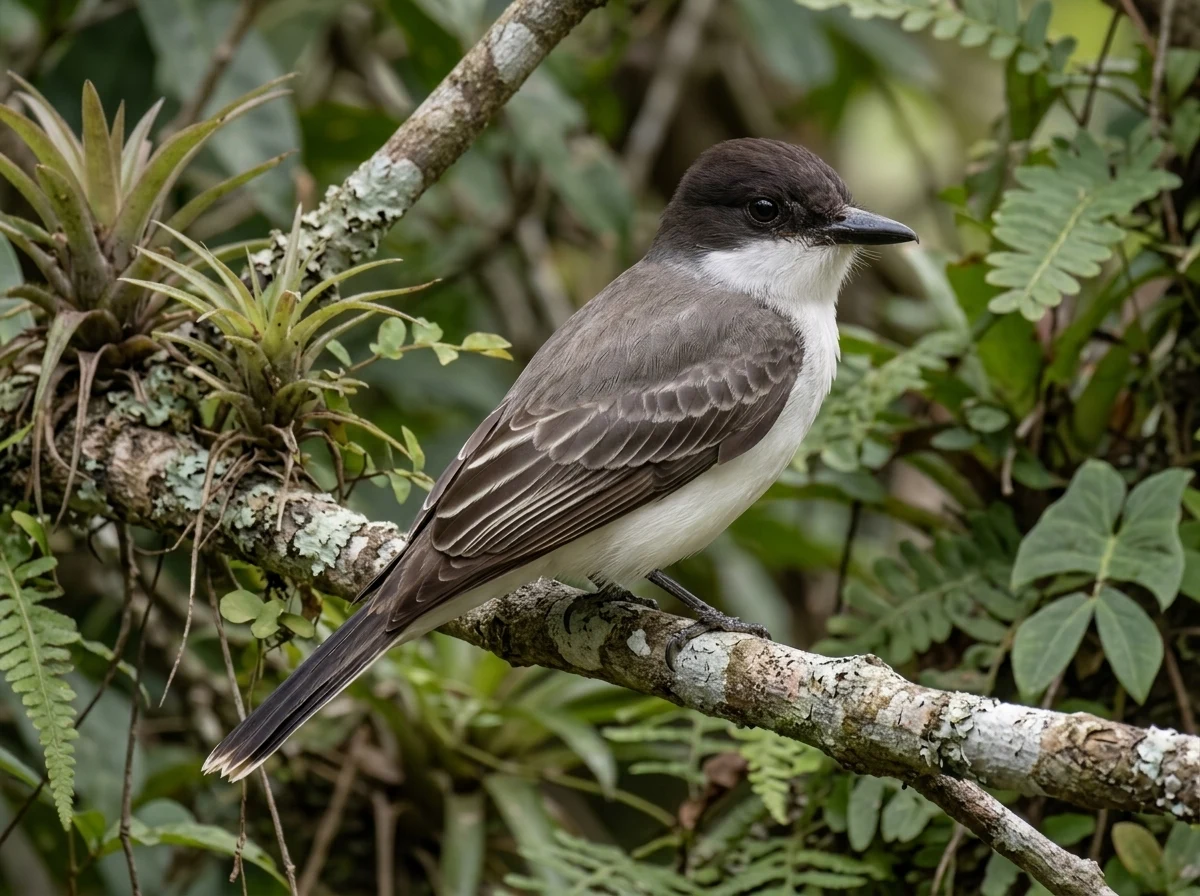
The clérigo is the Loggerhead Kingbird (Tyrannus caudifasciatus), a sturdy flycatcher with a black head, gray back, and heavy bill that lives in Puerto Rico's woodlands, shade coffee, mangroves, and montane clearings. It is a relative of the Gray Kingbird, the island's Pitirre, which is why it is also called Pitirre de Monte.
Clérigo is the official local name in the Sociedad Ornitológica Puertorriqueña's catalog. This guide explains how to recognize it, how to separate it from the Gray Kingbird and the Puerto Rican Flycatcher, what it eats, when it nests, and why the Puerto Rico and Vieques population has been proposed as a separate species.
The forest kingbird
The clérigo in numbers
24–26 cmlongA large kingbird, a bit bigger than the Gray Kingbird (about 23 cm).
Feb–julbreeding in Puerto RicoNest building can begin in November.
7subspeciesPuerto Rico and Vieques hold T. c. taylori.
01
Clérigo in Puerto Rico, guatíbere in Cuba
The SOPI catalog lists Clérigo for Tyrannus caudifasciatus, and the Spanish Ornithological Society calls it Tirano Guatíbere. In Cuba it is pitirre guatíbere and in the Dominican Republic pitirre manjuila. Our catalog also records the name Pitirre de Monte (forest pitirre), which neatly sums up its kinship with the Gray Kingbird and its preference for woodland.
The sources we reviewed record the name clérigo but do not document its origin, so we will not guess. If your family explains the name in a particular way, it is worth writing down with the municipality and the generation that uses it.
02
How to recognize the clérigo
It measures 24–26 cm (9.5–10 in) and has a heavy bill. The head is black except for the throat, contrasting with a gray back and pale underparts. It has an orange crown patch that is rarely seen outside displays. In most populations the tail ends in a grayish band, which can be white.
It hunts from exposed perches and sallies out for flying insects, like other kingbirds. If you see a “pitirre” with a black hood at a forest edge or coffee farm rather than on a city wire, think clérigo.
03
Loggerhead or Gray Kingbird
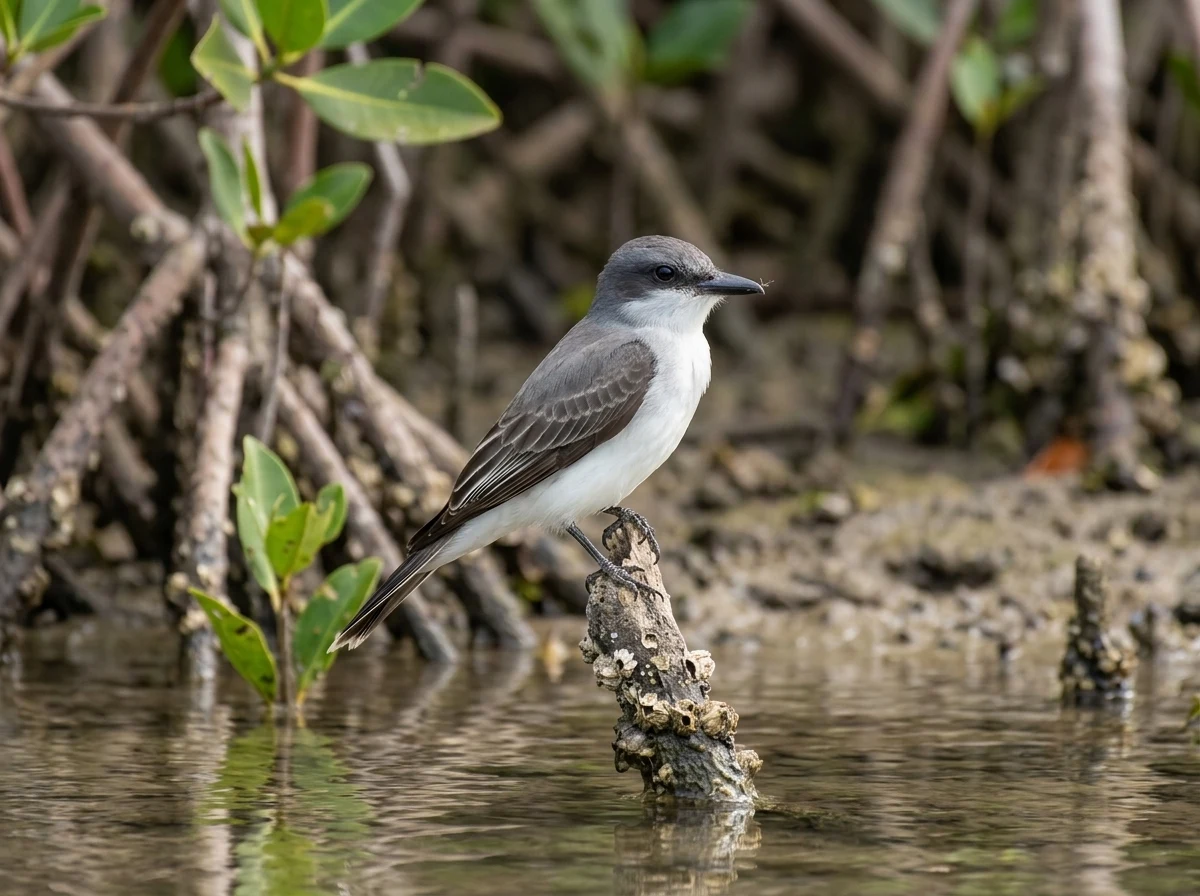
The Gray Kingbird (Pitirre, Tyrannus dominicensis) is about 23 cm long and weighs 37–52 g. It is gray above and white below, with a dusky mask through the eye and a concealed yellow crown stripe. It lacks the clérigo's black hood; its head looks gray with a mask, not black.
Voice and setting help. The Gray Kingbird's call is a loud trill, “pipiri, pipiri,” which gave it its Antillean name, and it uses open sites, wires, and coasts. The Loggerhead prefers woodland, coffee farms, and mangroves. Both defend territories boldly; in Puerto Rico, Gray Kingbirds have been photographed mobbing an American Kestrel.
04
Where it lives and what it eats
Across the Antilles it lives in pine and broadleaf forest, shade coffee plantations, mangroves, and open park-like habitats, from the coast into the lower mountains. In Puerto Rico it is a resident breeder, and our catalog ties it to forest edges, woodland, shade coffee, and montane clearings.
It eats flying insects, small fruit and berries, and small lizards. That mix explains why it turns up in shade coffee with fruit trees, where it has high perches for hunting and extra food when insects are scarce.
05
Courtship and nesting in Puerto Rico
In Puerto Rico breeding occurs mainly from February to July, though nest building can start in November. The pair builds a cup-shaped nest of twigs, stems, and grass, and lays 2–4 eggs.
Courtship is noisy: the pair calls constantly, with rattles and loud notes, and chases each other. Both choose the nest site; the female flattens herself on the branch, turns in a circle, and flutters her wings while calling, and the male joins in and raises his crown feathers, revealing the colored patch he normally keeps hidden.
06
A Puerto Rican species in waiting?
The species has seven subspecies across the Greater Antilles, the Bahamas, and the Cayman Islands. Puerto Rico and Vieques hold Tyrannus caudifasciatus taylori, which has been proposed for elevation to a separate species under the name Puerto Rican Kingbird (Tyrannus taylori).
For now this catalog, like the local list, treats it as a subspecies, so the clérigo does not count among the official endemics. If the proposal succeeds, Puerto Rico would add another bird found nowhere else, which is one more reason to document well where it lives and how it sounds.
Linked profiles
The clérigo and the flycatchers it is confused with
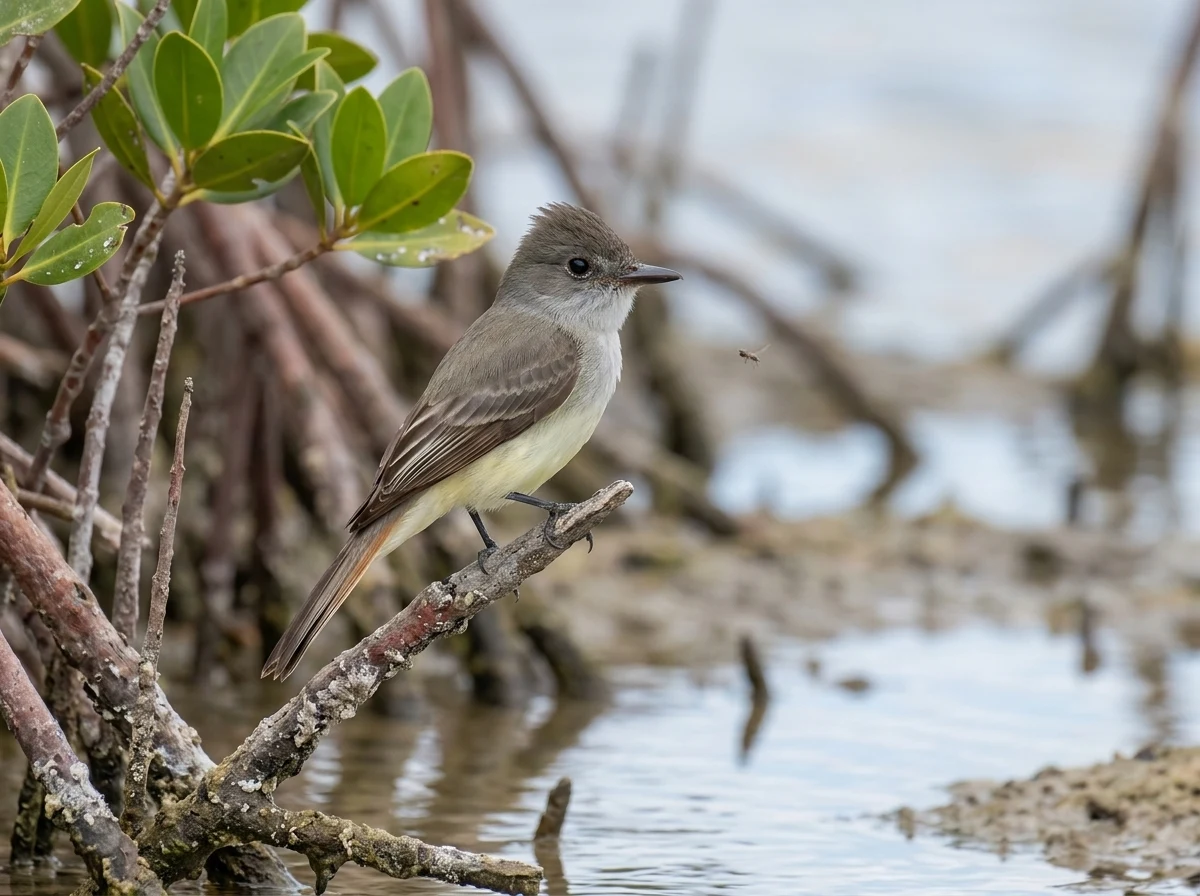
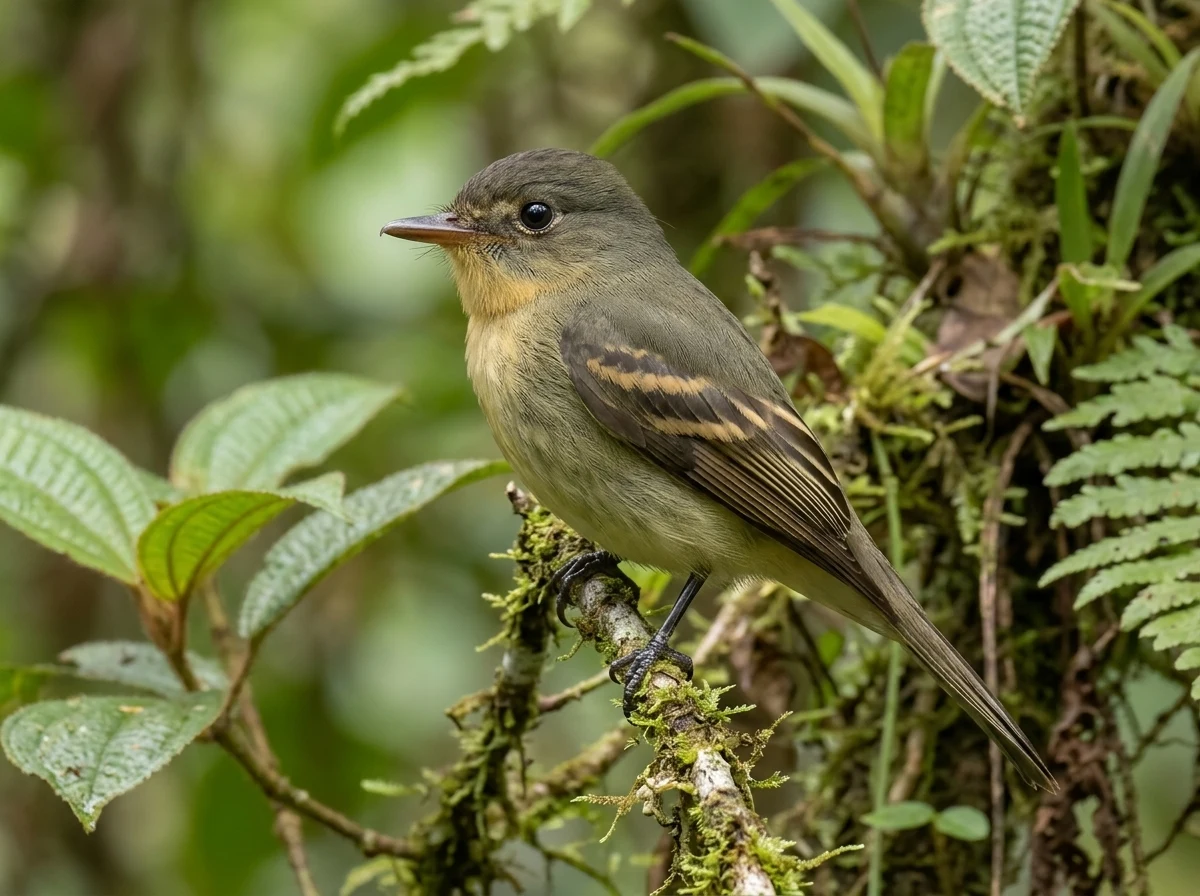
Compare the silhouette, bill, and voice of Loggerhead Kingbird, Gray Kingbird, Puerto Rican Flycatcher, and Lesser Antillean Pewee.
Sound archive
Hear its voice
Explore real songs and calls. The spectrogram turns each sound into a visual trace of time and frequency.
XC962711Recording 1 of 3song

Play: song by Hans Matheve
Choose another recording
Sound recorded by Hans Matheve · XC962711 · CC BY-NC-ND 4.0. Visualization by Stichting Xeno-canto voor Natuurgeluiden.
Every recording retains the creator, catalogue number, and license published by Xeno-canto. Metadata via GBIF ↗
01
What bird is the clérigo?
It is the Loggerhead Kingbird (Tyrannus caudifasciatus), a sturdy kingbird with a black head, gray back, and heavy bill. In Puerto Rico it lives in woodland, shade coffee, and mangroves, and is also called Pitirre de Monte.
02
Are the pitirre and the clérigo the same bird?
No. They are two species in the same genus. The Gray Kingbird is gray with a mask and uses open sites and wires; the Loggerhead has a black hood, a heavier bill, and prefers woodland. The “pipiri” call belongs to the Gray Kingbird.
03
Is the clérigo endemic to Puerto Rico?
Not as a species: it also lives in Cuba, Hispaniola, Jamaica, the Bahamas, and the Caymans. But the Puerto Rico and Vieques subspecies, T. c. taylori, has been proposed as a separate species, the Puerto Rican Kingbird.
04
What does the clérigo eat?
Flying insects it catches from exposed perches, plus small fruit, berries, and small lizards.
05
When does the clérigo nest in Puerto Rico?
Mainly from February to July, though nest building can start in November. It builds a cup of twigs, stems, and grass and lays 2–4 eggs.
06
What does the clérigo sound like?
During courtship the pair gives rattles and loud calls almost nonstop while chasing each other. It is not the Gray Kingbird's “pipiri”; compare with the recordings on its profile, because in the forest a Loggerhead Kingbird is often heard before it is seen.
07
Are there Loggerhead Kingbirds on Vieques?
Yes. The subspecies T. c. taylori ranges across Puerto Rico and the island of Vieques. Look for it at forest edges, in woodland, and in mangroves rather than in open urban areas.
08
Is the sucha the same as the clérigo?
No. Sucha is a Bolivian name for the Black Vulture, a carrion bird, not a Puerto Rican bird name. The clérigo is a tyrant flycatcher.
Keep exploring
Connected routes
Sources and review
The evidence is one link away.
These sources support the editorial scope of this guide. Bird profiles also retain their own taxonomy, occurrence, and conservation references.
Reviewed:
01↗02↗03↗04↗05↗06↗
Sociedad Ornitológica Puertorriqueña
Catalog of the Birds of Puerto Rico (2007)
Official local names (Mozambique, Tordo Lustroso, Pizpitas, Querequequé, Clérigo, Aura Tiñosa), Spanish SEO names, and introduced status.Wikipedia
Loggerhead kingbird
The taylori subspecies of Puerto Rico and Vieques, measurements, habitat, diet, and Puerto Rico breeding calendar.Wikipedia en español
Tyrannus caudifasciatus, Spanish Wikipedia
Names by island: pitirre guatíbere in Cuba, pitirre manjuila in the Dominican Republic, and clérigo in Puerto Rico.Wikipedia
Gray kingbird
Gray Kingbird measurements and plumage, pipiri call, and mobbing of raptors in Puerto Rico.Sociedad Ornitológica Puertorriqueña
Official bird list
Local names, occurrence categories, and the public summary of 17 endemics.Xeno-canto Foundation / GBIF
Xeno-canto recordings published through GBIF
Metadata, authorship, licenses, and catalogue records for field recordings used by the atlas.The atlas continues