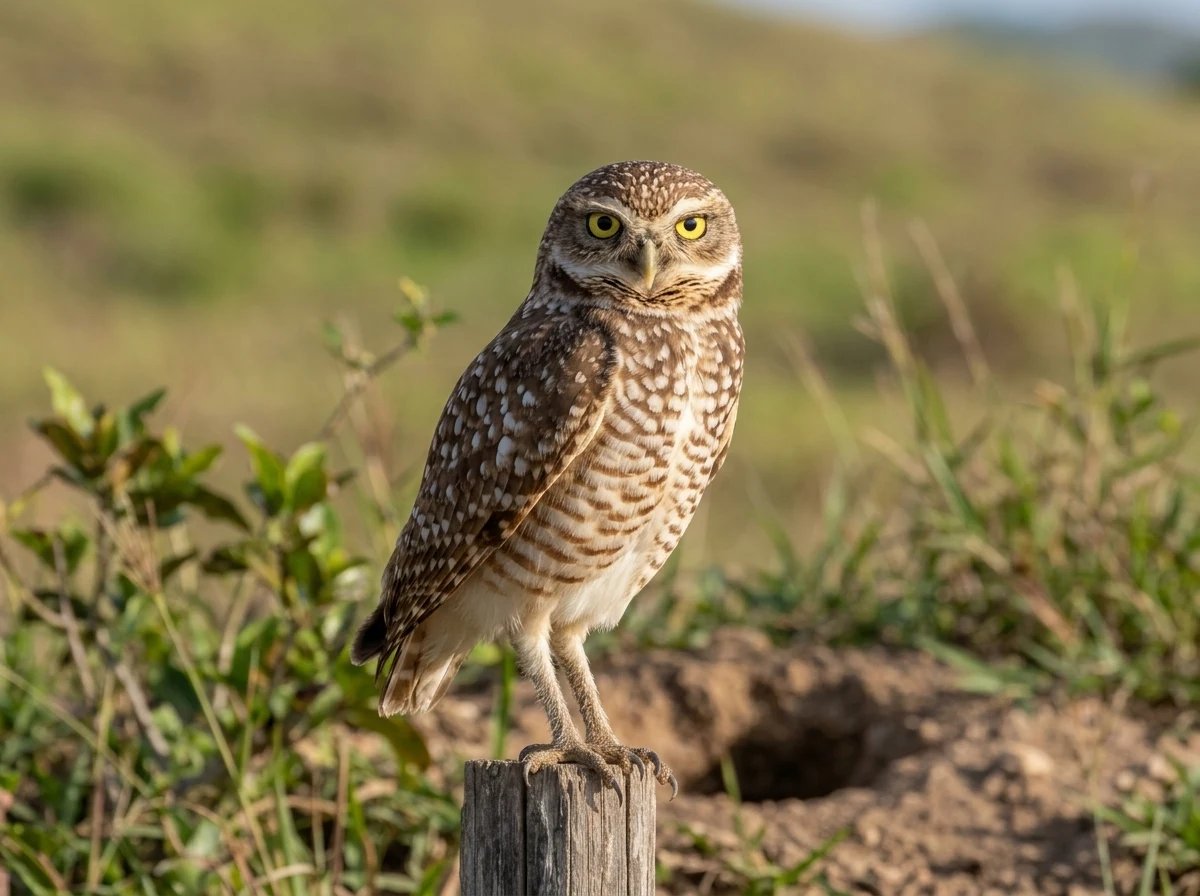
 AI
AIAI reconstruction created with Nano Banana 2 · 1K, grounded in the profile’s documented taxonomy, habitat, natural-history sources, and an open-license visual reference when available. It is an interpretive image, not documentary evidence. Image policy →
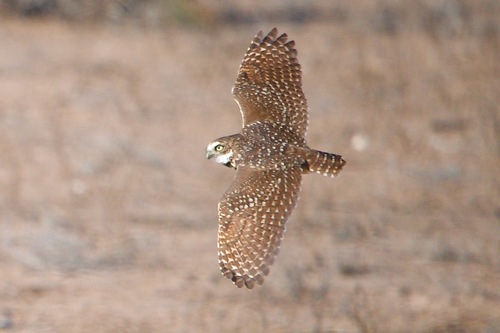
Burrowing Owl
Múcaro de Madriguera
Athene cunicularia
The burrowing owl (Athene cunicularia), also called the shoco, is a small, long-legged, primarily terrestrial—though not flightless—species of owl native to the open landscapes of North and South America. They are typically found in grasslands, rangelands, agricultural areas, deserts, or any other open, dry area with low vegetation. They nest and roost in burrows, and, despite their common name, do not often construct these dwellings themselves, rather repurposing disused burrows or tunnels previously excavated and inhabited by other species, such as American badgers (Taxidea taxus), foxes (Vulpes sp.), ground squirrels or prairie dogs (Cynomys spp.), among others. Unlike most owls, burrowing owls are often active during the day, although they tend to avoid the heat of midday. But, similar to many other species of owls, they are mostly crepuscular hunters, as they can utilize their night vision and attuned hearing to maximum potential during sunrise and sunset. Having evolved to live on open grasslands and prairie habitat (as well as badlands, chaparral and desert ecosystems), as opposed to dense forest, the burrowing owl has developed longer legs than other owls, a trait which enables it to sprint when pursuing its prey, not dissimilarly to the greater roadrunner, as well as providing momentum when taking flight; however, burrowing owls typically only become airborne for short bursts, such as when fleeing threats, and typically do not fly very high off of the ground.
Sound archive
Hear its voice
Explore real songs and calls. The spectrogram turns each sound into a visual trace of time and frequency.

Play: alarm call by Paul Lenrumé
Choose another recording
Sound recorded by Paul Lenrumé · XC1007847 · CC BY-NC-SA 4.0. Visualization by Stichting Xeno-canto voor Natuurgeluiden.
Every recording retains the creator, catalogue number, and license published by Xeno-canto. Metadata via GBIF ↗
Island profile
About the Burrowing Owl
This atlas includes Burrowing Owl (Athene cunicularia) with atlas status “Accidental / vagrant” within scope “Avibase inferred core 380.” Global trait data associate it primarily with grassland; consult the linked records to resolve its Puerto Rico habitat use.
Conservation
Least Concern
IUCN LC
- Global IUCN
- LC
- Puerto Rico DNER
- No current listing in source crosswalk
- Federal ESA
- No current listing in source crosswalk
- Critical habitat
- Not identified in source crosswalk
Natural history
How it lives
- Habitat
- grasslands
- Elevation
- 0–4500 m
- Nest
- Burrow / ground cavity · Ground
- Clutch
- 6–11 eggs
- Social behavior
- Colonial
Keep exploring
This bird belongs to 6 paths through the atlas.
Guides featuring this bird
Follow this record beyond the profile.
Identification, sound, place, and explanatory guides connecting this species to larger questions.
Related in the atlas
Where to fly next
Connected by taxonomy, habitat, occurrence, and conservation.
 AI
AI AI
AI AI
AI AI
AI AI
AI AI
AI
Evidence trail