 AI
AINatural history
The Burrowing Owl in Puerto Rico: status and history
A long-legged owl that lives on the ground and hunts by day sounds like island legend, but it is a real Pleistocene story. Here is what the bones say and what we still do not know.
Reviewed:Are there Burrowing Owls in Puerto Rico?
There is no known population of the Burrowing Owl (Athene cunicularia) in present-day Puerto Rico. The species is known on the main island and on Mona from cave fossils, and the Puerto Rican bones are distinct enough that they may represent a different species. When the DRNA described the island's living owls in 2015, it named only the Puerto Rican Owl, the Short-eared Owl, and the Barn Owl.
Our catalog, which follows regional checklists, lists it as an accidental species, but we found no published modern record to cite. So this guide treats the Burrowing Owl as a chapter of Puerto Rico's natural history: where it lived, why it vanished from much of the West Indies, how to recognize one, and what to do if someone thinks they have seen it.
Natural history
The Burrowing Owl in three facts
0known populations todayNot among the three living owls the DRNA describes.
2Puerto Rican islands with fossilsPuerto Rico and Mona, per Pregill and Olson (1981).
19–25 cmbody lengthSimilar to the Puerto Rican Owl, but long-legged and ground-dwelling.
18recognized subspeciesPer Birds of the World, across its whole range.
01
What the Burrowing Owl is
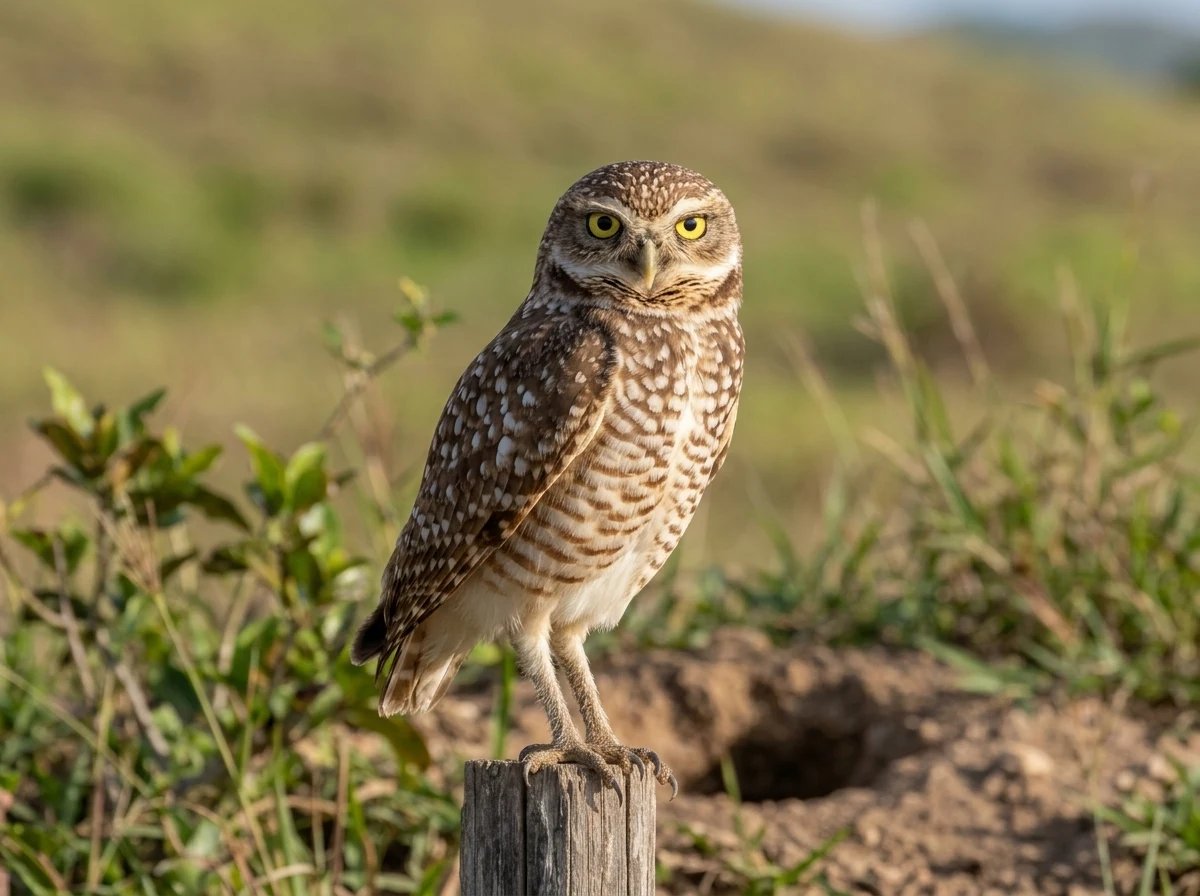
The Burrowing Owl is a small owl, 7.5–9.8 inches (19–25 cm) long, with long legs, barred underparts, and terrestrial habits. It lives in grasslands, prairies, farmland, and open places with very short grass or bare soil, including airports, golf courses, and vacant lots. Unlike most owls it is active by day, especially when breeding, though it hunts mostly at dusk and at night.
It nests and roosts in burrows that it rarely digs itself, usually reusing tunnels made by other animals. It nests in colonies, lays 6 to 11 eggs, and incubates for 28 to 30 days, according to our catalog data. Its voice includes a mellow “coo-coooo” repeated twice and liquid cackling. In Spanish it goes by many names: mochuelo de madriguera in Spain, lechucita vizcachera in Argentina, tecolote llanero in Mexico.
02
The fossils from Puerto Rico and Mona
Pregill and Olson (1981) summarized Burrowing Owl fossils from Jamaica, Cayman Brac, Mona, Puerto Rico, Barbuda, Antigua, and two Bahamian islands. Of the Puerto Rican material they wrote that it is quite distinct from the other populations and may represent a different species. In other words, the island may have had its own burrowing owl, now gone.
These bones come from late Pleistocene cave deposits, from the time of the last glaciation. The same Puerto Rican cave deposits hold other birds that no longer live here, such as the cave barn owl Tyto cavatica. Together they show that Puerto Rico's owl community was more diverse than it is today.
03
Why it disappeared: the loss of dry habitat
Pregill and Olson describe the Burrowing Owl as a bird of dry places: arid prairie or open scrub with soft, sandy soil for burrows. At the end of the Pleistocene the West Indian climate became wetter and forests expanded. To these authors, the owl's present West Indian distribution is a relict best explained by the loss of that dry, open habitat.
In historical times the species was known in the Greater Antilles region only from the Bahamas and Hispaniola, and in the Lesser Antilles from Nevis, Antigua, and Marie-Galante. The Lesser Antillean populations, two endemic subspecies, went extinct, presumably wiped out by introduced predators. It is a useful warning for Puerto Rico, where Wetmore already blamed the mongoose for the decline of the Short-eared Owl, another ground-nesting owl.
04
Current status: what we know and what we don't
We found no published evidence of a modern breeding population in Puerto Rico. The DRNA's 2015 release describes the Barn Owl as the island's third owl species, alongside the Puerto Rican Owl and Short-eared Owl, without mentioning the Burrowing Owl. The federal list of protected migratory birds does include it, because that list covers the species across the United States and its territories, not because it lives here.
Our catalog marks it as accidental because it appears on regional checklists, and we keep that label with caution. Since the Burrowing Owl still lives on Hispaniola and in the Bahamas, a wandering individual is not impossible, but it would be an extraordinary find that needs clear photos and expert review.
05
Saw an owl on the ground? Rule these out first
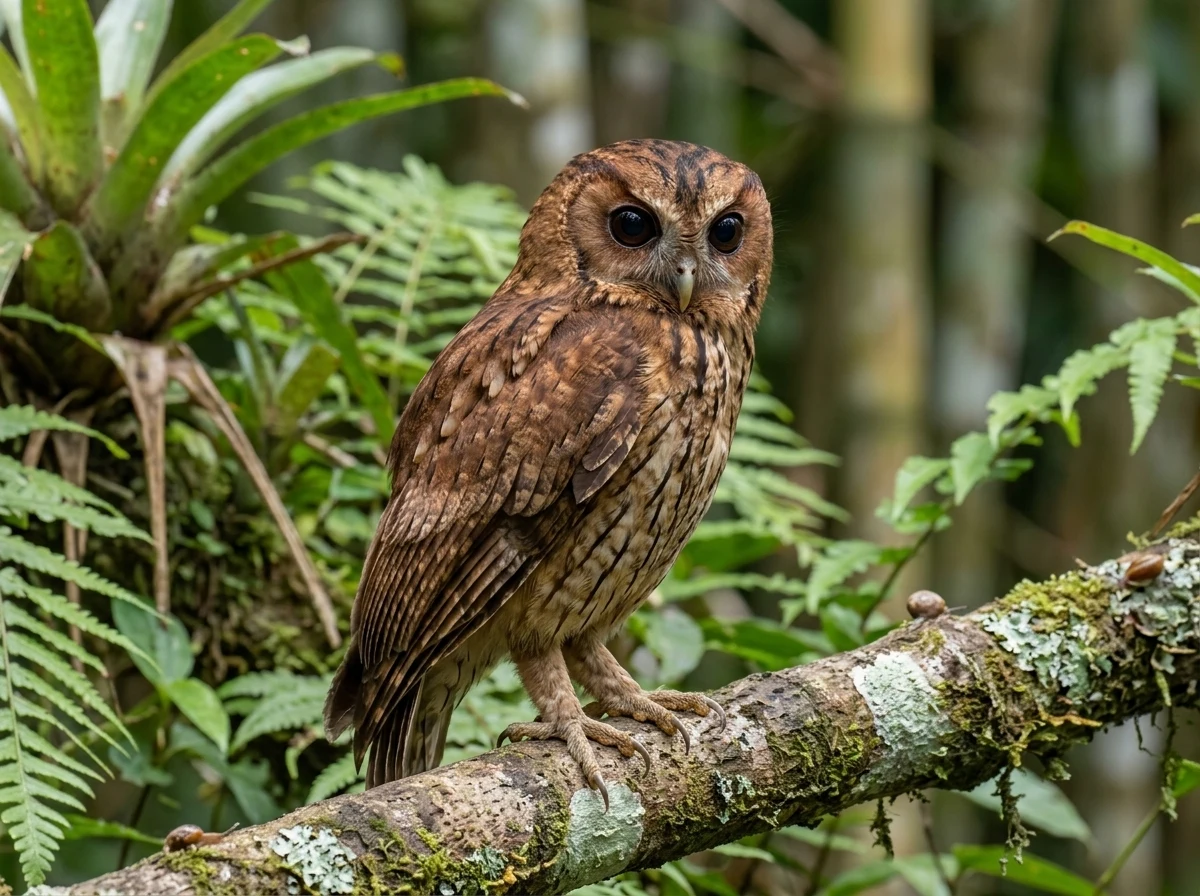
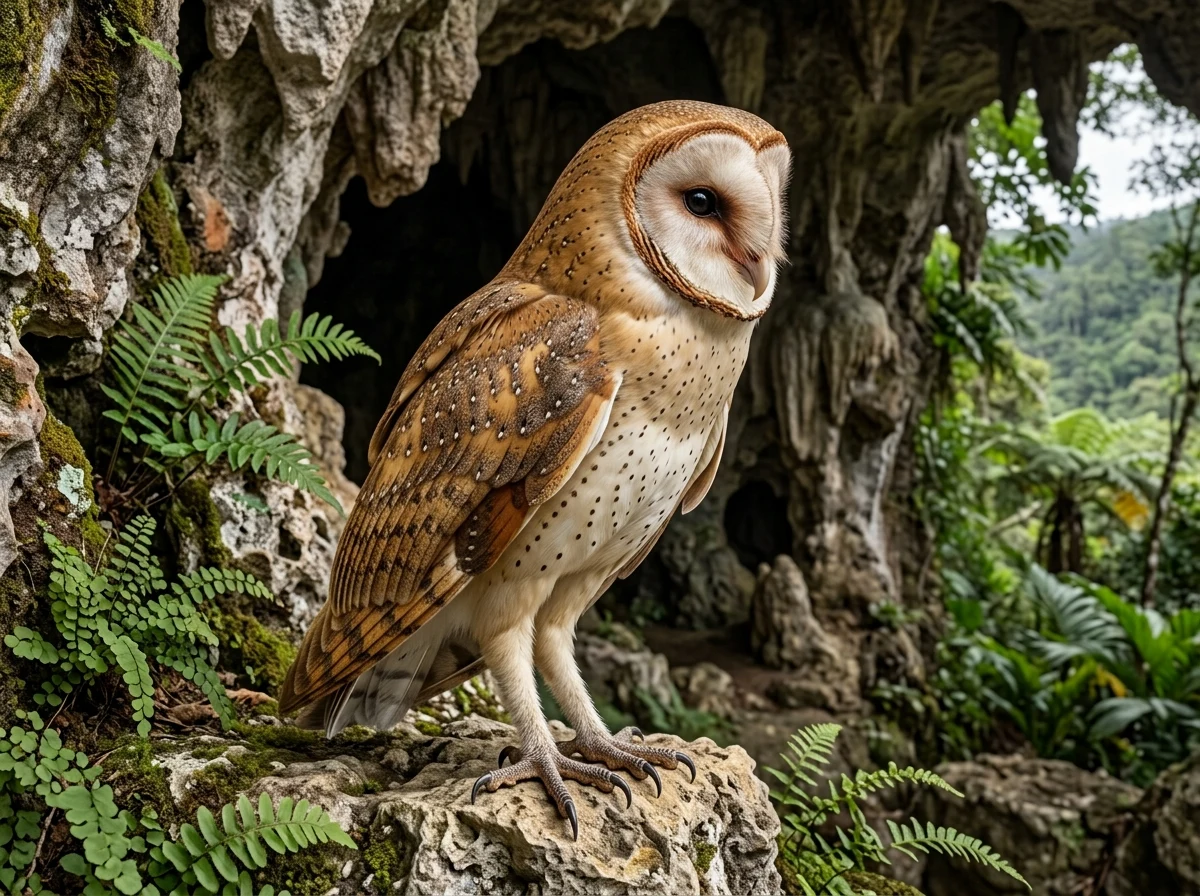
In Puerto Rico, a small owl seen low is almost always a Puerto Rican Owl: it is the same length as a Burrowing Owl (20–25 cm), also has bare legs, and by day roosts hidden in thick clumps of leaves. The difference is shape: the Puerto Rican Owl is compact, brown or rufous, round-headed, and lives among trees; the Burrowing Owl is very long-legged with barred underparts, and walks or runs across open ground.
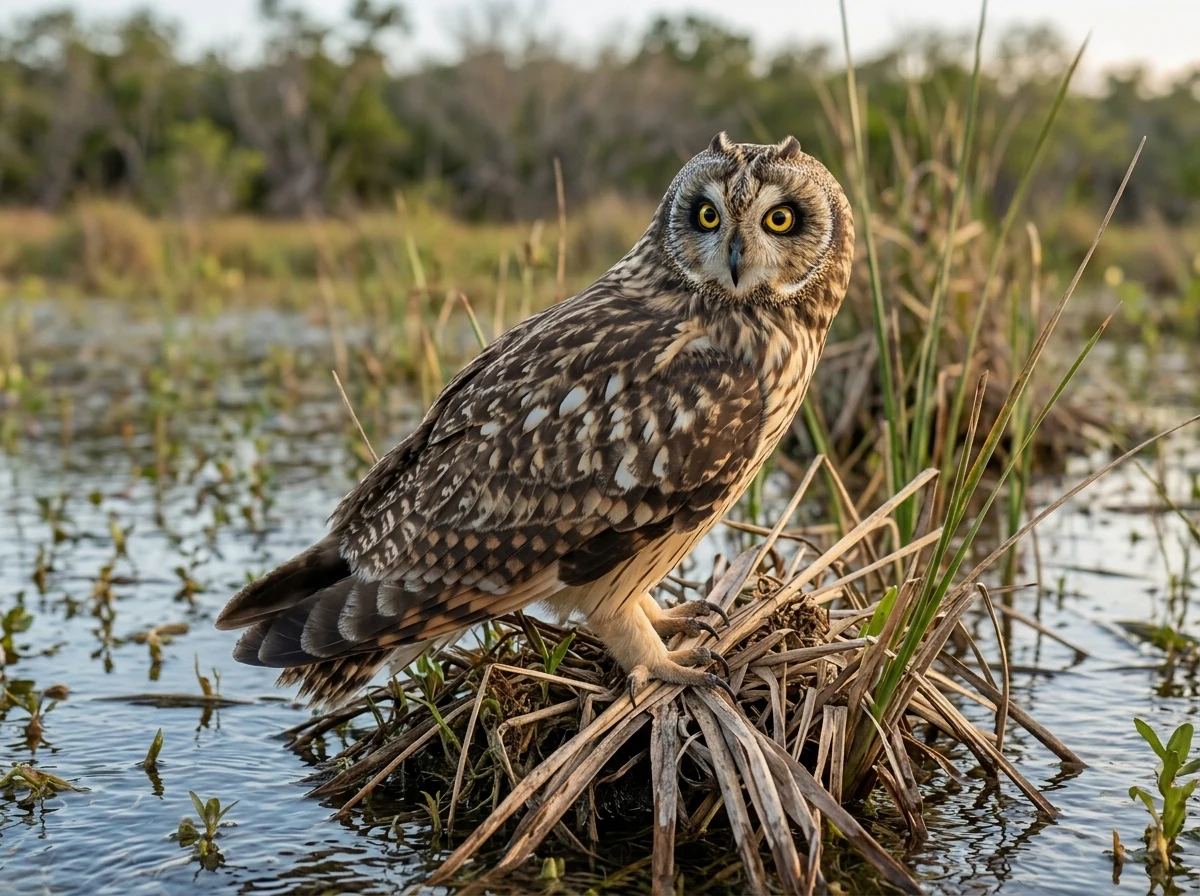
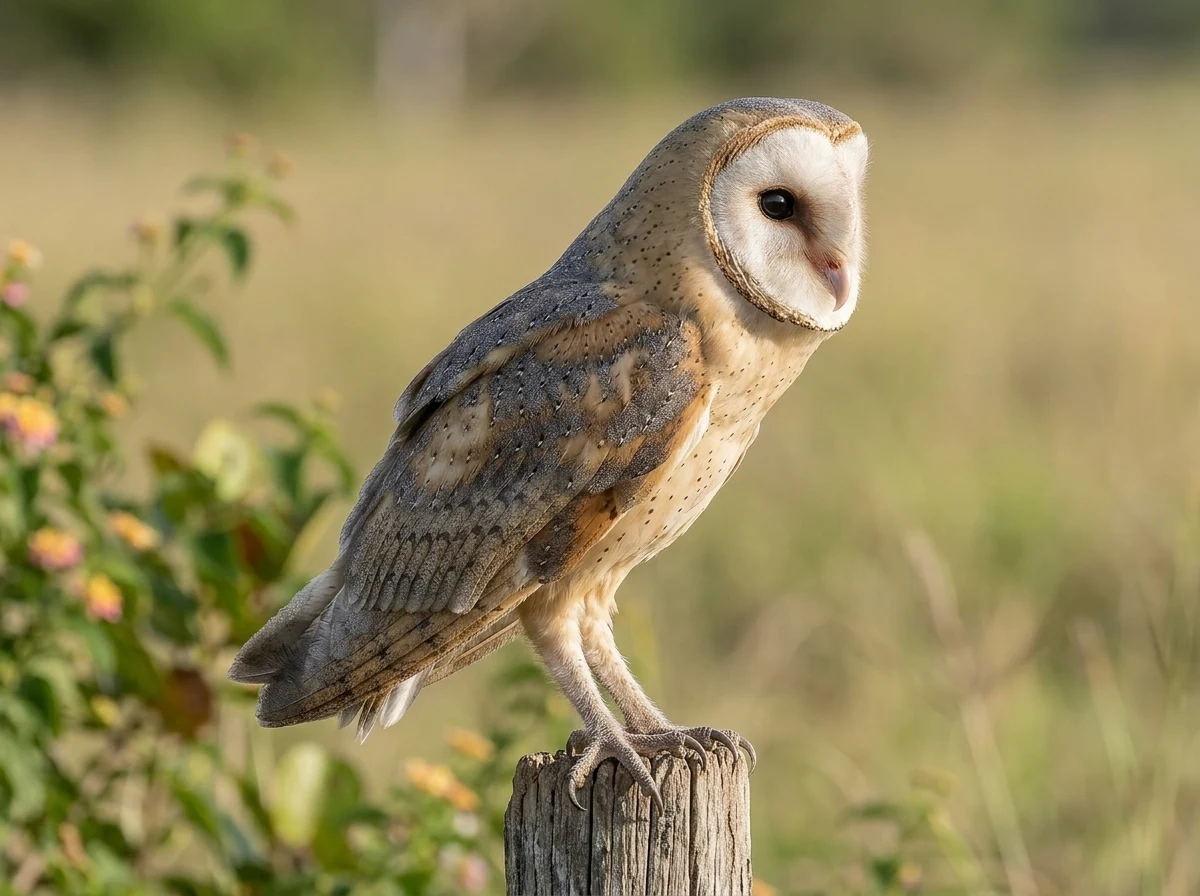
A large, buffy owl flushed from grassland is probably a Short-eared Owl (41 cm), which nests on the ground and flies low at dawn and dusk. A pale owl with a white, heart-shaped face is a Barn Owl. If after ruling out those three you still think it is a Burrowing Owl, photograph the whole bird, its legs, and the site, and report it.
06
How to report a possible Burrowing Owl
Document first: photos or video from a distance, date, time, exact location, terrain, and behavior. Do not approach a burrow or try to pull the bird out; the Burrowing Owl is protected by the Migratory Bird Treaty Act, and Puerto Rico's wildlife law prohibits disturbing nests, eggs, or young without authorization.
Then submit the record to eBird with photos and let the Sociedad Ornitológica Puertorriqueña know, since it maintains the island's bird list. If the bird looks injured, follow the injured-bird guide and call the DRNA. A well-documented record is the only way to change what we know about this species in Puerto Rico.
Linked profiles
The Burrowing Owl and the owls it gets confused with
Compare the Burrowing Owl profile with Puerto Rico's three living owls and the extinct cave barn owl.
Sound archive
Hear its voice
Explore real songs and calls. The spectrogram turns each sound into a visual trace of time and frequency.
XC1007847Recording 1 of 3alarm call

Play: alarm call by Paul Lenrumé
Choose another recording
Sound recorded by Paul Lenrumé · XC1007847 · CC BY-NC-SA 4.0. Visualization by Stichting Xeno-canto voor Natuurgeluiden.
Every recording retains the creator, catalogue number, and license published by Xeno-canto. Metadata via GBIF ↗
01
Are there Burrowing Owls in Puerto Rico?
No current population is known. The species is known from Pleistocene fossils on Puerto Rico and Mona, and the DRNA does not include it among the island's three living owls. A sighting would be exceptional and should be documented with photos.
02
What is a burrowing owl?
It is Athene cunicularia, a small, long-legged owl of open grasslands that nests in burrows, usually dug by other animals. It is active by day, especially when breeding, and ranges from western North America and Florida to South America and parts of the Caribbean.
03
Why did the Burrowing Owl disappear from the West Indies?
According to Pregill and Olson (1981), the main cause was the loss of dry, open habitat since the end of the Pleistocene, when the climate became wetter. Historical populations on Antigua, Nevis, and Marie-Galante later went extinct, presumably because of introduced predators.
04
Is the Múcaro de Madriguera the same bird as the Burrowing Owl?
Yes. Múcaro de madriguera, mochuelo de madriguera, búho de madriguera, and lechuza de madriguera are Spanish names for the same species, Athene cunicularia. Our catalog lists it as Múcaro de Madriguera.
05
What small owl might I see on the ground in Puerto Rico?
Almost always the Puerto Rican Owl, the island's common small owl. It is compact, brown or rufous, and round-headed. If it is injured or in danger, call the DRNA instead of taking it home.
Keep exploring
Connected routes
Sources and review
The evidence is one link away.
These sources support the editorial scope of this guide. Bird profiles also retain their own taxonomy, occurrence, and conservation references.
Reviewed:
01↗02↗03↗04↗05↗06↗07↗08↗09↗10↗11↗12↗
Pregill & Olson, Annual Review of Ecology and Systematics (Zenodo)
Zoogeography of West Indian Vertebrates in Relation to Pleistocene Climatic Cycles (1981)
Burrowing Owl fossils from Puerto Rico and Mona, its historical West Indian distribution, and the loss of dry habitat.National Audubon Society
Field guide: Burrowing Owl
Long legs, barred underparts, terrestrial habits, 7.5–9.8 in, daytime activity when breeding, and a “coo-coooo” voice.Birds of the World / Cornell Lab of Ornithology
Burrowing Owl (Athene cunicularia): introduction
General range in grasslands and arid regions of the Americas and the Caribbean, with 18 recognized subspecies.Departamento de Recursos Naturales y Ambientales
DRNA documents a third owl species in Puerto Rico
August 20, 2015 release on the Barn Owl (Tyto alba) nest found after an injured chick was rescued; names the Puerto Rican Owl and Short-eared Owl.Electronic Code of Federal Regulations / U.S. Fish and Wildlife Service
List of protected migratory birds (50 CFR 10.13)
Lists Puerto Rican Owl (Gymnasio nudipes), Short-eared, Burrowing, and Barn Owls under the Migratory Bird Treaty Act, which applies in Puerto Rico.Alexander Wetmore / Bulletin of the American Museum of Natural History (Internet Archive)
Bird remains from the caves of Porto Rico (1922)
Remains of the extinct Tyto cavatica from Toraño cave near Utuado and Puerto Rican Owl bones from several caves.Alexander Wetmore / U.S. Department of Agriculture (Internet Archive)
Birds of Porto Rico (USDA Bulletin 326, 1916)
Historical description of the Puerto Rican Owl's call, diet, and habits, and local names for the Short-eared Owl in 1911–1912.Birds of the World / Cornell Lab of Ornithology
Puerto Rican Owl (Gymnasio nudipes): introduction
Brown and rufous morphs, round head without ear tufts, 3–5 second deep trill, habitat up to about 900 m, and an April–June breeding season.National Audubon Society
Field guide: Short-eared Owl
16 in, pale buffy look, streaked chest, black around the eyes, black wrist mark, and low flight at dawn and dusk.National Audubon Society
Field guide: American Barn Owl
Heart-shaped face, dark eyes, pale plumage, 13–16 in, screams and hisses, nocturnal hunting over open ground.Oficina de Gerencia y Presupuesto de Puerto Rico
Puerto Rico Wildlife Act (Law 241-1999, as amended)
Article 6: prohibits keeping wildlife in captivity and taking nests, eggs, or young without authorization from the DRNA Secretary.Sociedad Ornitológica Puertorriqueña
Official bird list
Local names, occurrence categories, and the public summary of 17 endemics.The atlas continues