 AI
AIHabitat guides
How Kingfishers Use Rivers
The Belted Kingfisher does not swim or wade: it watches the river from above, dives headfirst, and digs its nest in the bank. This guide explains that use of the river step by step.
Reviewed:Prepared with AI assistance and linked sources. Illustrations are not field photographs.
A river seen from a perch
The Belted Kingfisher (Megaceryle alcyon) is a large, conspicuous bird of the family Alcedinidae, native to North America. In the Puerto Rico bird catalog it is listed as a native occurrence, and Birds of the World notes that most individuals migrate, with some reaching as far south as northern South America. It is not a resident or breeding species in Puerto Rico according to the catalog, so on the island it should be understood as a migratory visitor, not a bird that nests here.
The question in this guide is specific: how does it use the river? The answer has three parts that can be observed separately: where it positions itself to watch the water, how it captures prey, and where it places its nest. None of the three requires the bird to swim, walk on the bottom, or stay submerged for long periods. Everything happens from the air, from a branch, or from an earthen bank.
Habitat guides
Key facts
Zambullida de cabezaCapture methodIt plunges headfirst with closed eyes and takes prey near the surface with its straight bill.
2.5 a 6 piesNesting tunnelBoth sexes dig a horizontal tunnel in a bank, with a chamber at the end and an upward slope from the entrance.
PelletsUndigested remainsBones, scales and shells are regurgitated as pellets that fall beneath fishing and roosting perches.
01
The perch: reading the river from above
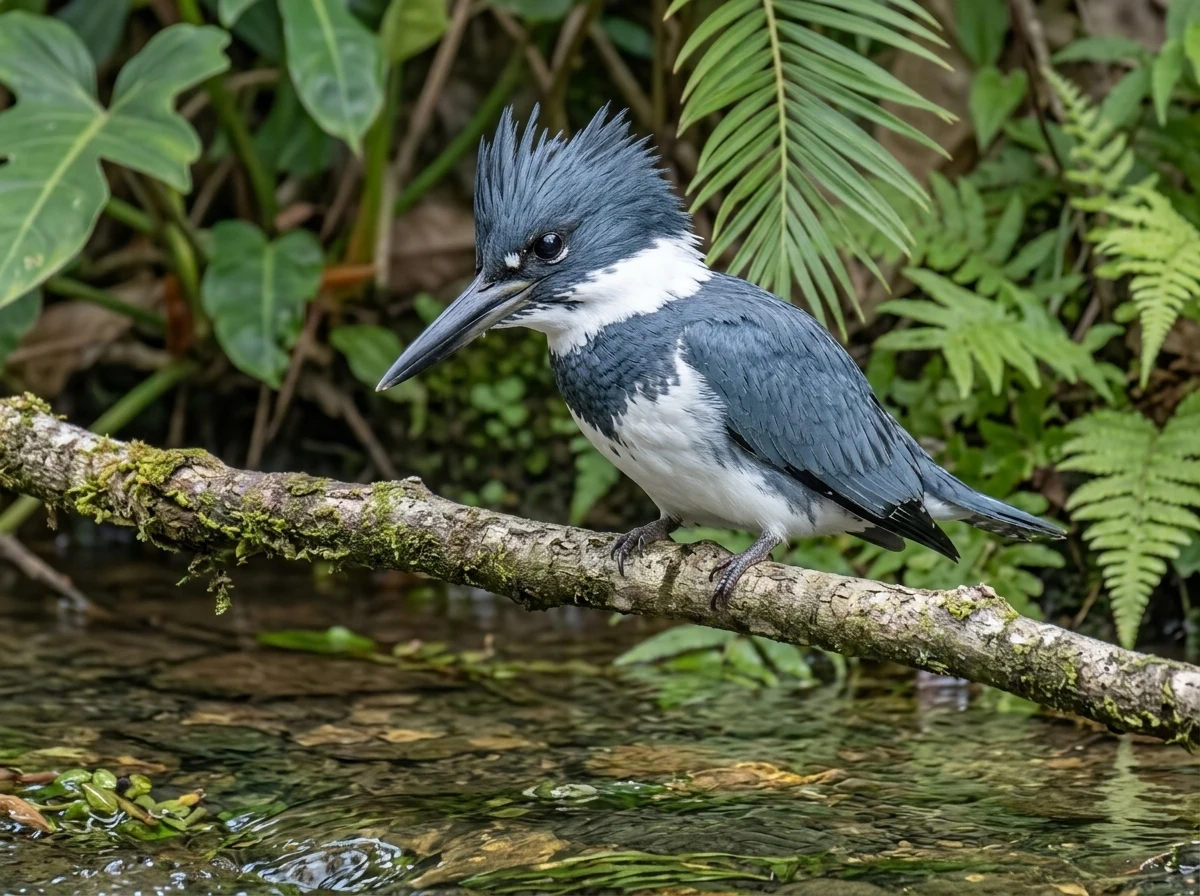
The Belted Kingfisher depends on water for food and is found along streams, rivers, lakes, ponds, bays, or coasts in areas with perches and visible prey. The key word is "perches." Before diving, the bird needs an elevated point from which to see the water: a branch, a wire, a rock, or another perch above the surface. From there it watches, and that watching is the first way it uses the river.
This explains why the bird is often detected first by its call: a loud, penetrating rattle given at any disturbance or territory dispute. It also explains why it defends territories along the shorelines of lakes or rivers throughout the year, with strident vocalizations and aerial chases. The river is not just a pantry: it is a space the bird patrols and defends from the air and from its lookout points.
02
The plunge: catching prey without staying wet
Capture happens in a very specific way: the bird plunges headfirst into the water with closed eyes and takes prey near the surface with its straight bill. It may also hover above the water, rapidly beating its wings, before diving. In other words, the river is used in two stages: first the wait or the hover, then the plunge. There is no underwater chase and no swimming.
The diet is mostly small fish, such as trout, sticklebacks, or mummichogs, but also includes crayfish, frogs, tadpoles, and aquatic insects. Away from the water it may take small prey, including young birds and reptiles, and it has been reported to eat berries. Indigestible parts —bones, scales, and shells— are later regurgitated as pellets. That detail is useful to an observer: pellets fall beneath fishing and roosting perches, so a perch with remains below it is a clue to repeated use of the river.
03
The bank: the river is also the nest site
During the breeding season, the bird may be found nesting in banks, in areas with dirt banks suitable for digging. The nest is not in a tree: both sexes take part in digging a long horizontal tunnel with a chamber at the end. The tunnel is generally 2.5 to 6 feet long and usually slopes upward from the entrance. It rarely nests in a tree cavity. The availability of suitable nesting sites —earthen banks where burrows can be excavated— appears critical for the distribution and local abundance of this species.
Here it is worth being precise for readers in Puerto Rico: the catalog does not list the Belted Kingfisher as a breeding species on the island. So when a Belted Kingfisher is observed along a Puerto Rican river, what is being seen is feeding and resting use —perches, dives, pellets— and not necessarily an active nest. Tunnel digging is part of its breeding biology in its breeding areas, and it is mentioned here to complete the explanation of river use, not as a local observation.
04
Comparison: the river versus other aquatic habitats
The Belted Kingfisher is not exclusive to rivers. The Audubon source states that it depends on water for food and can be found along streams, rivers, lakes, ponds, bays, or coasts, always in areas with perches and visible prey. During winter and migration it uses most aquatic habitats, including the edges of small streams and ponds, large rivers and lakes, marshes, estuaries, and rocky coastlines. The difference is not the type of water but the structure: a perch and visible prey are required.
That comparison helps answer the title question. On a river, the bird exploits the current as a corridor of prey passing in front of its perch; on a lake or pond, still water forces it to search actively or hover more. In both cases the mechanism is the same: watch from above, plunge headfirst, capture near the surface, and regurgitate the remains. What changes is how the water is distributed and, therefore, where it pays to position oneself.
05
Observation exercise and checklist
This exercise is a suggested method, not a validated protocol. Choose a stretch of river or stream with accessible banks and stay at a fixed point, without chasing the bird. First listen: the loud, penetrating rattle often announces its presence before you see it. Then locate elevated perches above the water —branches, wires, rocks— and note which ones it uses. Watch whether the bird waits motionless or hovers with rapidly beating wings before diving. Record the plunge: headfirst, with closed eyes, taking prey near the surface. Finally, check beneath the perches for remains or pellets, without touching or collecting them.
Checklist: (1) Did I hear the rattle before seeing the bird? (2) Did I identify at least one perch above the water? (3) Did the bird wait from the perch or hover? (4) Did I observe a headfirst plunge? (5) Did I see prey taken near the surface? (6) Are there remains or pellets beneath any perch? (7) Did the bird defend the stretch with vocalizations or chases? Note time, conditions, and behavior, without inferring abundance from a single observation. If the bird is carrying prey in its bill, do not assume a nest is nearby: in Puerto Rico the catalog does not list it as a breeding species.
Linked profiles
The bird in this guide
The Belted Kingfisher is a large, conspicuous bird native to North America that, according to the catalog, should be understood as a migratory visitor in Puerto Rico.
AI01
Does the Belted Kingfisher swim or walk in the river?
No. It forages by plunging headfirst into the water with closed eyes and capturing prey near the surface with its straight bill. It may also hover above the water before diving. There is no swimming or underwater chase.
02
Where does it nest?
In an earthen bank, not in a tree. Both sexes dig a horizontal tunnel 2.5 to 6 feet long, with a chamber at the end and an upward slope from the entrance. It rarely nests in tree cavities.
03
Does the Belted Kingfisher nest in Puerto Rico?
The Puerto Rico bird catalog does not list it as a resident or breeding species on the island. It appears as a native occurrence, and Birds of the World notes that most individuals migrate. In Puerto Rico it should be treated as a migratory visitor, not a local breeding bird.
04
What are pellets and why do they matter?
They are the undigested remains of prey —bones, scales, shells— that the bird regurgitates. They fall beneath fishing and roosting perches, so a perch with remains below it is a clue to repeated use of the river.
05
How can I tell if it is fishing or just resting?
If it is fishing, it watches the water from a perch or hovers, then plunges headfirst. If it is only resting, it stays perched without focusing on the water. In both cases it may give the rattle at any disturbance.
Keep exploring
Connected routes
Sources and review
The evidence is one link away.
These sources support the editorial scope of this guide. Bird profiles also retain their own taxonomy, occurrence, and conservation references.
Reviewed:
The atlas continues