 AI
AIHabitat guide
Leaf Litter as a Food Source for Birds
A layer of dead leaves is a dining room for birds that walk and probe on the forest floor. Here we explain the mechanism, the Ovenbird example, and how to observe it.
Reviewed:Prepared with AI assistance and linked sources. Illustrations are not field photographs.
The forest floor is also a dining room
When we think of birds feeding, we picture fruit on branches or insects in the air. Yet a large part of the food of many forest birds lives among the dead leaves covering the ground. That layer is called leaf litter, and it works as a damp, dark refuge for insects, spiders, snails, and other invertebrates.
Leaf litter is not trash: it is a habitat within a habitat. Birds that use it tend to walk slowly, flip leaves with the bill, or look under fallen logs. In this guide we explain how that mechanism works, use the Ovenbird as a documented example, and propose a simple exercise to observe the phenomenon without disturbing birds.
Habitat guide
Three key ideas
HojarascaInvertebrate refugeDead leaves hold moisture and hiding places for small prey.
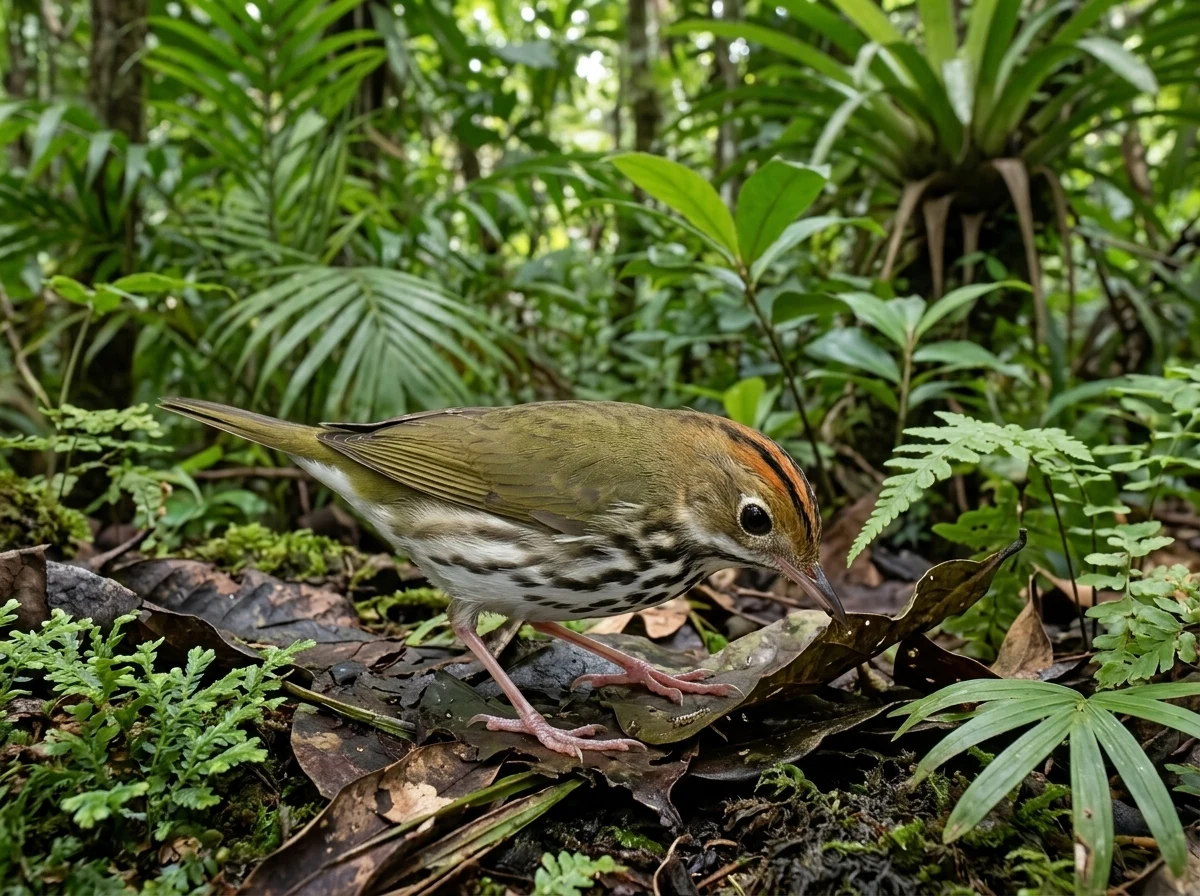
Caminar y escarbarSearch methodThe Ovenbird takes insects from leaf litter while walking on the ground.
Observa sin tocarField ruleWatch from a distance; do not lift leaves or move logs.
01
What leaf litter is and why it attracts food
Leaf litter is the layer of leaves, twigs, bark, and dead plant material that accumulates on the forest floor. As it decomposes, it holds moisture and creates tiny spaces between leaves. Those spaces are used by invertebrates such as beetles, ants, caterpillars, flies, true bugs, worms, spiders, and snails.
For an insect-eating bird, leaf litter is a pantry that does not require flying. Food is concentrated but hidden; that is why birds that exploit it develop search techniques: walking slowly, staring, pecking among leaves, and sometimes probing with the bill. The structure of the litter, its depth, and its moisture influence which invertebrates are available.
02
The Ovenbird: a documented example
The Ovenbird (Seiurus aurocapilla) is a warbler that walks on the forest floor with deliberate steps and its tail held up. According to Birds of the World, the species forages on the ground for leaf-litter arthropods. Audubon describes that it takes insects from leaf litter while walking on the ground and rotting logs, and that it sometimes probes among leaf litter, hovers to take insects from foliage, or catches them in mid-air.
Its summer diet includes adult beetles and their larvae, ants, caterpillars, flies, true bugs, worms, spiders, and snails. The winter diet is not well known, but it has been reported to include seeds and other vegetable matter. This example shows that leaf litter is not a minor detail: it is central to how this bird obtains energy.
As for its presence in Puerto Rico, the catalog records it as a native species of natural occurrence, not resident and not breeding, with migratory status. This should not be interpreted as abundance or as year-round presence. For context on migratory birds on the island, see the migratory birds guide.
03
Comparison: searching leaf litter versus searching the air
Not all insect-eating birds search the same way. Some catch insects in flight, others pick them from foliage, and others walk on the ground. The Ovenbird belongs to the last group: its body, behavior, and nest are tied to the ground. Its nest is a domed structure made mainly of leaves, placed on the ground, and its common name comes from its resemblance to an oven.
The difference matters for conservation. An altered or removed leaf-litter layer reduces invertebrate refuge and therefore the food available to birds that depend on it. Keeping the forest floor with its leaf litter is an indirect way of maintaining the food chain that supports these birds.
04
Observation exercise: follow the leaf litter
This exercise is a suggested method, not a verified local observation. Choose a trail with a leafy floor and walk slowly. Stop every few meters and look at the leaf litter without touching it. Look for movement: a bird walking with short steps, tilting its head, pecking among leaves, or lifting its tail. Note the time, the type of cover, and whether the ground is wet or dry.
Field checklist: binoculars; notebook or phone for notes; watch; trail map or app; muted-color clothing; water; and patience. Do not lift leaves, do not move logs, and do not approach a nest if you find one. The goal is to observe foraging behavior, not to manipulate the habitat.
To identify what you see, consult the warblers guide and the visual bird guide for Puerto Rico. If you hear songs, the songs and calls guide helps separate sounds. Remember that the Ovenbird is migratory in Puerto Rico according to the catalog, so its presence should not be assumed on any given date.
Linked profiles
Featured bird
The Ovenbird illustrates how leaf litter becomes food.
AI01
What does the Ovenbird eat in leaf litter?
According to Audubon, it takes insects from leaf litter while walking on the ground and rotting logs. Its summer diet includes beetles, ants, caterpillars, flies, true bugs, worms, spiders, and snails.
02
Does the Ovenbird live in Puerto Rico?
The catalog records it as a native species of natural occurrence, not resident and not breeding, with migratory status. This should not be interpreted as abundance or year-round presence.
03
Can I lift leaves to see what a bird eats?
No. Leaf litter is invertebrate habitat and bird refuge. Watch from a distance without touching the ground or moving logs; this avoids altering the food you are trying to study.
04
Why is leaf litter important for birds?
Because it holds moisture and hiding places for invertebrates that serve as food. Birds that walk on the ground depend on that layer to find prey without flying.
Keep exploring
Connected routes
Sources and review
The evidence is one link away.
These sources support the editorial scope of this guide. Bird profiles also retain their own taxonomy, occurrence, and conservation references.
Reviewed:
The atlas continues