 AI
AIIdentification
Great Egret Breeding vs Nonbreeding Plumage
A focused guide to the Great Egret's soft-part changes and nuptial plumes, with an observation procedure and a field checklist.
Reviewed: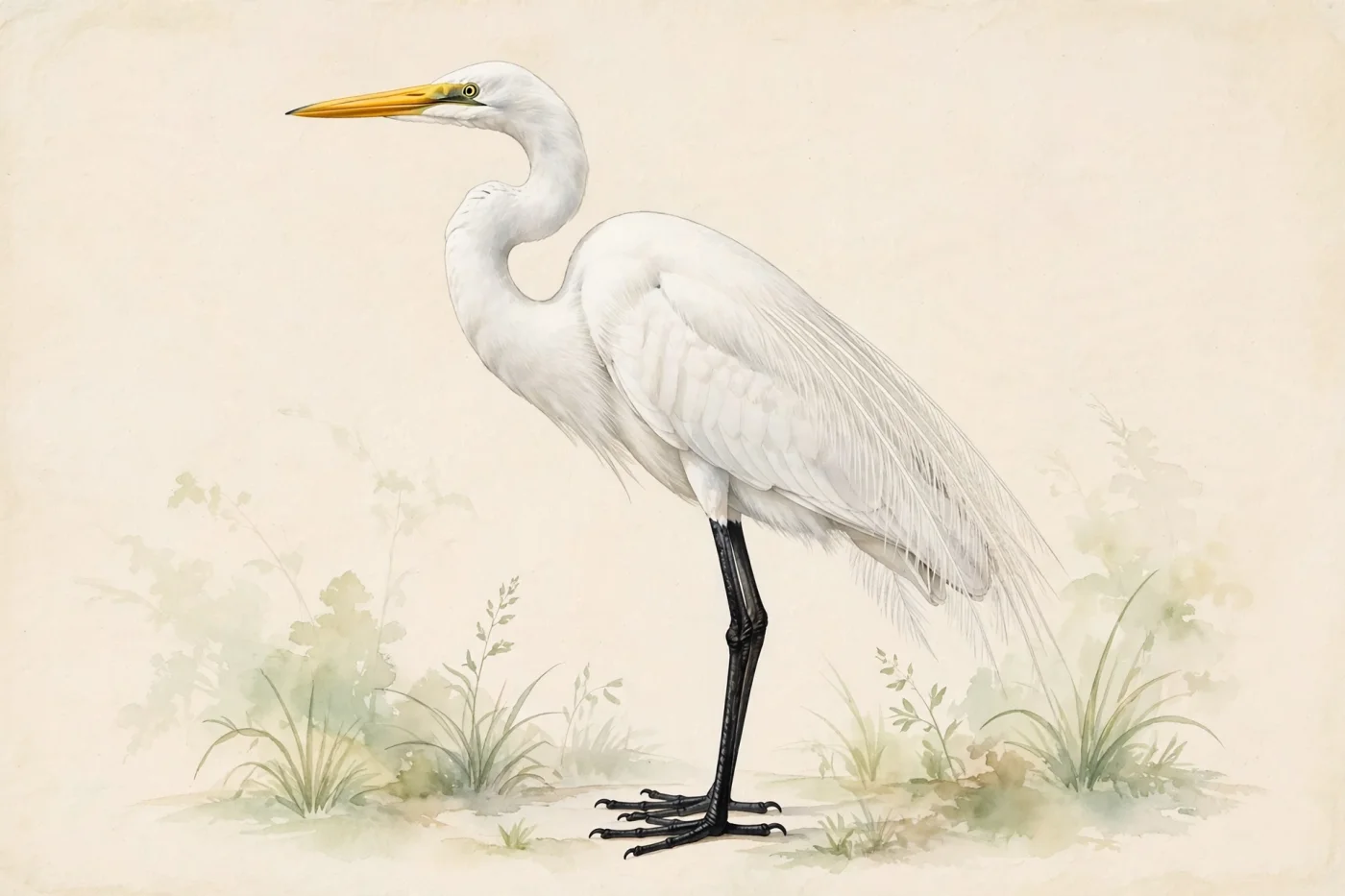
Prepared with AI assistance and linked sources. Illustrations are not field photographs.
The Same Egret, Two Looks
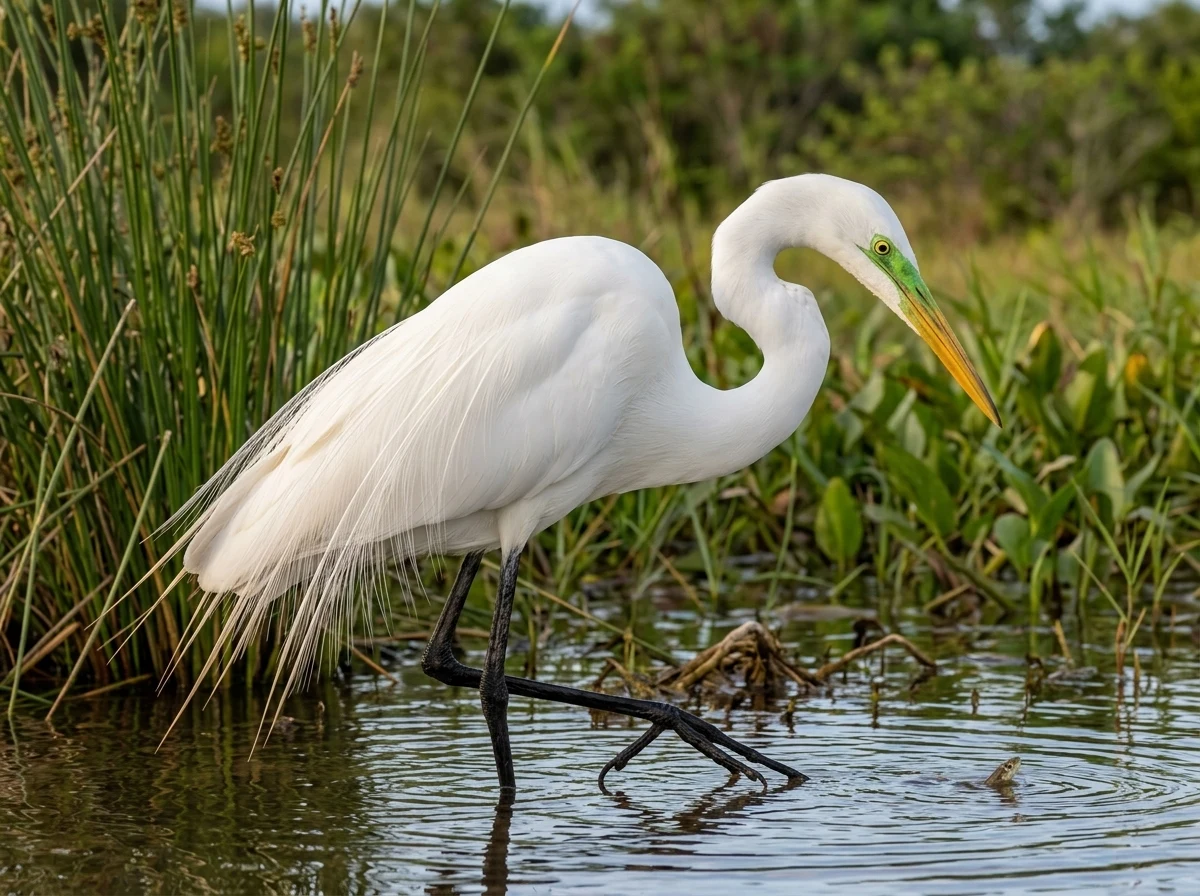
The Great Egret (Ardea alba) is a large, all-white heron about 80–104 cm long, with a long, dagger-like bill and predominantly black legs. It often holds its neck in a characteristic 'S' shape. In the nonbreeding season, adults have a yellow bill and yellowish to olive-green facial skin. In the early breeding season, the bill turns partly or wholly black and long nuptial plumes, called aigrettes, grow on the back.
This guide answers one focused question: how do you tell breeding plumage from nonbreeding plumage in the Great Egret? It is not a general species profile or a guide to every white heron. The goal is to help you read seasonal signals in the bill, lores, eyering, and back plumes, and to recognize when those signals are ambiguous. The information comes from recognized ornithological sources and the Puerto Rico bird catalog; no local observations or breeding months are invented.
Identification
Seasonal Clues
Pico amarilloNonbreeding seasonNonbreeding adults have a yellow bill and yellowish to olive-green facial skin.
Pico negroEarly breeding seasonThe bill turns partly or wholly black during courtship and early breeding.
Plumas nupcialesAigrettes on the backThey can reach up to 50 cm and extend beyond the tail.
01
What Changes and What Does Not
The Great Egret is always white. It has no darker color morphs. What changes between seasons are the soft parts and the nuptial plumes. In the nonbreeding season, adults of all subspecies have a yellow bill, yellowish to olive-green facial skin, and at least partially black tarsi. The legs and feet are predominantly black at all times.
In the early breeding season, long nuptial plumes grow on the scapulars; they can reach up to 50 cm and extend beyond the tail. During courtship, the bare parts become more intensely colored. At the height of breeding, the bill becomes partly black in subspecies egretta or wholly black in alba, melanorhynchos, and modesta, while the lores and eyering become a brighter bluish green in all subspecies. When incubation begins, the bill, lores, and eyering fade to a yellowish hue, and the plumes are reduced in length and number.
In the Caribbean, breeding Great Egrets may show bright green lores and more orangey bills, a regional variation documented by BirdsCaribbean. This difference matters for observers in Puerto Rico: do not expect only the bluish-green described for other populations. Juveniles resemble nonbreeding adults, but the yellow bill has a blackish tip. That dark tip should not be confused with the black bill of the breeding season.
02
How to Observe It in the Field
Start with the bill. If it is clean yellow, you are probably looking at a nonbreeding adult. If it is black or partly black, consider the early breeding season. But do not stop there: check the lores, the eyering, and the presence of nuptial plumes. A partly black bill with bright bluish-green lores and long back plumes points to breeding. A yellowish bill with dull lores and no long plumes points to nonbreeding or the post-incubation phase.
Light matters. A yellow bill can look pale in strong sun, and a black bill can appear gray at a distance. Observe from several angles and, if possible, with magnification. Black legs are a constant feature, but they are often hidden by water or vegetation. Do not use leg color as your only seasonal clue.
Compare with nearby birds. The Great Egret is clearly larger than the Snowy Egret, which has a black bill, black legs, and yellow feet. The Snowy Egret has yellow lores, a detail that helps separate it from the Great Egret when the latter shows a dark bill. The Snowy Egret does not change to a yellow bill in the nonbreeding season.
03
Common Mistakes and Limits of the Evidence
A common mistake is assuming a dark bill always means active breeding. In subspecies egretta, the bill becomes only partly black, and in all subspecies the bill fades to yellowish when incubation begins. So a partly dark bill can appear both early and late in the breeding season. The combination of bill, lores, eyering, and plumes is more reliable than any single feature.
Another mistake is confusing the blackish tip of a juvenile's bill with the breeding black bill. Juveniles have a yellow bill with a blackish tip, not a mostly black bill. The extent of black is the key.
The available evidence describes the species' global biology and general identification. It does not document breeding months or local abundance in Puerto Rico. To learn when and where to see a Great Egret in breeding plumage on the island, consult local guides and citizen-science records; this guide does not replace that information.
04
Checklist and Exercise
Use this checklist every time you watch a Great Egret and want to assess its season: 1) Is the bill yellow, partly black, or wholly black? 2) Are the lores and eyering yellowish or bright bluish green? 3) Are there long, loose plumes on the back that extend beyond the tail? 4) Are the legs and feet predominantly black? 5) Is the bird in a group with other herons or alone? 6) Does the light allow you to see the bill color well? Record your answers and, if possible, take a photo or a short video.
Exercise: the next time you see a large white heron, spend two minutes observing only the bill and lores. Then check the back for nuptial plumes. Compare your notes with another observation from a different time of year. Over time, you will learn to recognize the transition between breeding and nonbreeding plumage without relying on a single feature.
Remember that this guide focuses on the Great Egret. To distinguish it from other white herons, consult the related guides on herons and white birds.
Linked profiles
Species Covered
The Great Egret (Ardea alba) is a large, all-white heron, native to Puerto Rico and widely distributed worldwide.
AI01
Does the Great Egret always have a yellow bill?
No. In the nonbreeding season, adults have a yellow bill. During courtship and early breeding, the bill turns partly or wholly black. When incubation begins, the bill fades to yellowish.
02
What are aigrettes or nuptial plumes?
They are long plumes that grow on the scapulars during the early breeding season. They can reach up to 50 cm and extend beyond the tail. They are conspicuously erected during courtship displays at the nest site.
03
How do I tell a Great Egret from a Snowy Egret?
The Great Egret is much larger, with a long, thick bill, black legs, and an 'S'-shaped neck. The Snowy Egret is smaller, with a black bill, black legs, yellow feet, and yellow lores. The Snowy Egret does not change to a yellow bill in the nonbreeding season.
04
Does the lores color change during breeding?
Yes. In the nonbreeding season, the lores and facial skin are yellowish to olive-green. At the height of breeding, the lores and eyering become a brighter bluish green in all subspecies; in the Caribbean, they may be bright green. When incubation begins, they fade to a yellowish hue.
05
Do juveniles look different?
Juveniles are similar to nonbreeding adults, but the yellow bill has a blackish tip. That dark tip should not be confused with the black bill of the breeding season.
06
Does this guide document Great Egret breeding in Puerto Rico?
No. This guide describes plumage and soft-part changes based on global ornithological sources. It does not document breeding months or local abundance in Puerto Rico. For that information, consult local guides and citizen-science records.
Keep exploring
Connected routes
Sources and review
The evidence is one link away.
These sources support the editorial scope of this guide. Bird profiles also retain their own taxonomy, occurrence, and conservation references.
Reviewed:
01↗02↗03↗
Birds of the World (Cornell Lab of Ornithology)
Field Identification — Great Egret — Ardea alba
Evidence for cited sections; consult the original document.National Audubon Society
Snowy Egret | Audubon Field Guide
Evidence for cited sections; consult the original document.BirdsCaribbean
White Egret
Evidence for cited sections; consult the original document.The atlas continues