 AI
AIIdentification
Zenaida Dove vs Mourning Dove
A practical guide to separating two similar doves using proportions, tail shape, and wing marks, with a field routine and frequently asked questions.
Reviewed:Prepared with AI assistance and linked sources. Illustrations are not field photographs.
Two Doves That Are Easy to Confuse
The Zenaida Dove (Zenaida aurita) and the Mourning Dove (Zenaida macroura) belong to the same genus and share a general brown or grayish appearance. In Puerto Rico, both appear in the catalog of native birds, but that does not mean they are equally common or seen in the same places. The key to identifying them is not a single trait but a combination of size, tail shape, and wing marks.
This guide answers a specific question: how do you distinguish the Zenaida Dove from the Mourning Dove by size and marks? We use sources from the Cornell Lab of Ornithology and Audubon to describe diagnostic traits, and we clarify what can and cannot be claimed about their presence in Puerto Rico. At the end you will find an observation routine and frequently asked questions to apply in the field.
Identification
Three Keys to Remember
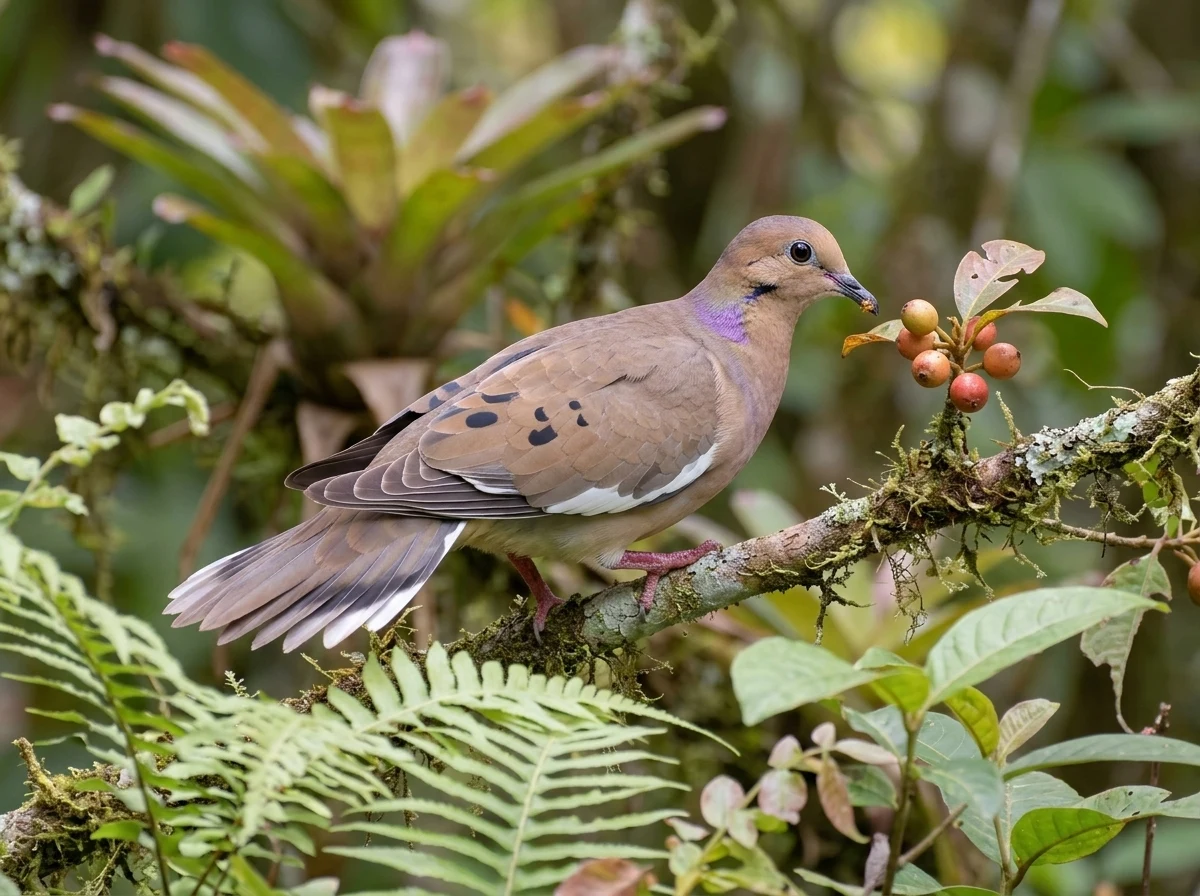
Cola cuadrada vs. cola larga y puntiagudaTail shapeThe Zenaida Dove has a shorter, square-tipped tail; the Mourning Dove has a long, pointed, wedge-shaped tail.
Banda blanca terminal en las secundariasWing markThe Zenaida Dove shows a terminal white band on the outer secondaries, visible both when the wing is folded and when it is open.
Manchas blancas en el borde de la colaTail in flightThe Mourning Dove shows white spots along the edge of the tail in flight.
01
Size and Proportions: What the Measurements Say
Published measurements help narrow the comparison. Audubon lists the Zenaida Dove at 23 to 28 cm in length, a wingspan of 45 to 53 cm, and a weight of 120 to 190 g. For the Mourning Dove, Audubon lists a length of 23 to 33 cm, a wingspan of 43 cm, and a weight of 85 to 170 g. The ranges overlap, so size alone does not always resolve the identification, but the Mourning Dove tends to have a proportionally longer tail.
In the field, that difference is perceived as a distinct silhouette. The Zenaida Dove looks more compact, with a short, square tail. The Mourning Dove looks more slender, with a long tail that tapers to a point. If you only see a perched bird and cannot compare, look at the tail: a square tip favors the Zenaida Dove; a long, pointed tail favors the Mourning Dove.
02
Wing and Tail Marks
The most useful wing mark is the terminal white band on the outer secondaries of the Zenaida Dove. Birds of the World describes it as distinctive and visible both when the wing is folded and when it is open. Audubon agrees: in flight a white trailing edge is visible on the inner part of the wing, and when the bird is standing that mark shows as a white spot on the wing. The Mourning Dove lacks that terminal white band on the secondaries; instead, it shows white spots along the edge of the tail in flight.
The tail also offers clues. The Zenaida Dove has a shorter, square-tipped tail. The Mourning Dove has a long, pointed, wedge-shaped tail, with white spots along the edge visible in flight. If the bird is perched and the tail is folded, the overall tail shape is still useful: short and square versus long and tapered.
03
Presence in Puerto Rico: What Can Be Claimed
The Puerto Rico bird catalog includes both the Zenaida Dove and the Mourning Dove as native species of natural occurrence. Birds of the World states that the subspecies Zenaida aurita zenaida ranges from the Bahamas, Cuba, the Cayman Islands, and Jamaica through Hispaniola and Puerto Rico to the Virgin Islands. That is a distribution reference, not an inference of local abundance. We should not conclude that one species is more common than the other in Puerto Rico from these sources.
Audubon notes that the Zenaida Dove was documented nesting in the Florida Keys in the early 1800s and that today it is a very rare visitor to Florida. That historical note does not describe the situation in Puerto Rico and should not be used to infer local status. To know what to expect on the island, consult the general Puerto Rico bird guides and local records, not descriptions from other regions.
04
Observation Routine and Checklist
When you see a dove and are unsure between the two species, follow this procedure. First, look at the tail: is it short and square-tipped, or long and pointed? Second, look for the wing mark: is there a terminal white band on the secondaries, visible as a white spot on the folded wing? Third, if the bird flies, check the tail: does it have white spots along the edge? Fourth, assess the overall proportion: compact with a short tail, or slender with a long tail. Fifth, note habitat and behavior, but do not use them as the sole proof.
Field checklist: (1) tail shape; (2) presence or absence of a terminal white band on the secondaries; (3) white spots along the edge of the tail in flight; (4) overall body proportion; (5) light and distance conditions. If you cannot confirm at least two traits, it is better to leave the identification as probable rather than certain. This routine is a suggested method, not a validated scientific protocol.
Linked profiles
The Two Species Compared
Profiles of the Zenaida Dove and Mourning Dove with their scientific names and their presence in the Puerto Rico catalog.
AI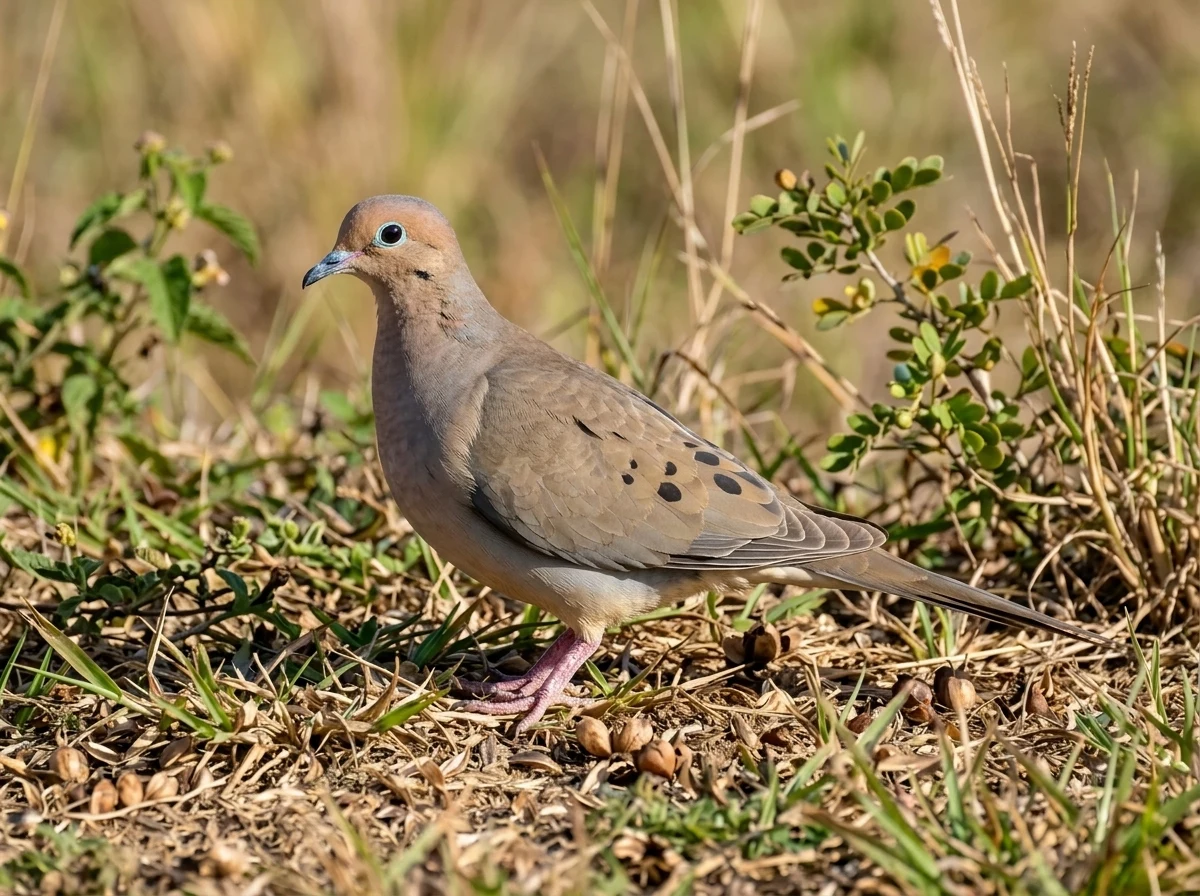 AI
AI01
What is the most reliable difference between the Zenaida Dove and the Mourning Dove?
The combination of tail shape and wing mark. The Zenaida Dove has a shorter, square-tipped tail and shows a terminal white band on the outer secondaries. The Mourning Dove has a long, pointed, wedge-shaped tail, with white spots along the edge of the tail in flight.
02
Is size alone enough to identify them?
No. The length and weight ranges overlap according to measurements published by Audubon. The Mourning Dove tends to have a proportionally longer tail, but size should be combined with tail shape and wing marks.
03
Where can I see each species in Puerto Rico?
This guide does not claim abundance or specific locations. Both species appear in the Puerto Rico native bird catalog. To learn where and when to observe them, consult the general Puerto Rico bird guides and local records, and do not infer status from descriptions of other regions.
04
Is the Zenaida Dove a resident in Puerto Rico?
The catalog lists it as a native species of natural occurrence, but it does not specify residency, breeding, or migration for Puerto Rico. Birds of the World states that the subspecies Zenaida aurita zenaida ranges through Puerto Rico and the Virgin Islands, which is a distribution reference, not a confirmation of local residency.
05
What should I note if I am not sure of the identification?
Note the tail shape, the presence or absence of a white band on the secondaries, white spots on the tail in flight, overall proportion, light, and distance. If you cannot confirm at least two traits, record the identification as probable rather than certain.
Keep exploring
Connected routes
Sources and review
The evidence is one link away.
These sources support the editorial scope of this guide. Bird profiles also retain their own taxonomy, occurrence, and conservation references.
Reviewed:
01↗02↗03↗
Cornell Lab of Ornithology
Zenaida Dove (Zenaida aurita) — Birds of the World
Evidence for cited sections; consult the original document.National Audubon Society
Zenaida Dove | Audubon Field Guide
Evidence for cited sections; consult the original document.National Audubon Society
Mourning Dove | Audubon Field Guide
Evidence for cited sections; consult the original document.The atlas continues