 AI
AIBehavior guide
How American Oystercatchers Feed
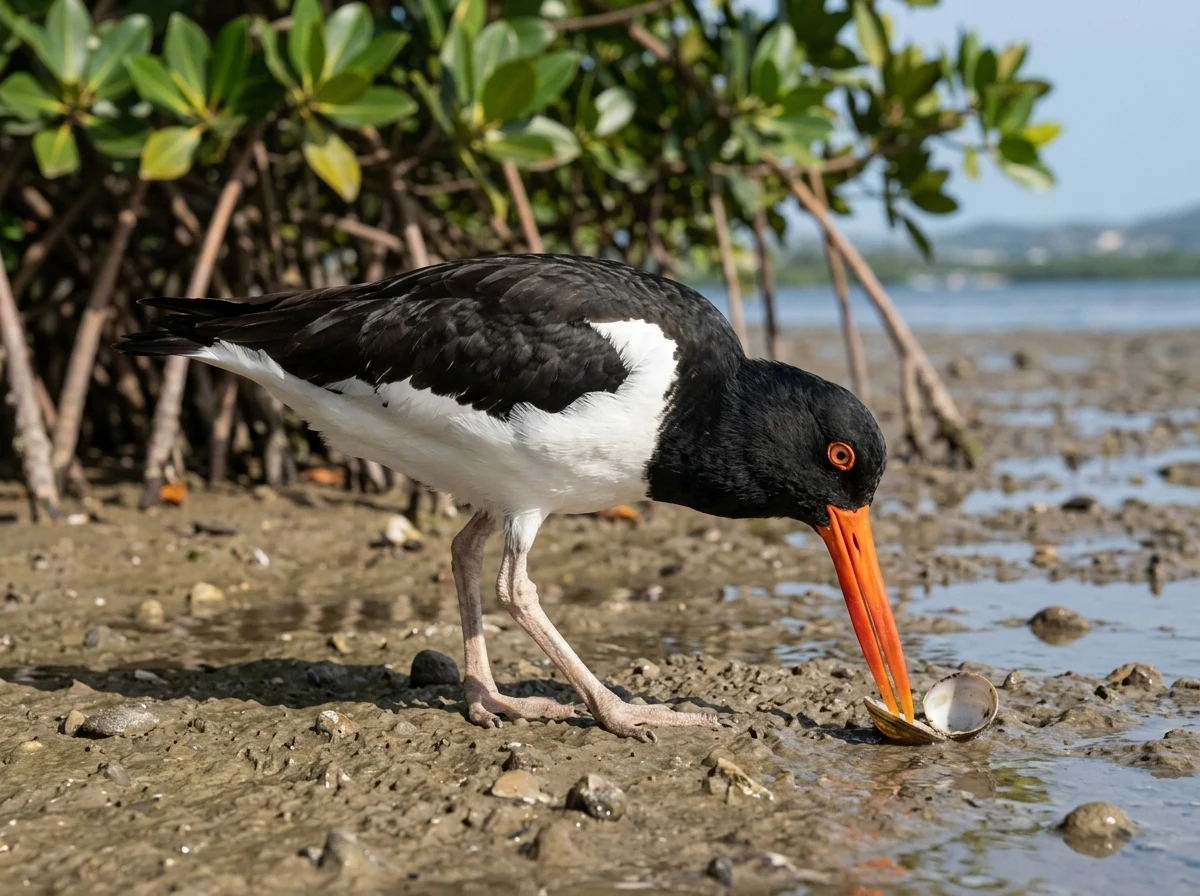
The American Oystercatcher does not only eat oysters: it opens mollusks in two distinct ways and supplements its diet with intertidal invertebrates.
Reviewed:Prepared with AI assistance and linked sources. Illustrations are not field photographs.
A specialist with two techniques
The American Oystercatcher (Haematopus palliatus) is one of the few birds that specializes on marine bivalves. Its long red bill is not just an identification mark: it is the tool it uses to reach inside closed shells. In Puerto Rico it is called ostrero, and the local catalog records it as a native resident and breeder on rocky and sandy coasts, mudflats and cays.
This guide answers one concrete question: how does it feed? The answer has two parts: what it eats and how it manages to open prey protected by hard shells. Understanding that mechanism helps you interpret what an oystercatcher is doing when you watch it on the shore, and to distinguish its behavior from other shorebirds.
Behavior guide
Three keys to its feeding
Dosmethods for opening shellsThe bird can insert its bill through a gap or hammer the shell until it breaks.
Bivalvosmain preyMussels, clams and oysters head the documented diet.
Zona intermarealforaging areaIt searches for food by walking in shallow water and substrates exposed by the tide.
01
What the American Oystercatcher eats
The documented diet is made up mainly of mussels, clams and oysters. Added to these bivalves are other intertidal invertebrates: marine worms, sand crabs, limpets, sea urchins, jellyfish and other small creatures. It is therefore a carnivorous predator of coastal substrates, not a generalist omnivore.
Its dependence on bivalves explains its distribution: the American Oystercatcher is completely restricted to marine habitats. Do not look for it in freshwater lagoons or open fields. The presence of good food supplies, such as oyster beds or clam flats, is a key element of the habitat according to the Audubon field guide.
02
The two methods for opening a shell
The first method takes advantage of a natural gap. When the oystercatcher finds a mussel with its shell slightly open, it quickly jabs its bill into the opening, cuts the muscles and cleans out the contents. It is a precision maneuver that depends on finding the prey at the right moment.
The second method is brute force: the bird hammers on the shell until it breaks. The Audubon field guide describes both methods, and Birds of the World characterizes the species as one of the few specialists on saltwater bivalves.
03
How it forages: walking and watching
The oystercatcher often forages by walking in shallow water and searching for food by sight. That means its behavior is relatively easy to follow: it moves slowly, looks down and examines the substrate before deciding.
That visual search method fits the habitats where it is observed: extensive beaches, tidal flats, salt marshes and rocky coasts. In the Caribbean, a study published in the Journal of Caribbean Ornithology found oystercatchers on rocky shores in the northern Bahamas and noted that little or nothing has been recorded about the foraging habits of Bahamian and West Indian birds. That is one more reason to observe carefully and not assume they feed exactly like North American populations.
04
What we know in Puerto Rico and what remains to be studied
The local catalog records the American Oystercatcher as a native resident and breeder in Puerto Rico, present on rocky and sandy coasts, mudflats and cays. Caribbean literature mentions Puerto Rico among the Caribbean islands where the species breeds. It should not be interpreted as an abundance estimate.
The northern Bahamas study (Kushlan et al., 2011) notes that the Caribbean population is relatively small and that the available breeding-population estimate (550 individuals) is highly derived and should be treated with caution. That same study states that no studies have yet demonstrated whether Bahamian birds feed on soft substrates like North American Atlantic coast birds or on hard substrates like West Indian birds. That ecological division is fundamental among oystercatchers. Observing and documenting where and how an oystercatcher feeds in Puerto Rico is therefore a useful contribution, not a minor detail.
05
Observation exercise: follow the bill
Next time you see an oystercatcher on the shore, try this exercise. First, observe patiently: keep your distance and use binoculars or a telephoto lens. Second, note what the bill does: does it insert into a gap or strike the shell repeatedly? Third, record the substrate where it forages: sand, mud, rock or shallow water. Fourth, note whether it is alone or in a group. Fifth, if you can, document the prey without interfering.
This sequence turns a casual observation into useful data. You do not need to identify the mollusk species to contribute information about the opening method and the substrate. That distinction between the precision method and the hammering method is exactly what sets the oystercatcher apart from other shorebirds, and it is the part of its biology you can best observe from the shore.
Linked profiles
The American Oystercatcher in Puerto Rico
Native resident and breeder on rocky and sandy coasts, mudflats and cays. Its red bill and black-and-white pattern make it unmistakable.
AI01
Does the American Oystercatcher only eat oysters?
No. Although oysters are part of its diet, it feeds mainly on mussels and clams, and also on marine worms, sand crabs, limpets, sea urchins, jellyfish and other intertidal invertebrates.
02
How does it open a closed shell?
It has two methods. If it finds the shell slightly open, it quickly jabs its bill in, cuts the muscles and removes the contents. If not, it hammers the shell until it breaks.
03
Can the American Oystercatcher be seen in Puerto Rico?
The local catalog records it as a native resident and breeder on rocky and sandy coasts, mudflats and cays. This is not an abundance estimate, so observation depends on searching the right habitat.
04
Does it feed the same way in the Caribbean as in North America?
It has not been demonstrated. A Caribbean study notes that no studies have yet demonstrated whether Bahamian birds feed on soft substrates like North American Atlantic coast birds or on hard substrates like those of the West Indies.
05
What should I note if I observe an oystercatcher feeding?
Note the opening method (inserting the bill or hammering), the substrate (sand, mud, rock or shallow water), whether it is alone or accompanied and, if you can, the prey. You do not need to identify the mollusk species to contribute useful data.
Keep exploring
Connected routes
Sources and review
The evidence is one link away.
These sources support the editorial scope of this guide. Bird profiles also retain their own taxonomy, occurrence, and conservation references.
Reviewed:
01↗02↗03↗
Birds of the World, Cornell Lab of Ornithology
Diet and Foraging — American Oystercatcher (Haematopus palliatus)
Evidence for cited sections; consult the original document.National Audubon Society
American Oystercatcher — Audubon Field Guide
Evidence for cited sections; consult the original document.Journal of Caribbean Ornithology (BirdsCaribbean)
The American Oystercatcher (Haematopus palliatus) in the Caribbean / breeding in the Greater Antilles including Puerto Rico
Evidence for cited sections; consult the original document.The atlas continues