 AI
AIHabitat guide
How Mangroves Shelter Birds
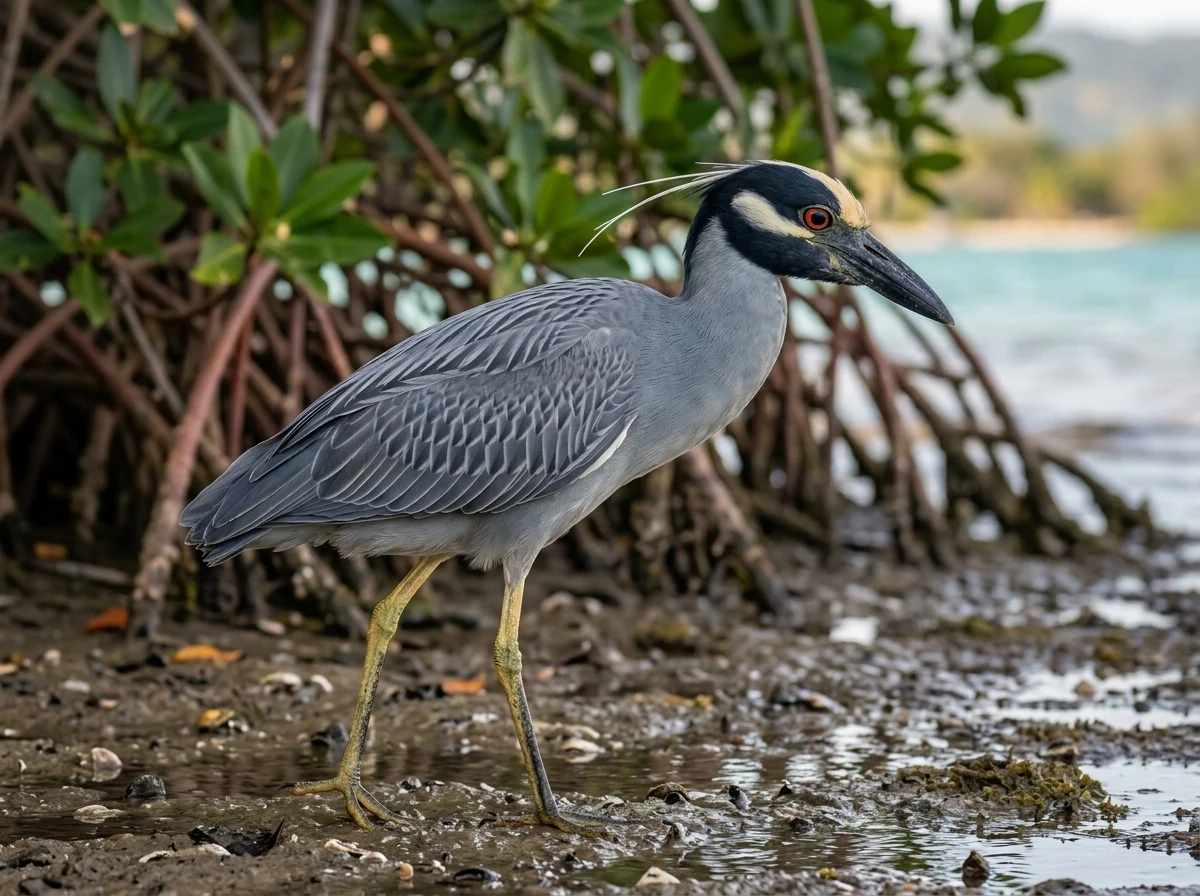
A concrete comparison between the Yellow-crowned Night Heron and the Little Blue Heron shows how mangroves shelter birds in layers: nesting substrate, shallow feeding water and resting cover.
Reviewed:Prepared with AI assistance and linked sources. Illustrations are not field photographs.
What mangroves do for birds
A mangrove forest is not just coastal woodland: it is a shelter structure. Its roots, trunks and canopy create layers where birds can rest, feed and nest without staying exposed. This guide asks a concrete question: how does that shelter work, and how is it visible in two Puerto Rico herons?
We use two sources: Audubon's Yellow-crowned Night Heron account (Nyctanassa violacea) and the USDA Forest Service Puerto Rico Breeding Bird Atlas. The first describes habitat, feeding and nesting for one species; the second documents breeding distribution of Puerto Rico's birds. Together they let us separate what is known from what is assumed.
Habitat guide
Three key ideas
CapasVertical shelterRoots, trunks and canopy offer rest, feeding and nesting.
Dos garzasComparisonYellow-crowned Night Heron and Little Blue Heron use mangroves differently.
AtlasLocal evidenceThe Atlas documents bird breeding in Puerto Rico.
01
Mangroves as layered shelter
A mangrove forest shelters birds because it combines three things: cover, substrate and shallow water. Cover is the branches and leaves that hide a bird from predators and wind. Substrate is the branches and trunks where a bird perches or builds a nest. Shallow water among the roots is where many birds find prey. That combination explains why mangroves appear repeatedly in heron habitat descriptions.
Audubon's Yellow-crowned Night Heron account is explicit: its habitats include mangroves, and it nests in mangrove or cypress swamps, sometimes in trees 30-40 feet above ground, but also very close to water in thickets and mangroves. In other words, the mangrove works as shelter both for resting and for breeding. That is not a minor detail: the same forest meets two different needs.
02
Comparison: Yellow-crowned Night Heron and Little Blue Heron
The Yellow-crowned Night Heron is more solitary and secretive than the Black-crowned Night Heron, according to Audubon. It feeds on hard-shelled crustaceans, mainly crabs and crayfish, and walks slowly on land or in shallow water, or stands still waiting for prey to approach. That strategy fits mangroves: roots and trunks create edges where crabs occur and where a bird can ambush without being seen.
The Little Blue Heron (Egretta caerulea) is a small, dark heron with a two-toned bill; juveniles are entirely white. The catalog classifies it as native to Puerto Rico and associates it with wetlands. The Puerto Rico Breeding Bird Atlas documents breeding distribution of the archipelago's birds, including aquatic birds, and serves as a baseline for comparing distributions. The practical difference is this: the Yellow-crowned Night Heron is tied to mangroves in its habitat description, while the Little Blue Heron is associated with wetlands more broadly. Both may use mangroves, but not in the same way or with the same specialization.
03
Feeding: the mangrove as pantry
Mangroves do not only hide: they also feed. Their roots and associated mud concentrate invertebrates, and shallow water lets birds such as the Yellow-crowned Night Heron catch crabs without fully submerging. Audubon notes the species is more of a specialist than most herons and that its diet includes many crustaceans, especially in coastal areas. That specialization explains why mangroves suit it: they offer hard, accessible prey.
For the Little Blue Heron, the catalog indicates a carnivorous diet and an aquatic predator niche. It does not state that it depends on mangroves, but that it inhabits wetlands. That is an important distinction: not every wetland bird is a mangrove bird. Mangroves are a wetland type with woody structure, and that structure creates the layered shelter this guide describes.
04
Nesting and breeding: where it is confirmed
Shelter becomes most critical during breeding. Audubon indicates the Yellow-crowned Night Heron nests in mangrove or cypress swamps, sometimes in trees 30-40 feet up, sometimes near water in thickets. It also notes it may nest in mixed colonies with other herons. That means mangroves do not only protect one pair: they can support a set of nests.
The Puerto Rico Breeding Bird Atlas documents breeding of 130 species on the island and its satellite islands, with more than 45,500 observations between 2004 and 2009. It is not an abundance list, but a breeding distribution record. So we should not infer that a species is abundant in mangroves just because it appears in the Atlas. What we can say is that the Atlas offers a baseline for studying how birds respond to land use and climate change.
05
Observation exercise: reading the mangrove in layers
This exercise is a suggested method, not a scientific protocol. Choose a fixed point with a view of a mangrove and observe for 15 minutes without moving. Mentally divide what you see into three layers: shallow water among roots, trunks and low branches, and canopy. Note which bird uses each layer and what it is doing: resting, walking, ambushing or carrying material to a nest.
Checklist: (1) Are herons in the shallow water? (2) Is any standing still, waiting for prey? (3) Are birds perched on low branches? (4) Is any carrying twigs or food to a fixed point? (5) Do they use the canopy or the mangrove edge? Record time, layer and behavior. You do not need to identify the species for the exercise to be useful: behavior tells you which mangrove layer is acting as shelter at that moment.
To identify later, consult the heron and mangrove bird guides. The comparison between the Yellow-crowned Night Heron and the Little Blue Heron helps separate a crustacean specialist from a more general wetland heron.
Linked profiles
The two herons in this guide
One is tied to mangroves in its habitat description; the other is associated with wetlands more broadly. That difference is the heart of the comparison.
AI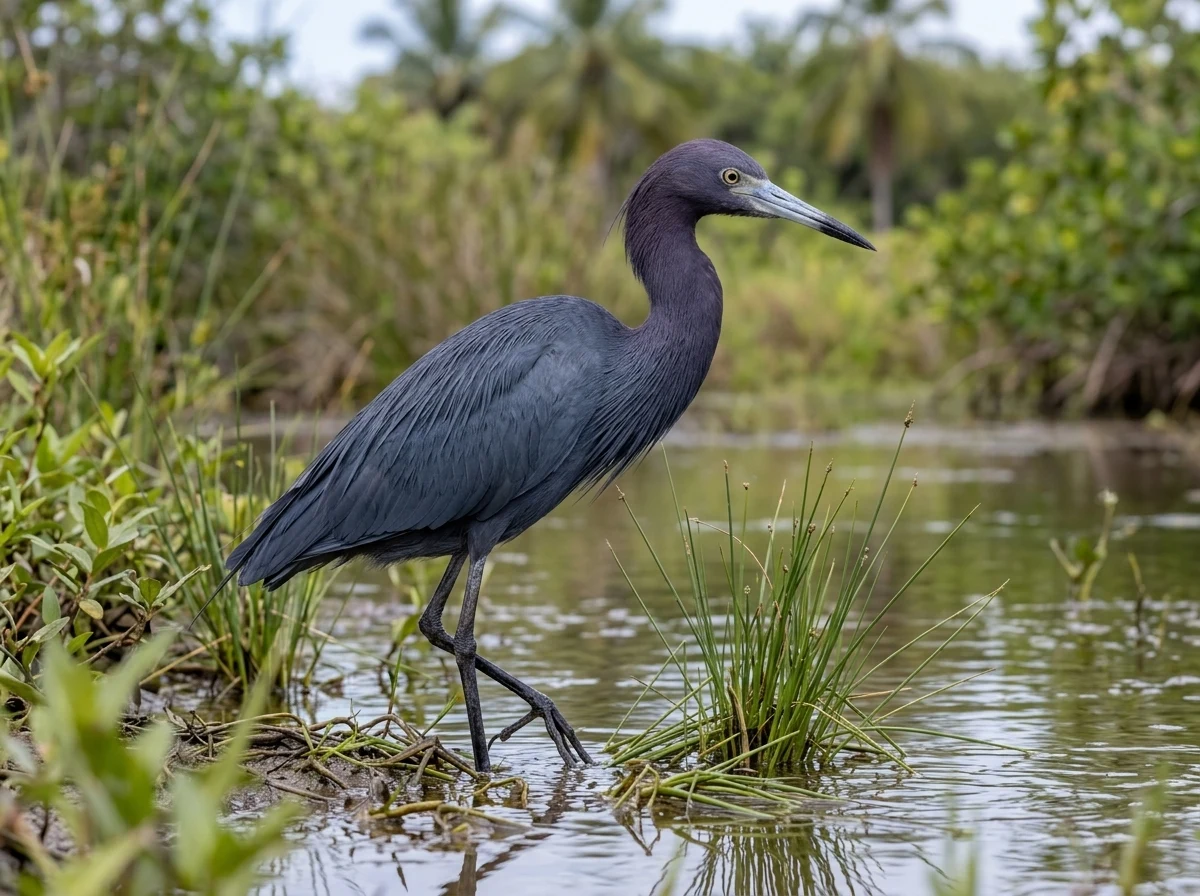 AI
AI01
Are mangroves the only shelter for these herons?
No. Audubon describes the Yellow-crowned Night Heron in mangroves, cypress swamps, streams and other wetlands. The Little Blue Heron is associated with wetlands more broadly. Mangroves are an important shelter, but not the only one.
02
Does the Puerto Rico Breeding Bird Atlas prove a species is abundant?
No. The Atlas documents distribution and breeding, not abundance. Its maps show breeding likelihood per hexagon, not how many individuals there are.
03
Can I use the layer exercise to identify species?
The exercise is for observing behavior and habitat use, not for identifying on its own. To identify, use the heron and mangrove bird guides, and compare traits such as bill, size and color pattern.
04
Does the Yellow-crowned Night Heron nest in colonies?
Audubon indicates it often nests in isolated pairs or very small groups, and where common it may nest in colonies, sometimes mixed with other herons. Mangroves can hold both solitary and grouped nests.
05
What does the Yellow-crowned Night Heron eat in mangroves?
Audubon notes it feeds on crustaceans, mainly crabs and crayfish, and is more of a specialist in coastal areas. It also eats mollusks, frogs, insects and fish.
06
Is the Little Blue Heron native to Puerto Rico?
Yes. The catalog classifies it as native to Puerto Rico, with natural occurrence. Abundance should not be inferred from that classification.
Keep exploring
Connected routes
Sources and review
The evidence is one link away.
These sources support the editorial scope of this guide. Bird profiles also retain their own taxonomy, occurrence, and conservation references.
Reviewed:
The atlas continues