 AI
AIBehavior guide
How Nectar-feeding Birds Eat
The tongue is not a straw: it transforms, traps liquid, and the bill works as a dynamic pump. Here is the mechanism, step by step.
Reviewed:Prepared with AI assistance and linked sources. Illustrations are not field photographs.
The direct question
Nectar-feeding birds do not sip nectar like a straw. In hummingbirds, the tongue ends in two grooves that open and close, and liquid becomes trapped inside flexible lamellae as the tongue leaves the nectar. The bill also participates: its tips and base open and close with a phase shift that helps move liquid toward the throat.
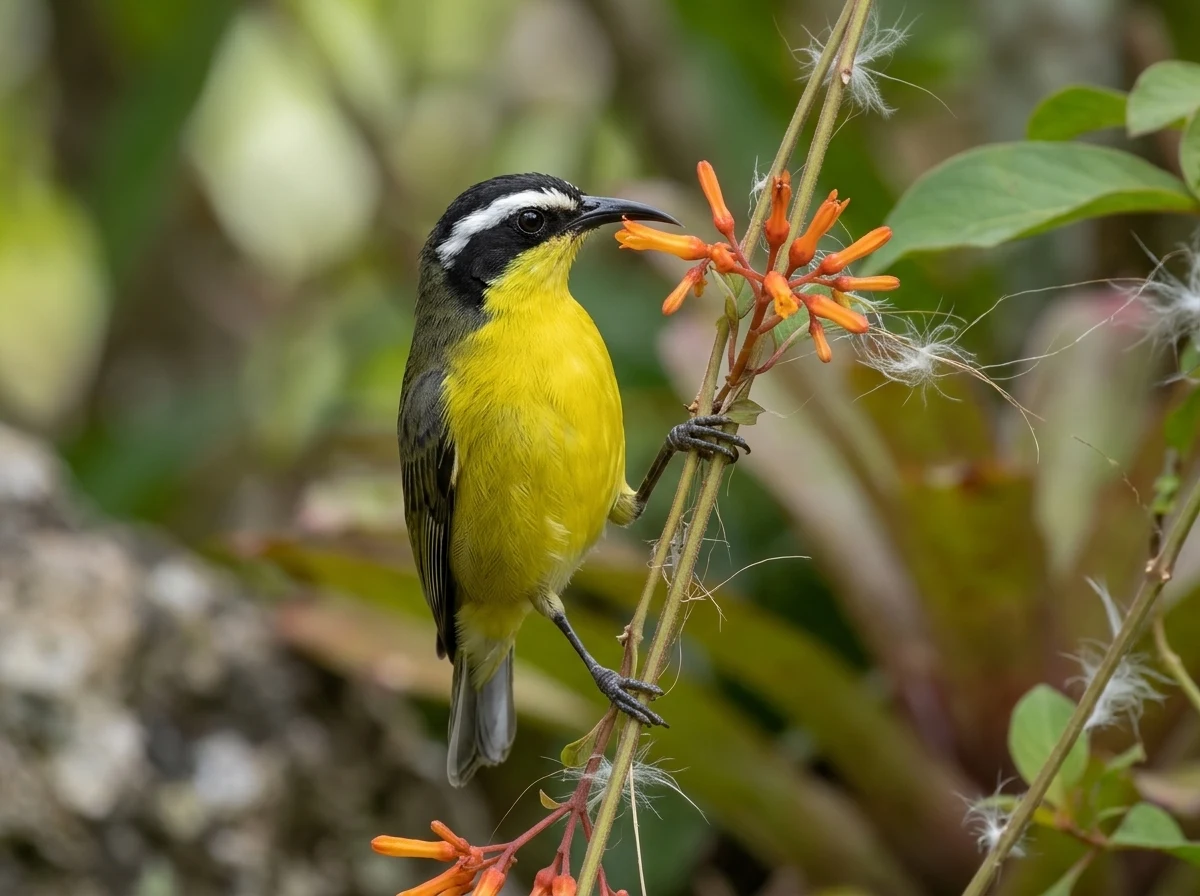
This guide explains that mechanism using published evidence on hummingbirds and compares it with what we know about the Bananaquit, a short-billed nectarivore that also visits flowers in Puerto Rico. The goal is to help you observe the process with clear criteria, without mistaking the tongue for a static tube.
Behavior guide
Three key ideas
Atrapa, no aspiraCapture mechanismThe hummingbird tongue traps nectar with lamellae that close as it leaves the liquid.
Pico dinámicoIntraoral transportBill tips and base move with a phase shift to facilitate flow toward the throat.
Dos escalasComparison in Puerto RicoThe Puerto Rican Emerald is endemic and small; the Bananaquit is a short-billed nectarivore widely distributed on the island.
01
The tongue that transforms
For decades it was believed that the hummingbird tongue worked like a pair of capillary tubes: nectar rose by capillarity. High-speed video evidence showed otherwise. The tongue tip has flexible lamellae supported by rods. When the tongue enters nectar, the lamellae unfurl; when it leaves, they roll inward and trap the liquid. The full cycle can occur in a fraction of a second. The trapping and releasing mechanism also occurs in dead specimens, demonstrating that neither unfurling nor furling requires muscular work: the process results purely from the structural configuration of the tongue tip.
That finding changes the explanation for why hummingbirds prefer more concentrated nectars than capillarity models predicted. If capture does not depend on liquid rising through a tube, then concentration does not limit loading speed in the same way. The tongue traps nectar even in thin layers, allowing birds to use flowers with small volumes.
02
The bill also pumps
Once the tongue is loaded, nectar must travel from the bill tip to the throat. That journey is not passive. Synchronized high-speed filming showed that the bill tips and base open and close with a phase shift: when the tips are most open, the base is most closed, and vice versa. That pattern appeared in all the individuals and species filmed, although the degree of phase offset varied among species and individuals.
The authors describe three complementary mechanisms: distal wringing, where the tongue is wrung out near the bill tip; tongue raking, which moves nectar mouthwards using the tongue base and its flexible flaps; and basal expansion, which increases the bill's internal capacity to facilitate flow. The tongue is not a straw and the bill is not a static tube.
03
Comparison in Puerto Rico: Emerald and Bananaquit
The Puerto Rican Emerald (Riccordia maugaeus) is endemic to the archipelago, resident, and found in dry and moist forests, plantations, and gardens. The catalog records a mass of about 4.25 g, while the BirdsCaribbean source states approximately 3 g; both figures are estimates and the discrepancy reflects different sources. Its recorded diet is nectar. The Bananaquit (Coereba flaveola) is also a native resident with a nectar diet, but the catalog records about 10.2 g and it occupies nearly all wooded and human-modified habitats, including gardens. Both visit flowers, but their sizes and bills differ.
The BirdsCaribbean source on the Emerald states that it uses its long, extendible tongue to retrieve nectar while hovering, and sometimes hangs on the flower. That source uses the informal 'straw-like' description, but the biomechanics literature (s1, s2) shows the tongue is not a straw. The same source notes that, because of its small size, the Emerald visits short-corolla flowers and sometimes pierces the base of larger flowers, which is nectar robbery because it does not pollinate. That description is local and specific to the Emerald; it should not be generalized to all nectar-feeding birds without evidence.
04
How to observe without confusion
You do not need a high-speed camera to notice the general pattern. Find a flower or feeder with nectar and watch a hummingbird for several cycles. You will see the tongue enter and leave quickly, and the bill does not remain still: the tips open and close. If you can record with a phone in slow motion, check whether the tongue looks like a structure that unfurls and rolls inward, not a rigid tube.
For the Bananaquit, observation is different: its bill is shorter and it often perches or clings to the flower. Compare posture, time spent at the flower, and whether it pierces the base. Note the species, plant, time, and whether another bird interacted. That notebook will give you useful data for your own conclusions, without inventing abundances or visits you did not see.
Linked profiles
The two birds in this guide
One is endemic and tiny; the other is a short-billed nectarivore widely present on the island. Both help explain the mechanism.
AI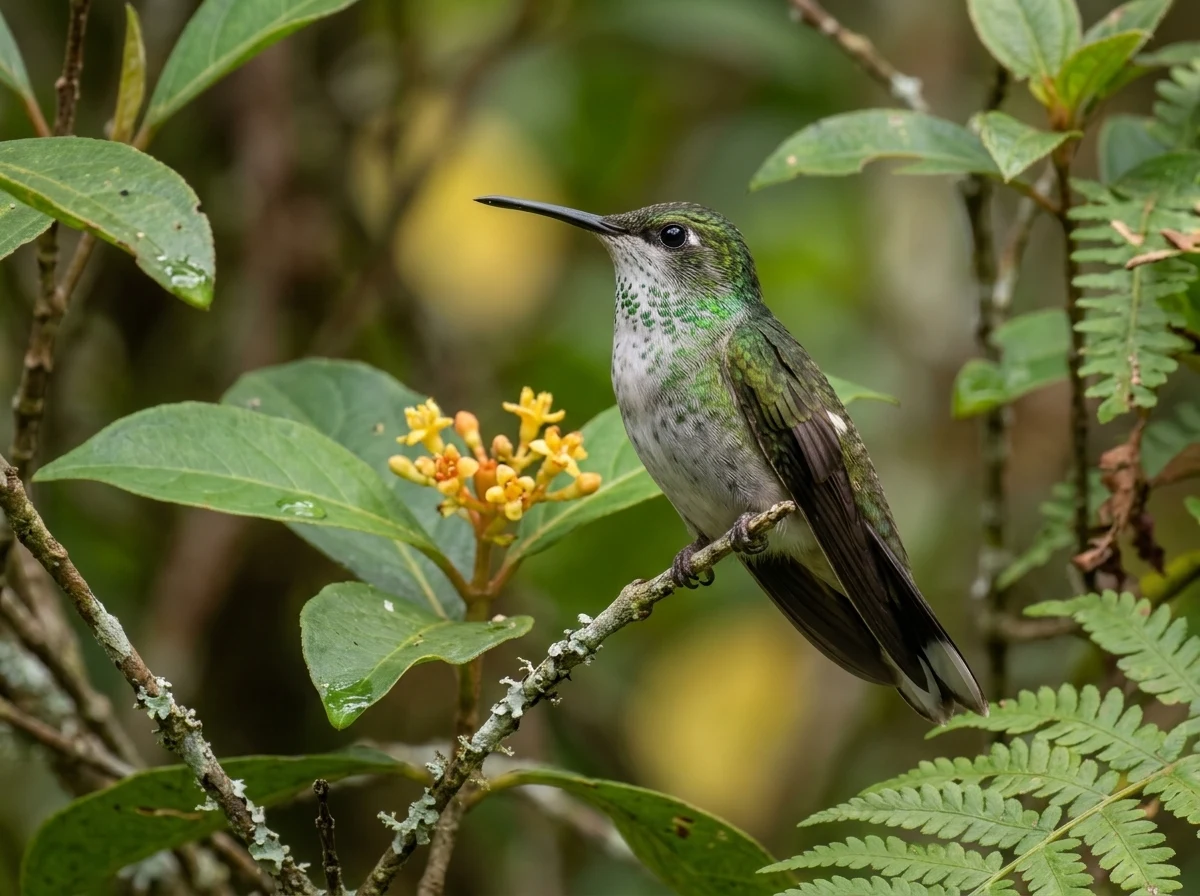 AI
AI01
Do nectar-feeding birds suck nectar like a straw?
No. In hummingbirds, evidence shows the tongue traps nectar with flexible lamellae that close as it leaves the liquid. It does not work as a pair of static capillary tubes. The bill also participates in transport.
02
Does the hummingbird tongue use muscles to open and close the trap?
Evidence indicates the trapping and releasing mechanism occurs in dead specimens and requires no muscular work: it results from the structural configuration of the tongue tip.
03
Is the Puerto Rican Emerald endemic?
Yes. The catalog records it as endemic to the Puerto Rico archipelago, resident, and native. The BirdsCaribbean source also describes it as endemic and found only in the archipelago.
04
Is the Bananaquit also a nectarivore?
The catalog records its diet as nectar and its trophic niche as nectarivore. It is a native resident species in Puerto Rico, present in nearly all wooded and human-modified habitats, including gardens.
05
Can I use a feeder to observe the mechanism?
Yes, a clean feeder with nectar can attract hummingbirds and let you observe feeding cycles. The BirdsCaribbean source mentions that hummingbirds may visit local feeders and recommends cleaning and refilling it every couple of days.
Keep exploring
Connected routes
Sources and review
The evidence is one link away.
These sources support the editorial scope of this guide. Bird profiles also retain their own taxonomy, occurrence, and conservation references.
Reviewed:
01↗02↗03↗
PNAS / PubMed Central
The hummingbird tongue is a fluid trap, not a capillary tube
Evidence for cited sections; consult the original document.Journal of Experimental Biology / PubMed Central
Nectar feeding beyond the tongue: hummingbirds drink using phase-shifted bill opening, flexible tongue flaps and wringing at the tips
Evidence for cited sections; consult the original document.BirdsCaribbean
Endemic Bird of the Day: Puerto Rican Emerald
Evidence for cited sections; consult the original document.The atlas continues