 AI
AIBehavior guide
How Puerto Rican Woodpeckers Find Food in Wood
Puerto Rico's only resident woodpecker does not rely on a single substrate: the main source describes it as omnivorous, with a diet of arthropods and fruits. This guide explains what is documented and proposes an observation exercise.
Reviewed:Prepared with AI assistance and linked sources. Illustrations are not field photographs.
The direct question
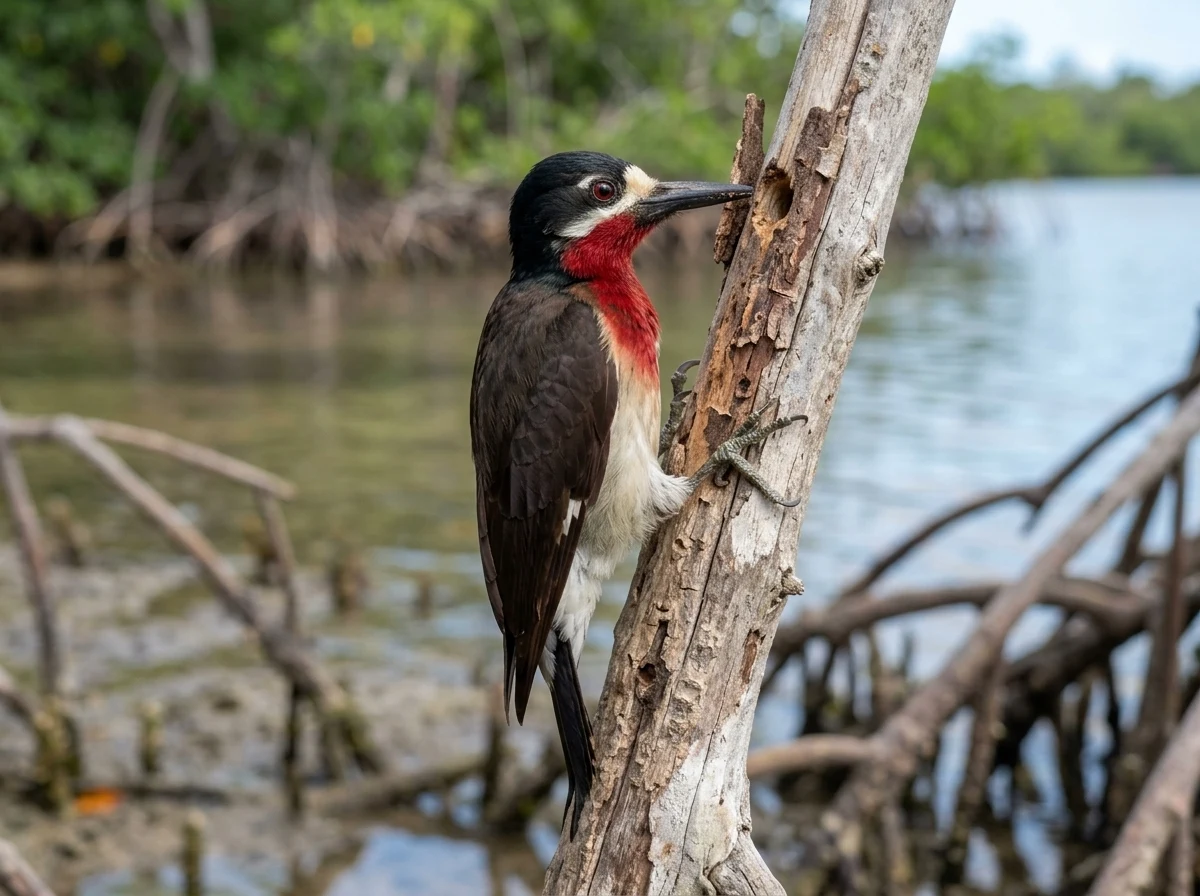
The Puerto Rican Woodpecker (Melanerpes portoricensis) is the only resident member of the family Picidae in Puerto Rico. This guide's question is concrete: how does it find food inside wood? The short answer is that it does not do so in a single way. The main source consulted describes the woodpecker as omnivorous, with a broad diet of arthropods and fruits. That means wood is one of several substrates it searches, not the only one.
This guide separates what is documented from what is suggested observation. The information on diet and habits comes from the Birds of the World species account. The occurrence in Puerto Rico and Vieques comes from that same source and the local catalog. Any field activity we propose here is an observation suggestion, not a scientific finding.
Behavior guide
Three keys to understanding the method
OmnívoroBroad dietThe source describes a diet of arthropods and fruits, not only wood insects.
Artrópodos y frutosTwo documented categoriesThe species account mentions both categories; it does not detail the sensory detection mechanism.
ResidentePresent year-roundThe species is found in Puerto Rico and Vieques; it is not migratory.
01
What the evidence says about its diet
The Birds of the World species account describes the Puerto Rican Woodpecker as omnivorous. It eats a wide variety of arthropods and fruits. This description matters because it corrects the idea that a woodpecker only eats insects extracted from wood. The same source notes that many aspects of its life history and behavior are not well understood.
The local catalog agrees on the essentials: it classifies its diet as invertebrates and its trophic niche as invertivore, but the main source broadens the picture with fruits. For the observer, the practical consequence is clear: if you see a woodpecker pecking wood, it is searching for food, but that is not the only way it feeds. It may also be eating fruits in the canopy.
02
The mechanism: what the source does not detail
The main source consulted confirms that the species is omnivorous and that it searches for arthropods, but it does not describe the exact sensory mechanism it uses to detect them inside wood. It does not document whether it taps the surface to detect cavities, whether it scales bark before excavating, or whether it follows a fixed sequence of steps. That information is not in the sources available for this guide.
What is documented is the general substrate: the species is found in all treed habitats of Puerto Rico and Vieques, according to the species account. The local catalog classifies its habitat as dry and moist forest, mangrove, plantations, parks, and gardens. That habitat classification is not equivalent to specific observations in each forest type, but rather to the categories where it may be found. For the observer, this means that any tree with visible bark or dead wood in those habitats is a reasonable place to look, although the exact detection method remains undocumented.
03
Comparison: a flexible strategy
The useful comparison here is not with other woodpeckers, but with the popular image of a woodpecker. The main source describes the Puerto Rican Woodpecker as omnivorous, with a diet of arthropods and fruits. That description separates it from the idea of a bird that only lives on wood-boring insects. The sources consulted for this guide cover only Melanerpes portoricensis and do not include dietary information about other species in the genus Melanerpes.
This difference is useful for the observer. If you see a Puerto Rican Woodpecker eating fruits, it is not anomalous behavior: it is within what is documented. If you see it pecking wood, that is also documented. The comparison is not meant to diminish its excavating ability, but to understand that its feeding strategy is flexible. That flexibility may explain why it is found in so many treed habitats in Puerto Rico and Vieques.
04
Observation exercise: procedure and checklist
This is an original exercise, not a behavioral test. Choose a tree with visible bark, dry branches, or a standing dead trunk. Search in treed habitats of Puerto Rico or Vieques, where the species is documented. Sit at a distance that does not disturb the bird. Observe for at least ten minutes. Note whether the woodpecker taps the surface, scales bark, excavates, or eats fruits. Record the height at which it works and the type of substrate: trunk, thick branch, or thin branch.
Checklist: 1) Does the bird tap quickly and shallowly? It could be probing, but that is a hypothesis to test, not a diagnosis. 2) Does it strike hard and produce wood chips? It could be excavating, also as a hypothesis. 3) Does it move to another branch after a few seconds? It could be exploring. 4) Does it stop to eat something that is not wood? It could be a fruit. 5) Does it return to the same tree on later visits? That would indicate a recurring foraging site. You do not need to identify the insect or fruit species for the observation to be useful. The interpretations of tap patterns are hypotheses you can test, not behaviors established by the sources.
Linked profiles
The bird of this guide
The Puerto Rican Woodpecker is endemic to the archipelago and the only resident picid. The main source describes it as omnivorous, with a diet of arthropods and fruits.
AI01
Does the Puerto Rican Woodpecker only eat insects from wood?
No. The main source describes it as omnivorous, with a diet of arthropods and fruits. Wood is an important substrate, but not the only one.
02
How does the woodpecker detect insects inside wood?
The source consulted confirms that it searches for arthropods, but does not document the exact sensory mechanism. One should not state that it taps the surface to detect cavities as an established fact.
03
Where can I observe this behavior in Puerto Rico?
The species is found in treed habitats of Puerto Rico and Vieques. The local catalog classifies its habitat as dry and moist forest, mangrove, plantations, parks, and gardens. Look for trees with visible bark or dead wood. Local abundance is not documented in this guide.
04
What is the difference between pecking and excavating?
For this exercise, we use our own working definitions: pecking is a quick, shallow strike that may serve to explore or communicate, and excavating is a harder, repeated strike that removes wood. These are not facts documented by this guide's sources for the Puerto Rican Woodpecker, but practical categories for noting what you observe.
05
Is the Puerto Rican Woodpecker migratory?
No. The local catalog classifies it as resident and non-migratory. It is found in Puerto Rico and Vieques year-round.
Keep exploring
Connected routes
Sources and review
The evidence is one link away.
These sources support the editorial scope of this guide. Bird profiles also retain their own taxonomy, occurrence, and conservation references.
Reviewed:
01↗02↗
Cornell Lab of Ornithology, Birds of the World
Diet and Foraging - Puerto Rican Woodpecker (Melanerpes portoricensis)
Evidence for cited sections; consult the original document.Cornell Lab of Ornithology, Birds of the World
Puerto Rican Woodpecker - Melanerpes portoricensis
Evidence for cited sections; consult the original document.The atlas continues