 AI
AIBehavior guide
How Shorebirds Find Food in Mud
Two shorebirds, two strategies: a sewing-machine bill that stitches through mud and a small bill that feels its way. Learn to read behavior in the mud.
Reviewed:Prepared with AI assistance and linked sources. Illustrations are not field photographs.
The direct answer
Shorebirds find food in mud mainly with their bills. Some, like the Short-billed Dowitcher (Limnodromus griseus), insert the bill deeply and repeat a rapid motion often compared to a sewing machine. Others, like the Least Sandpiper (Calidris minutilla), use a shorter bill to peck and feel the surface and soft upper mud.
The difference is not only size: rhythm, depth, and movement also change. In Puerto Rico, both species appear in the catalog as native with natural occurrence, neither resident nor breeding, and associated with wetlands. This guide explains the mechanism, compares the two species, and proposes an orderly way to observe it without inventing local data.
Behavior guide
Three keys to remember
SondearMain mechanismThe bill enters the mud; the prey does not need to be seen to be caught.
RitmoBehavioral clueThe Short-billed Dowitcher is usually deliberate; the Least Sandpiper is small and quick.
SensoresDetection without contactSome shorebirds detect buried prey with sensory organs in the bill.
01
What happens beneath the mud
Mud at the edge of a shore, salt marsh, or shallow lagoon is not empty space: it holds invertebrates, larvae, mollusks, marine worms, and crustaceans. The Short-billed Dowitcher eats many insects and their larvae, and during migration and winter also mollusks, marine worms, and crustaceans; in spring it may feed on horseshoe crab eggs. The Least Sandpiper, for its part, appears in the catalog with an invertebrate diet and a much smaller size.
The key is that food is usually buried or partly hidden. That is why the bill is not just a pair of tweezers: it is an exploration tool. The bird inserts the tip, detects resistance, movement, or chemical signals, and decides whether to capture or continue. The BirdsCaribbean source summarizes this clearly: some shorebirds can probe sand and mud and detect where mollusks are without touching them, thanks to special sensory organs in the bill.
02
The Short-billed Dowitcher: deep probe and sewing-machine rhythm
The Short-billed Dowitcher is a medium-sized, stocky bird with a long bill. The Audubon source states that it typically forages by wading in shallow water, sometimes walking on wet mud, and probes deeply in the mud with its bill. Its feeding is usually deliberate: it stands in one spot or moves forward slowly. That combination of a long bill and slow movement allows it to exploit deeper layers that other shorebirds cannot reach.
The catalog describes its diet as invertebrates, often by rapidly probing its bill into mud in a sewing-machine fashion. That image is useful: the probe enters and exits many times, but the bird does not run aimlessly. In the comparison with the Least Sandpiper, the Short-billed Dowitcher represents the strategy of depth and repetition.
03
The Least Sandpiper: short bill, fine touch, and surface
The Least Sandpiper is the smallest shorebird. Its short bill cannot reach the deep layers explored by the Short-billed Dowitcher, but it allows the bird to quickly check the surface and soft mud. The catalog classifies it as a wetland bird, native, neither resident nor breeding in Puerto Rico, with an invertebrate diet. That combination of small size and invertebrate diet suggests a strategy of fine, frequent exploration rather than deep excavation.
In practice, this means that when observing a mixed group on a muddy edge, the Least Sandpiper requires more attention to follow its pecks because its scale is smaller. The comparison with the Short-billed Dowitcher is not better or worse: they are two ways of dividing the same resource. One reaches deep; the other checks the shallows more frequently.
04
Practical comparison: how to tell the two strategies in the field
You do not need to identify the species to notice the difference. First look at size and relative bill length. A medium-sized, stocky bird with a long bill that tilts down and keeps the tip inside the mud longer suggests a Short-billed Dowitcher. A small bird with a short bill that pecks quickly and changes position frequently suggests a Least Sandpiper. Then observe the rhythm: deep and repeated versus shallow and fast.
The BirdsCaribbean source adds an important clue: shorebirds can produce pellets, meaning they expel through the bill the indigestible parts they compact in the gizzard. That is not a search strategy, but it confirms that they process prey with shells or hard parts. For the comparison, what matters is that both species depend on mud invertebrates and that their bills are designed to detect them in different ways.
05
Observation exercise and checklist
Choose a muddy edge visible from a trail or overlook, without entering the wetland or disturbing the birds. Observe for 10 to 15 minutes with binoculars. Record only what you see: approximate time, number of birds, relative size, apparent bill length, whether they are in shallow water or on wet mud, and whether the bill goes deep or only touches the surface. Do not write down species if you are not sure; write down behavior categories.
Checklist: 1) Does the bird keep its bill inside the mud for more than a second? 2) Does it repeat the motion at the same spot? 3) Does it move slowly or take quick steps? 4) Is the bill clearly longer than the head? 5) Is the bird sparrow-sized or noticeably larger? 6) Does it share the edge with other birds of different sizes? With these answers you can describe the strategy without a definitive identification.
Linked profiles
The two species in this guide
Both appear in the catalog as native birds with natural occurrence in Puerto Rico, associated with wetlands and neither resident nor breeding.
AI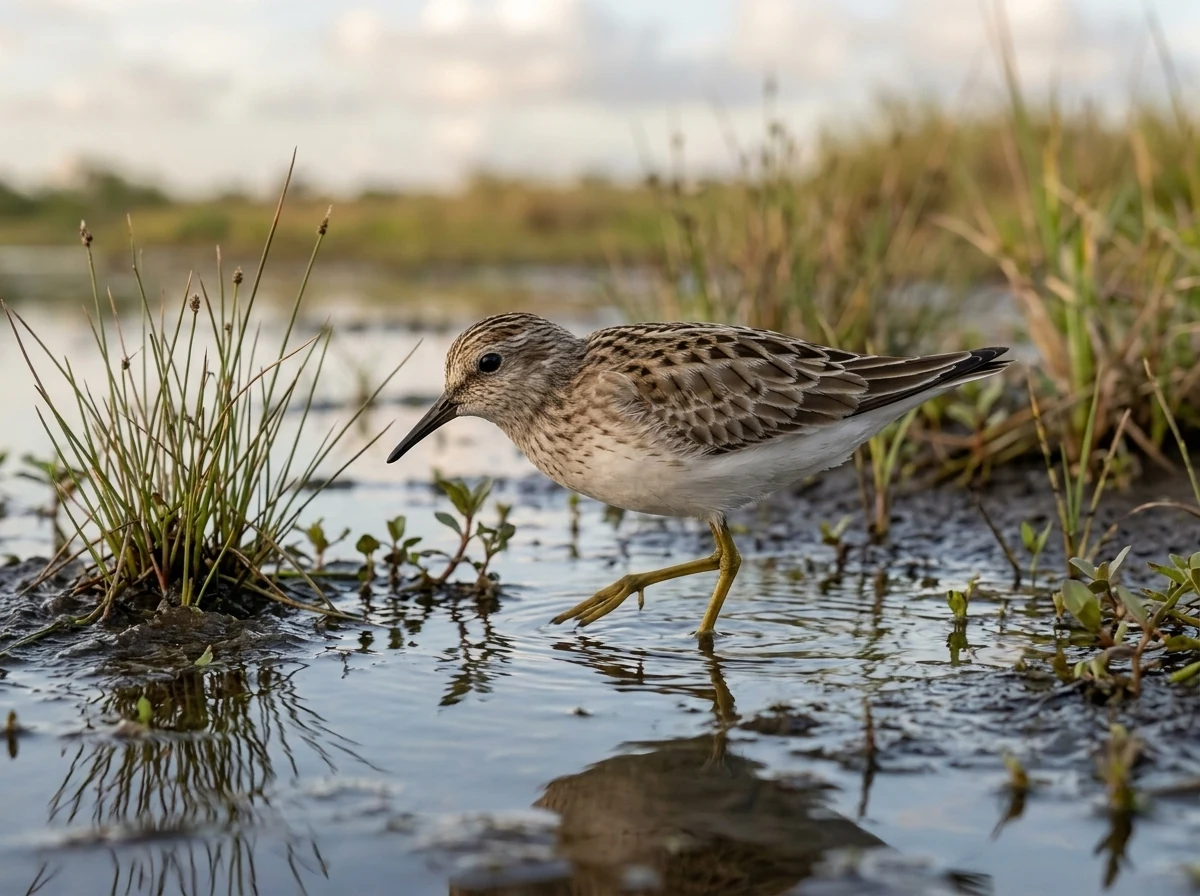 AI
AI01
Do shorebirds see food inside the mud?
Not always. The BirdsCaribbean source states that some shorebirds can detect mollusks without touching them, using sensory organs in the bill. That means detection does not depend only on sight.
02
Do the Short-billed Dowitcher and Least Sandpiper eat the same thing?
Both eat invertebrates, but the Short-billed Dowitcher includes mollusks, marine worms, and crustaceans, and sometimes horseshoe crab eggs. The Least Sandpiper appears with an invertebrate diet and a much smaller size.
03
Can I use bill length to identify the Short-billed Dowitcher?
Not reliably. The Audubon source warns that bill length is unreliable for separating it from the Long-billed Dowitcher. Voice is the clearest identification method.
04
Do shorebirds expel pellets?
Yes. The BirdsCaribbean source explains that some shorebirds compact indigestible parts, such as bones and shells, in the gizzard and expel them through the bill. It is not a search strategy, but a processing one.
05
Do these species breed in Puerto Rico?
The catalog records them as neither resident nor breeding in Puerto Rico, with natural occurrence. No abundance or local nesting should be inferred from this guide.
Keep exploring
Connected routes
Sources and review
The evidence is one link away.
These sources support the editorial scope of this guide. Bird profiles also retain their own taxonomy, occurrence, and conservation references.
Reviewed:
The atlas continues