 AI
AIHabitat guides
Why Birds Use Different Forest Layers
A forest is not one room: it is a building of floors with different light, food, and shelter. Here we explain how to read those layers and how to practice observing them.
Reviewed:Prepared with AI assistance and linked sources. Illustrations are not field photographs.
The question in one sentence
Birds use different forest heights because each height offers different resources: light, foliage, fruit, insects, perches, and nesting sites. Height is not a whim of each species; it follows where food is, where cover is, and how forest structure changes over time.
In Puerto Rico this has been documented in detail. An 18-month study at the Luquillo Experimental Forest, after Hurricane Hugo in September 1989, measured foliage profiles by height intervals and recorded birds with mist nets and point counts. The central finding for our question is direct: when wind and rain stripped the canopy, birds that normally foraged high up began showing up in captures in the understory. In other words, the layer a bird uses can change when forest structure changes.
Habitat guides
Three key takeaways
Dos capasWhat birds appear to distinguish at El VerdeThe study cites earlier work (MacArthur et al. 1966) reporting that at El Verde birds recognize only two vertical layers, versus four in mainland Panama. This is not a measurement from the 18-month study.
18 mesesLength of post-hurricane monitoringMonitoring at Luquillo ran for a year and a half after Hurricane Hugo.
Perfiles de follajeHow structure was measuredVegetation presence was recorded in vertical height intervals, from 0-0.25 m up to 25-30 m.
01
What a forest layer is
A layer is a horizontal band of vegetation at a certain height above the ground. In the Luquillo study, foliage profiles were measured in intervals from 0-0.25 m, 0.25-0.50 m, 0.50-0.75 m, 0.75-1.0 m, 1.0-1.5 m, 1.5-2.0 m, 2-3 m, 3-5 m, 5-10 m, 10-15 m, 15-20 m, 20-25 m, and 25-30 m. That scale is useful because it shows that "height" is not just up or down: there are many intermediate levels.
Before the hurricane, the studied forest had a closed canopy 20 to 24 m above an open understory. That sentence sums up the architecture: a dense roof above and a more open space below. Birds distribute themselves between those extremes and the middle levels according to what each band offers.
02
Why food and light change with height
Light is the engine. The canopy receives more light and produces more new foliage, flowers, and fruit; the understory lives in shade and its vegetation responds differently. After the hurricane, fruit production concentrated in pre-existing gaps and peaked 93 to 156 days after the storm. Those gaps recorded higher capture rates and a distinct set of birds, in contrast to the understory and a powerline opening without fruit.
That means height and structure are not the only things that matter: where food is at a given moment matters too. A bird can move up, down, or sideways following fruit and insects. The study describes pre-existing gaps as a possible "keystone habitat" that maintains frugivore populations when fruit is scarce elsewhere in the forest.
03
The hurricane case: when layers blur
The study attributes the sharp increase in captures shortly after the hurricane to a downward shift by canopy birds. Capture rates for understory species were indistinguishable from baseline rates. In addition, foliage profiles from different habitats became increasingly similar as vegetation recovered: in October 1989 profiles within the same habitat were more similar to each other than between habitats, but that distinction faded over time.
The text concludes that it may take many years after a hurricane for the understory and gaps to become sufficiently distinct in structure and resources, and for birds to differentiate them again. This explains why the question "at what height does this bird live?" has a conditional answer: it depends on the state of the forest.
04
Two birds, two height strategies
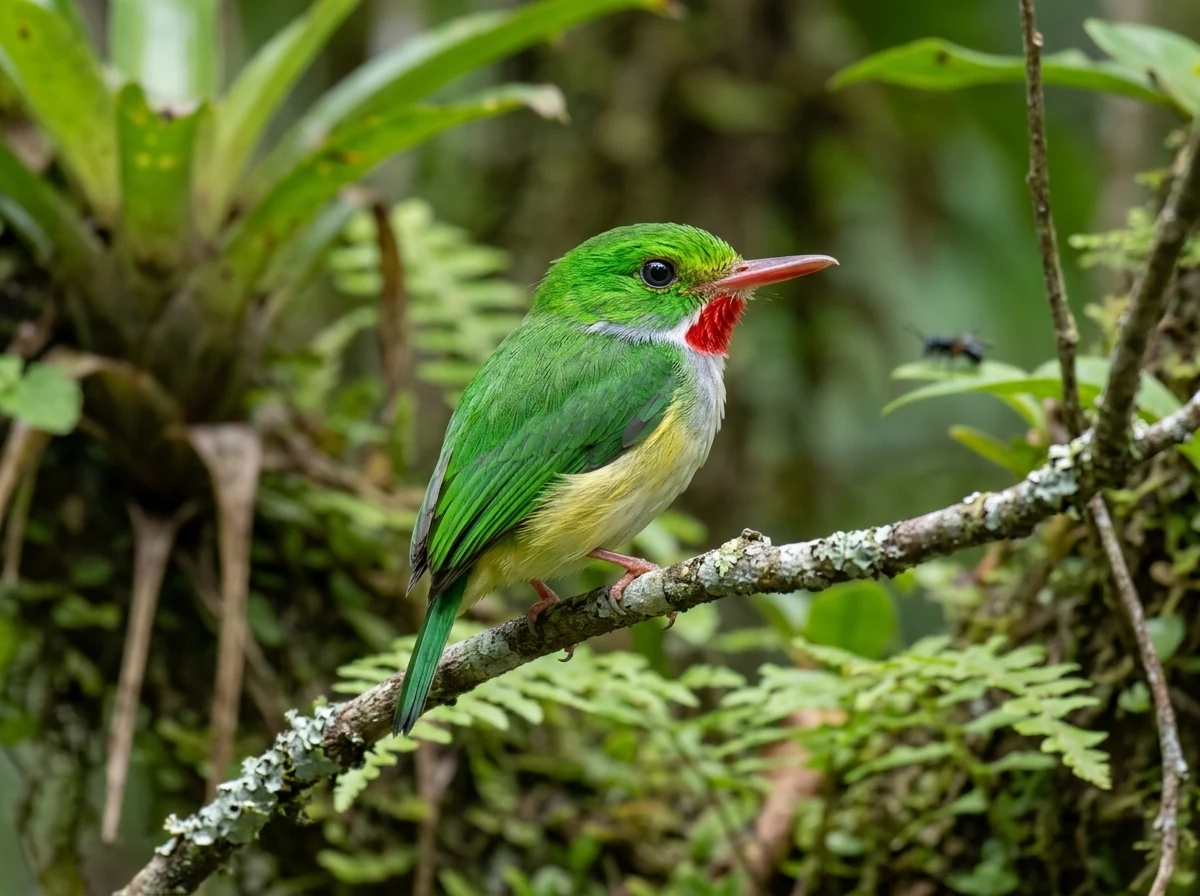
The Puerto Rican Tody (Todus mexicanus) is endemic to the main island of Puerto Rico and is associated with forest, woodland, karst, and shade coffee plantations. It is a small bird, about 6.2 g, that eats invertebrates and nests in burrows dug in the ground. Its size and diet tie it to microenvironments where it can ambush insects and find low or middle perches. In the Luquillo study, the Tody was one of only two species out of 17 that showed a significant correlation between mist-net captures and point-count detections; the other was the Puerto Rican Tanager.
The Pearly-eyed Thrasher (Margarops fuscatus) represents the opposite: it is a large omnivore, about 114 g, described as a colonizing "supertramp" with great plasticity in habitat, diet, foraging techniques, and even morphology. In Puerto Rico it is described as common only in species-poor habitats, and it reaches its highest relative abundance in wet forests. That plasticity means it is not tied to a single layer: it can use several as opportunity allows. Comparing the two species teaches that height is not a fixed destiny but a response to resources and competition.
05
How to practice it: a layered observation exercise
Pick a fixed spot with vegetation at several heights and stay still for a few minutes. Mentally divide the space into three bands: ground and grass (0-1 m), middle (1-5 m), and high (above 5 m). Note each bird you see or hear in the band where you detected it, not where you think it "should" be. Also record what it was doing: perched, foraging, flying between layers, or singing.
Repeat the exercise at the same spot on two visits separated by weeks or months. Compare your lists: did any species change band? Did birds appear in layers where you had not seen them before? This method does not prove abundance or trends, but it trains attention to structure. If you want to contribute data, citizen-science protocols let you record time, place, and behavior in an organized way.
Short checklist: 1) fixed point and silence; 2) three height bands defined in advance; 3) record species, band, and behavior; 4) note whether the canopy is closed, open, or recovering; 5) repeat on another date and compare. No special equipment is needed: binoculars, a notebook, and patience are enough.
Linked profiles
The birds in this guide
Two species that illustrate opposite strategies: one small and tied to microenvironments, the other large and plastic.
AI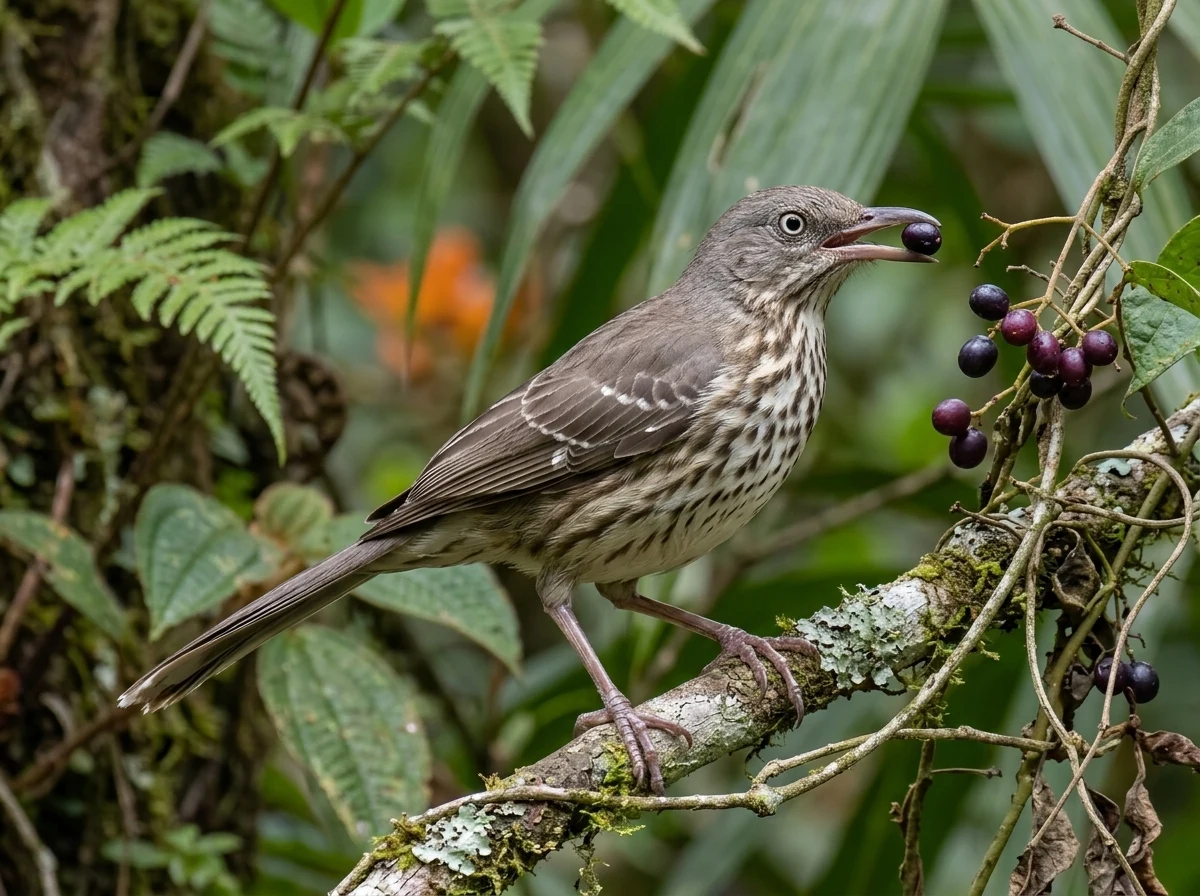 AI
AI01
Do birds always use the same height?
No. The Luquillo study documented that, after Hurricane Hugo, canopy birds appeared foraging in the understory. The height a bird uses can change when forest structure changes.
02
Why are fewer layers distinguished at El Verde than in Panama?
The study cites earlier work (MacArthur et al. 1966) reporting that birds at El Verde recognize only two vertical layers, while four are recognized in mainland Panama. The Luquillo study authors suggest that frequent hurricanes limit the height of Caribbean forests and restrict the vertical profile where segregation could occur.
03
Does height depend only on the species?
No. It also depends on available food, light, foliage structure, and competition. The study found that gaps with fruit concentrated birds and captures, and that the signal faded when fruit production stopped.
04
Can I use this to identify birds?
It works as a context clue, not as proof. Knowing that a species is often detected in a certain band helps you search, but identification requires seeing or hearing diagnostic traits. The band is a working hypothesis, not a confirmation.
05
What happens to layers after a hurricane?
They become less distinct. The study indicates that foliage profiles from different habitats became increasingly similar as vegetation recovered, and that it may take many years before understory and gaps become distinguishable again for birds.
Keep exploring
Connected routes
Sources and review
The evidence is one link away.
These sources support the editorial scope of this guide. Bird profiles also retain their own taxonomy, occurrence, and conservation references.
Reviewed:
01↗02↗03↗
USDA Forest Service / The Condor (Cooper Ornithological Society)
Responses of Bird Populations in a Puerto Rican Forest to Hurricane Hugo: The First 18 Months
Evidence for cited sections; consult the original document.Cornell Lab of Ornithology
Pearly-eyed Thrasher (Margarops fuscatus) – Birds of the World
Evidence for cited sections; consult the original document.USDA Forest Service Research and Development
The Puerto Rico Breeding Bird Atlas
Evidence for cited sections; consult the original document.The atlas continues