 AI
AIIdentification
Adult vs Juvenile Laughing Gull
A practical guide to separating adults from juveniles by plumage, bill, and legs, with a field routine and links to the general guides.
Reviewed:Prepared with AI assistance and linked sources. Illustrations are not field photographs.
Why this comparison matters
The Laughing Gull (Leucophaeus atricilla) is a medium-sized gull with a dark hood and a laugh-like call. In Puerto Rico it appears on the list of birds of the archipelago, and the local source describes it as the most common gull on the island. That presence does not mean every gull you see is a Laughing Gull: the Ring-billed Gull (Larus delawarensis) also appears on the Puerto Rico list, and juveniles of both species can be confused at a distance.
The concrete question —adult or juvenile— is best answered with a sequence: first the head and bill as a set, then the pattern of the back and wings, and finally the legs. This article does not repeat the general species profile; it focuses on plumage changes and on how to observe them without inventing local data.
Identification
Three keys to remember
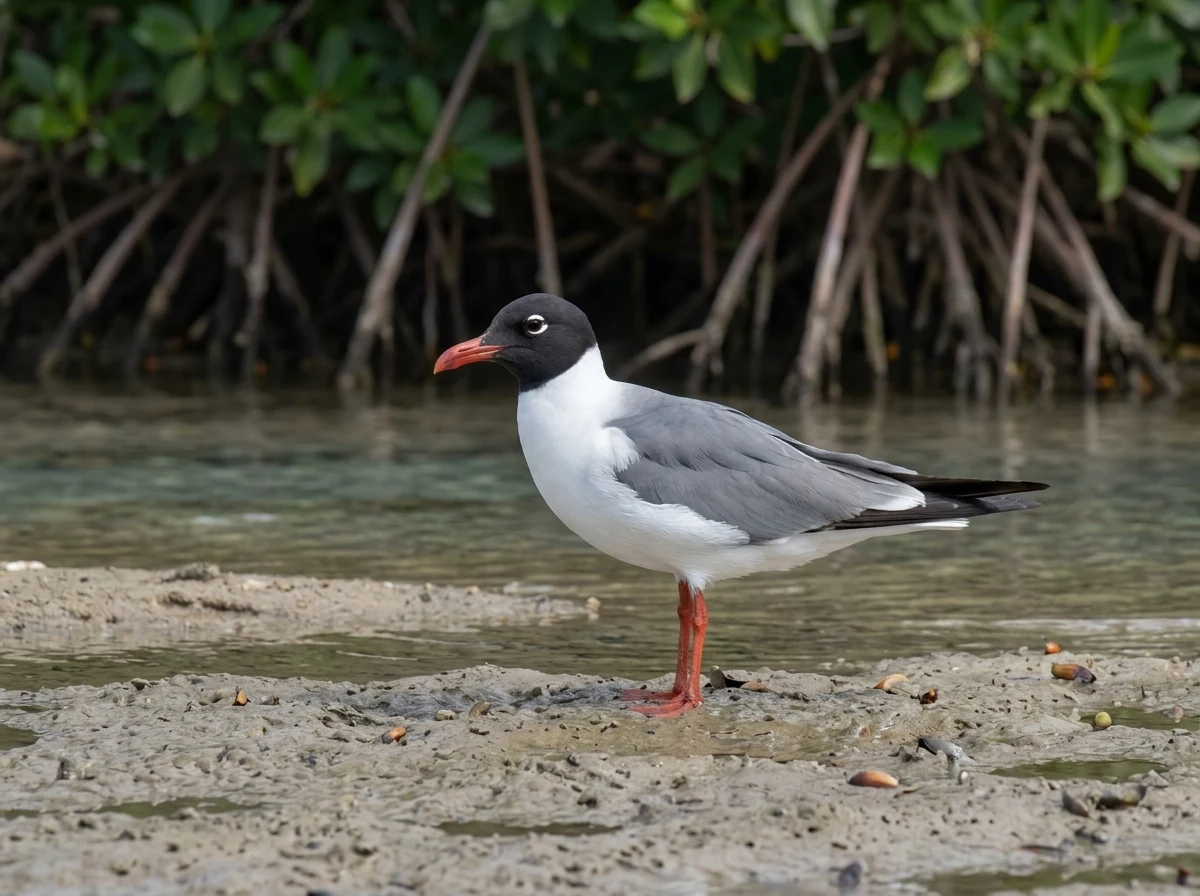
CapuchaThe black hood belongs to adults in breeding plumageImmatures do not show a full black hood; their head is brownish or whitish with dark markings.
Pico y patasThe adult has dark bill and legs, often with a red tingeJuveniles also have dark bill and legs, so this trait alone does not separate ages.
DorsoThe juvenile shows a scaly brown pattern; the adult has a dark gray backAudubon describes immatures with a scaly brown pattern at first and a gray back by first winter.
01
What changes between an adult and a juvenile
The breeding adult Laughing Gull has a black hood, a dark gray back fading into mostly black wingtips, and dark bill and legs, often with a strong red tinge. The Cornell source describes the gleaming black head, the dark gray mantle, and the dark eyes ringed with narrow white eye-crescents. That combination —hood, back, and bill— is the reference for recognizing an adult in the breeding season.
The juvenile is different. Audubon describes it with a scaly brown pattern at first, becoming gray-backed by first winter. That is, the young bird does not have a full black hood or the clean gray back of the adult; its plumage mixes browns, pale feather edges, and a generally duller look. The transition is not instant: it passes through stages the sources call first winter and second winter.
02
Molt: why the same individual changes appearance
Molt is the mechanism behind the comparison. Birds do not change age overnight; they change plumage. The Cornell source organizes the species into plumage categories —breeding adult, juvenile, first winter, second winter, nonbreeding adult— and that explains why a gull can look intermediate. A bird in transition is not necessarily a hybrid or a different species: it is an individual in a molt stage.
For the observer, this means that date and plumage state matter more than a single photo. A nonbreeding adult may lose the black hood and show a paler head, while a juvenile keeps a brownish, scaly look. The practical key is to ask: is the head fully black, partial, or pale? Is the back clean gray or scaly brown? Are the bill and legs dark with a red tinge or simply dark?
03
How to observe it in Puerto Rico without confusing it with the Ring-billed Gull
In Puerto Rico, the list of birds of the archipelago includes both the Laughing Gull and the Ring-billed Gull. The local source describes the Laughing Gull as the most common gull on the island, but that is a statement from the source, not an invitation to assume every gull is one. The Ring-billed Gull has a pearl-gray back and a black band at the tip of the bill, according to the Spanish description in the catalog; that bill detail is a useful clue when the bird is close.
The recommended routine is simple: look first at the head and bill, then at the back and wings, and finally at the legs. If you see a full black hood, a dark gray back, and a dark bill with a red tinge, you are looking at an adult Laughing Gull. If you see a scaly brown pattern, no full hood, and a dark bill without the crisp black ring of the Ring-billed Gull, consider the possibility of a juvenile Laughing Gull. Do not declare a species or an age from a single image: note what you saw and, if you can, observe it again at another time.
04
Field exercise: a comparison sheet
Before you go out, prepare a sheet with four columns: head, back and wings, bill, legs. In each column write what you see, not what you expect to see. For the head, note whether it is fully black, partial, or pale. For the back, whether it is clean gray or scaly brown. For the bill, whether it is dark with a red tinge or has a black band at the tip. For the legs, whether they are dark or another color. That sheet forces you to look at traits in order and reduces the risk of deciding by general impression.
Afterward, compare your notes with the plumage categories from the Cornell source: breeding adult, juvenile, first winter, second winter, nonbreeding adult. If your bird does not fit any of them, you are probably seeing an intermediate stage or the distance does not allow resolution. In that case, the honest answer is 'undetermined,' and that is also useful data. You can repeat the exercise on another visit and compare sheets.
Linked profiles
The two gulls in this comparison
The Laughing Gull is the focus; the Ring-billed Gull is the local reference that helps prevent overgeneralizing.
AI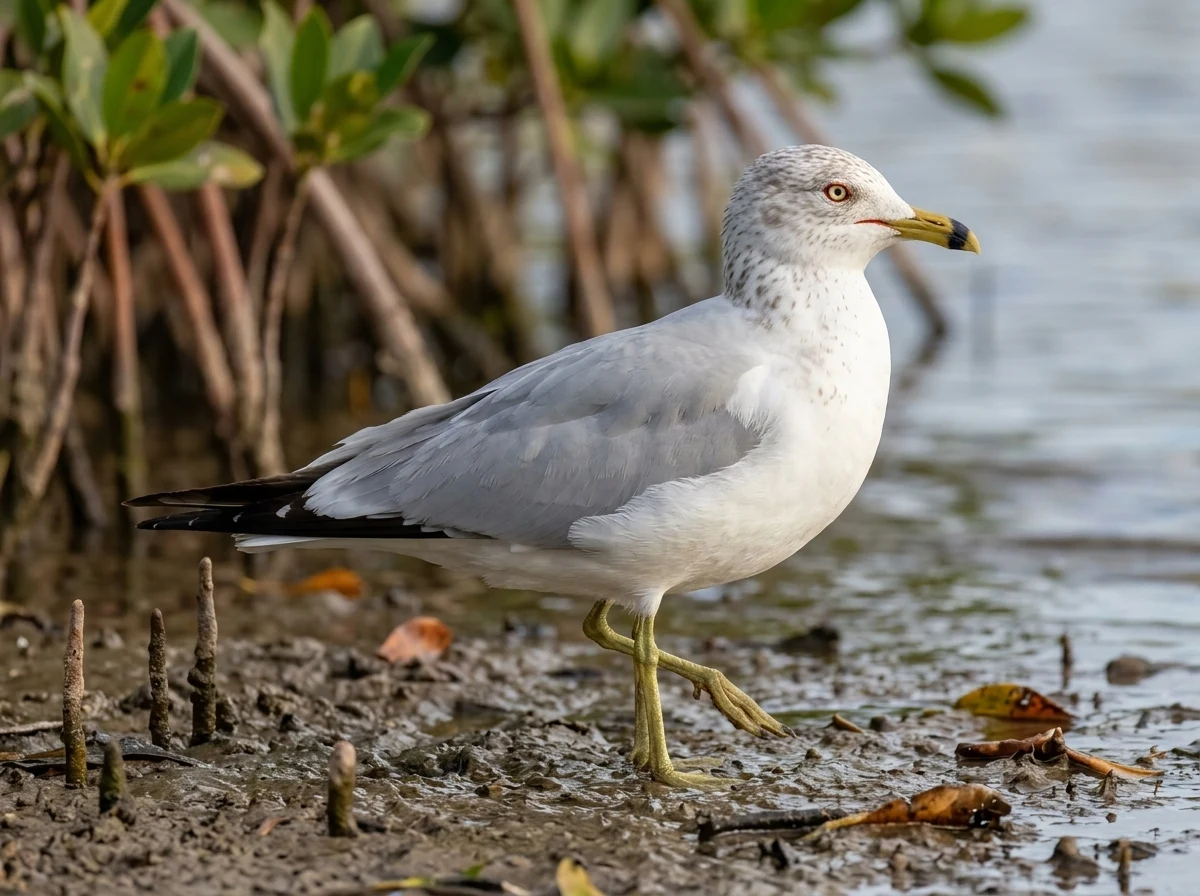 AI
AI01
Does a juvenile Laughing Gull have the black hood?
No. The full black hood belongs to the adult in breeding plumage. Immatures show a brownish or whitish head with dark markings, and their overall pattern is scaly brown at first.
02
Is the dark bill with a red tinge exclusive to the adult?
No. Juveniles also have dark bill and legs. The strong red tinge is associated with the adult, but dark color alone does not separate ages. You must combine bill, head, and back.
03
How long does a juvenile take to look like an adult?
The sources describe first-winter and second-winter stages, plus the nonbreeding adult. It is not a single or immediate change: it is a sequence of molts. That is why an intermediate gull can be an individual in transition.
04
How do I distinguish a juvenile Laughing Gull from a Ring-billed Gull?
The Ring-billed Gull has a pearl-gray back and a black band at the tip of the bill, according to the catalog description. The juvenile Laughing Gull shows a scaly brown pattern and lacks that crisp band. Look at the bill closely and note its shape and pattern.
05
Can I identify a Laughing Gull from a distant photo alone?
Not always. Distance blurs the hood, the back pattern, and the bill detail. If the photo does not resolve those traits, the correct answer is 'undetermined.' A field note with date and place is more useful than a forced identification.
Keep exploring
Connected routes
Sources and review
The evidence is one link away.
These sources support the editorial scope of this guide. Bird profiles also retain their own taxonomy, occurrence, and conservation references.
Reviewed:
01↗02↗03↗
Cornell Lab of Ornithology (Birds of the World)
Plumages, Molts, and Structure — Laughing Gull (Leucophaeus atricilla)
Evidence for cited sections; consult the original document.National Audubon Society
Laughing Gull — Audubon Field Guide
Evidence for cited sections; consult the original document.Wikipedia (citing Avibase/Bird Checklists of the World and eBird Puerto Rico)
List of birds of Puerto Rico
Evidence for cited sections; consult the original document.The atlas continues