 AI
AIIdentification
American Coot vs Common Gallinule
A practical guide to separating two dark wetland birds using the bill, frontal shield, and a few supporting cues.
Reviewed:Prepared with AI assistance and linked sources. Illustrations are not field photographs.
The short answer
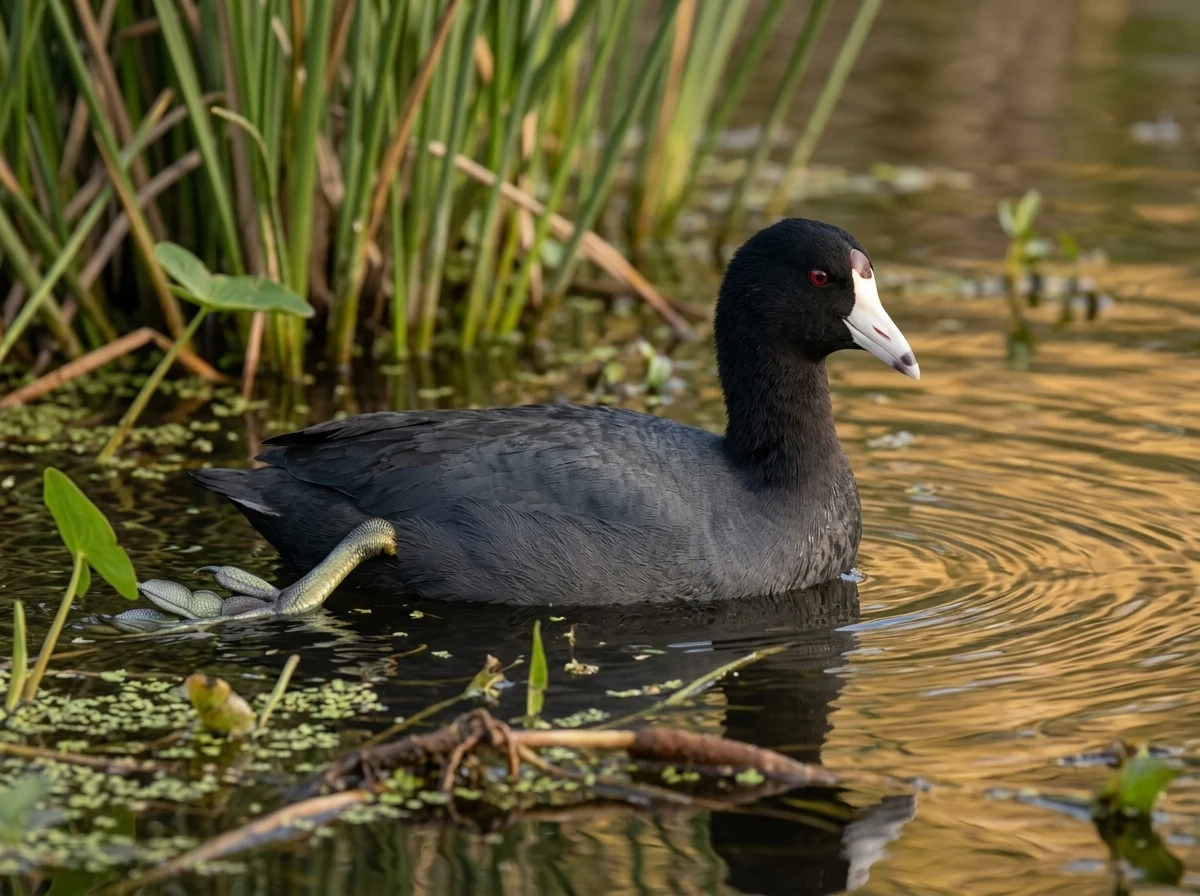
The most direct difference between the American Coot (Fulica americana) and the Common Gallinule (Gallinula galeata) is on the face: the coot has a short, thick white bill with a white frontal shield that usually has a reddish-brown spot near the top of the bill between the eyes. The Common Gallinule has a red frontal shield during the breeding season and a bill that is red at the base and yellow at the tip. That red-and-yellow combination is the fastest cue when the bird is close and well lit.
Both belong to the family Rallidae and can occur in the same wetlands. The gallinule is generally less bold and spends more time hiding in marsh vegetation, while the coot swims more openly and often walks on land. In Puerto Rico, both appear in the project bird catalog as native species; the American Coot entry is marked resident, breeder, and also migrant or vagrant, while the Common Gallinule entry is marked native without those additional categories. Treat that status difference as catalog information, not as an estimate of local abundance.
Identification
Three keys to remember
BlancoCoot bill and shieldShort, thick white bill with a white shield and sometimes a reddish spot near the top.
Rojo y amarilloGallinule billRed base and yellow tip; red frontal shield during the breeding season.
Dos familiasSame family, different lookBoth are Rallidae, but they separate well by face and behavior.
01
Bill and frontal shield: the core comparison
The UF/IFAS source frames this as the most obvious difference: the American Coot has a short, thick white bill and a white frontal shield that usually has a reddish-brown spot near the top of the bill between the eyes. The Common Gallinule has a red shield on the forehead during the breeding season, and its bill is red at the base and yellow at the tip. That matches Audubon's description of the gallinule: a thick bill and frontal shield usually red and yellow, sometimes all yellow or brownish, with greenish legs.
For Audubon, the American Coot is charcoal gray with a blacker head, a white bill, and a white and chestnut frontal shield extending up the forehead. That white-with-chestnut combination is distinct from the gallinule's red and yellow. The Birds Canada / Ontario Breeding Bird Atlas identification guide summarizes adult visual separation this way: gallinules have a red bill with a yellow tip and a face shield extending onto the forehead, while coots have a white bill. That is the rule to memorize first.
02
Supporting cues: tail, feet, and silhouette
If the bill is not visible, other cues help. UF/IFAS notes that the American Coot has small, not very visible white marks on its tail feathers, while the Common Gallinule has a longer, more distinct tail with obvious white markings along the sides of the tail and wing feathers. Audubon also describes a white stripe along the side of the adult gallinule, and a white stripe on the side of immatures, which are paler gray with dull bill and legs.
Feet are another clue. UF/IFAS describes the coot's long, yellow-green toes with two to three fleshy lobes, adapted to push through water and to walk on a variety of surfaces; the gallinule has very long toes that help it walk on top of aquatic vegetation and mucky substrates. Audubon mentions strong legs and big feet with lobed toes for the coot, and greenish legs for the gallinule. In practice, a coot swimming in open water often looks rounder and more visible, while a gallinule moves more among reeds and dense vegetation.
03
When the bird is hidden: voices and caution
Both species are secretive and often heard before seen. Birds Canada / Ontario Breeding Bird Atlas warns that both make a wide variety of complex sounds with overlap, and that identification by sound alone should be done cautiously. According to that source, the gallinule has a long or whinny call, high, descending, and nasal, and also a sharp, nasal, squeaky keek call. The coot's vocalizations are generally more grating and raspy; its long call is a slow series of grating croaks or nasal wails, with individual notes longer and more drawn out.
The same source recommends recording the bird as moorhen/coot/gallinule sp. if unsure, because the information is still valuable. For a Puerto Rico identification guide, that advice is useful: do not force an identification from a single note. Audubon also notes that the gallinule can be found with the coot in many places but requires more marsh growth, which helps anticipate where to look.
04
A wetland observation routine
Before heading out, review each species entry in the project catalog and note what you already know: the American Coot is listed as native, resident, breeder, and also migrant or vagrant; the Common Gallinule is listed as native without those additional categories. That difference does not tell you how common either is at a specific site, but it reminds you not to infer abundance from presence. Carry a notebook or a phone note and write down time, water type, and dominant vegetation.
In the field, follow this sequence: first look for the bill and shield in good light; if the bird is facing away, check the tail and side; if you only hear it, record or describe the call in words before deciding. If the bird swims in open water and shows a white bill with a white shield, it is an American Coot. If it walks on floating vegetation and shows a red bill with a yellow tip, it is a Common Gallinule. If you cannot see the face or confirm the voice, record moorhen/coot/gallinule sp. and return another day. This routine is a suggested method, not an official protocol.
Linked profiles
The two birds in this comparison
Project catalog entries for the American Coot and the Common Gallinule.
AI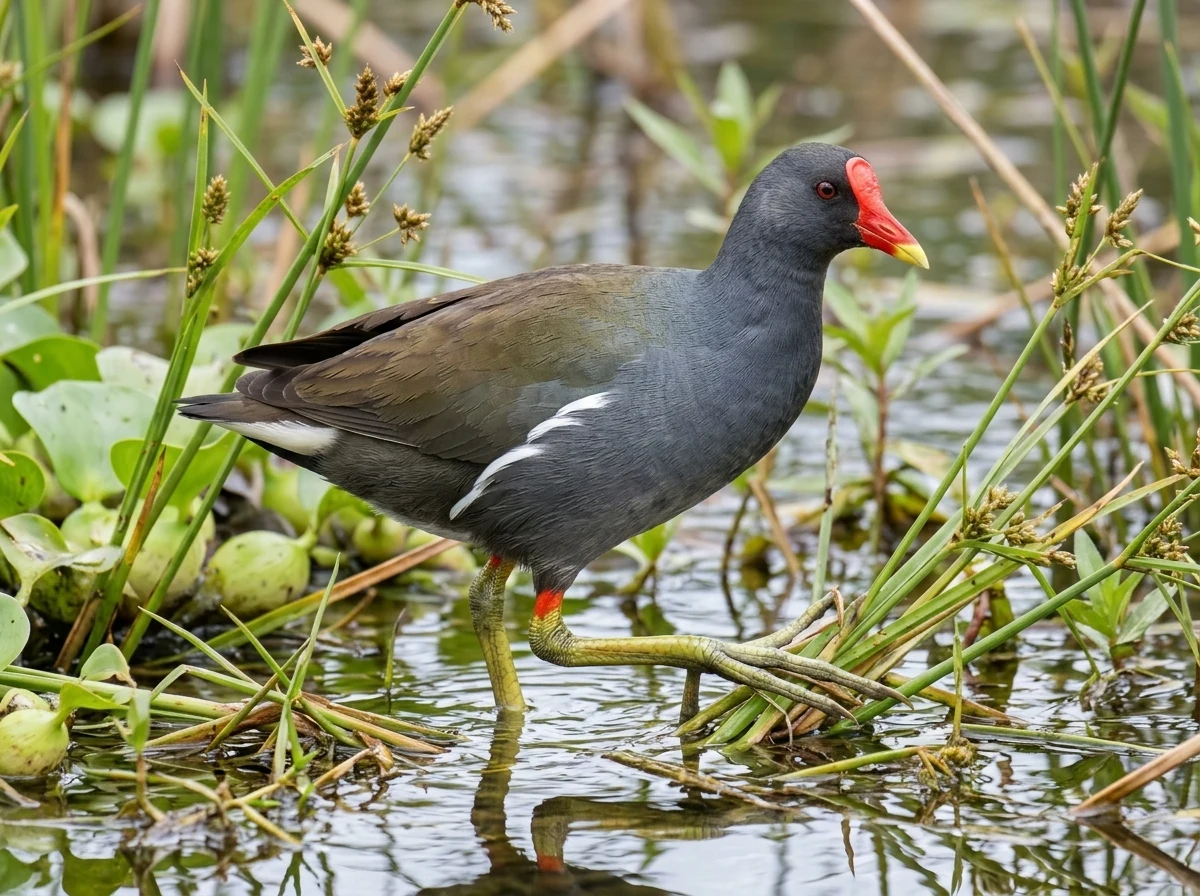 AI
AI01
What is the fastest difference between the American Coot and the Common Gallinule?
The bill and frontal shield. The coot has a white bill and white shield, sometimes with a reddish spot near the top. The gallinule has a bill that is red at the base and yellow at the tip, with a red frontal shield during the breeding season.
02
What other cues help if I cannot see the bill?
Look at the tail and side. The gallinule has a longer tail and obvious white markings along the sides of the tail and wings, plus a white stripe on the side. The coot has small, not very visible white marks on the tail. Feet also help: the coot has lobed toes and the gallinule has very long toes.
03
Can I identify them by sound alone?
With caution. Birds Canada / Ontario Breeding Bird Atlas warns that there is a great deal of overlap in calls. The gallinule has a high, descending, nasal long call and a sharp, squeaky keek call. The coot has more grating and raspy vocalizations, with longer drawn-out croaks or wails. If unsure, record moorhen/coot/gallinule sp.
04
What does the project catalog say about their occurrence in Puerto Rico?
Both are listed as native species. The American Coot is marked resident, breeder, and also migrant or vagrant. The Common Gallinule is marked native without those additional categories. That status information should not be used to infer local abundance.
05
Where are they most likely to be seen together?
Audubon notes that the gallinule can be found with the coot in many places but requires more marsh growth. Look for wetlands with open water and also dense vegetation along the edges. The coot uses a wider variety of aquatic habitats outside the breeding season.
Keep exploring
Connected routes
Sources and review
The evidence is one link away.
These sources support the editorial scope of this guide. Bird profiles also retain their own taxonomy, occurrence, and conservation references.
Reviewed:
01↗02↗03↗04↗
UF/IFAS Extension Pinellas County (University of Florida)
American Coot or Common Gallinule?
Evidence for cited sections; consult the original document.National Audubon Society
Common Gallinule | Audubon Field Guide
Evidence for cited sections; consult the original document.National Audubon Society
American Coot | Audubon Field Guide
Evidence for cited sections; consult the original document.Birds Canada / Ontario Breeding Bird Atlas
Atlas Identification Challenges – American Coot vs. Common Gallinule
Evidence for cited sections; consult the original document.The atlas continues