 AI
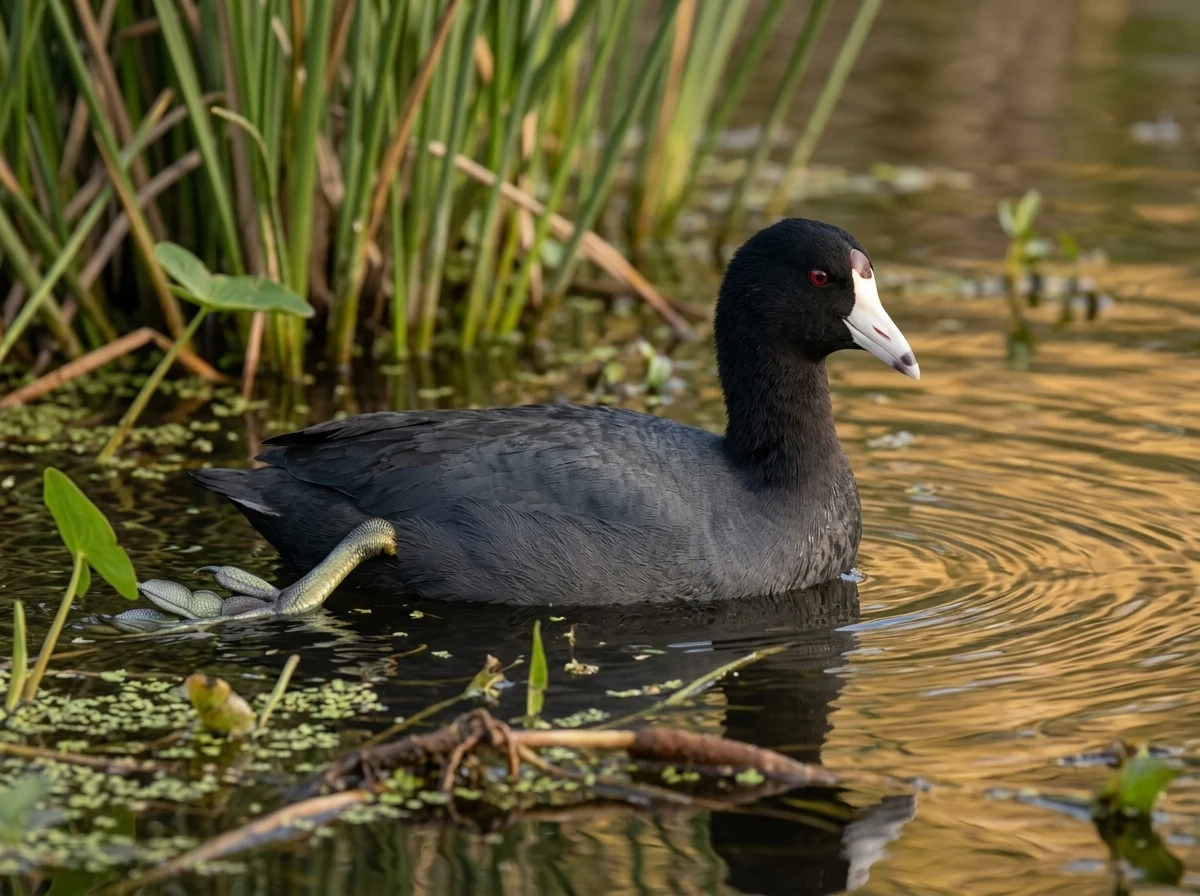
AIAI reconstruction created with Nano Banana 2 · 1K, grounded in the profile’s documented taxonomy, habitat, natural-history sources, and an open-license visual reference when available. It is an interpretive image, not documentary evidence. Image policy →
American Coot
Gallinazo Caribeño
Fulica americana
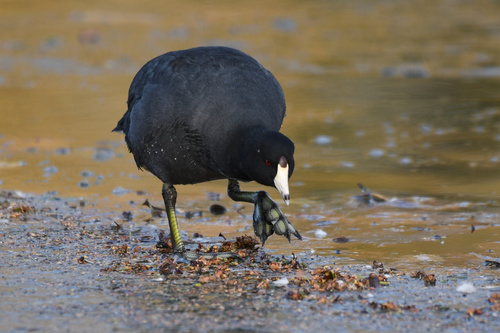
The American coot (Fulica americana), also known as a mud hen or pouldeau, is a bird of the family Rallidae. Though commonly mistaken for ducks, American coots are only distantly related to ducks, belonging to a separate order. Unlike the webbed feet of ducks, coots have broad, lobed scales on their lower legs and toes that fold back with each step to facilitate walking on dry land. Coots live near water, typically inhabiting wetlands and open water bodies in North America. Groups of coots are called covers or rafts. The oldest known coot lived to be 22 years old. The American coot is a migratory bird that occupies most of North America. It lives in the Pacific and southwestern United States and Mexico year-round and occupies more northeastern regions during the summer breeding season. In the winter they can be found as far south as Panama. Coots generally build floating nests and lay 8–12 eggs per clutch. Females and males have similar appearances, but they can be distinguished during aggressive displays by the larger ruff (head plumage) on the male. American coots eat primarily algae and other aquatic plants but also animals (both vertebrates and invertebrates) when available. The American coot is closely related to the Eurasian coot (Fulica atra), which occupies the same ecological niche in Eurasia and Australia as the American coot does in North America. Eurasian coots can be distinguished from this species by the absence of a red callus above the bird's frontal shield. The American coot is listed as "Least Concern" under the IUCN conservation ratings. Hunters generally avoid killing American coots because their meat is not as sought after as that of ducks. American coots display several interesting breeding habits; mothers will preferentially feed offspring with the brightest plume feathers, which has resulted in coot chicks having brightly ornamented plumage which becomes drabber as they age. American coots are also susceptible to conspecific brood parasitism and have evolved mechanisms to differentiate their offspring from those of parasitic females.
Sound archive
Hear its voice
Explore real songs and calls. The spectrogram turns each sound into a visual trace of time and frequency.

Play: call by Greg Irving
Choose another recording
Sound recorded by Greg Irving · XC1040189 · CC BY-NC-SA 4.0. Visualization by Stichting Xeno-canto voor Natuurgeluiden.
Every recording retains the creator, catalogue number, and license published by Xeno-canto. Metadata via GBIF ↗
Island profile
About the American Coot
This atlas includes American Coot (Fulica americana) with atlas status “Resident” within scope “Avibase inferred core 380.” Puerto Rico context sources associate it with Freshwater marshes; reservoirs; lagoons.
Conservation
Least Concern
IUCN LC; DNER VU
- Global IUCN
- LC
- Puerto Rico DNER
- VU
- Federal ESA
- No current listing in source crosswalk
- Critical habitat
- Not identified in source crosswalk
Natural history
How it lives
- Habitat
- Freshwater marshes; reservoirs; lagoons
- Elevation
- 0–2500 m
- Nest
- Platform · Water
- Clutch
- 6–15 eggs
- Social behavior
- Not resolved
Keep exploring
This bird belongs to 8 paths through the atlas.
Guides featuring this bird
Follow this record beyond the profile.
Identification, sound, place, and explanatory guides connecting this species to larger questions.
See all related guides (2)
Related in the atlas
Where to fly next
Connected by taxonomy, habitat, occurrence, and conservation.
 AI
AI AI
AI AI
AI AI
AI AI
AI AI
AI
Evidence trail
Sources, media & further reading
Research note: Legal sources retain Fulica caribaea; many current global lists lump Caribbean Coot into Fulica americana