 AI
AIIdentification
American Kestrel vs Merlin
Two small falcons that can overlap in Puerto Rico. Learn to separate them with observable criteria and a clear procedure.
Reviewed:Prepared with AI assistance and linked sources. Illustrations are not field photographs.
Two Small Falcons, Two Different Strategies
The American Kestrel (Falco sparverius) and the Merlin (Falco columbarius) are two small falcons that can overlap in Puerto Rico. The kestrel is a breeding resident across much of its American range and also has migratory populations; in the Caribbean, BirdsCaribbean notes that resident island forms are joined in winter by migrants of the northern subspecies. The Merlin, by contrast, is a compact, fast falcon that breeds in the northern forests of North America and Eurasia and, according to Audubon, mostly migrates, with some northern birds reaching South America.
In the Puerto Rico bird catalog, the kestrel is listed as a native species of natural occurrence, while the Merlin is listed as native with accidental or vagrant occurrence. That status difference should not be turned into a claim about abundance: what matters for identification is that both can appear and that their features allow separation with careful observation. This guide focuses on those features and on a field procedure, not on how many there are or exactly where.
Identification
Three Keys to Tell Them Apart
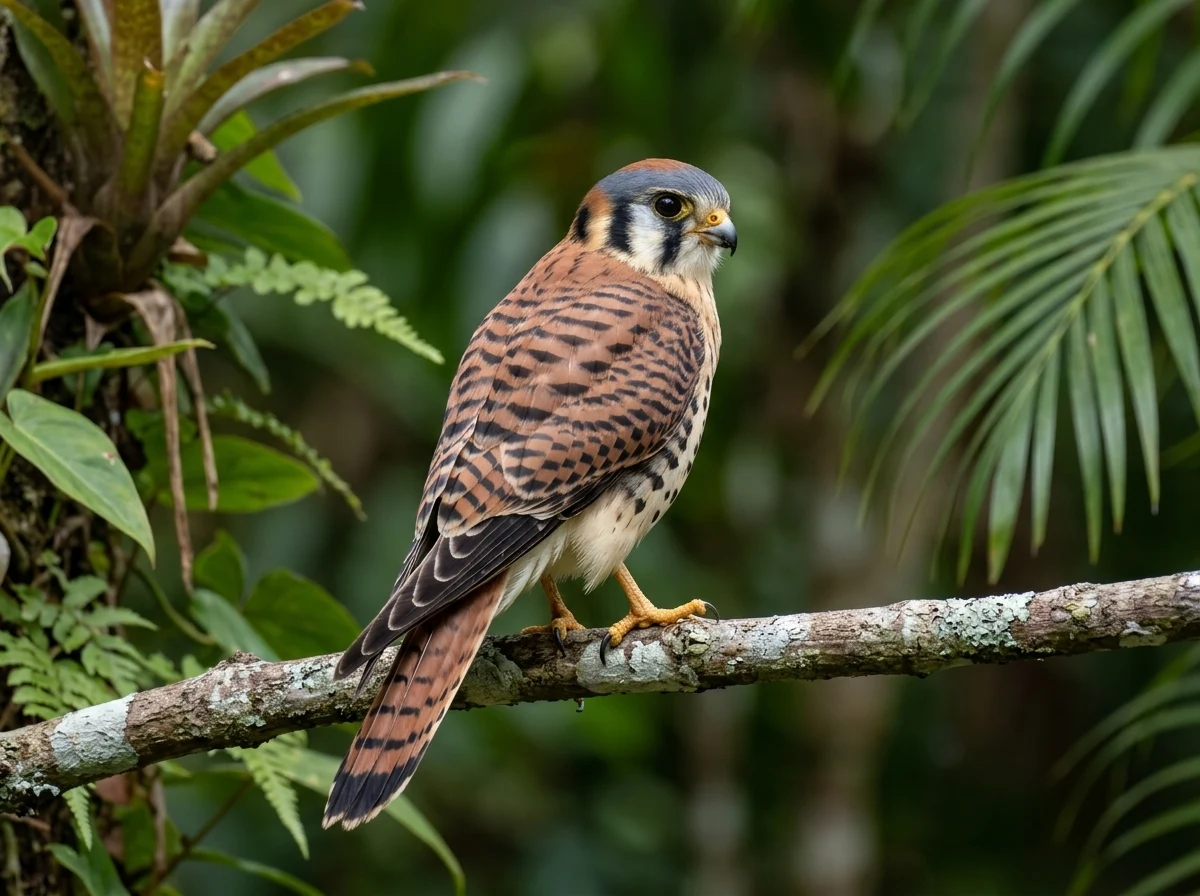
Cernícalo: colorido y cola largaKestrel patternMales with rufous back and tail and slate-blue wings; both sexes with black facial marks and dark spots on the nape.
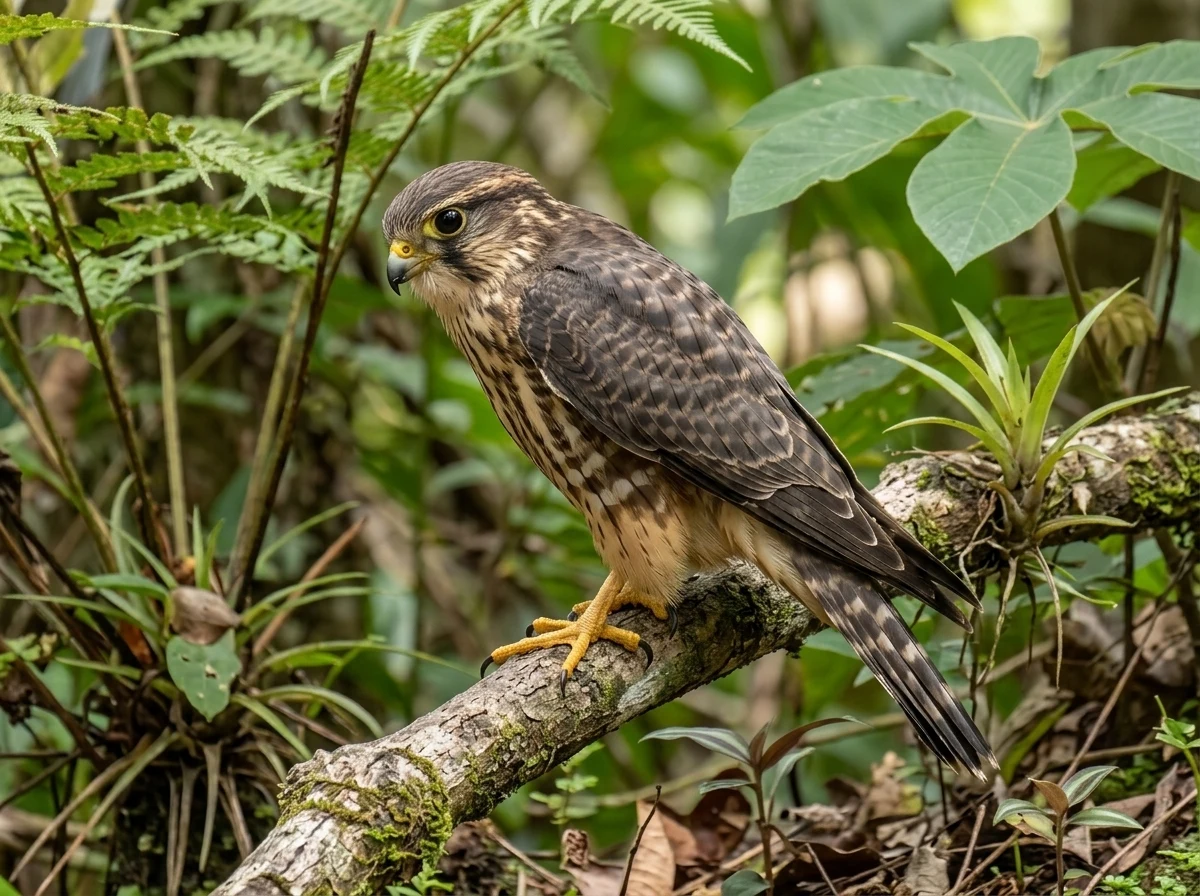
Merlin: compacto y de cola cortaMerlin silhouetteRelatively short-tailed; female and immature brown above, male blue-gray, all streaked below with narrow whitish bands on the dark tail.
Tamaño y proporciónSize comparisonThe Merlin measures 25–36 cm with a wingspan of about 58 cm; the kestrel is a small falcon, often described as about the size of a Mourning Dove or smaller.
01
What the Sources Say About Each Species
Audubon describes the Merlin as a rather small falcon, compact and fast-flying, a common breeder across the northern forests of North America and Eurasia. It feeds mostly on small birds, which it captures in mid-air in rapid pursuit. The same source notes that most Merlins migrate, that some northern birds reach South America, and that the Pacific Northwest form is mostly a permanent resident. As for appearance, Audubon states that it is relatively short-tailed, that the female and immature are brown above, that the male is blue-gray above, and that all are streaked below with a dark tail crossed by narrow whitish bands.
BirdsCaribbean presents the American Kestrel as North America’s smallest falcon and one of the most widespread raptors in the Western Hemisphere. It describes males with warm rusty backs and tails contrasting with slate-blue wings, and females as reddish-brown above with dark barring. Both sexes have pale underparts with brownish spotting, distinctive black vertical slashes on the sides of the face — a “mustache” and a “sideburn” — and two black spots or “false eyes” on the back of the head. The same source notes that males sport a single black tail band, while females show multiple bars.
02
Direct Comparison: Five Observable Traits
First, size and proportion. The Merlin measures 25–36 cm with a wingspan of about 58 cm, according to Audubon. The kestrel is a small falcon; BirdsCaribbean describes it as roughly the size of a Mourning Dove. In the field, that proportional difference is most noticeable in the tail: the Merlin is relatively short-tailed, while the kestrel usually appears longer- and narrower-tailed.
Second, color pattern. The male kestrel combines a rufous back and tail with slate-blue wings, a striking combination the Merlin does not share. The male Merlin is blue-gray above, without the rufous contrast of wings and back. Female and immature Merlins are brown above and streaked below, with pale bands on the dark tail. Female kestrels are reddish-brown above with dark barring and show multiple bars on the tail.
Third, the face. The kestrel has black vertical facial marks — mustache and sideburn — and two black spots on the nape that function as “false eyes.” The Merlin lacks that double facial pattern and those nape spots; its head is more uniform and compact.
Fourth, the tail. In the kestrel, the male shows a single black band and the female several bars. In the Merlin, the tail is dark and crossed by narrow whitish bands, according to Audubon. That pattern difference is useful when the bird is perched or gliding.
Fifth, flight and hunting. The Merlin is a fast flier that pursues small birds in the air; Audubon notes that it often hunts by watching from a perch and then flying out to capture prey in the air, and that it seldom dives steeply from above. The kestrel, according to BirdsCaribbean, prefers a “sit-and-wait” style from wires or posts, and is also skilled at hover-hunting, hanging in mid-air while scanning below.
03
Field Observation Procedure
When you see a small falcon perched on a wire, a post, or an open branch, start with the tail and silhouette. Ask yourself: does the tail look long and narrow, or short and compact? Does the body seem slender or more stout? That first impression guides the comparison before the bird flies.
Next, review the color pattern calmly. If it is a male, look for the rufous-and-slate-blue contrast of the kestrel or the uniform blue-gray of the Merlin. If it is a female or a young bird, note whether the back is reddish-brown with dark barring or brown with streaking below. Then observe the face: the presence of a mustache, sideburn, and nape spots points to the kestrel; their absence points to the Merlin.
If the bird flies, note how it does so. The Merlin actively pursues and captures prey in the air; the kestrel may hover in mid-air or launch from a perch. If you can see the tail in flight, count the bands: one black band on the male kestrel, several bars on the female, and narrow whitish bands on a dark tail in the Merlin.
A useful exercise is to draw or write in a notebook with three columns: tail, face, and flight. For each bird observed, mark what you see and leave blank what you cannot confirm. At the end of the outing, compare your notes with the descriptions from Audubon and BirdsCaribbean. This habit prevents hasty conclusions and trains observation.
04
Occurrence in Puerto Rico and What Not to Conclude
The Puerto Rico bird catalog lists the American Kestrel as a native species of natural occurrence, and the Merlin as a native species with accidental or vagrant occurrence. That status information is not a measure of abundance or a prediction of where to see them. Nor does it authorize saying the Merlin is a resident or breeder in Puerto Rico: the catalog does not mark it as resident or breeder, and Audubon describes it as a breeder of northern forests that mostly migrates.
BirdsCaribbean notes that resident forms of the kestrel on some Caribbean islands are joined in winter by migrants of the northern subspecies. That observation is general to the Caribbean and should not be turned into a claim about specific months or specific Puerto Rico locations. What can be stated with the available sources is that both species can overlap and that the described traits allow separation.
For the observer, the practical consequence is simple: do not assume every small falcon you see is the same species. Check tail, face, color, and flight, and document what you can. If the observation is brief or doubtful, it is better to leave it as “small falcon unidentified” than to force an identification.
Linked profiles
The Two Species in the Catalog
Reference profiles for the American Kestrel and the Merlin.
01
What is the quickest difference between the kestrel and the Merlin?
The tail and silhouette. The Merlin is relatively short-tailed and compact; the kestrel usually appears longer- and narrower-tailed. If you also see the color pattern, the male kestrel has a rufous back and tail with slate-blue wings, while the male Merlin is blue-gray above.
02
Is the Merlin a resident in Puerto Rico?
The Puerto Rico bird catalog lists it as a native species with accidental or vagrant occurrence, and does not mark it as resident or breeder. Audubon describes it as a breeder of northern forests that mostly migrates. Therefore, it should not be presented as a resident or breeder in Puerto Rico.
03
How do I identify the kestrel by the face?
BirdsCaribbean notes that both sexes of the kestrel have black vertical facial marks — a “mustache” and a “sideburn” — and two black spots or “false eyes” on the nape. The Merlin lacks that double facial pattern and those nape spots.
04
What difference is there in the tail?
In the kestrel, the male shows a single black tail band and the female shows multiple bars. In the Merlin, the tail is dark and crossed by narrow whitish bands, according to Audubon.
05
How do they hunt, and how does that look in the field?
The Merlin often hunts by watching from a perch and then pursuing and capturing small birds in the air; it seldom dives steeply from above. The kestrel prefers a “sit-and-wait” style from wires or posts and can also hover in mid-air while scanning the ground.
06
Can I conclude a small falcon is a Merlin just because it is migratory?
No. The kestrel also has migratory populations and, in the Caribbean, resident forms are joined in winter by northern migrants. Identification should be based on observable traits — tail, face, color, and flight — not on the assumption that every migratory bird is a Merlin.
Keep exploring
Connected routes
Sources and review
The evidence is one link away.
These sources support the editorial scope of this guide. Bird profiles also retain their own taxonomy, occurrence, and conservation references.
Reviewed:
The atlas continues