 AI
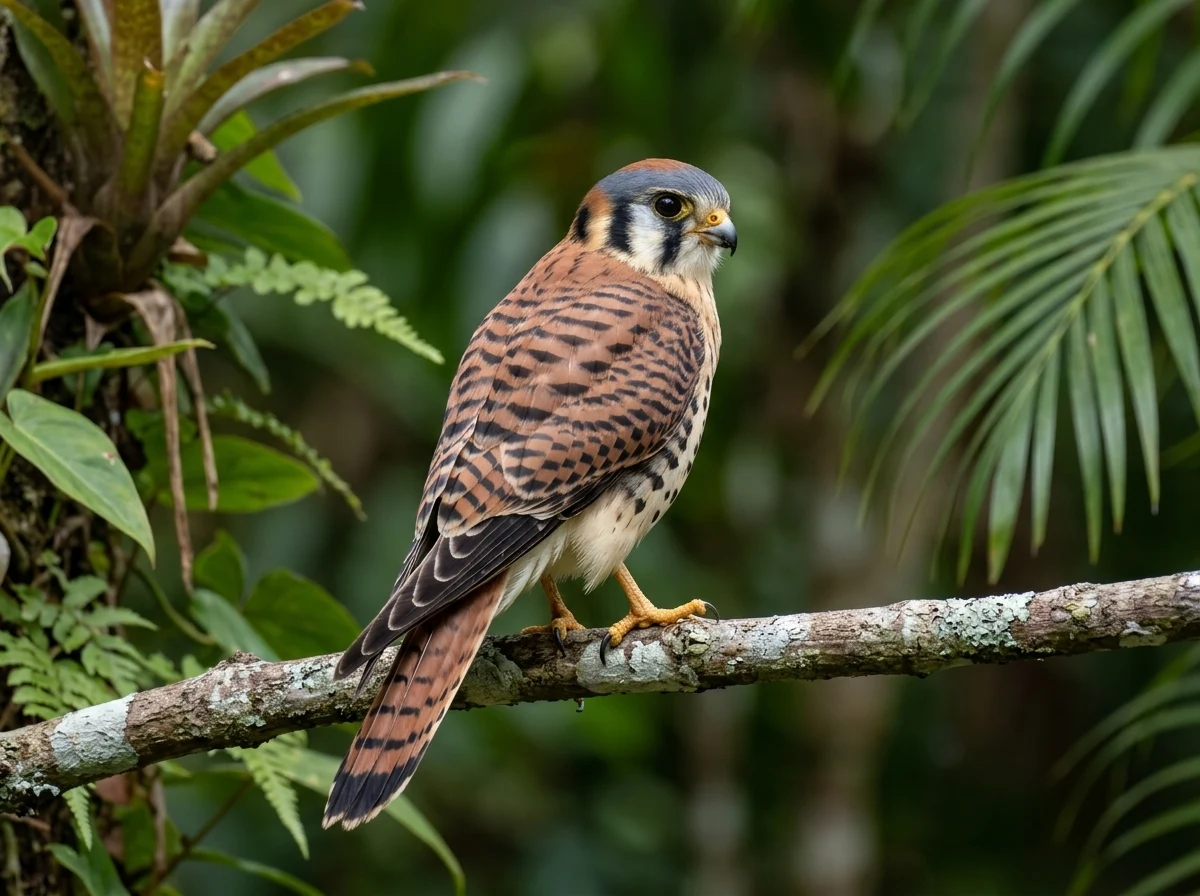
AIAI reconstruction created with Nano Banana 2 · 1K, grounded in the profile’s documented taxonomy, habitat, natural-history sources, and an open-license visual reference when available. It is an interpretive image, not documentary evidence. Image policy →
American Kestrel
Falcón Común
Falco sparverius
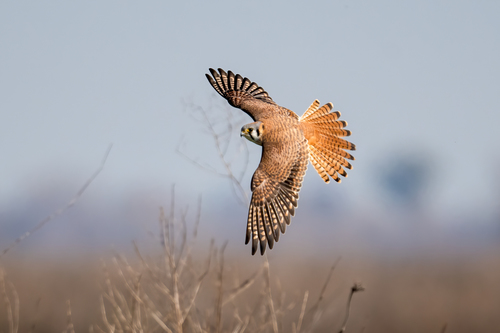
The American kestrel (Falco sparverius) is the smallest and most common falcon in North America. Though it has been called the American sparrowhawk, this common name is a misnomer; the American kestrel is a true falcon, while neither the Eurasian sparrowhawk nor the other species called sparrowhawks are in the Falconidae family, hence only very distantly related to the American kestrel. It has a roughly two-to-one range in size over subspecies and sex, varying in size from about the weight of a blue jay to a mourning dove. It also ranges to South America and is a well-established species that has evolved into 17 subspecies adapted to different environments and habitats throughout the Americas. It exhibits sexual dimorphism in size (females being moderately larger) and plumage, although both sexes have a rufous back with noticeable barring. Its plumage is colorful and attractive, and juveniles are similar in plumage to adults. The American kestrel usually hunts in energy-conserving fashion by perching and scanning the ground for prey to ambush, though it also hunts from the air. It sometimes hovers in the air with rapid wing beats while homing in on prey. Its diet typically consists of grasshoppers and other insects, lizards, mice, and small birds (e.g. sparrows). This broad diet has contributed to its wide success as a species. It nests in cavities in trees, cliffs, buildings, and other structures. The female lays three to seven eggs, which both sexes help to incubate. Its breeding range extends from central and western Alaska across northern Canada to Nova Scotia, and south throughout North America, into central Mexico and the Caribbean. It is a local breeder in Central America and is widely distributed throughout South America. Most birds breeding in Canada and the northern United States migrate south in the winter. It is an occasional vagrant to Western Europe. Based on appearance and behavior it was for many years considered a member of the primarily European and African kestrel clade within the genus Falco, but DNA analysis shows the American kestrel to actually be genetically more closely related to the larger American falcons such as the peregrine, aplomado, and prairie falcons. Though the species has not been renamed as a result of these genetic analyses, it is not actually a kestrel in the phylogenetic sense. Instead, a process of convergent evolution to fit a similar small prey niche in the ecosystem as the true kestrels have left it with similar physical characteristics and hunting methods. The American kestrel is a common bird used in falconry, especially by beginners. Though not as strong a flyer as many other, larger falcons, proper training and weight control by the falconer allows many American kestrels to become effective hunters of birds in the size range of sparrows and starlings, with occasional success against birds up to approximately twice their own weight.
Sound archive
Hear its voice
Explore real songs and calls. The spectrogram turns each sound into a visual trace of time and frequency.

Play: song by JAYRSON ARAUJO DE OLIVEIRA
Choose another recording
Sound recorded by JAYRSON ARAUJO DE OLIVEIRA · XC1101990 · CC BY-NC-SA 4.0. Visualization by Stichting Xeno-canto voor Natuurgeluiden.
Every recording retains the creator, catalogue number, and license published by Xeno-canto. Metadata via GBIF ↗
Island profile
About the American Kestrel
This atlas includes American Kestrel (Falco sparverius) with atlas status “Native / natural occurrence” within scope “Avibase inferred core 380.” Global trait data associate it primarily with woodland; consult the linked records to resolve its Puerto Rico habitat use.
Conservation
Least Concern
IUCN LC
- Global IUCN
- LC
- Puerto Rico DNER
- No current listing in source crosswalk
- Federal ESA
- No current listing in source crosswalk
- Critical habitat
- Not identified in source crosswalk
Natural history
How it lives
- Habitat
- forests
- Elevation
- 0–4000 m
- Nest
- Tree cavity; Other bird's nest · Building; Ground; Rock; Tree
- Clutch
- 1–7 eggs
- Social behavior
- Solitary
For kids and families
Turn this bird into your own artwork
Download a clean, print-ready coloring page, learn one quick fact, and color this Puerto Rico bird.
Keep exploring
This bird belongs to 5 paths through the atlas.
Guides featuring this bird
Follow this record beyond the profile.
Identification, sound, place, and explanatory guides connecting this species to larger questions.
Related in the atlas
Where to fly next
Connected by taxonomy, habitat, occurrence, and conservation.
 AI
AI AI
AI AI
AI AI
AI AI
AI AI
AI
Evidence trail