 AI
AIBird identification
Blue-winged Teal vs Northern Shoveler
Two surface-feeding ducks that can share shallow wetlands. Learn to separate them by silhouette, bill, color, and behavior, and distinguish what we know about their occurrence in Puerto Rico from their global biology.
Reviewed:Prepared with AI assistance and linked sources. Illustrations are not field photographs.
Why they get confused and how to resolve it
The Blue-winged Teal (Spatula discors) and the Northern Shoveler (Spatula clypeata) are surface-feeding ducks that can forage in shallow water and share wetlands during migration. Both show a blue wing patch visible in flight, enough for a beginner to confuse them at a distance or in poor light.
Separation does not depend on a single feature. The shoveler's bill is large and spatulate, while the teal's bill is shorter and more like that of other surface-feeding ducks. Size, body shape, head pattern, and feeding behavior provide complementary clues. This guide answers the specific question of how to tell them apart and clarifies which evidence applies to Puerto Rico and which applies to their general biology.
Bird identification
Three keys to remember
PicoThe first markThe shoveler has a large, spatulate bill; the teal has a shorter, less conspicuous bill.
TamañoDifferent silhouetteThe teal is a small duck; the shoveler is larger and more heavily built.
Ala azulShared, not diagnosticBoth show a blue wing patch in flight; use it as a clue, not as sole proof.
01
Bill and shape: the most direct difference
The Northern Shoveler owes its name to its large, spatulate bill, adapted to straining food from water. Audubon's source describes that many dabbling ducks use their flat bills to strain food items from the water, but the shoveler's bill takes this habit to the extreme. In the field, that broad, flattened shape is often visible even at moderate distance, especially when the bird swims with its bill near the surface.
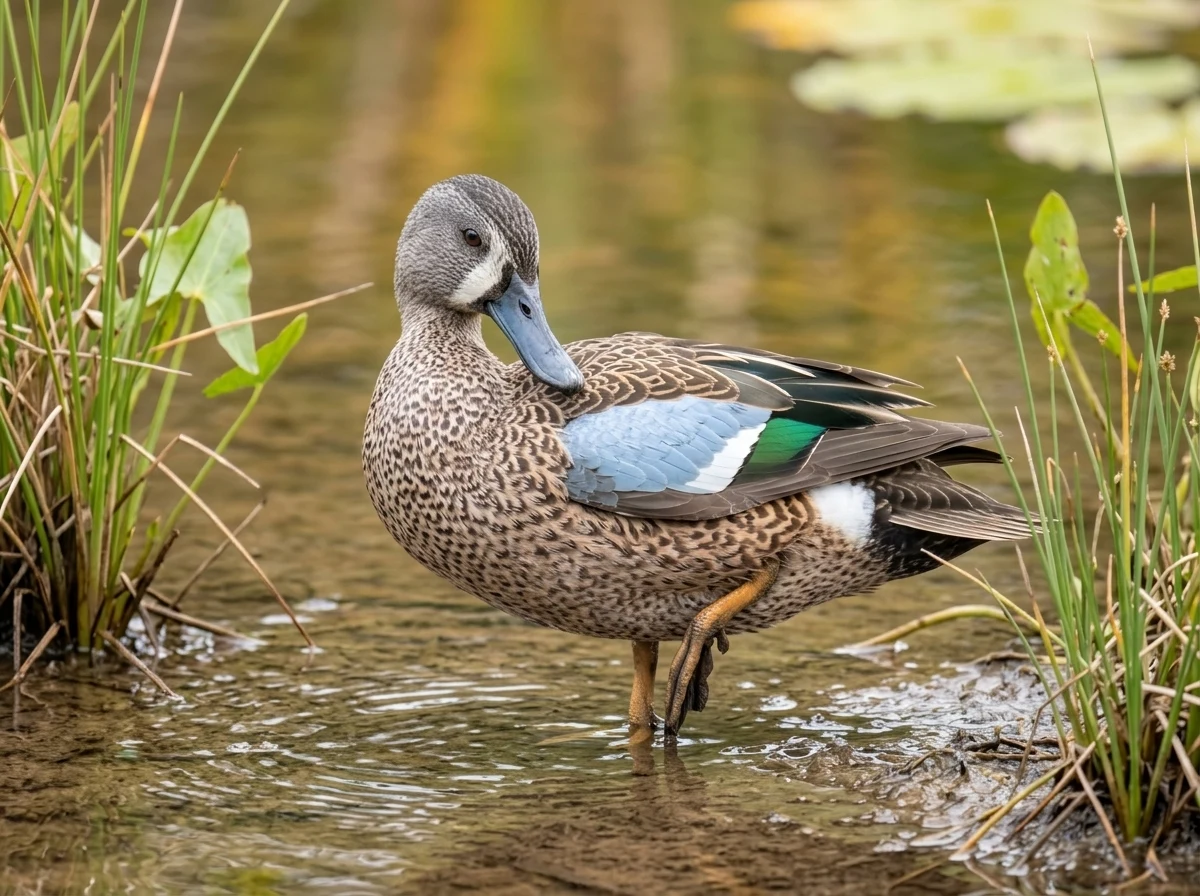
The Blue-winged Teal has a shorter, less broad bill. The U.S. Fish and Wildlife Service source notes that its head is round and its bill appears large compared to the head, but it does not reach the spatulate shape of the shoveler. That combination of a round head and a relatively short bill helps separate it when size is not obvious.
02
Size, body, and flight
The teal is a small duck. The U.S. Fish and Wildlife Service source describes it as among the smallest of the dabbling ducks, with a length of 14.2 to 16 inches (36 to 41 cm) and a wingspan of 22 to 24.4 inches (56 to 62 cm). Audubon gives a slightly different range: length 15.7 to 16.9 inches (40 to 43 cm) and wingspan 23 inches to 2 feet 1 inch (58 to 64 cm). These differences reflect variation among sources, not a contradiction to resolve in the field.
The shoveler is larger and more heavily built. Audubon reports a length of 17 to 21 inches (44 to 53 cm), a wingspan of 2 feet 3 inches to 2 feet 9 inches (66 to 84 cm), and a weight of 1 pound 2 ounces to 2 pounds 2 ounces (510 g to 1 kg). In flight, both show a blue wing patch, but the shoveler usually looks more corpulent and longer-winged. The teal, by contrast, is compact and fast, often flying in flocks that twist and turn in unison.
03
Plumage and head patterns
The male Blue-winged Teal in spring has a white crescent on a gray face. Audubon notes that in fall many males are in drab eclipse plumage and look like the female. The U.S. Fish and Wildlife Service source describes the male with a very prominent white facial crest between the bill and eye, brown-spotted breast and flanks, a pale blue shoulder patch, and a black rear end. The female has a dark eye line, mottled brown body, and a duller pale blue shoulder patch.
The male Northern Shoveler has a green head, white chest, and rusty sides; the female is mottled brown with a big gray and orange bill. Audubon also mentions that a molting male may show a pale face crescent. That crescent should not be confused with the teal's: in the shoveler it appears in the context of a green head and a heavier body, while in the teal it combines with a gray face and a small body.
04
Feeding and behavior on the water
The shoveler forages mainly by swimming slowly forward with its bill skimming the surface or with its head partly submerged, often swinging the bill from side to side to sift food from muddy water. Audubon notes that it seldom up-ends and rarely feeds on land. That image of a duck with an enormous bill sweeping the water is one of the most useful behavioral clues.
The teal also forages in very shallow water, but its method is more about gleaning items from the surface or swimming with its head partly submerged. Audubon notes that it seldom up-ends and seldom feeds away from water. The U.S. Fish and Wildlife Service adds that it prefers small wetlands and shallow areas with mudflats during fall migration, and can be found on almost any shallow water body, including flooded fields and coastal marshes.
05
What the catalog says about Puerto Rico
The Puerto Rico bird catalog records the Blue-winged Teal as a native or natural occurrence, non-resident and non-breeding within the catalog's scope. The Northern Shoveler appears as native or natural, non-resident and non-breeding, but also flagged as migratory or vagrant and accidental. That difference in status matters: the shoveler should not be presented as a regular bird of Puerto Rico without proper qualification.
The eBird source for the teal in Puerto Rico could not be read because the page displayed a bot-protection mechanism. Therefore, it is not used as evidence of abundance, seasonality, or localities. The global biology descriptions from Audubon and the U.S. Fish and Wildlife Service should not be interpreted as local records. To learn when and where these species have been reported in Puerto Rico, consult eBird or other occurrence databases directly and verify the date and locality of each record.
Linked profiles
The two species in the catalog
Blue-winged Teal and Northern Shoveler: recorded status and main traits according to the catalog and sources.
AI AI
AI01
What is the quickest difference between Blue-winged Teal and Northern Shoveler?
The bill. The shoveler has a large, spatulate bill adapted to straining food from water. The teal has a shorter, less broad bill. If the bill is not visible, use size and body shape: the teal is small and compact; the shoveler is larger and heavier.
02
Do both have the blue wing patch?
Yes. Audubon notes that the teal's blue wing patch stands out in flight, and also describes an obvious blue wing patch in flight for the shoveler. So wing color alone is not enough: combine it with bill, size, and head pattern.
03
Is the Northern Shoveler common in Puerto Rico?
The catalog records it as native or natural, non-resident and non-breeding, but also as migratory or vagrant and accidental. That combination requires qualification: it should not be described as a regular or abundant bird in Puerto Rico without specific local evidence. Consult current occurrence records to assess its presence.
04
Can I use feeding behavior to identify them?
Yes, as a complementary clue. The shoveler often swims with its bill skimming the surface or partly submerged, swinging it from side to side. The teal also forages in shallow water, but its method is more about gleaning items from the surface or swimming with its head partly submerged. Neither frequently up-ends.
05
Where can I verify local records of these species?
Consult eBird or other occurrence databases and review the date, locality, and observer of each record. In this guide, the eBird page for the teal in Puerto Rico could not be read due to bot protection, so it is not used as evidence of local abundance or seasonality.
Keep exploring
Connected routes
Sources and review
The evidence is one link away.
These sources support the editorial scope of this guide. Bird profiles also retain their own taxonomy, occurrence, and conservation references.
Reviewed:
01↗02↗03↗04↗
National Audubon Society
Blue-winged Teal | Audubon Field Guide
Evidence for cited sections; consult the original document.National Audubon Society
Northern Shoveler | Audubon Field Guide
Evidence for cited sections; consult the original document.U.S. Fish and Wildlife Service
Blue-winged Teal (Anas discors) | U.S. Fish & Wildlife Service
Evidence for cited sections; consult the original document.eBird (Cornell Lab of Ornithology)
Blue-winged Teal Spatula discors — Puerto Rico
Evidence for cited sections; consult the original document.The atlas continues