 AI
AIIdentification
Cattle Egret Juvenile vs Adult Plumage
How to recognize a juvenile or adult Cattle Egret without confusing it with other white herons.
Reviewed:Prepared with AI assistance and linked sources. Illustrations are not field photographs.
Introduction
The Western Cattle-Egret (Ardea ibis) is a white, gregarious, upland heron easily recognized by its association with grazing animals and its exaggerated, head-pumping strut. The central question of this guide is how to distinguish juvenile from adult plumage, a topic that often causes confusion because both ages are predominantly white.
The key lies in concrete details: bill color, leg color, iris color, and the presence or absence of breeding plumes. This guide focuses on that specific question and does not repeat the general species profile. The main sources are the Birds of the World account (Cornell Lab of Ornithology), the New York Natural Heritage Program conservation guide, and the Houston Audubon bird gallery.
Identification
Key facts
Blanco con corona anteJuvenile plumageJuveniles are all white except for a light tan-colored crown on top of the head.
Pico y patas negrosJuvenileThe juvenile's bill and legs are black; the iris is yellow.
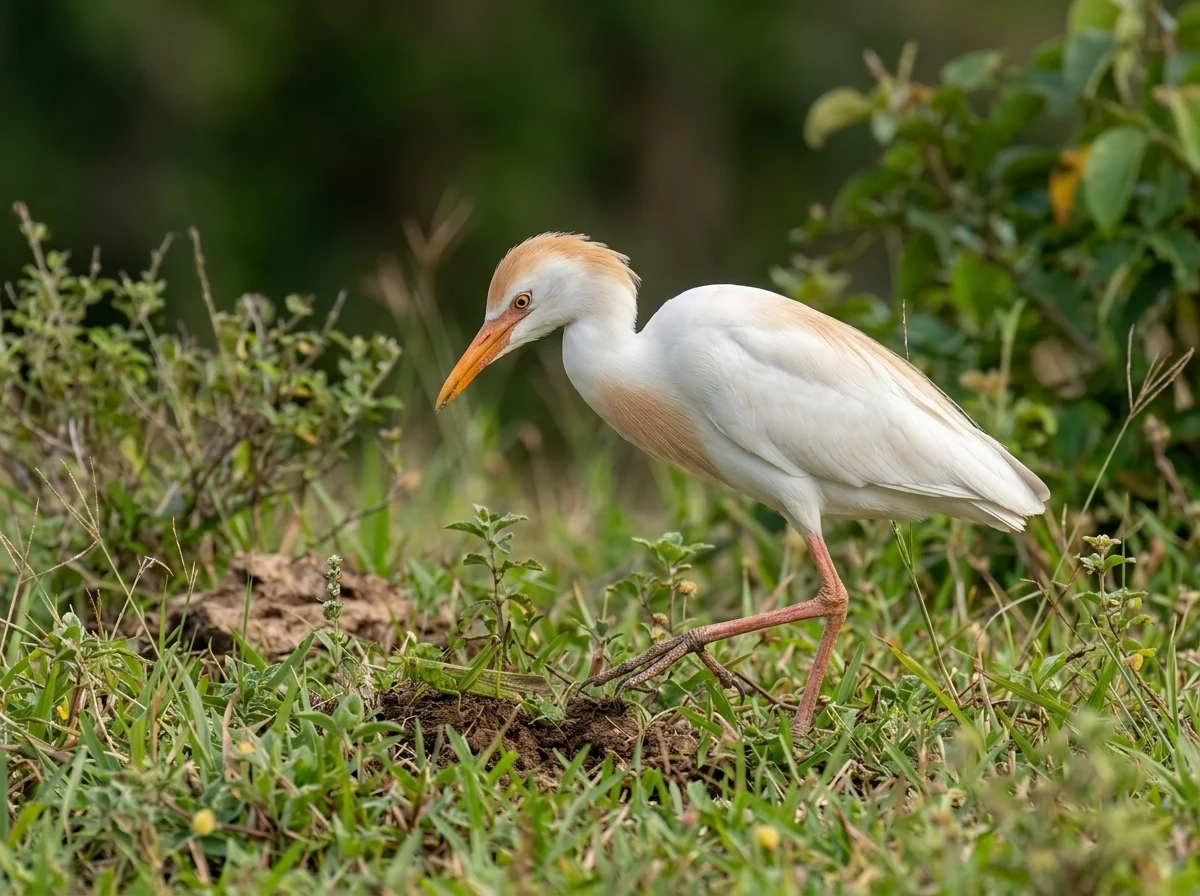
Pico naranja-rojizoBreeding adultWhen breeding, the bill turns orange-red and the legs become yellow-green or reddish.
01
What changes between a juvenile and an adult
The juvenile Cattle Egret is mostly white but shows a light tan-colored crown on top of its head. Its bill and legs are black, and its iris is yellow. These features separate it from non-breeding adults, which are mostly white with a pinkish-orange crest, yellow bill and iris, and dark green legs.
The breeding adult is more striking: it develops salmon-colored plumes on the breast, crest, and back. The iris becomes deep yellow, the bill turns orange-red, and the legs change to yellow-green and even deep red for a brief time. These differences are the basis for separating ages in the field.
02
How to observe them without confusion
Cattle Egrets are usually seen in fields, pastures, and lawns, often following cattle, tractors, or mowers. Their posture is stocky and their neck is short and thick compared with other herons. When observing one, focus first on the bill: if it is black and the bird has a tan crown, it is likely a juvenile. If the bill is yellow or orange-red and there are salmon plumes, it is an adult.
The legs also help: juveniles have black legs, while non-breeding adults have dark green legs and breeding adults have yellow-green or reddish legs. The iris, though harder to see at a distance, goes from yellow in the juvenile to deep yellow in the breeding adult. The combination of these traits is more reliable than a single character.
03
Comparison with the Snowy Egret
The Snowy Egret (Egretta thula) has a longer, slimmer neck, a black bill, and black legs with yellow feet. The Cattle Egret, in contrast, has a shorter, thicker neck, and the bill is usually yellow or orange-red in adults. Juvenile Cattle Egrets have black bills, which can be confused with Snowy Egret, but the tan crown and black legs without yellow feet help distinguish them.
In addition, Cattle Egrets tend to appear stockier and have a more rapid wing beat in flight. Snowy Egrets usually frequent shallow water, while Cattle Egrets prefer fields and pastures. These differences in behavior and habitat are useful identification clues.
04
Field checklist
Before heading out, review this mental checklist: 1) Is the bill black, yellow, or orange-red? 2) Is there a tan crown on the head? 3) Are the legs black, dark green, or yellow-green? 4) Are there salmon plumes on the breast, crest, or back? 5) Is the bird in a pasture or near cattle? 6) Is the neck short and thick?
During observation, note the date and location, and if possible take a photo or short video. Seasonal variation in adult plumage means that a bird without salmon plumes could be a non-breeding adult or a juvenile. The combination of bill, legs, crown, and iris is the safest way to decide.
Linked profiles
Bird covered
Western Cattle-Egret (Ardea ibis)
AI01
How do I distinguish a juvenile from a non-breeding adult?
The juvenile has a black bill and black legs, and a light tan crown. The non-breeding adult has a yellow bill, yellow iris, dark green legs, and a pinkish-orange crest. The combination of a black bill and tan crown is the key for juveniles.
02
Do juveniles have salmon plumes?
No. Salmon plumes on the breast, crest, and back are characteristic of breeding adults. Juveniles are white with a tan crown and do not develop those plumes.
03
Can I confuse a juvenile Cattle Egret with a Snowy Egret?
Yes, because both have black bills. But the Snowy Egret has black legs with yellow feet and a longer, slimmer neck. The juvenile Cattle Egret has black legs without yellow feet, a tan crown, and a stockier posture.
04
When is it easiest to identify an adult?
Identification is easiest when the adult is in breeding plumage, with salmon plumes, an orange-red bill, and yellow-green or reddish legs. Outside the breeding season, adults are mostly white and can be confused with other herons.
Keep exploring
Connected routes
Sources and review
The evidence is one link away.
These sources support the editorial scope of this guide. Bird profiles also retain their own taxonomy, occurrence, and conservation references.
Reviewed:
01↗02↗03↗
Cornell Lab of Ornithology
Field Identification — Western Cattle-Egret (Ardea ibis), Birds of the World
Evidence for cited sections; consult the original document.New York Natural Heritage Program
Western Cattle-Egret — Online Conservation Guide for Ardea ibis
Evidence for cited sections; consult the original document.Houston Audubon Society
Cattle Egret — Bird Gallery
Evidence for cited sections; consult the original document.The atlas continues