 AI
AIIdentification
Common Ground Dove vs Zenaida Dove
Two small doves that walk on the ground, but with clear differences in size, color, and habitat. Here is how to tell them apart calmly.
Reviewed:Prepared with AI assistance and linked sources. Illustrations are not field photographs.
Two Doves, Two Scales
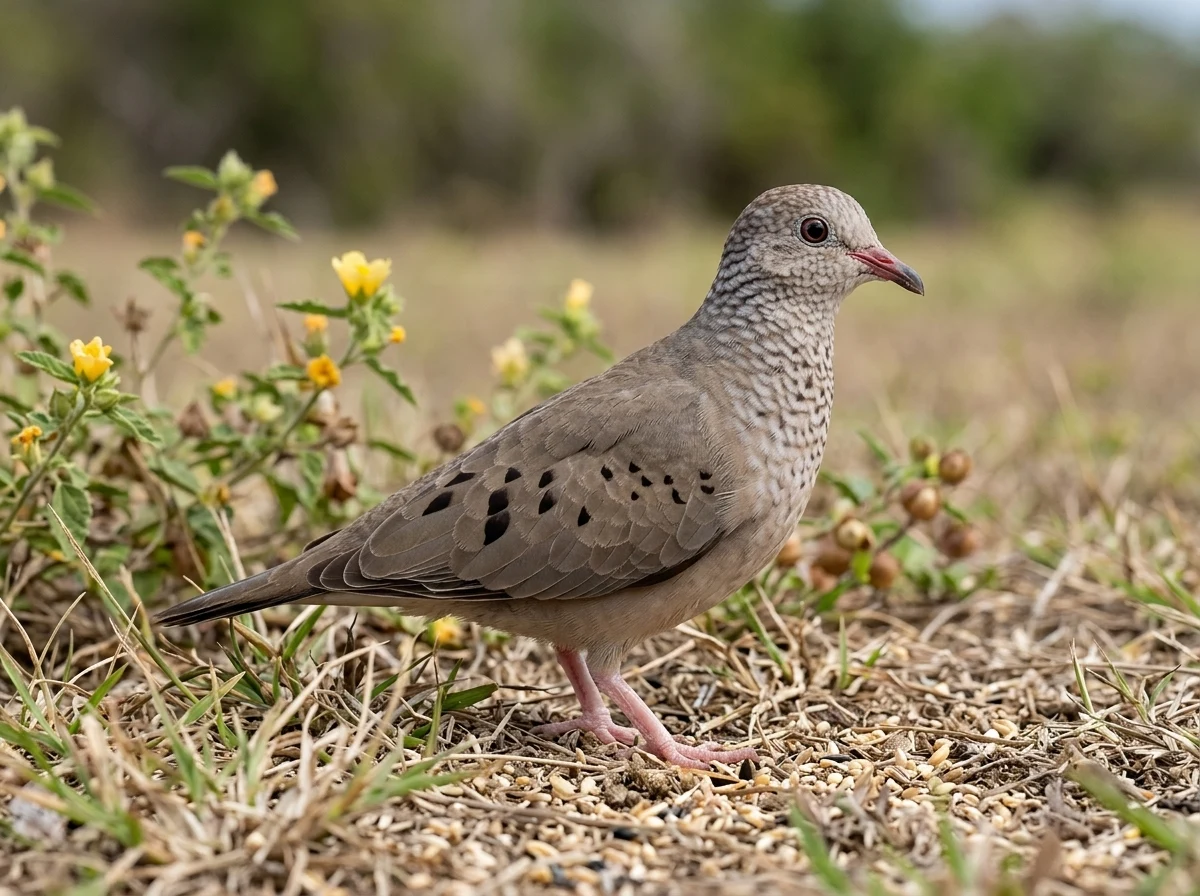
The Common Ground Dove (Columbina passerina) and the Zenaida Dove (Zenaida aurita) are two columbids that occur together in Puerto Rico and are often seen walking on the ground. The first is a very small dove with a short tail and scaly plumage; the second is larger, brown-toned, and has a white band on the wing edge that is visible even when perched. Telling them apart does not require a perfect view: size, tail, and chest pattern are enough.
This guide addresses the direct comparison between the two species. It is not a general profile of each, but an identification exercise focused on the traits that separate them in the field. Puerto Rico occurrence is taken from the bird catalog and local references; abundance is not inferred and no specific visits are described. The main sources are the Zenaida Dove account in Birds of the World and the Common Ground Dove account in Audubon.
Identification
Key Points at a Glance
PequeñaCommon Ground DoveLength 15–18 cm; short black tail with pale corners.
MedianaZenaida DoveBrown bird with purple neck gloss and white wing band.
SueloShared HabitBoth forage on the ground, but the Common Ground Dove is more strictly terrestrial.
01
Size and Silhouette: The First Clue
The Common Ground Dove is a tiny dove. Audubon gives a length of 15–18 cm, a wingspan of 23–28 cm, and a weight of 30–40 g. Its tail is short, and in flight it shows a black pattern with pale corners. The Zenaida Dove is clearly larger: Birds of the World describes it as a medium-sized brown dove with purple gloss on the neck sides and a terminal white band on the outer secondaries. That white band is visible both when the wing is folded and when it is open, which distinguishes it from other doves.
In practice, if the bird looks the size of a large sparrow or a small thrush, it is a Common Ground Dove. If it looks like a medium-sized dove with a longer, more proportionate tail, it is a Zenaida Dove. The mass difference is notable: the catalog records about 32.5 g for the Common Ground Dove and 151.5 g for the Zenaida Dove. That weight difference translates into a more compact, lighter silhouette in the Common Ground Dove and a more robust presence in the Zenaida Dove.
02
Plumage: Scales, Gloss, and White Band
The Common Ground Dove has a scaly pattern on the chest and head, with a pink base to the bill. Audubon notes that the sexes are similar in size and general pattern, though the adult male shows pinkish tones on the head, neck, and chest, a smooth pink belly, and a blue nape; the female and juveniles are lighter gray. In flight, the wings show bright rusty red and the short black tail has pale corners. The wings make a soft rattling sound on takeoff. The scaly pattern is distinctive, but remember that juvenile Mourning Doves can also appear scaly and short-tailed at first; therefore, size and the pink bill base should be used together.
The Zenaida Dove is brown overall, with purple gloss on the neck sides and black spots on the secondaries, rectrices, and below the ear coverts. Its most useful feature is the terminal white band on the outer secondaries, visible with the wing folded or open. Birds of the World also mentions that it resembles the Mourning Dove (Zenaida macroura) and the Eared Dove (Zenaida auriculata), but the white band separates it from both. To distinguish it from the Common Ground Dove, the contrast is even greater: the Common Ground Dove has no purple gloss or white wing band, and its scaly pattern is characteristic.
03
Habitat and Ground Behavior
Both species forage on the ground, but with nuances. The Common Ground Dove inhabits dry woodlands, scrub, grasslands, farms, and urban edges; the local catalog describes it as terrestrial and associated with open habitats with low brush and grass. Audubon notes that it walks on the ground in open, bushy places and that if startled it flies into the brush with a rattling of wings. The Zenaida Dove, according to Birds of the World, is found in open woodland and clearings, and feeds both in trees and on the ground, taking fruits and seeds. It also obtains salt from natural or artificial sources.
The Common Ground Dove's nest may be on the ground, in shrubs, or in low trees, and it generally lays two eggs. The Zenaida Dove nests in trees or shrubs and, where predators are few, in rock crevices or directly on the ground; its clutch may be one to three eggs. These differences reinforce the ecological separation: the Common Ground Dove is smaller and more tied to the ground and low vegetation, while the Zenaida Dove uses the arboreal layer more and has a more frugivorous diet. In Puerto Rico, both are recorded as native in the catalog, but their relative abundance is not inferred.
04
Field Exercise: Separating Them in Four Steps
When you see one of these doves on the ground, follow this procedure. First, assess size relative to nearby objects: if it is the size of a large sparrow, it is a Common Ground Dove; if it is clearly larger, it is a Zenaida Dove. Second, look at the tail: the Common Ground Dove's is short and black with pale corners; the Zenaida Dove's is longer and more proportionate. Third, check the chest pattern: scaly in the Common Ground Dove, smooth with purple neck gloss in the Zenaida Dove. Fourth, if the bird flies, note the wings: the Common Ground Dove shows rusty red and a soft rattle; the Zenaida Dove shows a terminal white band on the outer secondaries.
You can practice with a checklist in your field notebook: (1) relative size, (2) tail length and color, (3) chest and neck pattern, (4) wing color in flight, (5) immediate habitat (open ground with low brush versus forest edge or tree). You do not need to capture or touch the bird. If the observation is brief, write down what you saw and return another day. Consistency improves identification. For context on other Puerto Rico doves and pigeons, see the pigeons and doves guide and the small birds guide.
Linked profiles
The Two Species
Profiles of the Common Ground Dove and Zenaida Dove with their distinguishing traits.
AI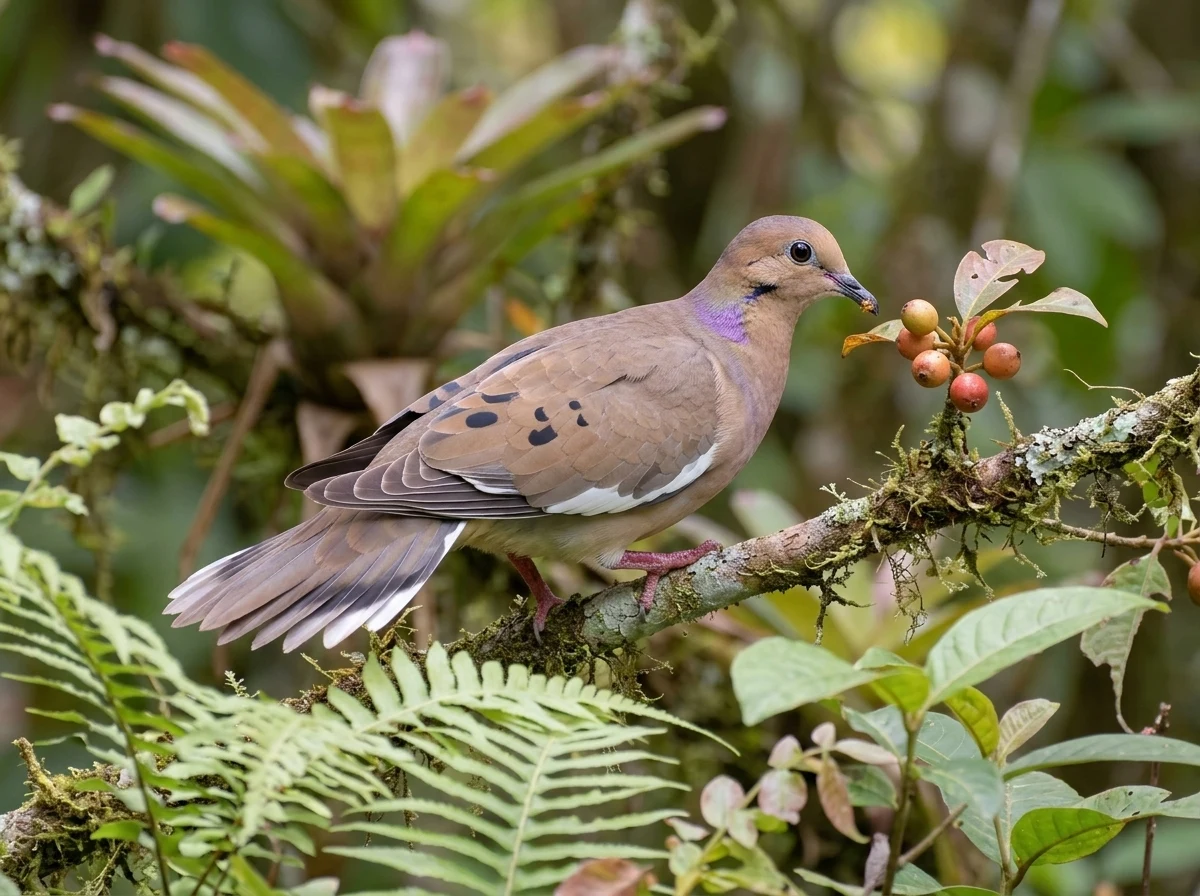 AI
AI01
Which is smaller, the Common Ground Dove or the Zenaida Dove?
The Common Ground Dove is much smaller. Audubon gives 15–18 cm in length and 30–40 g in weight, while the catalog records about 151.5 g for the Zenaida Dove. That size difference is the first clue for telling them apart.
02
What trait distinguishes the Zenaida Dove from other doves?
The terminal white band on the outer secondaries, visible with the wing folded or open. Birds of the World mentions it as the trait that separates it from the Mourning Dove and the Eared Dove. It also has purple gloss on the neck sides.
03
Do both walk on the ground?
Yes. The Common Ground Dove is more strictly terrestrial and is associated with open habitats with low brush. The Zenaida Dove also forages on the ground, but it also feeds in trees and uses the arboreal layer more.
04
Can I confuse the Common Ground Dove with a sparrow?
By size, it may look like a large sparrow, but its scaly pattern, pink bill base, short black tail with pale corners, and rusty-red wing flash with a soft rattle on takeoff are traits a sparrow does not have.
05
Are these species native to Puerto Rico?
The catalog records the Common Ground Dove as native, resident, and breeder in Puerto Rico. It records the Zenaida Dove as native, with occurrence in the archipelago, without asserting that it is resident. Abundance is not inferred from these data.
Keep exploring
Connected routes
Sources and review
The evidence is one link away.
These sources support the editorial scope of this guide. Bird profiles also retain their own taxonomy, occurrence, and conservation references.
Reviewed:
The atlas continues