 AI
AILook-alike birds
Gray Kingbird vs. Loggerhead Kingbird
Two kingbirds of the same genus, the same size, and the same habit of hunting from an exposed perch. Three marks separate them almost every time.
Reviewed:Check the head, the tail, and the place.
To tell a Gray Kingbird from a Loggerhead Kingbird in Puerto Rico, look at the head and tail: the Gray Kingbird (Pitirre, Tyrannus dominicensis) is pale gray above with a dark mask and a notched tail with no white band, while the Loggerhead Kingbird (Clérigo, Tyrannus caudifasciatus) has a black head, dark gray back, and a square tail tipped with a pale band. Gray Kingbirds own the wires and open spaces; Loggerheads favor forest clearings and edges.
Both are residents, both breed on the island, and both measure about 23 cm, so size is almost useless. This guide focuses only on the comparison: which marks work at distance, where each one usually sits, how they sound, and which mistakes are most common when one of them turns up outside its typical setting.
Look-alike birds
The two kingbirds in numbers
23 cmlength of bothThe breeding atlas gives 23 cm for both species; size does not separate them.
91 % vs. 51 %atlas hexagonsGray Kingbird appeared in 436 of 479 hexagons; Loggerhead in 243.
3key marksHead color, tail shape and tip, and habitat.
01
The head: gray mask or black cap
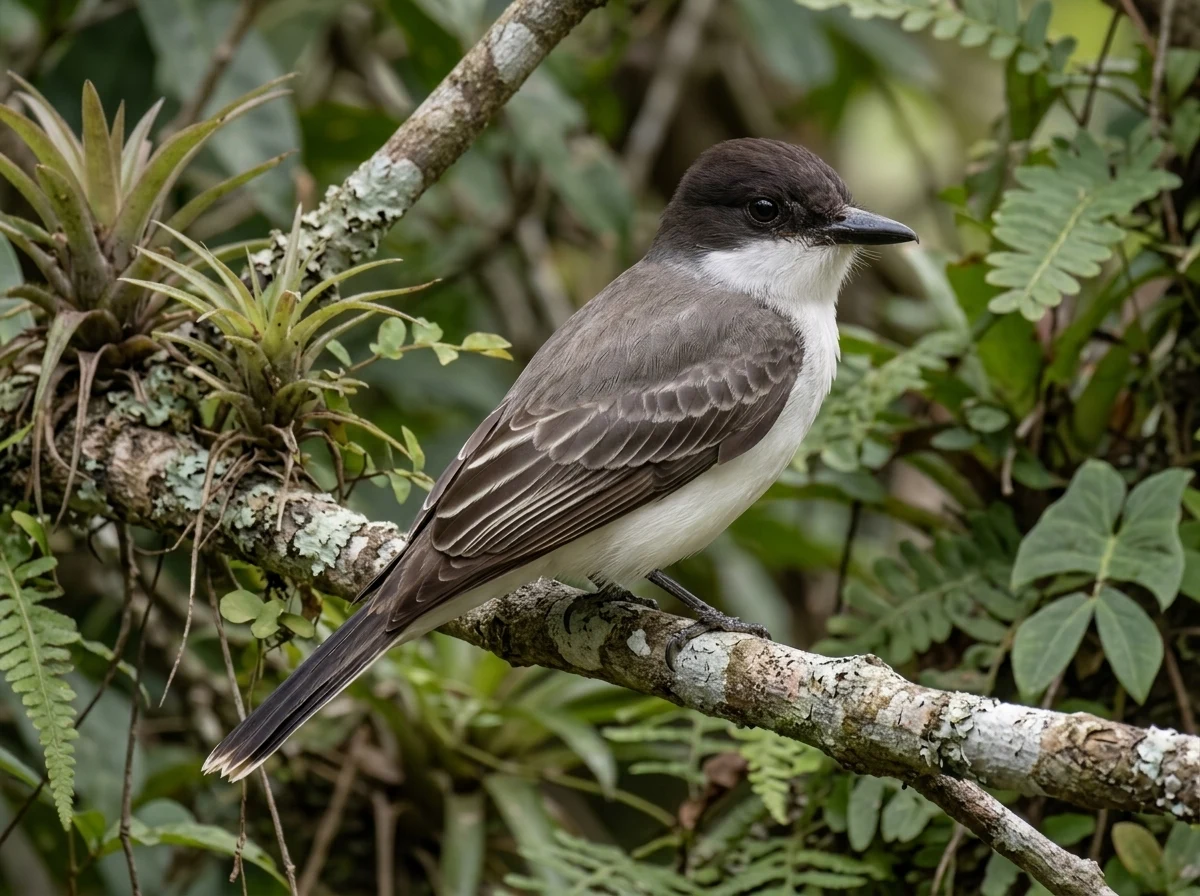
The Gray Kingbird has a pale gray crown and back, with a dark stripe running through the eye like a mask. The rest of the face looks pale and the breast is white with a faint gray wash. The bill is black, long, and heavy for a bird of its size.
The Loggerhead Kingbird trades the mask for a cap: the whole top of the head is black and contrasts with a white throat and cheeks. The back is dark gray, darker than a Gray Kingbird's. Both hide a colored crown patch that is rarely visible in the field, so do not rely on it.
02
The tail: notched, or square with a pale band
The tail is the easiest mark to confirm in a photo. A Gray Kingbird's tail ends in a shallow notch or fork and has no white band. If the photo shows the bird from behind or in flight, that notch is often visible even when the head is in shadow.
A Loggerhead Kingbird's tail is square and ends in a buffy-white band. That pale tip is behind its scientific name, caudifasciatus, meaning banded tail. When the bird perches facing away, the band shows as a pale edge at the end of a dark tail.
03
Where each one lives
The Gray Kingbird is one of Puerto Rico's most visible residents. It uses open country, parks, forest edges, and urban areas, and nests in trees, shrubs, and human-made structures. In the breeding atlas it appeared in 91% of hexagons, with breeding confirmed in 73% of them; it is the kingbird of power lines and roadside posts.
The Loggerhead Kingbird is a forest-edge bird: clearings and edges, shade coffee, dry and wet woodlands, and mangroves. It is common in clearings at Maricao State Forest, in the haystack hills of the northern karst, and in the lower forests of the Sierra de Luquillo, but it is rare in the San Juan metropolitan area. A dark-headed kingbird on a city-avenue post deserves a second look before you log it as a Loggerhead.
04
Voice and behavior
The Gray Kingbird carries its voice in its name: a loud rolling trill, pipiri pipiri, which gave rise to the names pitirre and pestigre. It calls from high, exposed perches, sallies out for flying insects, and returns. It defends its territory boldly and attacks intruders that come near the nest.
The Loggerhead Kingbird also hunts from exposed perches, but its diet adds small fruit and small lizards. Pairs call constantly during courtship with rattles and other loud notes, and adults defend the nest aggressively. That is why territorial behavior is not enough: both attack intruders, and the species must be confirmed by head and tail.
05
Nesting season
Published reports place Gray Kingbird nesting between April and June, with an open nest of twigs. The atlas found activity throughout the year, peaking in May and June. A Gray Kingbird carrying twigs to a utility pole or a backyard tree in those months is a very common sight.
The Loggerhead Kingbird builds a cup nest of twigs, stems, and grasses in a tree or shrub. It nests mostly from February to July, though activity has been noted from November to January; the atlas found the peak in May. If you find a nest, watch from a distance: adults may abandon it if disturbed.
06
Common mistakes and the Puerto Rican Loggerhead question
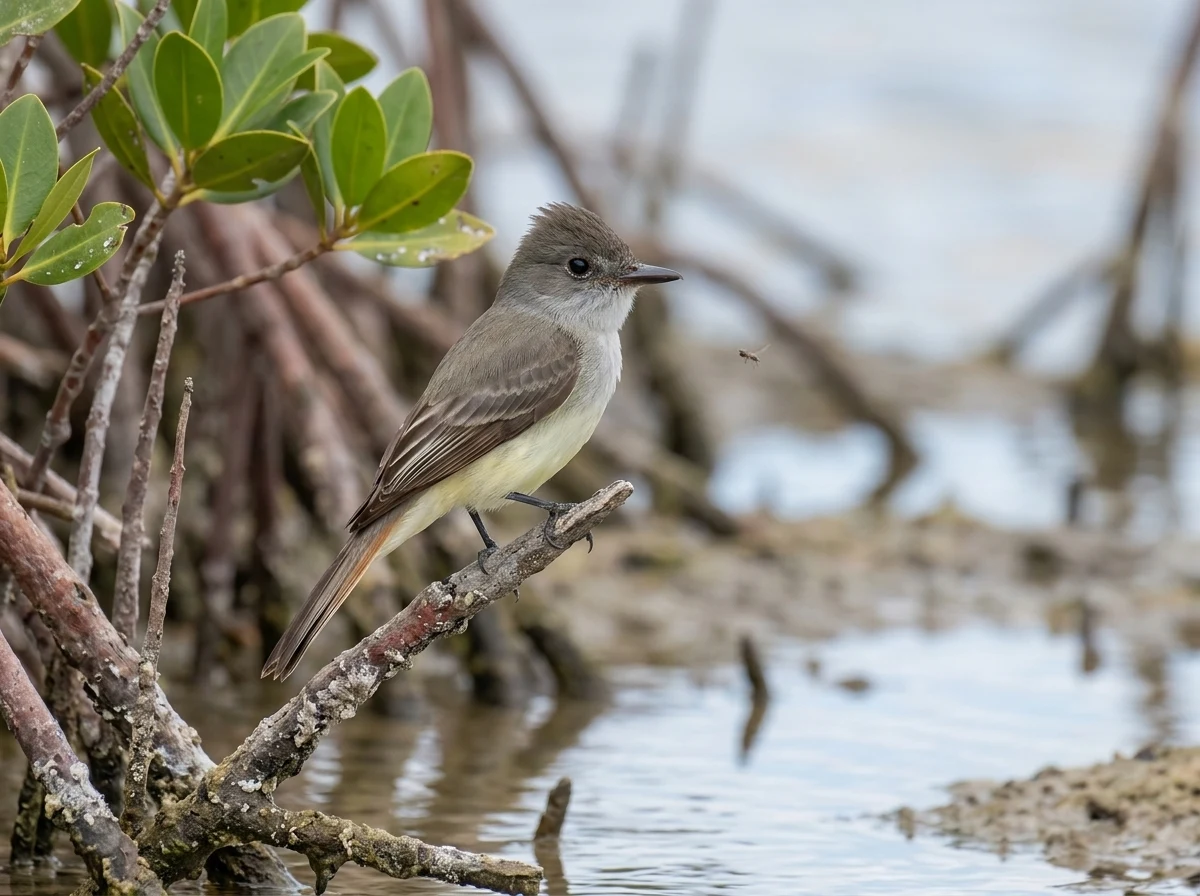
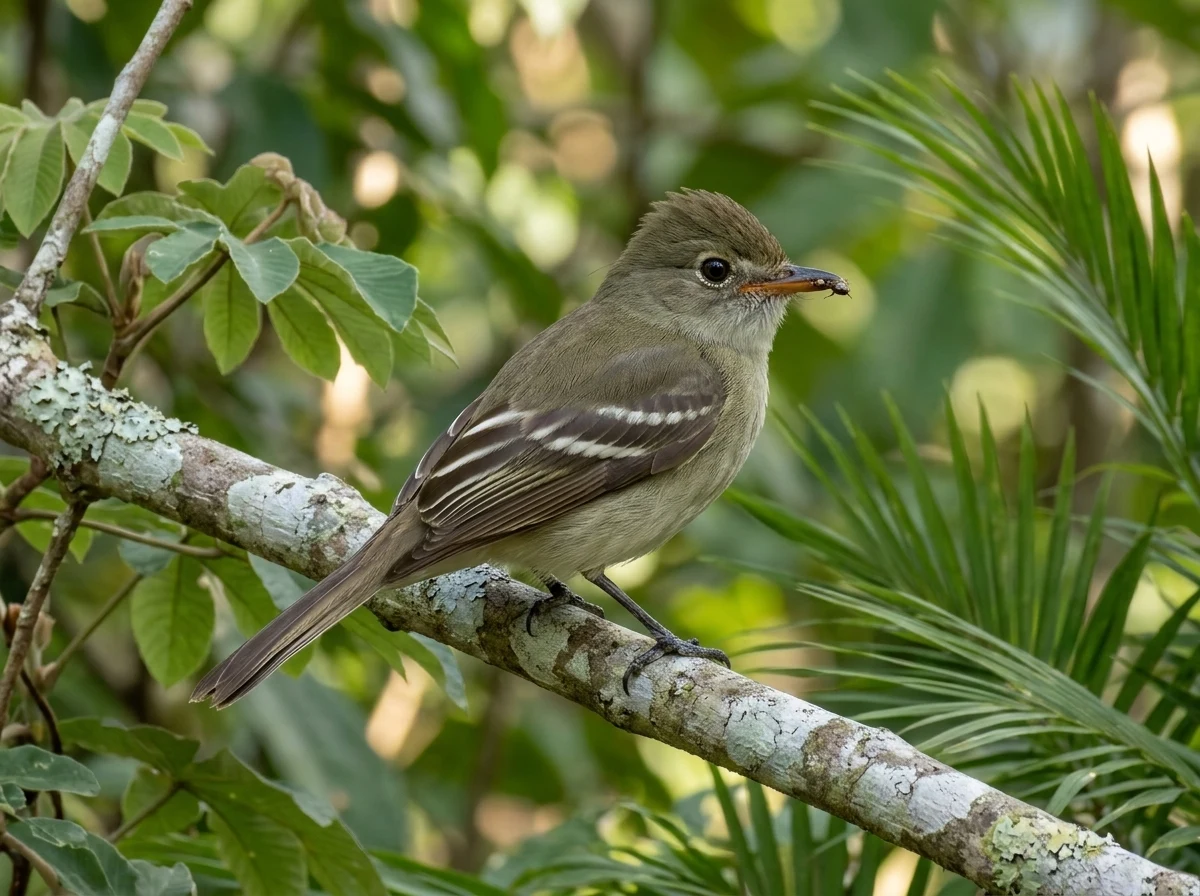
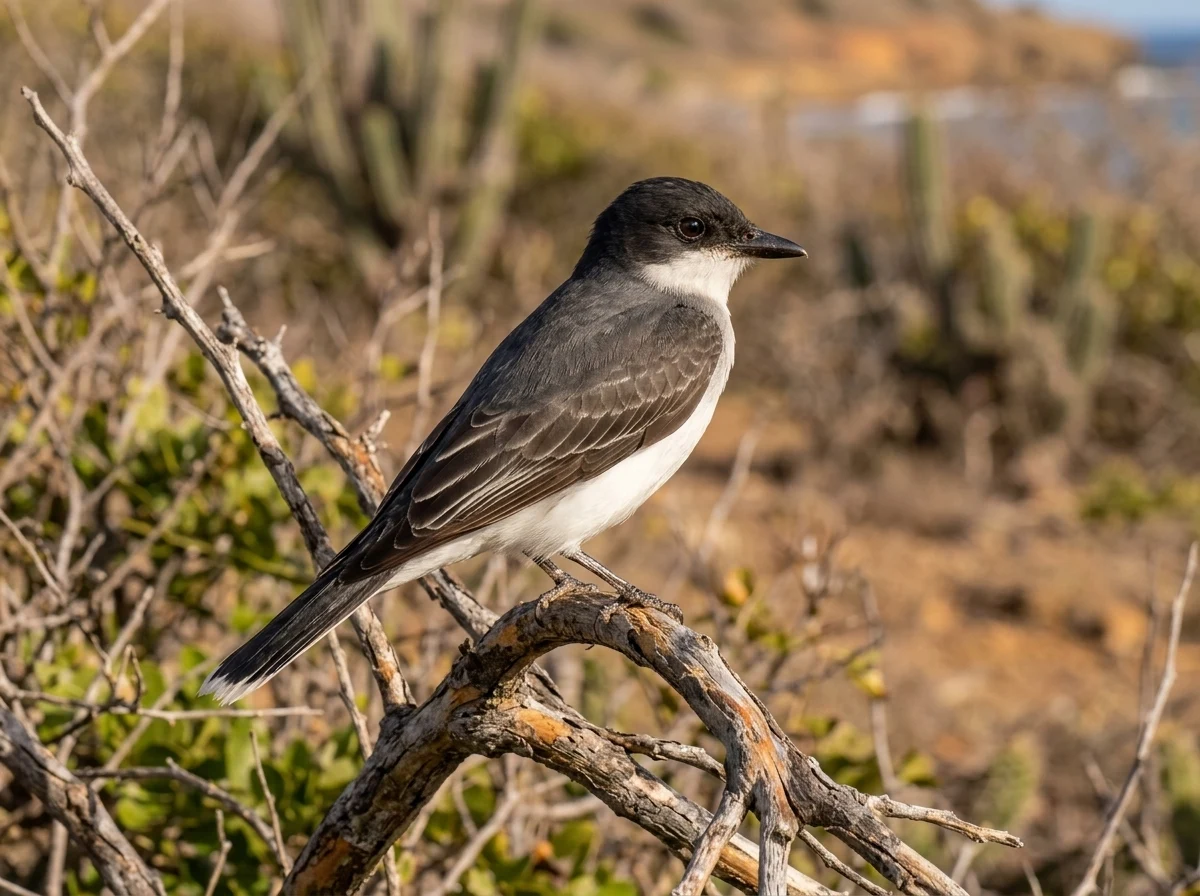
The most frequent mistake is calling a shaded-headed Gray Kingbird a Loggerhead, or calling any gray bird on a wire a Gray Kingbird. Other flycatchers add to the confusion: the Puerto Rican Flycatcher has a different structure and voice, and the Caribbean Elaenia is a much smaller olive flycatcher. There are also vagrant records of migrant kingbirds, such as Eastern Kingbird, which has a black tail with a crisp white terminal band and needs a photo.
The Puerto Rico and Vieques population of Loggerhead Kingbird is distinct enough that Garrido and colleagues (2009) proposed recognizing it as an endemic species, Tyrannus taylori. The American Ornithological Society check-list committee had not accepted that change as of the review cited by the atlas, so it is treated here as Loggerhead Kingbird. If its status changes, the clérigo would join the endemic list.
Linked profiles
The kingbirds that get confused
Open each profile to compare photos, recordings, and status.
Sound archive
Hear its voice
Explore real songs and calls. The spectrogram turns each sound into a visual trace of time and frequency.
XC998936Recording 1 of 3song

Play: song by GABRIEL LEITE
Choose another recording
Sound recorded by GABRIEL LEITE · XC998936 · CC BY-NC-SA 4.0. Visualization by Stichting Xeno-canto voor Natuurgeluiden.
Every recording retains the creator, catalogue number, and license published by Xeno-canto. Metadata via GBIF ↗
01
What is the difference between a Gray Kingbird and a Loggerhead Kingbird?
The Gray Kingbird is pale gray above with a dark mask and a notched tail with no white band. The Loggerhead Kingbird has a black head, dark gray back, and a square tail with a buffy-white tip. Gray Kingbirds are abundant in open and urban areas; Loggerheads prefer forest clearings and edges.
02
What is a loggerhead kingbird in Puerto Rico?
The Loggerhead Kingbird (Tyrannus caudifasciatus), called clérigo in Puerto Rico, is a resident kingbird with a black head and white throat that lives in the forests, shade coffee, and mangroves of Puerto Rico and Vieques. It is a close relative of the Gray Kingbird and is sometimes called pitirre de monte.
03
Can you see a Loggerhead Kingbird in San Juan?
It is rare in the San Juan metropolitan area, though it has been reported sporadically in the karst hills between Guaynabo and Bayamón. It is much easier to find in clearings at Maricao, in the northern karst, and in the lower forests of the Sierra de Luquillo.
04
Why is the Gray Kingbird called pitirre?
The name imitates its call, a loud rolling trill that sounds like pipiri pipiri. The same voice gave rise to other Caribbean names, such as pestigre in Spanish and petchary on English-speaking islands.
05
Is the Loggerhead Kingbird endemic to Puerto Rico?
Not at present. The Loggerhead Kingbird also lives in Cuba, Hispaniola, Jamaica, the Bahamas, and the Cayman Islands. However, in 2009 the Puerto Rico and Vieques population was proposed as a separate species (Tyrannus taylori), a proposal the AOS check-list had not accepted.
06
Which is bigger, the Gray Kingbird or the Loggerhead Kingbird?
They are practically the same size: the Puerto Rico breeding atlas gives about 23 cm for both. That is why size does not separate them; use the Loggerhead's black head and pale-tipped tail.
Keep exploring
Connected routes
Sources and review
The evidence is one link away.
These sources support the editorial scope of this guide. Bird profiles also retain their own taxonomy, occurrence, and conservation references.
Reviewed:
01↗02↗03↗04↗05↗06↗07↗08↗
Birds of Puerto Rico (datos del Puerto Rico Breeding Bird Atlas)
Gray Kingbird (Pitirre)
Measurements, mask, bill, pipiri call, and breeding-atlas results (91% of hexagons).Birds of Puerto Rico (datos del Puerto Rico Breeding Bird Atlas)
Loggerhead Kingbird (Clérigo)
Black head, square tail with pale band, forest habitat, rarity in San Juan, and the T. taylori taxonomic proposal.National Audubon Society
Field guide: Gray Kingbird
Notched tail without a white band, heavy black bill, and shrill voice.Wikipedia
Loggerhead kingbird
Diet (insects, small fruit, lizards), Puerto Rico nesting season, and courtship calls.Sociedad Ornitológica Puertorriqueña
Catalog of the Birds of Puerto Rico (official list)
Official Spanish names (Pitirre, Clérigo, Reinita Común, Reinita Mariposera, Gorrión Negro, Golondrina de Iglesias) and categories such as accidental or introduced.U.S. Forest Service Research and Development
Puerto Rico Breeding Bird Atlas
Distribution and breeding timing for 130 species breeding in Puerto Rico and its satellite islands.Xeno-canto Foundation / GBIF
Xeno-canto recordings published through GBIF
Metadata, authorship, licenses, and catalogue records for field recordings used by the atlas.Sociedad Ornitológica Puertorriqueña
Official bird list
Local names, occurrence categories, and the public summary of 17 endemics.The atlas continues