 AI
AIShorebird identification
Greater Yellowlegs vs Lesser Yellowlegs
Two yellow-legged shorebirds that are easily confused at a distance. Here are the characters that actually help and a procedure for watching them calmly.
Reviewed:Prepared with AI assistance and linked sources. Illustrations are not field photographs.
Two shorebirds, one question
The Greater Yellowlegs (Tringa melanoleuca) and the Lesser Yellowlegs (Tringa flavipes) share yellow legs, mottled upperparts, and a slender shorebird silhouette. In Puerto Rico both appear as native species of natural occurrence, neither resident nor breeding, according to the island's bird catalog. The comparison is not always easy: the size difference becomes obvious only when the two are seen together.
This guide answers the specific question of how to tell them apart using verifiable characters: bill proportions, structure, vocalization, and habitat context. It does not replace a general shorebird guide, but it gives you an orderly procedure for looking, listening, and deciding. The cited sources describe identification and voice for both species; Puerto Rico occurrence comes from the local catalog.
Shorebird identification
Three keys to remember
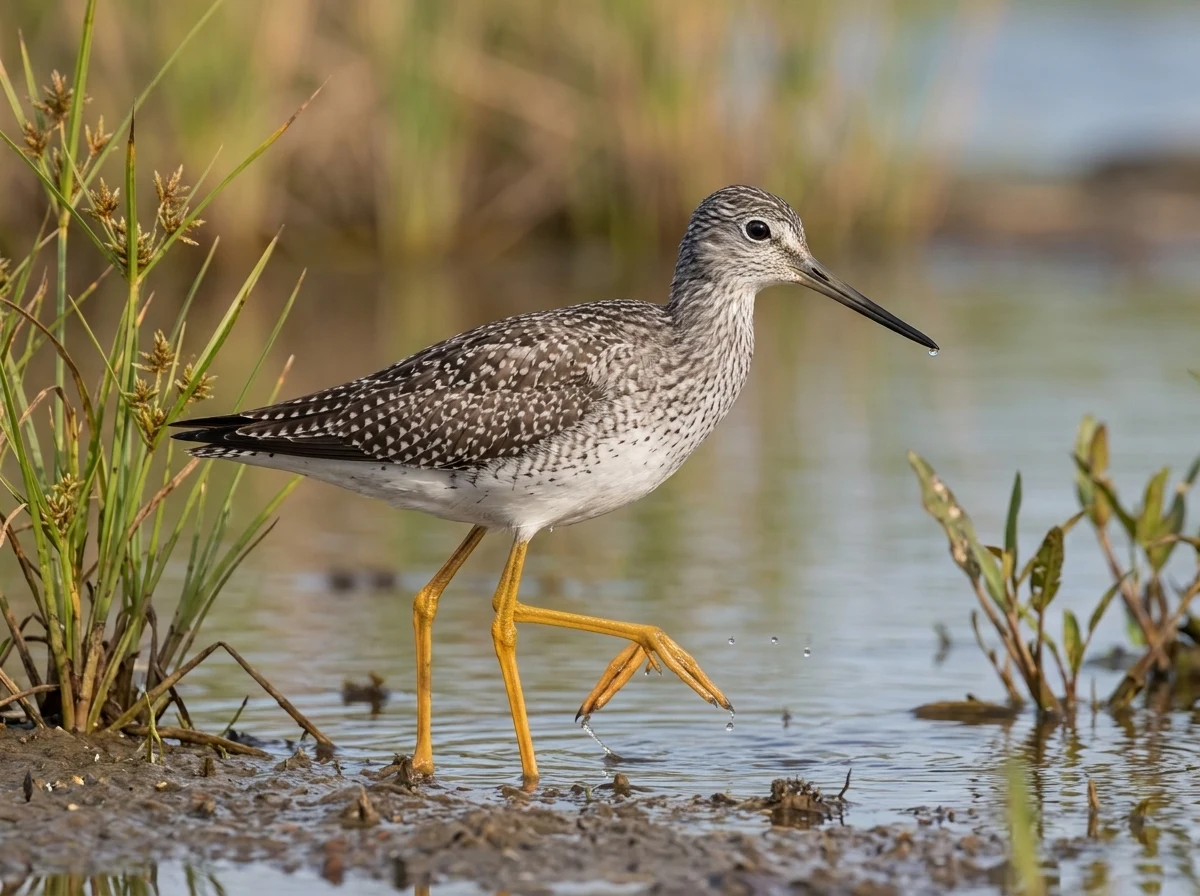
PicoThe Greater's bill is longer and thicker at the baseIt may look slightly upturned; the Lesser's is shorter and straighter.
VozVoice is the best clueThe Greater gives a series of 3 to 4 notes; the Lesser gives a tu-tu of 1 or 2 notes.
TamañoThe Greater is much larger and more heavily builtThe difference is obvious only when they are together.
01
Size and structure: the first impression
The Greater Yellowlegs is a large, robust bird. Audubon gives a length of 28 to 38 cm, a wingspan of 66 to 74 cm, and a weight of 105 to 210 g. The Lesser Yellowlegs is clearly smaller and lighter; the local catalog records an average body mass of about 88 g, compared with about 169 g for the Greater. That mass difference, even if you cannot see it in the moment, translates into a heavier silhouette and a fuller chest in the Greater.
Overall structure also helps. The Greater looks more voluminous, with a deeper body and an apparently thicker neck. The Lesser looks finer, more compact, and more delicately proportioned. BirdsCaribbean describes the Greater as much larger and more heavily built, and notes that if you see the two together you will be in no doubt as to who is who. The problem is that you rarely have them side by side, so it pays to lean on other characters.
02
The bill: proportion, thickness, and shape
The bill is the most useful character when size is not obvious. Audubon describes the Greater Yellowlegs' bill as longer, thicker toward the base, and possibly slightly upturned. BirdsCaribbean notes that the Lesser Yellowlegs can be picked out by its relatively shorter bill compared with the Greater. In practice, the Greater's bill often looks like a long, somewhat heavy tool, while the Lesser's looks shorter and straighter.
Proportion matters more than absolute length. A long bill that is thick at the base, with a slight upward curve, points to the Greater. A shorter, finer, straighter bill points to the Lesser. This difference is best seen with the bird in profile and in good light. If the bill looks blurry or the bird is facing you, it is better to wait and confirm with voice before deciding.
03
Voice: the most reliable character
Audubon states that voice is the best clue for separating these two species. The Greater Yellowlegs gives a series of musical whistled notes, described as whew-whew-whew, with a falling, flat pattern. BirdsCaribbean specifies that the Greater gives a strong tu-tu-tu of 3 to 4 notes, while the Lesser gives a whistled tu-tu of 1 or 2 notes, often repeated rapidly. That difference in note count is the practical key.
When you hear a yellowlegs, count the notes. If you hear three or four clear, strong notes, think Greater. If you hear one or two softer notes, think Lesser. Voice also helps when the bird is distant or partly hidden. Recording the sound on your phone and reviewing it later is a good way to confirm your initial impression.
04
Habitat and context in Puerto Rico
Both species use wetlands, but local context helps organize your observation. The Puerto Rico bird catalog records them as native species of natural occurrence, neither resident nor breeding on the island. They are not forest or yard birds: they appear in shallow aquatic environments such as lagoons, lake shores, marshes, and mudflats. BirdsCaribbean mentions that the Lesser can be found in freshwater and coastal wetlands, on mudflats, ponds, lagoons, and mangrove edges, and that it also uses agricultural areas.
Audubon describes a wide variety of settings for the Greater during migration and winter, including tidal flats, estuaries, open beaches, salt and fresh marshes, and lake and river shores. In Puerto Rico, that overlap in habitat means you cannot separate the species by location alone. Habitat serves as context, not diagnosis. Identification should rely on structure, bill, and voice.
05
Observation routine and checklist
To separate these shorebirds, follow a fixed order. First, observe the whole bird and note your impression of size and structure. Second, look at the bill in profile and assess length, thickness at the base, and shape. Third, listen and count the notes of the voice. Fourth, review habitat context without using it as the only criterion. Fifth, if you can, compare with nearby birds to calibrate size. This sequence keeps a single character from dominating your decision.
Checklist: 1) Does the bird look large and robust or small and fine? 2) Is the bill long and thick at the base, or short and fine? 3) Does the bill look slightly upturned? 4) How many notes does the voice have: 3-4 or 1-2? 5) Is it in shallow water, mud, or mangrove edge? 6) Are other shorebirds nearby for size comparison? If you cannot answer questions 2 and 4 confidently, it is better to leave the identification as Yellowlegs sp. and not force a conclusion.
Linked profiles
The two species
Reference profiles for the Greater Yellowlegs and the Lesser Yellowlegs.
AI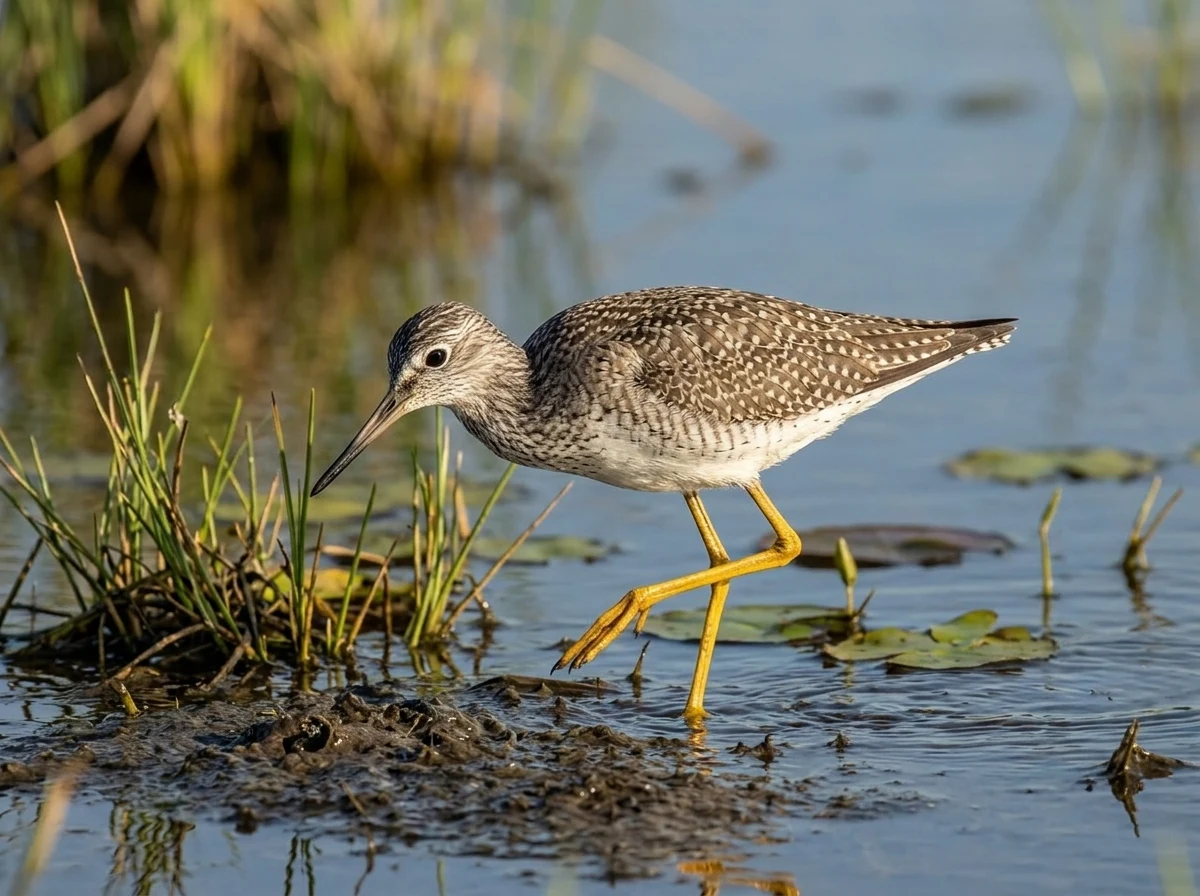 AI
AI01
What is the most reliable difference between Greater and Lesser Yellowlegs?
Voice. Audubon states that voice is the best clue. The Greater gives a series of 3 to 4 strong notes; the Lesser gives a softer tu-tu of 1 or 2 notes. The bill also helps: longer and thicker at the base in the Greater, shorter and finer in the Lesser.
02
Can they be identified by size alone?
Not reliably. Audubon notes that the size difference is obvious only when they are together. The Greater is much larger and more heavily built, but if you see one alone, use the bill and voice to confirm.
03
Are they residents in Puerto Rico?
No. The Puerto Rico bird catalog records them as native species of natural occurrence, but not resident or breeding on the island. They appear in wetlands during migration and winter.
04
What if I cannot hear the voice?
Focus on the bill in profile and overall structure. A long bill that is thick at the base and slightly upturned points to the Greater; a shorter, finer, straighter bill points to the Lesser. If doubt remains, record the bird as Yellowlegs sp. and do not force the identification.
05
Where can I see them in Puerto Rico?
In shallow wetlands: lagoons, lake shores, marshes, mudflats, and mangrove edges. The local catalog does not provide abundance or specific locations, so consult wetland guides and recent reports to plan your outing.
Keep exploring
Connected routes
Sources and review
The evidence is one link away.
These sources support the editorial scope of this guide. Bird profiles also retain their own taxonomy, occurrence, and conservation references.
Reviewed:
The atlas continues