 AI
AIIdentification
Killdeer vs Semipalmated Plover
Two plovers that can share beaches, mudflats, and shorelines. The fastest difference is in the breast bands and overall size.
Reviewed: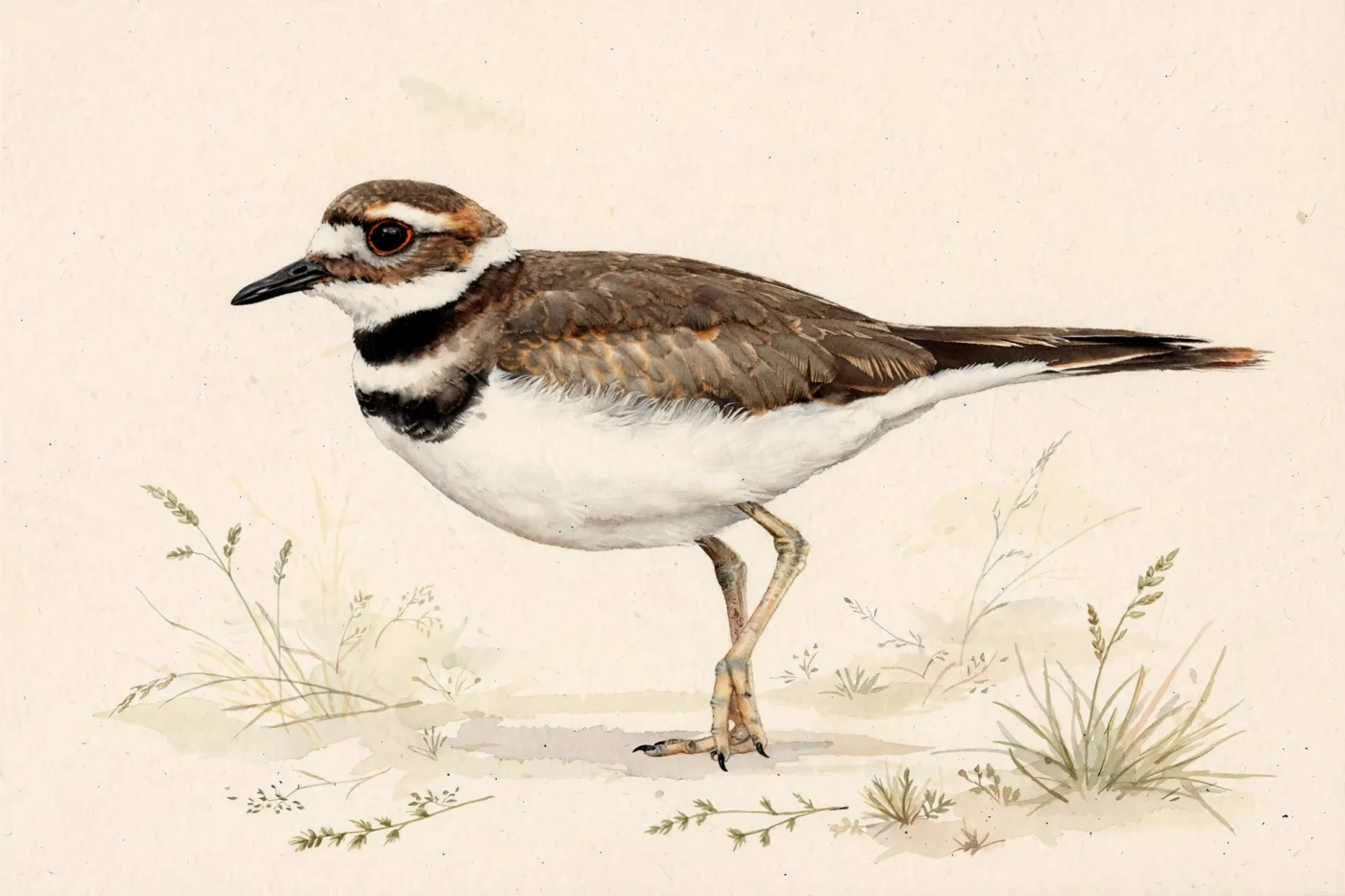
Prepared with AI assistance and linked sources. Illustrations are not field photographs.
Why they get confused
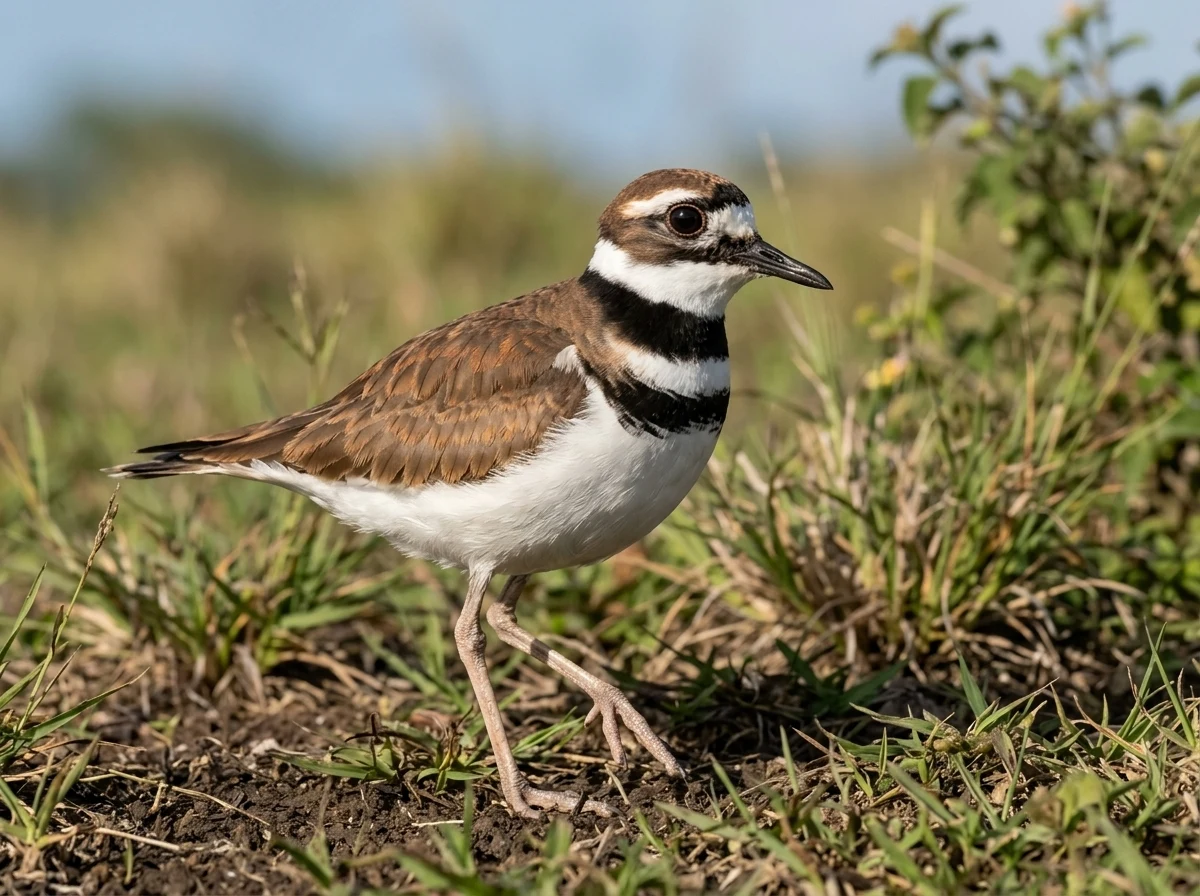
The Killdeer (Charadrius vociferus) and the Semipalmated Plover (Charadrius semipalmatus) are small to medium-sized shorebirds that can appear in open, wet environments. The Killdeer is clearly larger and has two bold black breast bands, plus a mostly orange tail. The Semipalmated Plover is smaller, with a single dark chest band and a more compact overall appearance.
The typical question is whether a bird with one band could be a juvenile Killdeer, or whether a bird with two bands could be something else. The practical answer is to check the number of bands first, then relative size, then behavior and habitat. This guide summarizes those differences using identification sources and Puerto Rico occurrence references.
Identification
Quick keys
Dos bandasKilldeer breastThe adult shows two separate black bands.
Una bandaSemipalmated Plover breastA single dark band crosses the chest.
TamañoOverall differenceThe Killdeer is noticeably larger and longer-tailed.
01
Breast bands: the main mark
The adult Killdeer has two black bands across the breast, separated by a white stripe. It also shows a white collar on the nape and a mostly orange tail. These two bands are the most direct signal to separate it from the Semipalmated Plover, which has a single dark breast band.
The adult Semipalmated Plover has a dark brown back, a single chest band, and legs that are usually orange. Its name refers to the partial webbing between its toes, a detail not visible at a distance. By contrast, the number of bands and the impression of size can be assessed with binoculars or a clear photo.
02
Size and proportions
The Killdeer measures about 20 to 28 cm in length and weighs between 75 and 128 g, with a wingspan of 46 to 48 cm. The Semipalmated Plover measures about 17 to 20 cm and weighs between 32 and 52 g, with a wingspan of 41 to 46 cm. In practice, the Killdeer appears more robust and longer-tailed, while the Semipalmated Plover is more compact and smaller.
When both species appear together, the size difference is usually obvious. If in doubt, compare with a known object or a nearby bird. It is not advisable to rely only on size if the bird is distant or alone; in that case, the breast bands and overall shape are more reliable.
03
Habitat and behavior in Puerto Rico
The Killdeer is found in open fields, pastures, riverbanks, mudflats, and coasts. It can be far from water and nests on the ground, sometimes on gravel roofs. The Semipalmated Plover favors very open habitats during migration, such as mudflats, sandy beaches, lake shores, and salt flats. In Puerto Rico, both species are recorded as native birds of natural occurrence, but abundance should not be inferred from that presence alone.
The Puerto Rico breeding bird atlas documents the distribution and breeding of the archipelago's birds; this comparison relies on identification sources. For observation, check wetlands, salt flats, and coasts during migration, and record each bird with a complete eBird checklist. Shorebird observation ethics recommend keeping distance and not chasing resting birds.
04
Field exercise: confirm in three steps
When you see a plover and are unsure, follow this procedure: first, count the breast bands. If there are two separate black bands, it is an adult Killdeer. If there is a single band, it suggests a Semipalmated Plover, but a juvenile Killdeer can also show a faint single band; confirm with size, shape, and habitat. Second, assess relative size: the Killdeer is larger and longer-tailed. Third, observe behavior: the Killdeer often runs and stops in open fields, while the Semipalmated Plover feeds on mudflats and shorelines.
If the bird is a juvenile, it may have only a faint single band. In that case, do not identify it by the band alone: consider size, body shape, and habitat. Take a photo if possible and review the bill proportions and tail length. Record the observation in your field notebook with time, place, and conditions.
Linked profiles
The two species
Brief profiles to review before heading into the field.
AI AI
AI01
How many bands does the Killdeer have?
The adult has two black breast bands separated by a white stripe. Juveniles may show only a faint single band, so also check size and tail.
02
Does the Semipalmated Plover have one or two bands?
The adult has a single dark breast band. It is smaller than the Killdeer and usually has orange legs.
03
Can both species be seen in Puerto Rico?
Yes. Both are recorded as native birds of natural occurrence in Puerto Rico. Do not infer abundance from presence alone; consult local lists and records.
04
What if the bird is far and I cannot see the bands?
Observe relative size, tail shape, and habitat. If possible, take a photo and review proportions. Do not force an identification without enough evidence.
Keep exploring
Connected routes
Sources and review
The evidence is one link away.
These sources support the editorial scope of this guide. Bird profiles also retain their own taxonomy, occurrence, and conservation references.
Reviewed:
01↗02↗03↗
National Audubon Society
Killdeer | Audubon Field Guide
Evidence for cited sections; consult the original document.National Audubon Society
Semipalmated Plover | Audubon Field Guide
Evidence for cited sections; consult the original document.USDA Forest Service, International Institute of Tropical Forestry
The Puerto Rico breeding bird atlas
Evidence for cited sections; consult the original document.The atlas continues