 AI
AIIdentification
Northern Waterthrush vs Louisiana Waterthrush
Two nearly identical warblers that walk at the water's edge. This guide resolves the comparison using observable characters, habitat, and behavior, without inferring abundance in Puerto Rico.
Reviewed:Prepared with AI assistance and linked sources. Illustrations are not field photographs.
Why they are confused
The Northern Waterthrush (Parkesia noveboracensis) and the Louisiana Waterthrush (Parkesia motacilla) are two Parkesia warblers that walk on the ground at the water's edge and bob the rear part of the body up and down. That combination of habits separates them from most warblers, but it does not always separate them from each other. Both are long-distance migrants, and both occur in the Caribbean outside the breeding season.
In the Puerto Rico bird catalog, both are listed as native, natural occurrences, neither resident nor breeding on the island. That means an observer in Puerto Rico encounters them as migrants or wintering birds, not as birds that nest here. This guide focuses on characters that can actually be seen in the field: the eyebrow, the throat, the bill, the breast pattern, and the habitat where the bird walks.
Identification
Three quick keys
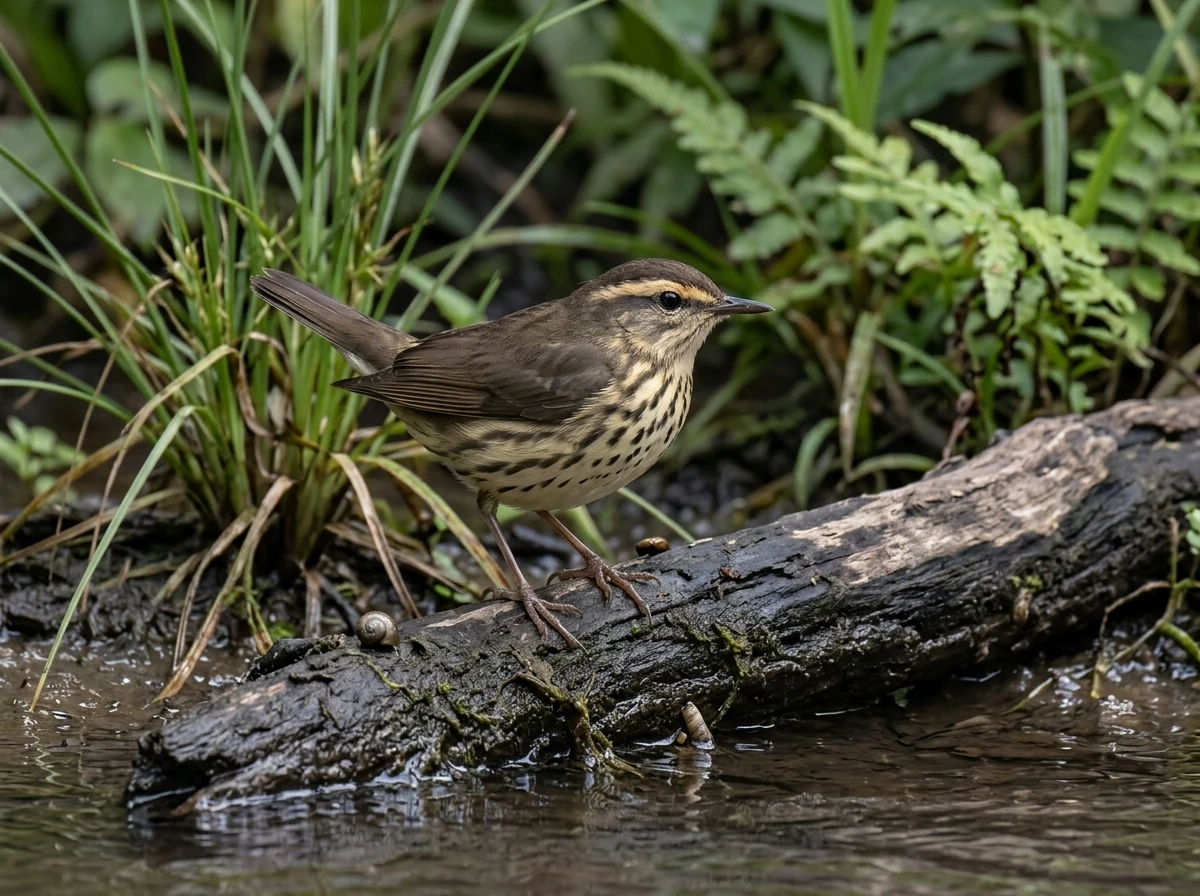
CejaEyebrow color and shapeOn Louisiana the eyebrow is always bright white and flares and broadens behind the eye; on Northern it is usually creamier or buffier and less flared.
GargantaThroat spottingLouisiana's throat is usually plain white; Northern's throat usually shows spotting or streaking.
PicoBill sizeLouisiana's bill is usually larger than Northern's.
01
The eyebrow and throat: the two main characters
The eyebrow is the most frequently cited character for separating these species. On the Louisiana Waterthrush, the eyebrow is always bright white and flares or broadens behind the eye. On the Northern Waterthrush, the eyebrow tends to be creamier or buffier and lacks that pronounced flare. The difference is one of degree and color, so it is best observed in good light and, if possible, by comparing several birds.
The throat provides a second character. The Louisiana Waterthrush usually has a plain white throat, while the Northern Waterthrush usually shows spotting or streaking on the throat. Neither character is absolute on its own, but together, and combined with bill size, they form a useful set. The Louisiana's bill is usually larger than the Northern's, and the Louisiana's underparts are white with a pinkish buff tinge on the flanks.
02
Habitat and behavior: where and how they move
Habitat helps separate them, especially where the two overlap. The Louisiana Waterthrush favors rapid-flowing, gravel-bottomed streams flowing through hilly, deciduous forest; it also uses wooded swamps, borders of lagoons, and slow or fast-moving streams depending on the region. The Northern Waterthrush, by contrast, favors still waters and stagnant bogs. In winter in the tropics, the Louisiana Waterthrush is found near streams in lowland woods and occasionally in coastal mangroves.
In the Caribbean, the Louisiana Waterthrush is solitary and territorial. It forages mostly on the ground, walking in a deliberate manner along the water's edge, jumping over obstacles, and characteristically bobbing and teetering as it captures aquatic insects and similar prey. The Northern Waterthrush also walks on the ground at the water's edge and bobs the rear part of its body, but its association with still and stagnant waters is a useful contrast when a bird is observed in a particular habitat.
03
What is known about their occurrence in Puerto Rico
The Puerto Rico bird catalog includes both the Northern Waterthrush and the Louisiana Waterthrush as native, natural occurrences. In both cases, the catalog indicates that they are neither resident nor breeding on the island. That is, they do not nest in Puerto Rico; they occur as migrants or wintering birds. This guide does not state abundance or encounter frequency, because the catalog does not provide that and it should not be inferred.
The Louisiana Waterthrush is a Neotropical migratory warbler that links North America, where it breeds, to the Caribbean, where it spends the winter. The Northern Waterthrush is also a long-distance migrant and winters in the Caribbean, among other regions. For an observer in Puerto Rico, the practical question is not whether the species is common, but whether the bird in front of you shows the described characters and whether the habitat and season are compatible with one of the two species.
04
Field exercise: comparing without capturing
When you find a bird of this type, observe first without moving your body and without approaching. Note or quietly record four things: eyebrow color, eyebrow shape behind the eye, presence or absence of throat spotting, and relative bill size. Then observe the habitat: is the bird walking next to flowing water or next to still or stagnant water? Finally, observe behavior: does it walk deliberately along the water's edge, jump over obstacles, and bob the rear part of its body?
Repeat the observation at the same place on different days if you can. Comparing birds is more useful than observing a single individual. If you have a camera, take photos of the head and breast in good light. There is no need to capture or handle the bird. If you want to document the sighting, note the date, time, place, and observed characters, and consider submitting the record to a citizen-science platform.
Linked profiles
The two species
Profiles of the Northern Waterthrush and Louisiana Waterthrush, with their Spanish common names and their occurrence in Puerto Rico according to the catalog.
AI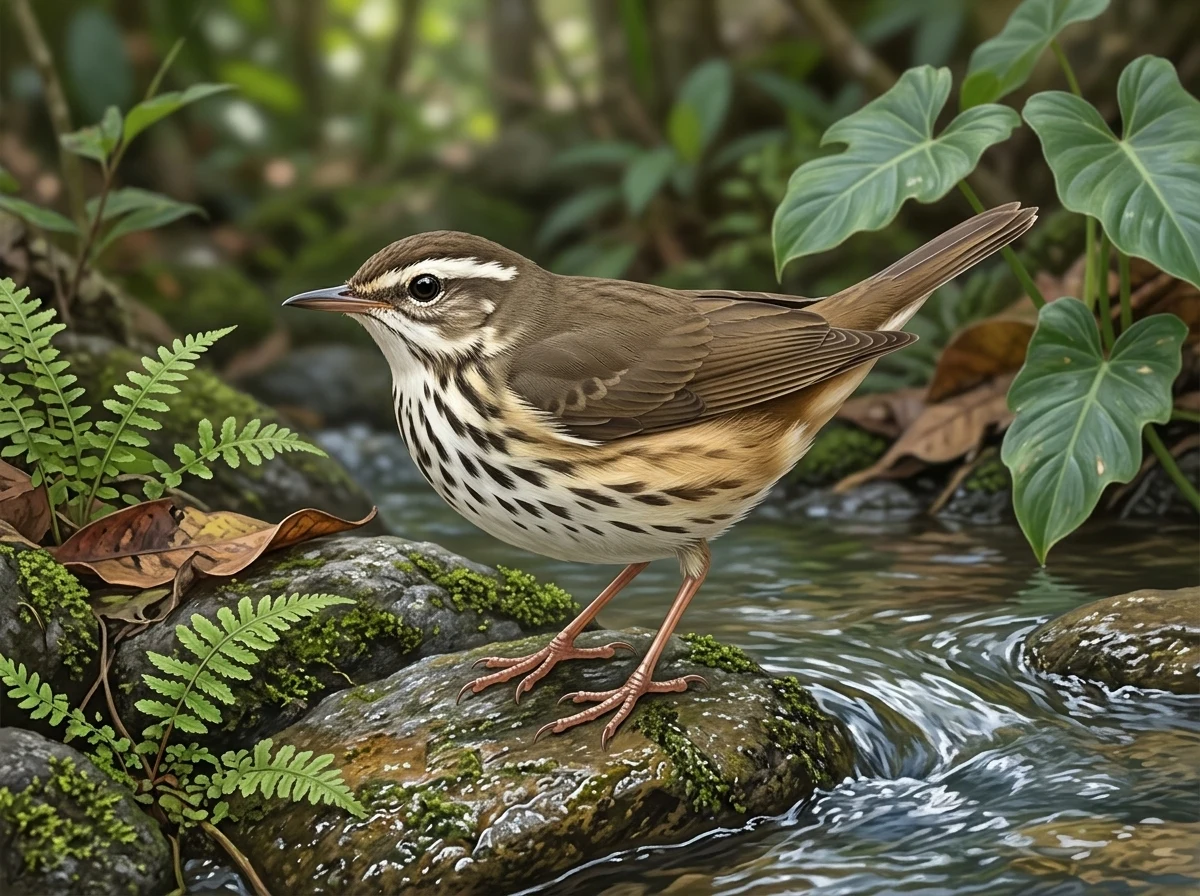 AI
AI01
What is the most reliable difference between the Northern and Louisiana Waterthrushes?
The eyebrow. On the Louisiana Waterthrush it is always bright white and flares behind the eye; on the Northern Waterthrush it is usually creamier or buffier and less flared. A plain throat and a larger bill reinforce the Louisiana identification.
02
Does the Louisiana Waterthrush breed in Puerto Rico?
No. The Puerto Rico bird catalog includes it as a native, natural occurrence, but not as resident or breeding on the island. It occurs as a migrant or wintering bird.
03
Does the Northern Waterthrush prefer flowing or stagnant water?
The Northern Waterthrush favors still waters and stagnant bogs. The Louisiana Waterthrush, by contrast, favors rapid-flowing, gravel-bottomed streams in hilly, deciduous forest, although it also uses wooded swamps and borders of lagoons.
04
What should I note if I want to document a sighting?
Note the date, time, place, habitat, behavior, and observed characters: eyebrow color and shape, throat spotting, and relative bill size. If you can, take photos of the head and breast in good light.
05
Why is the Louisiana Waterthrush described as an indicator of water quality?
Because it depends on forested streams and aquatic insects. Studies on its breeding and wintering grounds have shown that when water quality deteriorates, the availability of preferred aquatic prey such as mayflies declines, and the bird shifts its diet and foraging behavior.
Keep exploring
Connected routes
Sources and review
The evidence is one link away.
These sources support the editorial scope of this guide. Bird profiles also retain their own taxonomy, occurrence, and conservation references.
Reviewed:
01↗02↗
National Audubon Society
Louisiana Waterthrush | Audubon Field Guide
Evidence for cited sections; consult the original document.BirdsCaribbean
Lessons from the Louisiana Waterthrush: How Water Quality Affects the Survival of a Small Migratory Songbird
Evidence for cited sections; consult the original document.The atlas continues