 AI
AIIdentification · Raptors
Peregrine Falcon vs Merlin
Two migratory falcons that can overlap in Puerto Rico. The main difference is size; the second is flight style.
Reviewed:Prepared with AI assistance and linked sources. Illustrations are not field photographs.
Two falcons, one common question
The Peregrine Falcon (Falco peregrinus) and the Merlin (Falco columbarius) are two migratory raptors that can be seen in Puerto Rico. They share a family and a general falcon silhouette, but they are not the same size and they do not hunt the same way. This guide answers the direct comparison: what to look at first, what to confuse, and how to practice identification without relying on a single clue.
The main source for the Merlin is the Audubon Field Guide, which describes a rather small, compact, fast-flying falcon that captures small birds in mid-air. For the Peregrine, BirdsCaribbean coverage presents it as migratory or a passage migrant in the Caribbean and notes it may be becoming more common in urban areas. The local catalog confirms both species are of natural occurrence and migratory or vagrant in Puerto Rico, without implying abundance. The crow-size comparison for the Peregrine comes from the local catalog description, not from BirdsCaribbean.
Identification · Raptors
Three keys to tell them apart
Grande vs. pequeñoRelative sizeThe Peregrine is a large falcon, about the size of a crow; the Merlin is small and compact.
Picado vs. persecuciónHunting styleThe Peregrine is famous for its dive; the Merlin usually pursues prey in fast flight.
Aves medianas vs. aves pequeñasTypical preyThe Peregrine mostly hunts medium-sized birds; the Merlin specializes in small birds.
01
Size and proportion: the first clue
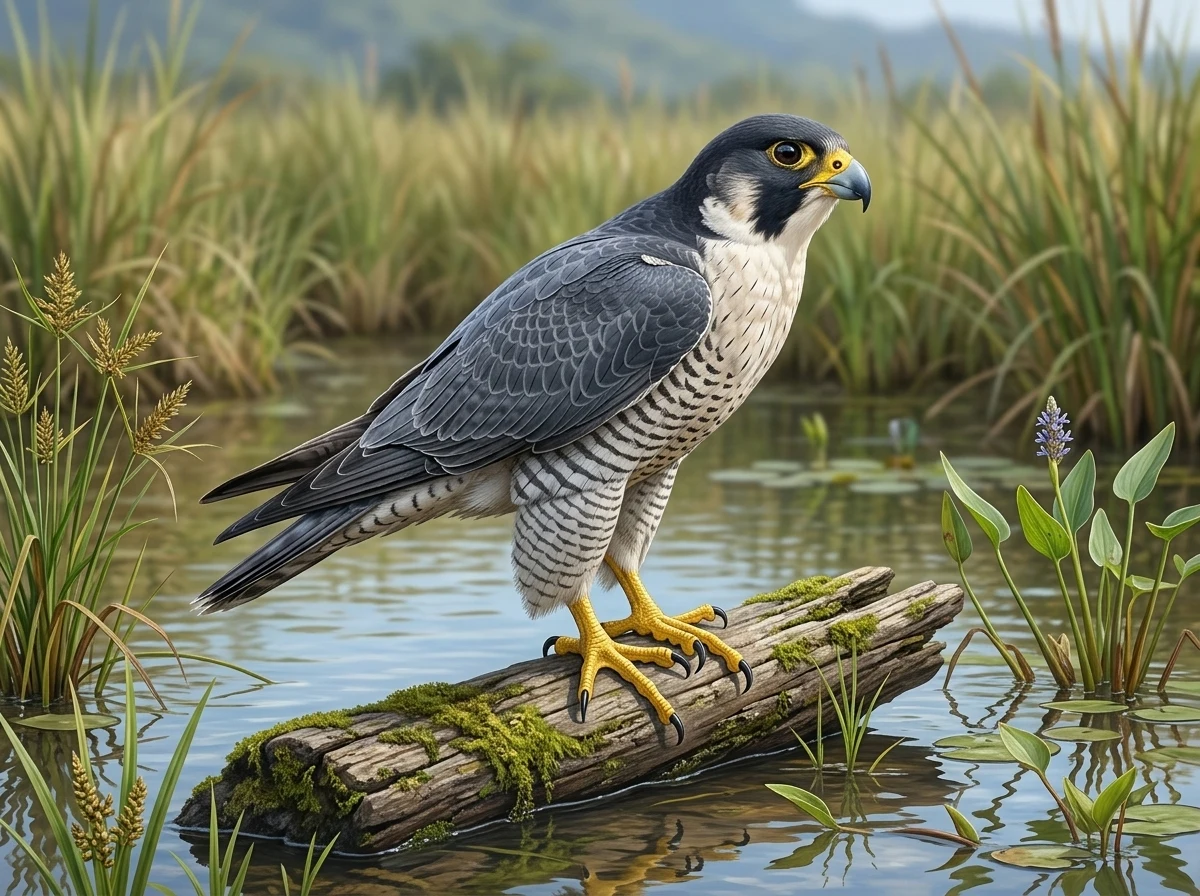
The Peregrine Falcon is a large falcon, described as about the size of a crow, with a blue-gray back, whitish underparts with dark markings, and a black head with a broad, characteristic malar stripe. It is a sexually dimorphic raptor: the female is considerably larger than the male. That size difference within the same species means a male Peregrine may look smaller than expected, but it still keeps the proportions of a large falcon.
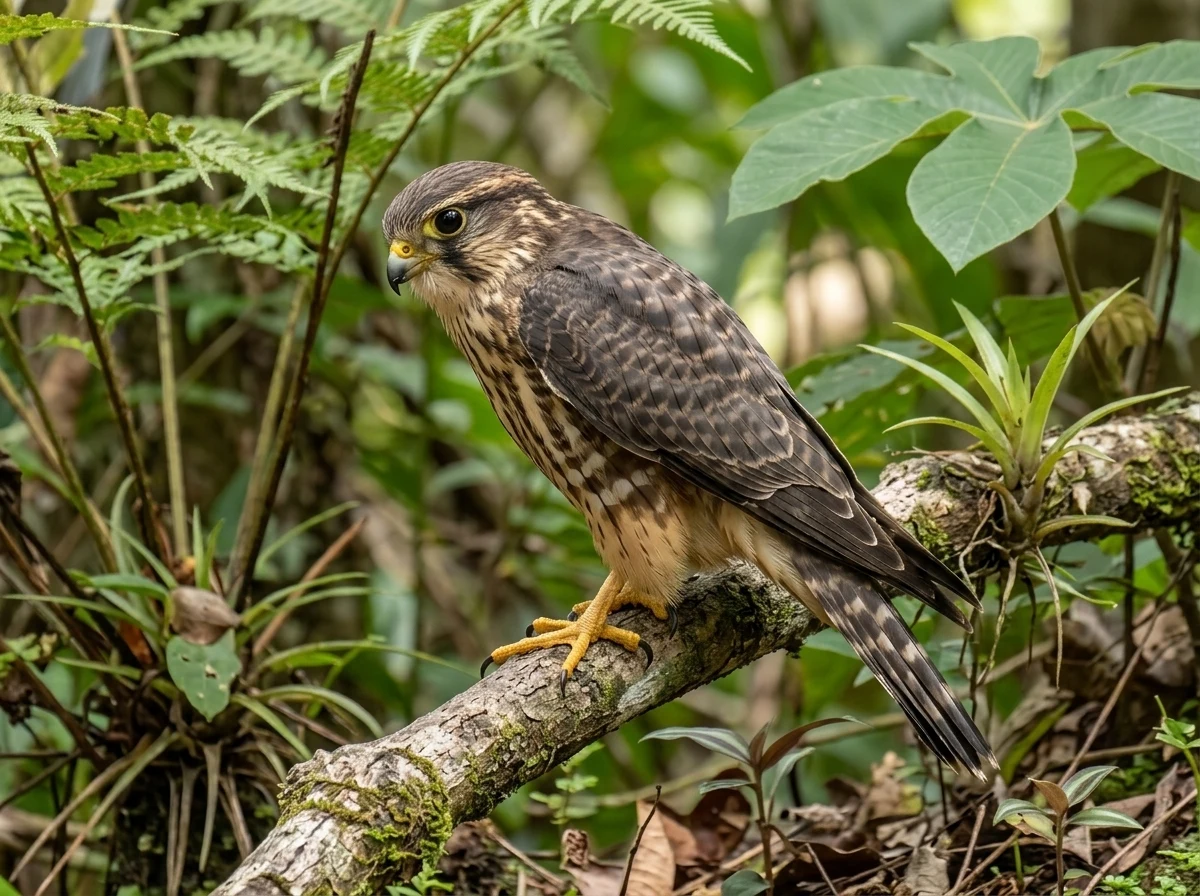
The Merlin is a small, compact raptor. Audubon gives a length of 25–36 cm and a wingspan of about 58 cm, with a relatively short tail. The female is slightly larger than the male. In practice, if the bird looks about the size of a small pigeon or a large thrush, the balance tips toward Merlin; if it looks about the size of a crow or larger, toward Peregrine. Overall proportion — compact body and short tail in the Merlin — helps even when there is no scale reference.
02
Flight and hunting: dive versus pursuit
The Peregrine is famous for its diving speed. BirdsCaribbean coverage includes a photograph whose caption describes it as the fastest animal on Earth, reaching speeds of up to 240 mph when in a dive. That ability is associated with hunting medium-sized birds, although the Peregrine can also take small mammals, reptiles, and insects. The local catalog states it normally does not fly at speeds above about 100 km/h, but its diving attack is its best-known trait. The two figures refer to different contexts: normal level flight versus maximum dive speed.
The Merlin hunts differently. Audubon notes it often watches from a perch and then flies out to capture prey in the air; it also hunts by flying low among trees or over the ground, taking prey by surprise. It seldom dives steeply from above. It feeds mostly on small birds, often specializing on locally abundant species, and supplements with large insects, rodents, bats, and reptiles. This difference in method — vertical dive versus fast, low pursuit — is one of the most useful behavioral clues.
03
Plumage and silhouette: what to look at without approaching
The adult Peregrine has a blue-gray back, whitish underparts with dark markings, and a black head with a broad malar stripe. The female is larger than the male. The Merlin shows a different pattern: the female and immatures are brown above, the adult male is blue-gray above, and all are streaked below. The dark tail is crossed by narrow whitish bands. That banded tail is a useful clue, though it may only be visible in good light.
Silhouette also helps. The Merlin has a relatively short tail and pointed, swept, tapered wings. The Peregrine, being larger, shows a more robust silhouette. A common mistake is confusing the Merlin with a Sharp-shinned Hawk, which has similar markings but rounded wingtips and no white bands on the tail. That comparison is useful to rule out before deciding between Peregrine and Merlin.
04
Occurrence in Puerto Rico: what the catalog says
The local catalog records the Peregrine Falcon as of natural occurrence, non-resident and non-breeding in Puerto Rico, with migratory or vagrant status. A review note states that the 2004 Commonwealth entry applies to the tundrius subspecies and should be retained as dated legacy status. That means the Peregrine's presence on the island is documented, but it should not be interpreted as abundance or permanent residence.
The Merlin appears in the catalog as of natural occurrence and also as accidental or vagrant, non-resident and non-breeding. BirdsCaribbean mentions that the Merlin migrates from north to south in winter, which matches its migratory status. Neither source allows a claim about how common either species is in Puerto Rico; they only confirm that both can occur. Assessing local abundance would require specific local counts or records, which are not part of this comparison.
05
Field exercise: how to practice telling them apart
Before heading out, prepare a short checklist. First, relative size: does it look like a crow or a large thrush? Second, silhouette: short tail and compact body, or longer tail and robust body? Third, flight: vertical dive, low pursuit, or gliding? Fourth, tail: are narrow whitish bands visible? Fifth, prey or context: small birds in fast flight or medium-sized birds? Write each answer separately, without trying to reach an identification from a single clue.
While observing, keep your distance and use binoculars. If the bird is perched, look first at overall proportion and tail; if it is flying, look at flight style before plumage. Afterwards, compare your notes with the Audubon description for the Merlin and the BirdsCaribbean coverage for the Peregrine. If the identification remains uncertain, record it as an unidentified falcon and note which clue was missing. That habit improves more than forcing an answer.
Linked profiles
The two species compared
Reference profiles for the Peregrine Falcon and the Merlin, with their common and scientific names.
01
What is the easiest difference to see between the Peregrine Falcon and the Merlin?
Size. The Peregrine is a large falcon, about the size of a crow, while the Merlin is small and compact, with a length of 25–36 cm according to Audubon. If the bird looks about the size of a large thrush or a small pigeon, it is probably a Merlin.
02
Does the Merlin dive like the Peregrine?
Not in the same way. Audubon notes the Merlin seldom dives steeply from above; it usually watches from a perch and pursues prey in the air, or flies low among trees. The Peregrine is the one associated with the high-speed vertical dive.
03
Are both species seen in Puerto Rico?
The local catalog records both as of natural occurrence, non-resident and non-breeding, with migratory or vagrant status. That confirms they can occur, but it does not indicate how common they are. Abundance should not be inferred from these profiles.
04
What other bird is the Merlin confused with?
Audubon notes that the Sharp-shinned Hawk has similar markings, but its wingtips are rounded and its tail has no white bands. That combination helps rule out the Sharp-shinned Hawk before deciding between Merlin and Peregrine.
Keep exploring
Connected routes
Sources and review
The evidence is one link away.
These sources support the editorial scope of this guide. Bird profiles also retain their own taxonomy, occurrence, and conservation references.
Reviewed:
The atlas continues