 AI
AIIdentification
Puerto Rican Tody vs Puerto Rican Emerald
Two green endemic birds, two very different silhouettes. This guide resolves the confusion with observable criteria and a field procedure.
Reviewed:Prepared with AI assistance and linked sources. Illustrations are not field photographs.
Two greens that are not alike
The Puerto Rican Tody (Todus mexicanus) and the Puerto Rican Emerald (Riccordia maugaeus) share one trait that can be enough to confuse an observer: green. Both are endemic to Puerto Rico and both can appear in forests, plantations, and gardens. But they belong to different orders, and their bodies are built for opposite tasks: one hunts insects from a perch, the other sips nectar in flight.
This guide does not repeat the general species profiles. It focuses on the concrete question: what do I look at to know which one I have in front of me? The answer lies in the bill, posture, flight, and behavior. With those four criteria, identification stops depending on color.
Identification
Key facts at a glance
Dos endémicasStatusBoth are endemic to Puerto Rico and resident year-round.
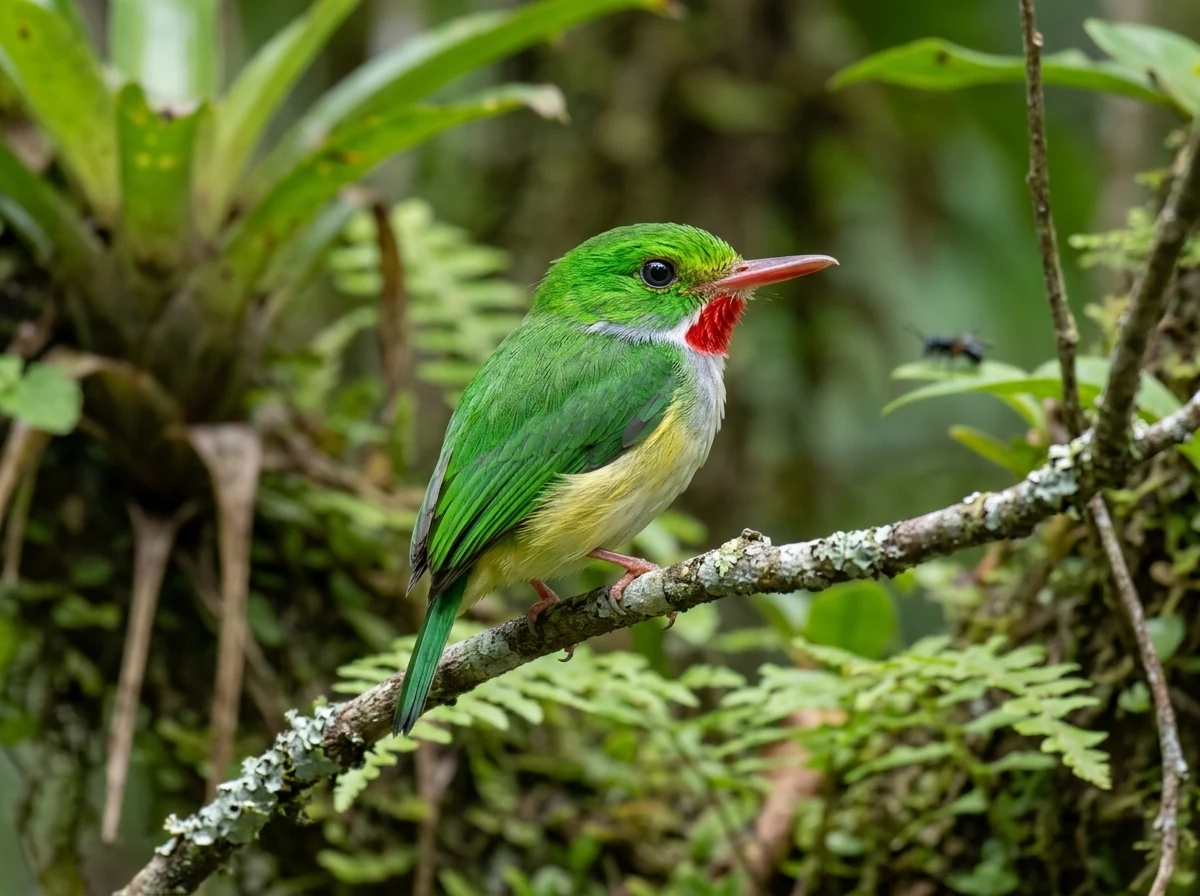
Pico largo y planoPuerto Rican TodyThe tody has a long, flattened bill; the emerald has a fine, straight hummingbird bill.
Vuelo suspendidoPuerto Rican EmeraldThe emerald feeds on nectar and can hover in place; the tody does not.
01
The bill decides almost everything
If I could look at only one part of the bird, I would look at the bill. The Puerto Rican Tody has a long, straight, flattened bill, described in the source as a long bill accompanying a large head and compact body. That shape belongs to a bird that catches insects and spiders, often from the undersides of leaves, and also eats small Anolis lizards. The bill is not built to enter a flower; it is built to capture prey.
The Puerto Rican Emerald has the fine, straight, proportionally shorter bill of a hummingbird. Its diet is nectar, and the source describes it foraging at low to medium levels using a wide variety of nectar sources. That bill difference is the first practical separation: a broad, flattened bill versus a needle-like bill. If the bird is in profile and the light is good, identification can be settled in seconds.
02
Color: the red, the blue, and the white
The adult Puerto Rican Tody is almost entirely bright green above, with a red chin and throat patch, white malar stripes, and yellow flanks. The sexes are virtually alike, differing only in iris color, if at all. That combination — red on the throat, white beside the face, yellow on the flanks — does not appear on the emerald.
The male Puerto Rican Emerald is largely green, with a blue throat patch and dark wings and tail. The female is principally off-white below, with whitish tail tips and a short postocular supercilium. In other words, the emerald may show blue or white, but not the intense red of the tody. The source also notes that the emerald is endemic to Puerto Rico and is found in most forested habitats on the island, from coastal mangroves to highland summits.
03
Posture, flight, and behavior
The Puerto Rican Tody is a perch bird. It sits upright, with a compact body and short tail, and from there makes brief sallies to catch insects. The source describes it as non-migratory, holding small year-round territories, and excavating its nest burrow in dirt banks. It does not hover in front of a flower.
The Puerto Rican Emerald is an aerial bird. Its flight includes the ability to hover, and its nectar feeding takes it from flower to flower. The source indicates that it forages at low to medium levels and probably nests virtually year-round, with a peak breeding season between February and May. For the observer, the difference is clear: if the bird is still on a branch and then flies out to grab something, it is a tody; if it is hovering in front of a flower, it is an emerald.
04
Habitat and overlap
Both species can be found in forests and gardens, but they do not occupy the same microhabitat. The Puerto Rican Tody occurs in forests, woodlands, karst, and coffee and shade plantations, from coastal lowlands into the mountains, where it holds small territories. The Puerto Rican Emerald is also found in dry and moist forests, woodlands, plantations, and gardens, and the source describes it from coastal mangroves to highland summits.
The overlap is real, especially at forest edges and in areas with flowers. The practical way to separate them in the field is not to ask where I am, but what the bird is doing. A tody may perch near flowers, but it does not visit them like a hummingbird. An emerald may cross a clearing, but it does not sit for long on a low perch waiting for insects.
05
Field procedure and checklist
When you see a small green bird, follow this order. First, look at the bill: is it broad and flattened, or fine like a needle? Second, look at the throat: is there intense red, blue, or white? Third, look at posture: is it sitting upright on a perch, or hovering in the air? Fourth, wait a few seconds: does it fly out to catch an insect, or move from flower to flower? Fifth, note the place: forest edge, shade coffee plantation, flower garden, mangrove?
Checklist to take into the field: (1) broad, flattened bill = Puerto Rican Tody; (2) fine, straight bill = Puerto Rican Emerald; (3) red throat = Puerto Rican Tody; (4) blue throat or whitish underparts = Puerto Rican Emerald; (5) hovering flight = Puerto Rican Emerald; (6) sallies from a perch = Puerto Rican Tody; (7) yellow flanks = Puerto Rican Tody; (8) tail with white tips = female Puerto Rican Emerald. If you can note at least three of these criteria, the identification is solid.
Linked profiles
The two species
Reference profiles for the Puerto Rican Tody and the Puerto Rican Emerald.
AI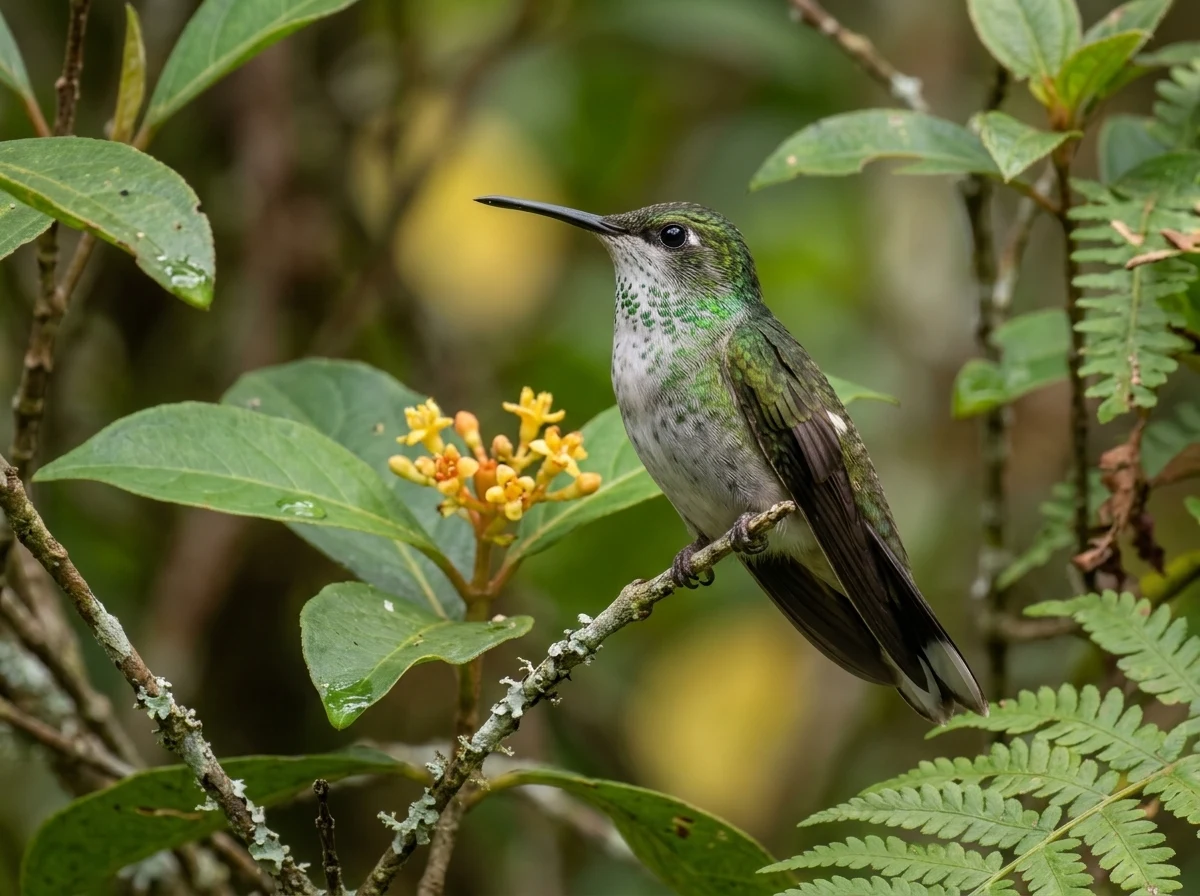 AI
AI01
What is the fastest difference between the Puerto Rican Tody and the Puerto Rican Emerald?
The bill. The tody's is long and flattened; the emerald's is fine and straight, like a needle. If the bill is not visible, watch the flight: the emerald can hover in place.
02
Does the Puerto Rican Tody have a red throat?
Yes. Adults have a red chin and throat patch, white malar stripes, and yellow flanks. The emerald does not show that red.
03
Is the Puerto Rican Emerald a hummingbird?
Yes. It belongs to the family Trochilidae and feeds on nectar. The source describes it foraging at low to medium levels and using a wide variety of nectar sources.
04
Can I see both species in the same place?
They can overlap at forest edges, shade coffee plantations, and flower gardens. The way to separate them is to watch what the bird does: the tody hunts from a perch; the emerald visits flowers and can hover.
05
Are both endemic to Puerto Rico?
Yes. Both species are endemic to Puerto Rico and resident year-round, according to the sources consulted.
Keep exploring
Connected routes
Sources and review
The evidence is one link away.
These sources support the editorial scope of this guide. Bird profiles also retain their own taxonomy, occurrence, and conservation references.
Reviewed:
01↗02↗
Birds of the World, Cornell Lab of Ornithology
Puerto Rican Emerald (Riccordia maugaeus), version 1.1
Evidence for cited sections; consult the original document.Birds of the World, Cornell Lab of Ornithology
Puerto Rican Tody (Todus mexicanus)
Evidence for cited sections; consult the original document.The atlas continues