 AI
AIIdentification
Purple Gallinule vs Common Gallinule
Two wetland rails that often share the same pond. The difference comes down to four features and an orderly look.
Reviewed:Prepared with AI assistance and linked sources. Illustrations are not field photographs.
Two gallinules, one wetland
In Puerto Rico's wetlands it is common to find birds of the family Rallidae walking on floating vegetation or swimming among reeds. Two of the most striking are the Purple Gallinule (Porphyrio martinica) and the Common Gallinule (Gallinula galeata). Although they share habitat and general silhouette, they belong to different genera and separate relatively easily when you observe the bill, frontal shield, legs, and body color pattern.
This guide answers the specific question of how to tell them apart. It does not replace the general species profiles; instead it offers a direct comparison and a field procedure. The presence of both in Puerto Rico is documented in catalogs and local references; abundance or breeding status is not inferred from those lists.
Identification
Three keys to remember
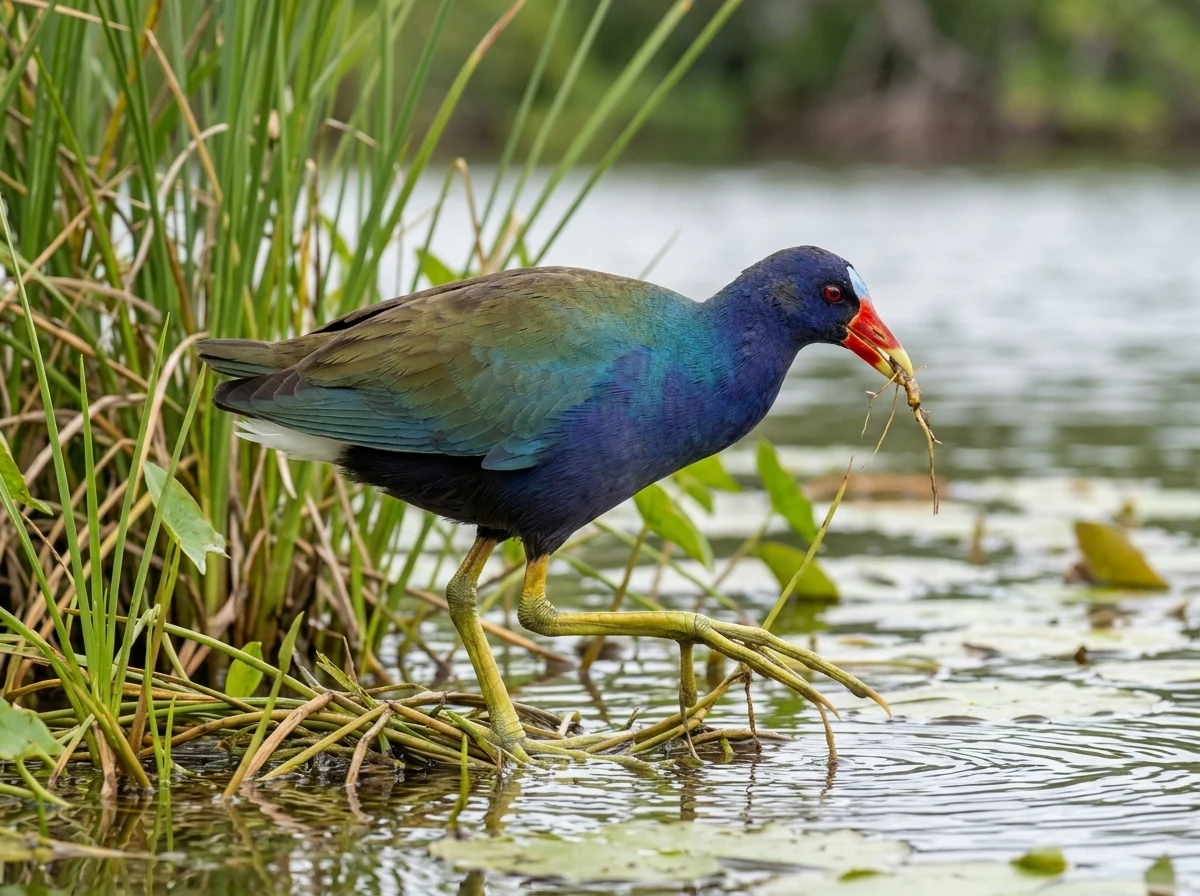
Pico y escudeteThe fastest featureThe Purple Gallinule has a thick bill with a red-and-yellow base and a pale blue shield; the Common Gallinule has a red bill with a yellow tip and a red shield.
PatasColor and lengthThe Purple Gallinule has yellow legs and very long toes; the Common Gallinule has greenish or yellowish legs with a red band on the upper leg.
CuerpoOverall colorThe Purple Gallinule is multicolored: blue, green, purple, with a bronze-green back; the Common Gallinule is dark slate gray with a white line along the sides.
01
Bill, shield, and forehead: the first look
The Purple Gallinule has a robust, thick bill. The base of the bill is red and the rest is yellow, with a pale blue frontal shield that extends onto the forehead. That combination —thick bill, red base, yellow tip, and blue shield— is unique among the region's rails. The Common Gallinule, by contrast, has a thinner bill, red with a yellow tip, and a red frontal shield that also rises onto the forehead. The shield color difference (pale blue versus red) is usually visible even at moderate distance in good light.
A common mistake is confusing the Purple Gallinule with a red-billed Common Gallinule. The key is shape and color: the Purple Gallinule's bill is taller and thicker, and the red base is more extensive. If the light is frontal and the bird is in profile, wait for it to turn its head to see the full shield. In the Common Gallinule, the red shield is narrower and more rounded; in the Purple Gallinule, the pale blue shield is broader and more striking.
02
Legs and toes: wetland adaptation
The Purple Gallinule's legs are bright yellow and its toes are extremely long, an adaptation for walking on floating vegetation such as water hyacinth and hydrilla. That combination of yellow legs and long toes is very visible when the bird walks on the leaves. The Common Gallinule also has long toes, but its legs are greenish or yellowish, with a characteristic red band on the upper leg, near the body. That red band is a diagnostic detail that shows well when the bird stands or walks out of the water.
In flight or while swimming, the Purple Gallinule's legs often dangle and show the intense yellow. The Common Gallinule, when swimming, keeps its legs closer to the body and the red band may be hidden. So it is best to observe the bird walking or standing on vegetation, where the legs are fully visible. If you only see it swimming, wait for it to climb onto a vegetation edge or a log.
03
Body color and overall pattern
The Purple Gallinule is a multicolored bird. Its plumage combines deep blue, green, and purple, with a bronze-green back and bluish underparts. The contrast between the green back and the rest of the blue-purple body is striking. The Common Gallinule is much more uniform: dark slate gray on the head, neck, and underparts, with a white line along the flanks and a white area under the tail. That lateral white line is a constant feature and easy to see when the bird is in profile.
At a distance, the Purple Gallinule may look dark in poor light, but the multicolored pattern shows in natural light. The Common Gallinule, by contrast, looks dark gray and compact. If in doubt, shield and leg color resolve the identification before plumage. The combination of a pale blue shield, a thick bill with a red base, and yellow legs points to Purple Gallinule; a red shield, a red bill with a yellow tip, and greenish legs with a red band point to Common Gallinule.
04
Behavior and habitat: context clues
The Purple Gallinule is known for walking on floating vegetation with its long toes, and for feeding on aquatic plants such as water hyacinth and hydrilla. It has also adapted to rice paddies and human-made impoundments. The Common Gallinule lives along marsh edges, ponds, canals, and other wetlands with dense vegetation, and tends to swim more than the Purple Gallinule. Both can appear in the same water body, but the Purple Gallinule tends to walk on floating plants, while the Common Gallinule swims or walks on muddy edges.
Behavior alone is not a diagnostic feature, but it helps direct your gaze. If the bird walks on water hyacinth with yellow legs and very long toes, it is a Purple Gallinule. If it swims with a lower body profile and shows a white lateral line, it is a Common Gallinule. In Puerto Rico, both species are documented in catalogs and local references; abundance or breeding status should not be inferred from those lists. Observation should focus on visible features, not on assuming which species is more common.
05
Field procedure and checklist
When you find a bird in this group, follow a fixed order. First, look at the bill and frontal shield: is the shield pale blue or red? Is the bill thick with a red base and yellow tip, or thin and red with a yellow tip? Second, look at the legs: are they bright yellow or greenish with a red band? Third, check the body: is there multicolor contrast with a bronze-green back, or is it uniform slate gray with a white lateral line? Fourth, note the behavior: does it walk on floating vegetation or swim in open water?
Checklist for your notebook: 1) shield pale blue or red; 2) bill thick with red base or thin red with yellow tip; 3) legs yellow or greenish with red band; 4) body multicolor or gray with white line; 5) walks on floating plants or swims. If you can, take a photo or a short video and review the features calmly. There is no need to capture the bird or get too close; distance observation with binoculars is enough for most cases.
Linked profiles
The two species compared
General profiles for context; this guide focuses on the direct comparison.
AI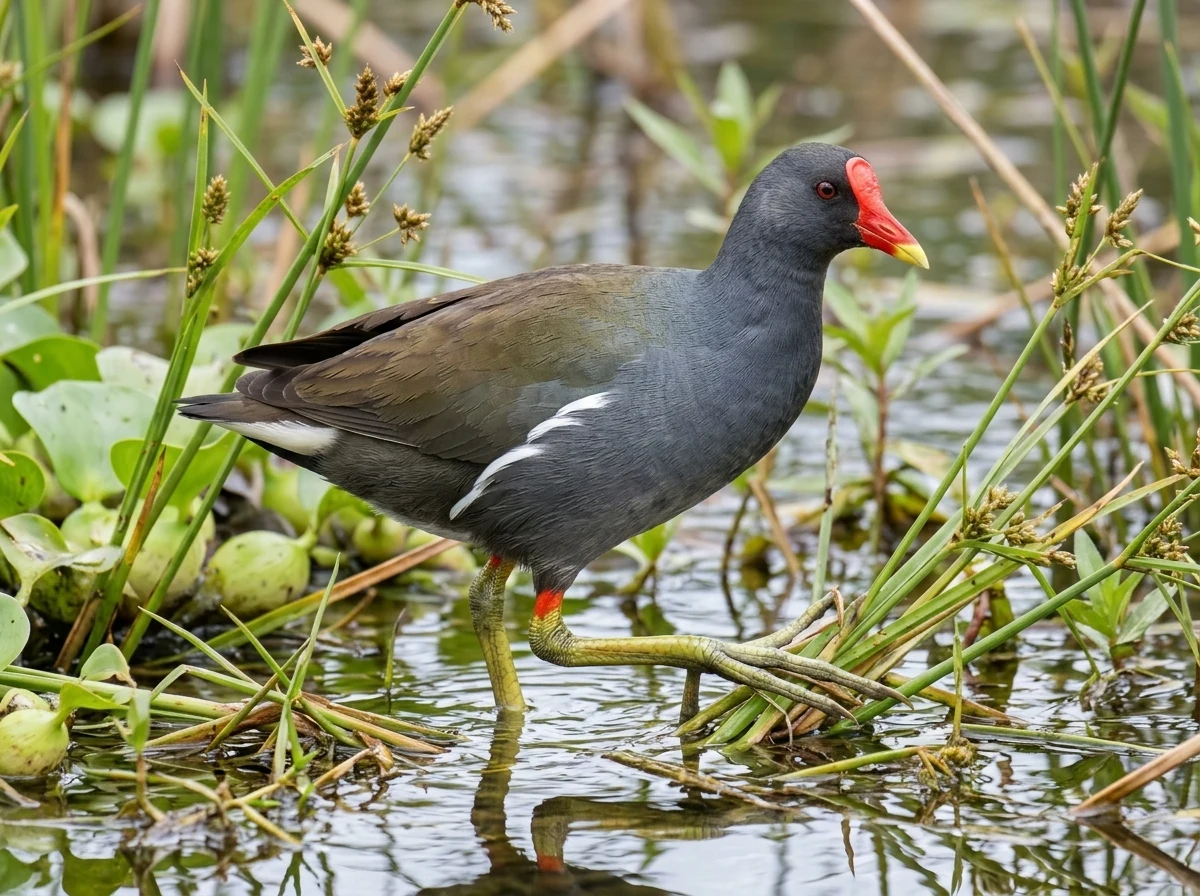 AI
AI01
What is the fastest difference between the Purple Gallinule and the Common Gallinule?
The color of the frontal shield: pale blue in the Purple Gallinule and red in the Common Gallinule. If the shield is not visible, check the bill: the Purple Gallinule has a thick bill with a red base and yellow tip; the Common Gallinule has a thinner red bill with a yellow tip.
02
Are the legs always different?
Yes, under normal conditions. The Purple Gallinule has bright yellow legs and very long toes; the Common Gallinule has greenish or yellowish legs with a red band on the upper leg. The red band may be hidden if the bird is swimming, so it is best to see it standing or walking.
03
Can they appear together in the same wetland?
Yes, both species are documented in Puerto Rico and can coincide in the same water body. The Purple Gallinule tends to walk on floating vegetation, while the Common Gallinule swims more and uses muddy edges. Presence on a list does not indicate abundance or breeding status.
04
What do I do if I only see the bird swimming?
Wait for it to climb onto a vegetation edge, a log, or the shore. There you can see the legs and shield. If it does not climb out, observe the body pattern: the white lateral line and uniform gray point to Common Gallinule; the multicolor contrast with a bronze-green back points to Purple Gallinule.
Keep exploring
Connected routes
Sources and review
The evidence is one link away.
These sources support the editorial scope of this guide. Bird profiles also retain their own taxonomy, occurrence, and conservation references.
Reviewed:
The atlas continues