 AI
AIIdentification
Smooth-billed Ani vs Greater Antillean Grackle
Two black birds often confused at a distance. The key is the bill and the tail, not just the color.
Reviewed:Prepared with AI assistance and linked sources. Illustrations are not field photographs.
Why they get confused
The Smooth-billed Ani (Crotophaga ani) and the Greater Antillean Grackle (Quiscalus niger) are two black birds commonly seen in open landscapes and settled areas of Puerto Rico. Against the light or at a distance, both look like dark silhouettes and may occur in similar habitats: shrubland, grassland, farms, and gardens. So the practical question is not just “is it black?” but “what shape is the bill, and what is the tail doing?”.
This guide answers that confusion directly. It first separates the two species by bill and tail, then offers a four-step observation routine, and ends with frequently asked questions. The goal is to help you decide from visible evidence, not impressions.
Identification
Three quick keys
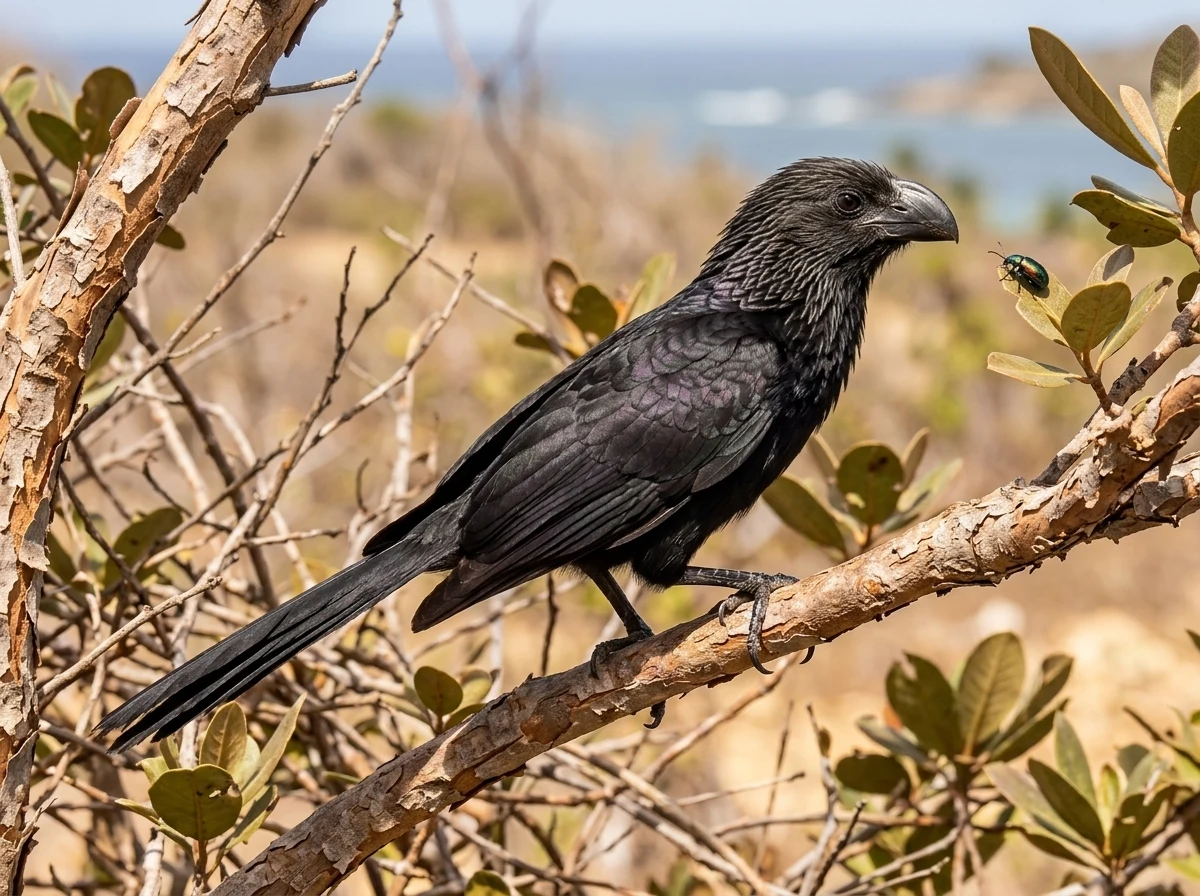
Pico alto y comprimidoSmooth-billed AniThe bill is large, deep, and curved in profile; it is not a thin, conical bill.
Cola larga y graduadaSmooth-billed AniThe tail is long and often hangs or moves irregularly.
Cola en quillaGreater Antillean GrackleThe tail is keel-shaped or V-shaped, and the bill is straight and pointed.
01
The bill: large and curved vs. straight and pointed
The Smooth-billed Ani is recognized by a large, deep bill that is compressed sideways, with a curved upper edge. It is a bill that dominates the head silhouette and does not look thin or conical. The Greater Antillean Grackle, by contrast, has a straight, pointed bill, more proportional to a passerine head. If you can see the head profile, the decision is usually immediate.
Confusion arises when the bird faces you or is backlit. In that position, the ani’s bill may look merely “dark and large,” and the grackle’s bill may disappear into the silhouette. So wait for a side profile or a posture in which the bill is outlined against the sky or water.
02
The tail: long and hanging vs. keel-shaped in a V
The Smooth-billed Ani has a long tail, often described as part of its black “Archaeopteryx-shaped” silhouette. That tail may hang, fan, or move irregularly as the bird walks or perches. The Greater Antillean Grackle has a keel-shaped tail, a “V” or “rudder” that is especially noticeable in flight and is less developed in the female.
The tail is useful because it can be seen at greater distance than the bill. If the bird flies, look at the tail shape: long and graduated in the ani, keel-shaped in the grackle. If it is perched, check whether the tail hangs or opens into a V. That difference, combined with the bill, resolves most cases.
03
A four-step observation routine
Step 1: look at the bill in profile. If it is deep, curved, and compressed, it is an ani. If it is straight and pointed, it is a grackle. Step 2: look at the tail. If it is long and hanging, ani; if it is keel-shaped or V-shaped, grackle. Step 3: check behavior. The ani often moves in groups and walks in low vegetation; the grackle is gregarious, forages on the ground, and is common in heavily disturbed areas. Step 4: if you still doubt, note what you saw and try again later.
This routine requires no special equipment. A notebook or a phone note is enough. The important thing is not to decide from a single clue. The bill and tail together are more reliable than either one alone.
04
Field checklist
Before closing the identification, review this list: Did I see the bill in profile? Was the bill deep and curved or straight and pointed? Did the tail hang or form a V? Was the bird in a group or alone? Was it walking on the ground or in low vegetation? Was the habitat shrubland, grassland, farm, or garden? If you can answer at least four of these questions, your identification has a solid basis.
If you cannot answer them, do not force the species. It is better to record “unidentified black bird” and try again another day. Identification by elimination without visible evidence is not reliable.
Linked profiles
The two species
Brief profiles to compare the ani and the grackle.
AI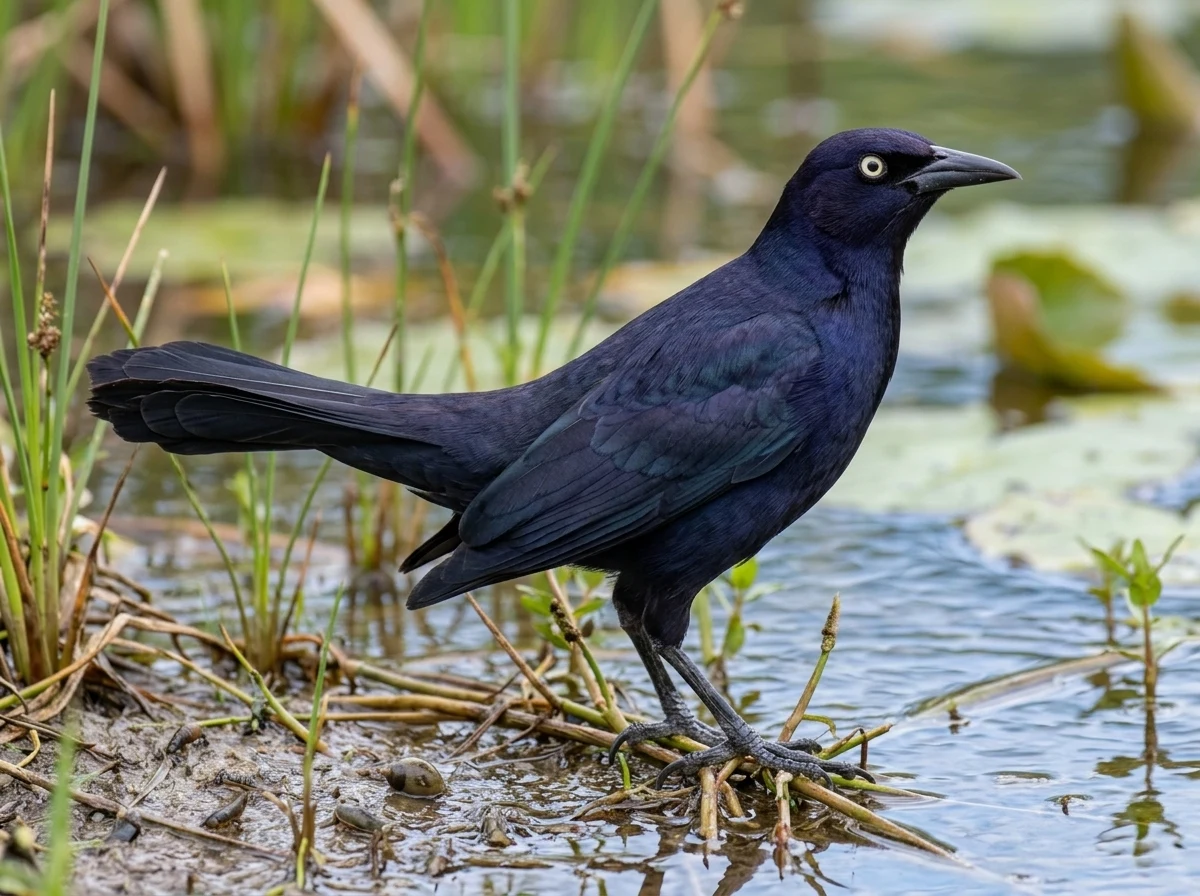 AI
AI01
Are the ani and the grackle the same species?
No. The ani is Crotophaga ani, in the cuckoo family Cuculidae. The grackle is Quiscalus niger, in the family Icteridae. They are different birds, even though both are black and may share habitat.
02
Which one has the larger bill?
The ani. Its bill is large, deep, and compressed, with a curved upper edge. The grackle’s bill is straight and pointed, thinner by comparison.
03
What is the grackle’s tail like?
It is keel-shaped or V-shaped, especially noticeable in flight. It is less developed in the female. The ani, by contrast, has a long tail that often hangs or moves irregularly.
04
Can I identify them by color alone?
It is not the most reliable approach. Both birds are black and look similar at a distance or against the light. Bill and tail shape are the most useful evidence for separating them.
Keep exploring
Connected routes
Sources and review
The evidence is one link away.
These sources support the editorial scope of this guide. Bird profiles also retain their own taxonomy, occurrence, and conservation references.
Reviewed:
01↗02↗
Birds of the World, Cornell Lab of Ornithology
Smooth-billed Ani Crotophaga ani (Quinn & Startek-Foote 2020)
Evidence for cited sections; consult the original document.Birds of the World, Cornell Lab of Ornithology
Greater Antillean Grackle Quiscalus niger (Fraga 2020)
Evidence for cited sections; consult the original document.The atlas continues