 AI
AIIdentification
White-winged Dove vs Mourning Dove
Two similar doves, but separable with patience: check the wing, the tail, and the silhouette before deciding.
Reviewed:Prepared with AI assistance and linked sources. Illustrations are not field photographs.
Why they get confused
The White-winged Dove (Zenaida asiatica) and the Mourning Dove (Zenaida macroura) share a general size, a brownish-gray tone, and a dark spot on the sides of the neck. In a quick view, or with a bird flying far away, it is easy to come away thinking they are the same species.
The comparison becomes manageable when you look for three concrete traits: the white wing patch, the tail shape, and the body build. This guide orders those traits according to what the Cornell Lab of Ornithology reference material and the Journal of Caribbean Ornithology article on White-winged Dove expansion in the Caribbean document.
Identification
Three quick keys
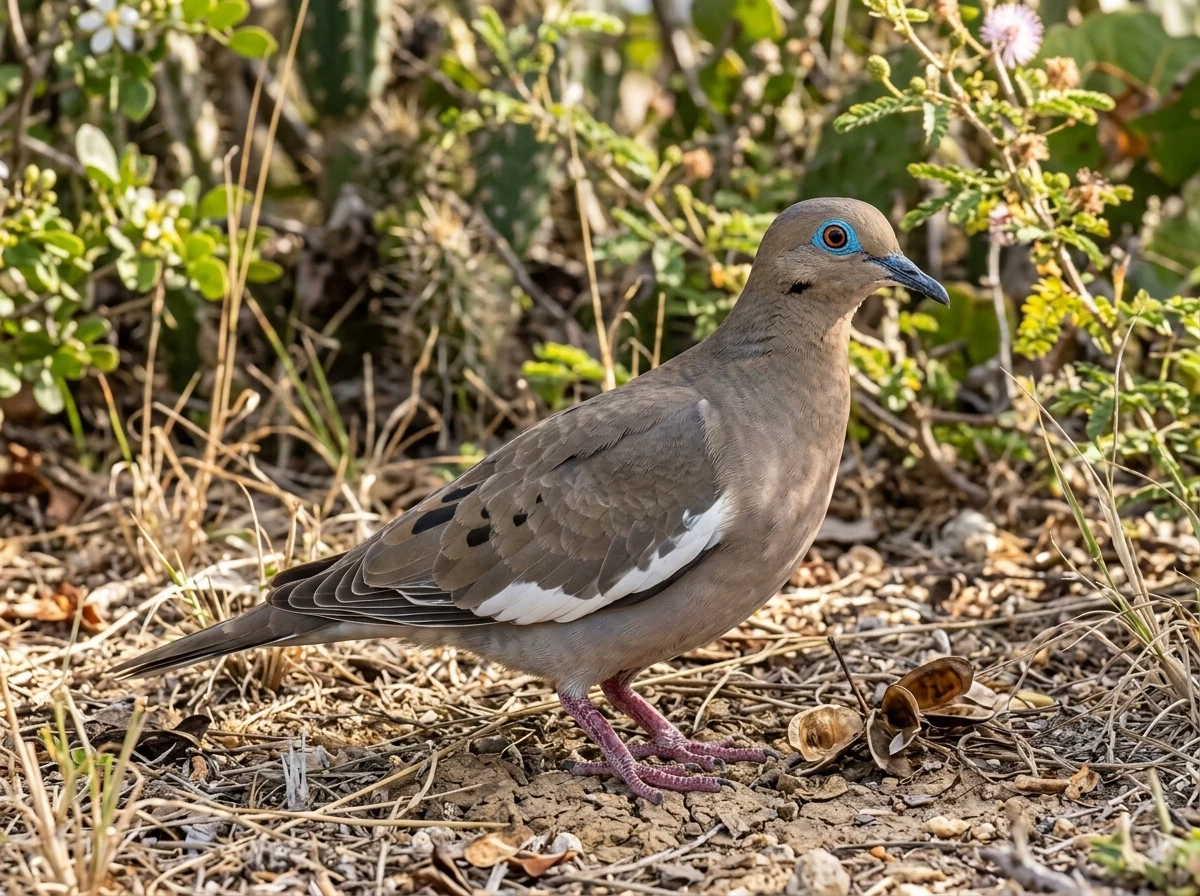
AlaWhite patch visible at restOn the White-winged Dove, the white in the wing is visible even when the bird is perched.
ColaLong and pointed vs. bluntThe Mourning Dove has a long, tapered tail; the White-winged Dove has a blunt-tipped tail.
CuerpoChunkier or slimmerThe White-winged Dove is similar in length but chunkier; the Mourning Dove is the smaller of the two.
01
The wing: the most reliable mark
Project FeederWatch material describes a large white patch along the edge of the wing for the White-winged Dove, visible when the bird is at rest. For the Mourning Dove it describes a brown wing with a few black spots. That difference is the first one to look for, because it does not depend on the bird opening its wings or being in flight.
The Journal of Caribbean Ornithology article reinforces the same idea from the Caribbean: it notes that, in the Caribbean, the White-winged Dove is the only dove with a large patch of white that encompasses the outer lesser coverts as well as the greater coverts on the upper wing, making it relatively easy to recognize in flight if seen well. That precision helps you avoid relying on a single flash of white.
In practice, look at the closed wing first. If the white forms a clear, extensive band along the edge, the balance tips toward the White-winged Dove. If the wing is brown with scattered black spots, check the tail before concluding.
02
The tail and the silhouette
The Mourning Dove has a distinctly long, tapered tail that comes to a point. The White-winged Dove has a blunt tail tip. This difference shows well when the bird is perched on a wire or an open branch, and also when it flies and the tail extends.
Size and build complete the picture. Project FeederWatch describes the White-winged Dove as similar in size to the Mourning Dove, about 12 inches, but chunkier. It describes the Mourning Dove as the smallest of the three species compared, about 12 inches long. That is, the length is similar, but the impression of body mass is not.
One way to train your eye is to observe the whole silhouette before focusing on color. The Mourning Dove tends to look slimmer and with a tail that extends; the White-winged Dove looks more compact and with a tail that ends more abruptly.
03
Habitat and occurrence in Puerto Rico
The Puerto Rico bird catalog includes the White-winged Dove and the Mourning Dove as species of native or natural occurrence, with high-confidence review and no pending caveats. That catalog information is what supports the presence of both species in the Puerto Rico context; abundance should not be inferred from it.
The Journal of Caribbean Ornithology article provides useful ecological context for the Caribbean. It states that the White-winged Dove prefers dry forest or a mosaic of agricultural areas within moist forest in Puerto Rico, as reported by Rivera-Milán (1992), and that in the Lesser Antilles it usually occurs in open areas at the edges of scrub, often in association with human habitation. It also mentions that Rivera-Milán (1996) found positive correlations in nest density between the White-winged Dove and the Zenaida Dove in Puerto Rico, indicating a lack of significant interspecific competition between those two species.
For the Mourning Dove, the catalog associates it with savanna, grasslands, and town-and-garden environments. That habitat difference is not an absolute rule, but it helps set expectations before you go out to observe.
04
A five-step observation procedure
First, locate the bird with binoculars and observe the whole silhouette for at least ten seconds without moving. Second, check the closed wing: look for an extensive white band along the edge or a brown wing with black spots. Third, look at the tail: does it end in a long, tapered point or a blunt tip? Fourth, assess the build: does it look chunky or slim? Fifth, note the immediate habitat: dry scrub, agricultural edge, grassland, garden, or urban area.
This procedure is a suggested method, not a published rule. Its value is that it forces you to look at traits in an order that reduces the risk of deciding from a single impression. If the bird flies before you complete the steps, note what you managed to see and do not force the identification.
A concrete list to carry in your notebook: wing (extensive white / brown with spots), tail (long and pointed / blunt), body (chunky / slim), habitat (dry scrub / grassland / garden), behavior (perched / flying / feeding). That short list covers the traits the sources describe and avoids relying on details that are not documented.
Linked profiles
The two species
Profiles of the White-winged Dove and the Mourning Dove to review their traits and their occurrence in Puerto Rico.
AI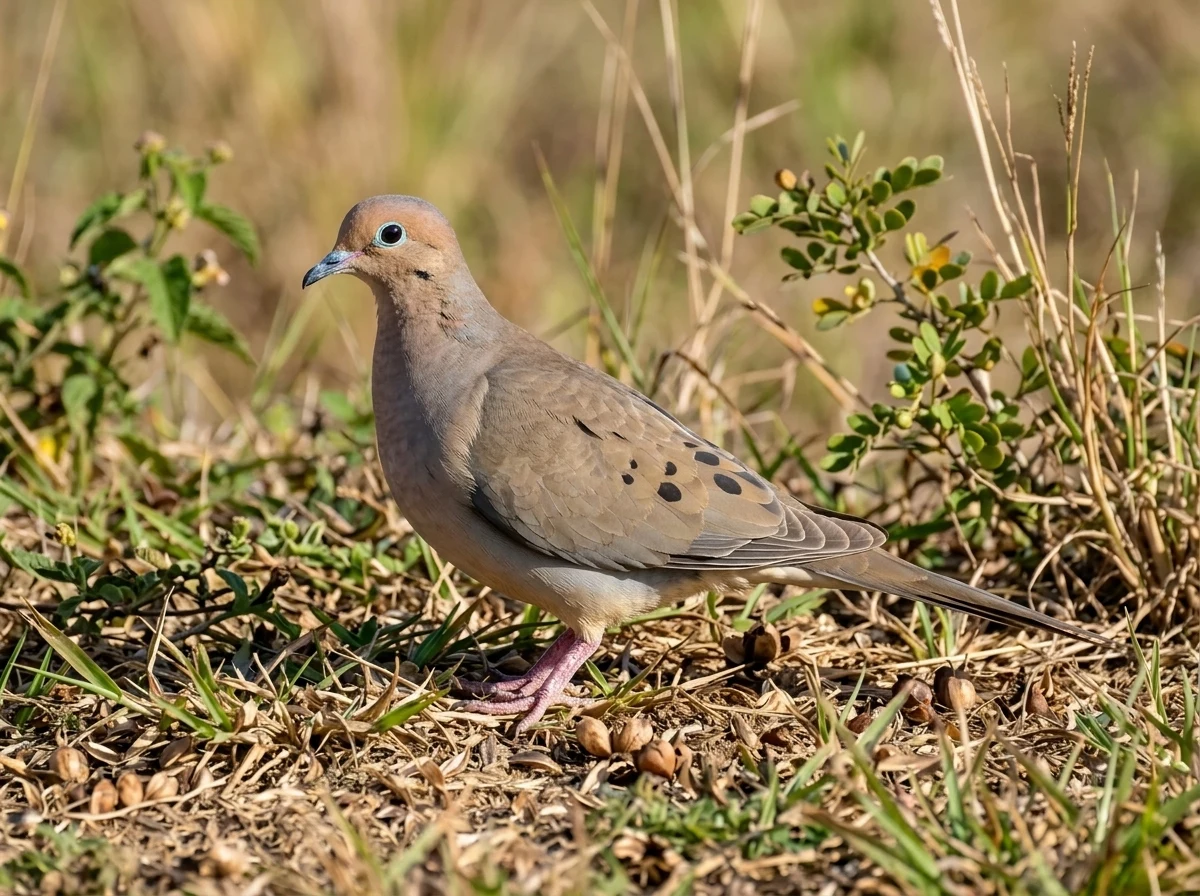 AI
AI01
What is the easiest difference to see between the White-winged Dove and the Mourning Dove?
The wing. The White-winged Dove has a large white patch along the edge of the wing that is visible even when the bird is perched. The Mourning Dove has a brown wing with a few black spots.
02
Does the Mourning Dove always have the longer tail?
The source describes the Mourning Dove's tail as distinctly long and tapered, coming to a point, and the White-winged Dove's as blunt-tipped. It is a useful trait, but it should be confirmed together with the wing and the build.
03
Which of the two is chunkier?
Project FeederWatch describes the White-winged Dove as similar in size to the Mourning Dove, about 12 inches, but chunkier. It describes the Mourning Dove as the smallest of the three species compared, about 12 inches long.
04
Are both species documented in Puerto Rico?
The Puerto Rico bird catalog includes the White-winged Dove and the Mourning Dove as species of native or natural occurrence, with high-confidence review. That catalog information supports their presence; abundance should not be inferred from it.
05
What habitat is associated with each according to the sources?
The Journal of Caribbean Ornithology article states that the White-winged Dove prefers dry forest or a mosaic of agricultural areas within moist forest in Puerto Rico, and in the Lesser Antilles it occurs in open areas at the edges of scrub, often near human settlements. The catalog associates the Mourning Dove with savanna, grasslands, and town-and-garden environments.
Keep exploring
Connected routes
Sources and review
The evidence is one link away.
These sources support the editorial scope of this guide. Bird profiles also retain their own taxonomy, occurrence, and conservation references.
Reviewed:
01↗02↗
Cornell Lab of Ornithology (Project FeederWatch)
Tricky Bird ID: Common Doves
Evidence for cited sections; consult the original document.Journal of Caribbean Ornithology / BirdsCaribbean
Range expansion of White-winged Dove (Zenaida asiatica) in the Lesser Antilles
Evidence for cited sections; consult the original document.The atlas continues