 AI
AIHabitats guide
Host Plants Caterpillars and Birds
A focused guide to the host plant → caterpillar → bird chain, with cited evidence and an observation procedure you can repeat in your own yard.
Reviewed:Prepared with AI assistance and linked sources. Illustrations are not field photographs.
The specific question: what do native plants actually provide?
The core idea is simple: native plants evolved alongside local wildlife and therefore host more insects than introduced plants. Doug Tallamy's work has shown that these trees and shrubs host many more caterpillars, and that yards with more native vegetation host more native bird species. Desiree Narango's research, published in Biological Conservation and reported by Audubon, took that idea down to a single species: the Carolina Chickadee in suburban areas around Washington, D.C.
This guide answers one question: what is the link between a host plant, its caterpillars and birds? It is not a species profile or a plant catalog. It explains why native vegetation works as a pantry of animal protein, especially during breeding, and how you can verify it with your own eyes without inventing data or relying on unsupported numbers.
Habitats guide
Three key takeaways
Más orugas en plantas nativasMeasurable differenceIn Narango's study, most sampled vegetation was introduced and had one caterpillar or less; native oaks yielded twenty or more larvae in five minutes.
Hasta 90% de la dietaInvertebrates in some birdsAudubon reports that invertebrates can make up to 90% of some Carolina Chickadee individuals' diets.
6,000 a 9,000 orugasTo raise a broodPrevious studies cited by Audubon indicate that raising five chickadee nestlings can require 6,000 to 9,000 caterpillars in a season.
01
What 'host plant' means and why it matters
A host plant is one that feeds the larvae of butterflies and moths (and other insects such as sawflies). Not all plants host the same amount. Native species, which share evolutionary history with local insects, tend to support far more larvae than introduced ones. Audubon cites Tallamy's Lepidoptera index: some oaks can host up to 534 species of moths and butterflies (updated to 557), Prunus such as wild cherry and plum up to 456, and maples up to 297.
The practical consequence is direct: if the goal is to feed insectivorous birds during breeding, the identity of the plant matters more than the amount of foliage. A garden dominated by introduced species can look green and lush yet offer very few caterpillars. Tallamy sums it up in the Audubon piece: when landscapes are made of Bradford pear and crape myrtle, 'there are almost no caterpillars.'
02
The evidence: caterpillars, broods and nesting decisions
Narango and Tallamy's study, reported by Audubon, followed chickadees for two years at 97 suburban homes selected through the Smithsonian's Neighborhood Nestwatch Project. The team catalogued the origin of each tree and shrub, searched the leaves of 16 plants per site for caterpillars, and recorded which plants chickadees visited most. The result: chickadees nested more often in yards with an abundance of native trees than in yards with more introduced species. Oaks, cherries, elms and maples were among the top performers because they housed the most moth and sawfly larvae.
The scale of the need is what makes the connection visible. Audubon cites previous studies showing that raising a brood of five chickadees can require 6,000 to 9,000 caterpillars in a season. In addition, invertebrates can make up to 90% of some individuals' diets. Narango observed that the trees her color-banded chickadees visited also attracted warblers, tanagers and orioles: in her words, those birds 'are basically telling us what these other birds want.'
03
The Caribbean context: heritage plants and birds
Narango and Tallamy's evidence comes from temperate North American birds and plants; it is not a study conducted in Puerto Rico. That limit should be stated clearly. What the Caribbean does provide is a regional framework: BirdsCaribbean published the Heritage Plants ebook as a habitat restoration resource for International Migratory Bird Day 2015. The organization describes native plants and trees as 'amongst the most important parts of the natural history and culture of the Caribbean' and as 'immensely important to birds and other wildlife.'
BirdsCaribbean also notes that, in a region supporting irreplaceable biodiversity and dense human development, cultivating native trees and plants is an important way to share the islands with native plants and animals. The book focuses on plants and trees particularly beneficial to native and migratory birds in the Caribbean, and is available in English and Spanish. That is the regional bridge: the same host plant → caterpillar → bird logic, applied to a Caribbean context and to habitat restoration at the scale of a garden, neighborhood or community project.
04
How to observe the connection without inventing data
You can turn the idea into a repeatable observation. The procedure is simple and needs no specialized equipment: choose two plants of comparable size, one native and one introduced, and check ten leaves of each for five minutes per plant. Count visible caterpillars or larvae, note the date, time, plant type and whether birds were foraging nearby. Repeat the exercise on at least three different days and keep your notes. What you are doing is a local comparison, not a controlled experiment; present it as such.
A useful checklist: (1) identify the plant with a guide or botanical garden; (2) check the underside of leaves, tender stems and buds; (3) record leaf damage, which suggests larval activity; (4) note whether you saw birds searching for insects in the foliage; (5) separate what you observed from what you know from sources. The distinction matters: a species' presence in the Puerto Rico bird catalog is an occurrence record, not proof that the species feeds on a specific caterpillar in your yard. That separation between catalogued occurrence and global biology is exactly what this guide asks you to maintain.
05
Two Puerto Rico birds and the logic of the food chain
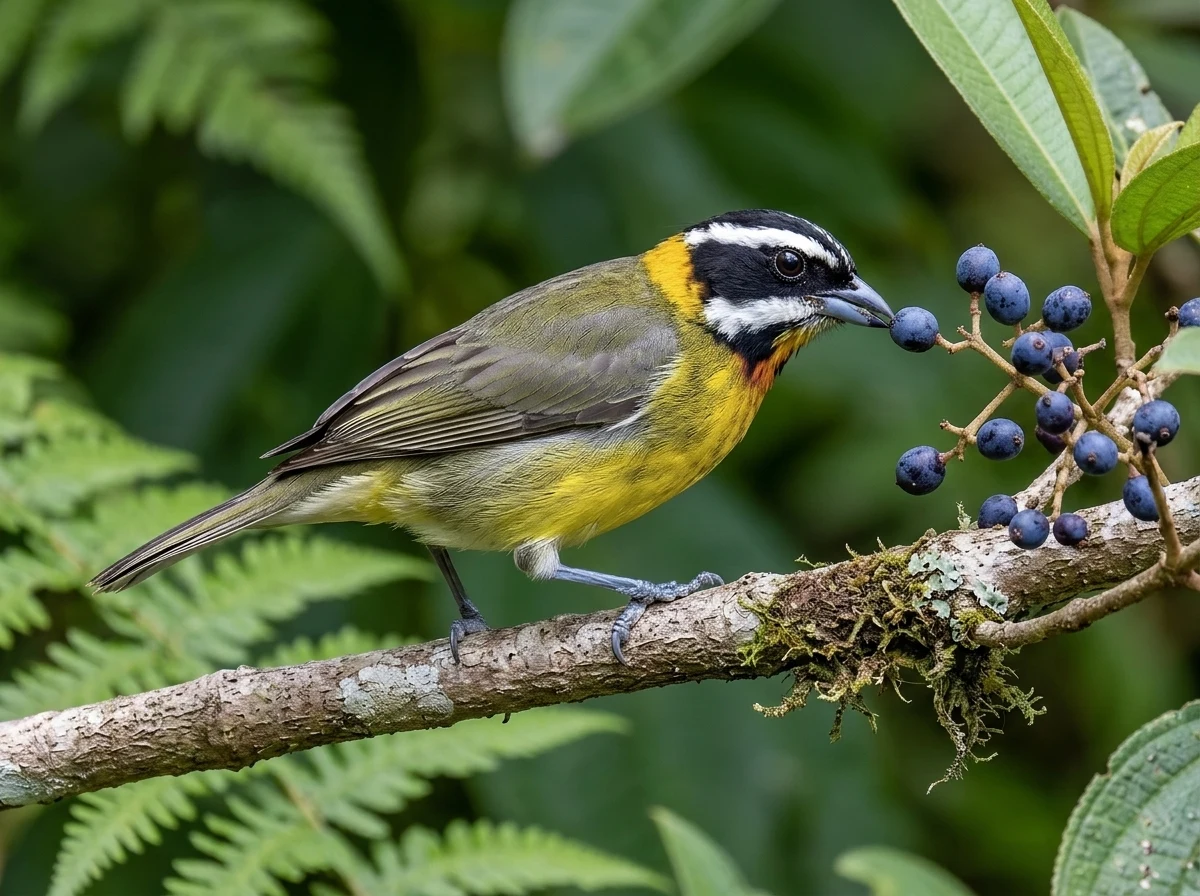
The catalog describes the Puerto Rican Spindalis (Spindalis portoricensis) as endemic to Puerto Rico, widely distributed, with a fruit diet and an important role in seed dispersal and plant reproduction. It also describes the Bananaquit (Coereba flaveola) as native, resident and nectarivorous, present in nearly all wooded and human-modified habitats, including gardens. Those descriptions are of occurrence and general traits; they do not claim that these birds depend on caterpillars in Puerto Rico.
The connection to this guide is conceptual and should be presented honestly. Narango and Tallamy's evidence shows that caterpillars are a critical resource for birds raising nestlings, and that native plants produce more caterpillars. In Puerto Rico, the Spindalis and Bananaquit illustrate two different trophic routes: fruit and nectar. Both may benefit indirectly from a landscape with more insects and more native plants, but these sources do not include a local study measuring how many caterpillars they consume. The guide must not turn that possibility into a fact.
Linked profiles
Birds mentioned in this guide
Two native Puerto Rico birds that illustrate different trophic routes: fruit and nectar. Their presence in the catalog does not imply they depend on caterpillars.
AI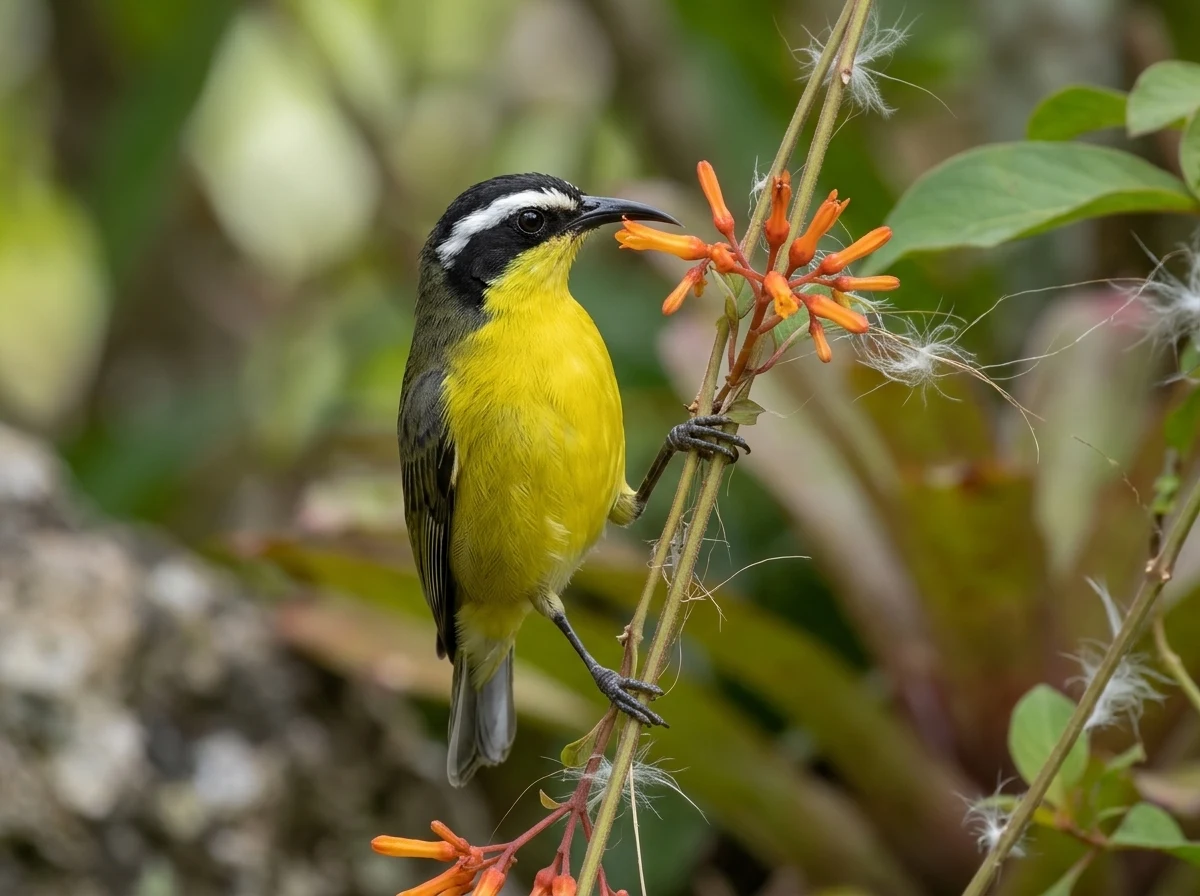 AI
AI01
Do native plants always have more caterpillars than introduced ones?
It is not an absolute rule, but the Audubon evidence points that way. In Narango's study, most sampled vegetation was introduced and had one caterpillar or less, while native oaks yielded twenty or more larvae in five minutes. Tallamy notes that unrelated introduced species are even worse. The comparison depends on the specific species and location.
02
How many caterpillars does a bird need to raise its nestlings?
Audubon cites previous studies indicating that raising a brood of five chickadees can require 6,000 to 9,000 caterpillars in a season. That figure applies to the Carolina Chickadee in temperate North America, not to a Puerto Rico bird. It should not be presented as a local figure.
03
Do the Puerto Rican Spindalis and Bananaquit eat caterpillars in Puerto Rico?
The catalog describes the Spindalis as having a fruit diet and the Bananaquit as nectarivorous. It does not state that they consume caterpillars in Puerto Rico, and the sources for this guide contain no local study measuring it. The connection to the caterpillar chain is conceptual, not a documented fact for these two species on the island.
04
Can I use BirdsCaribbean's Heritage Plants book to choose plants?
Yes. BirdsCaribbean describes it as a habitat restoration resource created for International Migratory Bird Day 2015, focused on plants and trees particularly beneficial to native and migratory birds in the Caribbean. It is available for free download in English and Spanish. It is a regional starting point, not an effectiveness study in Puerto Rico.
05
How do I distinguish an occurrence record from a claim about biology?
An occurrence record says a species is present in a place or in a catalog. A claim about biology says what it eats, how it nests or what it depends on. In this guide, the presence of the Spindalis and Bananaquit in the Puerto Rico catalog is occurrence; the evidence about caterpillars and breeding comes from studies in temperate North America. Keeping that separation prevents false conclusions.
Keep exploring
Connected routes
Sources and review
The evidence is one link away.
These sources support the editorial scope of this guide. Bird profiles also retain their own taxonomy, occurrence, and conservation references.
Reviewed:
01↗02↗
National Audubon Society (Audubon Magazine)
New Research Further Proves Native Plants Offer More Bugs for Birds
Evidence for cited sections; consult the original document.BirdsCaribbean
Resources (incl. Heritage Plants eBook on native Caribbean trees and birds)
Evidence for cited sections; consult the original document.The atlas continues