 AI
AIIntroduced species · Grassland birds
Pin-tailed Whydah in Puerto Rico: the long-tailed African newcomer
A small grassland bird that builds no nest: the male dances in the air with its ribbon tail and the female leaves her eggs for other birds to raise.
Reviewed:What is the Pin-tailed Whydah?
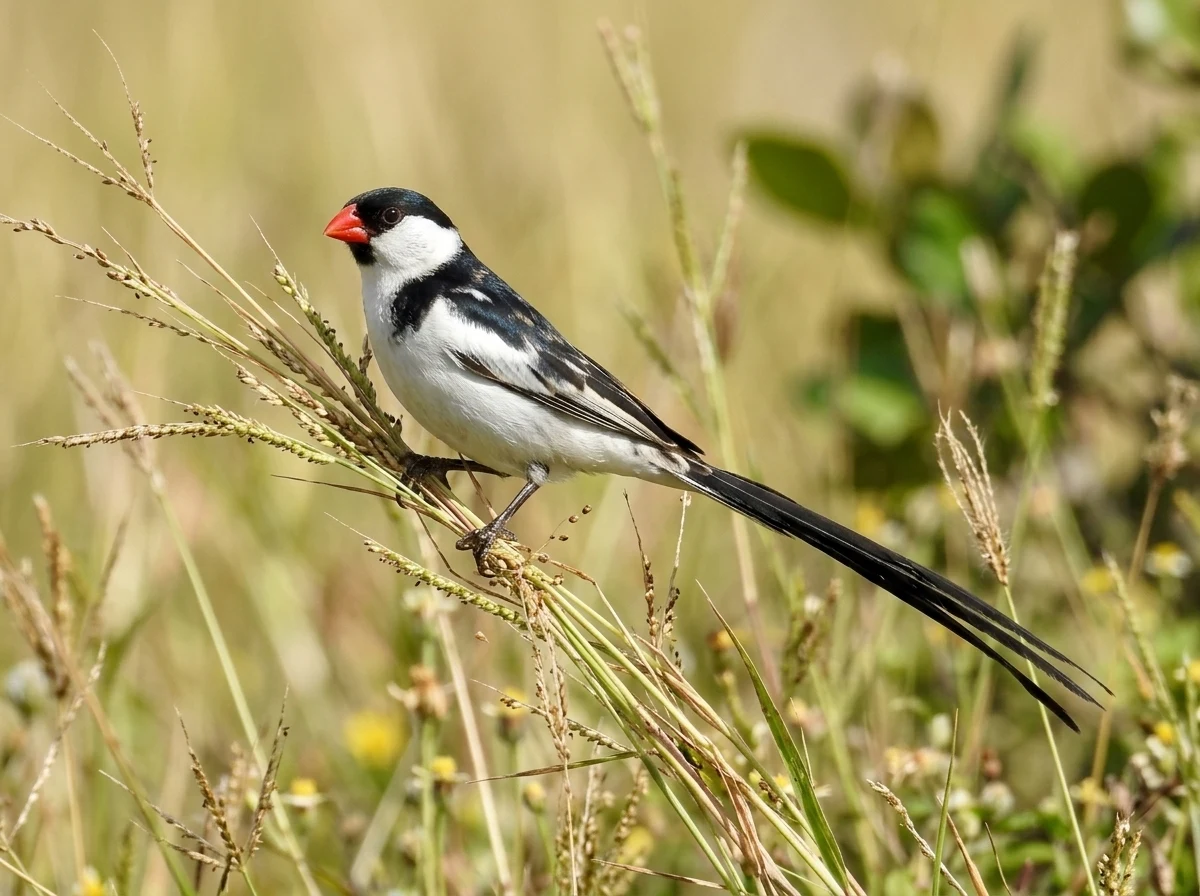
The Pin-tailed Whydah (Vidua macroura, viuda colicinta) is a small African bird introduced to Puerto Rico, probably in the 1960s through the pet trade; the first reported sighting was in 1971. The breeding male is black and white, with a red bill and extremely long tail feathers; females are brown.
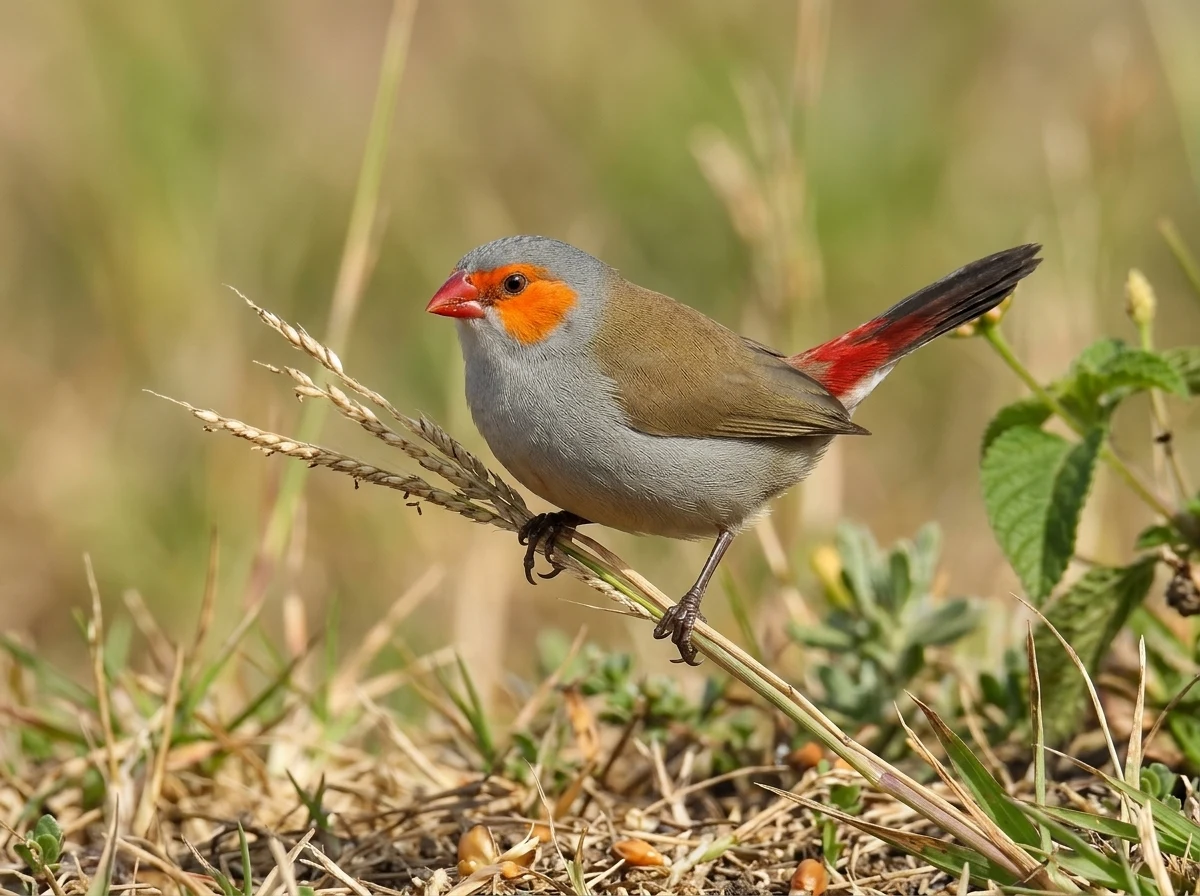
It is an obligate brood parasite: it builds no nest and lays its eggs in other birds' nests. In Puerto Rico it mainly uses the nests of the Orange-cheeked Waxbill (Veterano), another introduced African finch. Today it is an uncommon, local resident of the coastal plains and of grasslands, lawns, and farms, with records in the mountainous interior as well. It is not native, not threatened, and not protected locally as an endangered species.
Introduced species · Grassland birds
The Pin-tailed Whydah by the numbers
1971first reported sightingProbably introduced in the 1960s, apparently from Senegal.
168atlas hexagons35% of 479, from 281 records, with breeding confirmed in 17.
20+known host speciesFrom four families; in Puerto Rico it mainly parasitizes the Orange-cheeked Waxbill.
01
How to identify a Pin-tailed Whydah
The breeding male is unmistakable: black-and-white body, red bill, and very long, thin central tail feathers that ripple in flight. It is a small bird of about 15 g, so the tail looks out of proportion to the body.
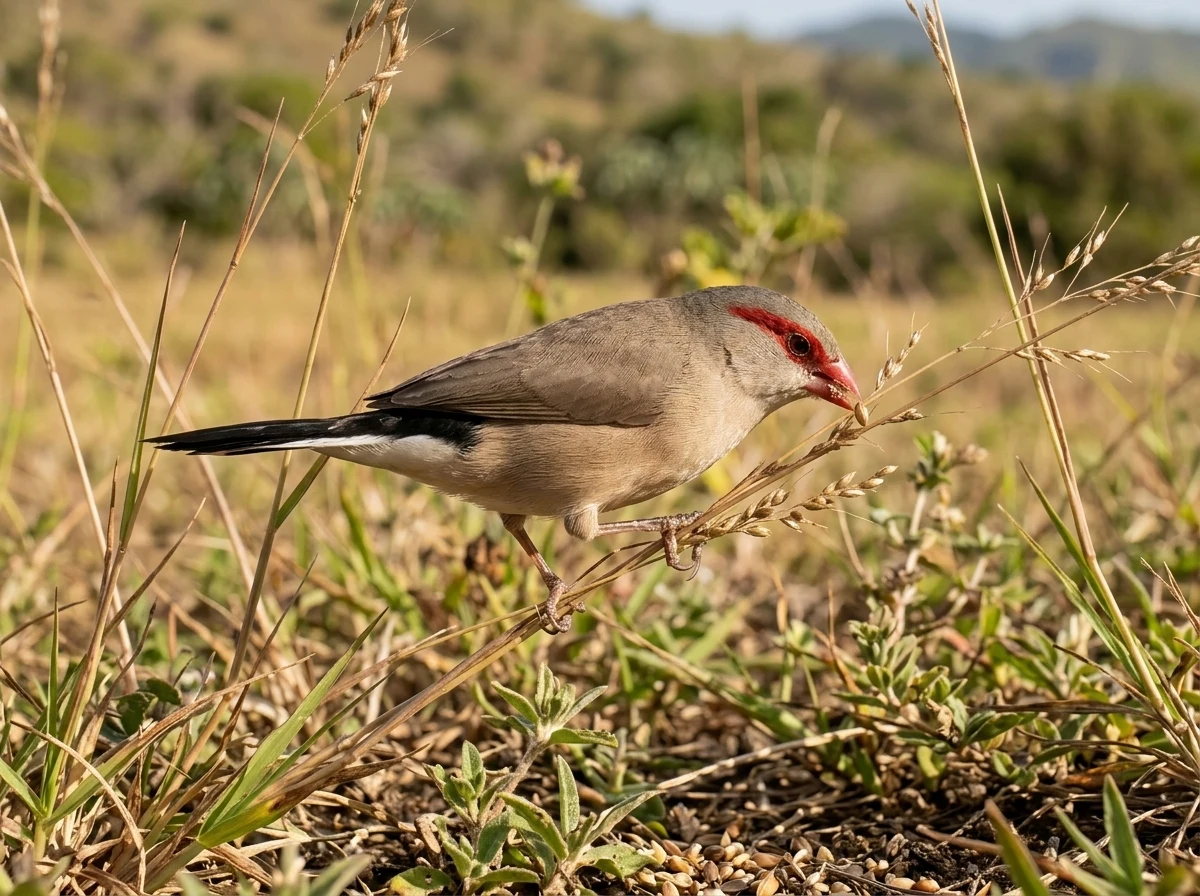
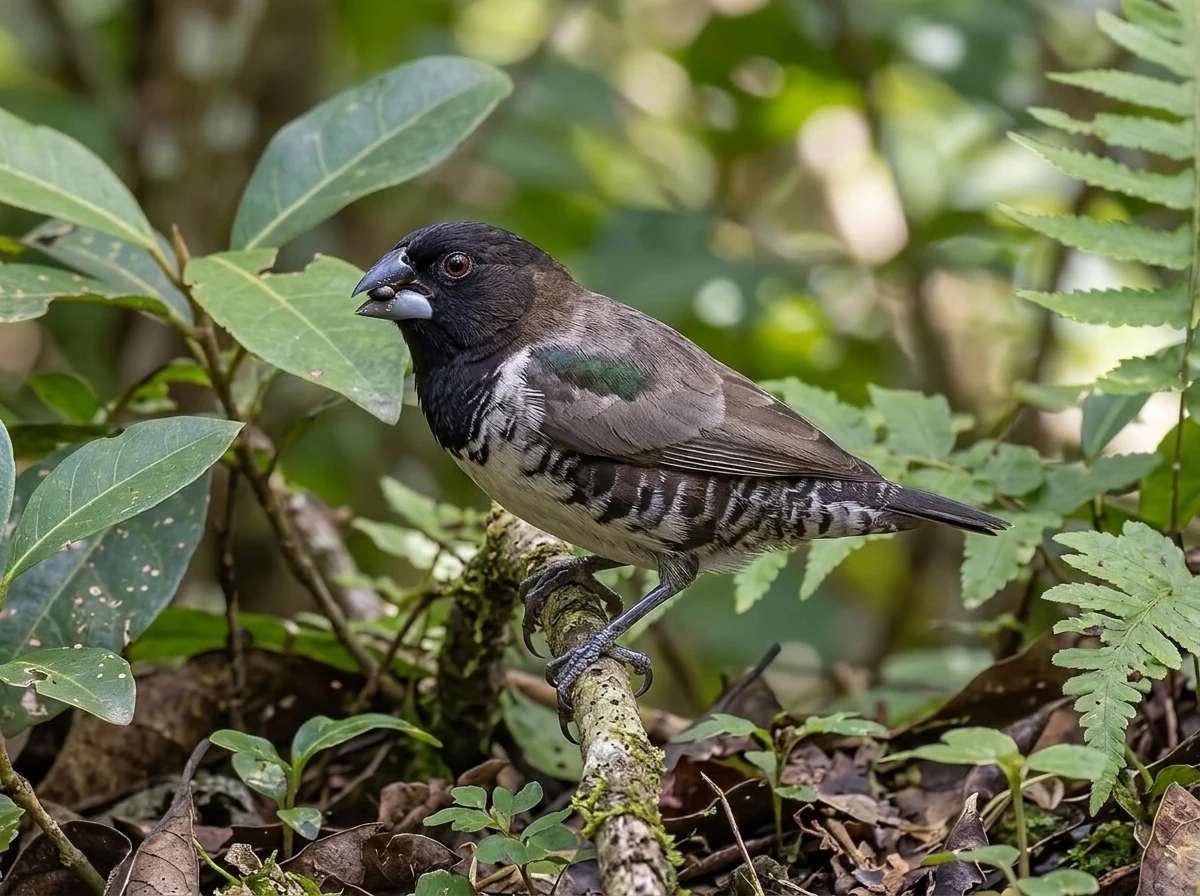
Females and non-breeding males look alike: warm brown above, a red bill, and black-and-white stripes on the face. Without the long tail they can be confused with other introduced grassland finches such as waxbills, mannikins, or munias; the red bill combined with the striped head pattern is the key.
02
How it reached Puerto Rico
The Pin-tailed Whydah is native to Africa south of the Sahara. Birds of the World says it was probably introduced to Puerto Rico in the 1960s, apparently from Senegal, and the first reported sighting dates from 1971. A study in The Condor attributes its arrival to accidental escapes and releases from the pet trade in the 1960s and 1970s.
Puerto Rico is one of two places in the Americas where it has established a viable breeding population; the other is most likely southern California. The same study modeled where else it could establish: the host-based model performed best, and the most important variable was the presence of the Common Waxbill (Estrilda astrild), followed by the Bronze Mannikin (Diablito), which is also introduced in Puerto Rico.
03
A brood parasite: the link with the Orange-cheeked Waxbill
The Pin-tailed Whydah builds no nest. The female lays her eggs in other birds' nests, and those birds raise the chicks as their own. In Africa its most common host is the Common Waxbill, and more than 20 host species from four families are known in all.
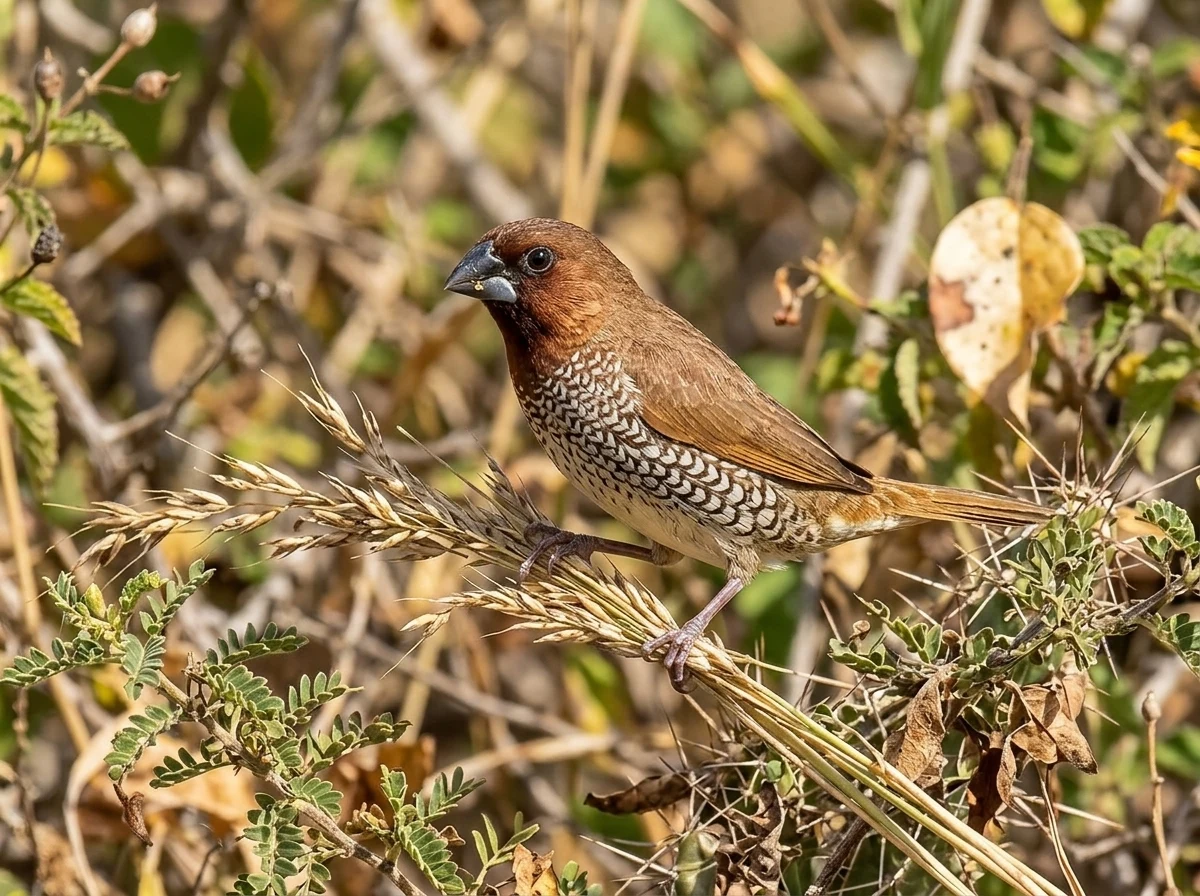
In Puerto Rico it mainly parasitizes the Orange-cheeked Waxbill (Veterano), an African finch introduced to the island before 1874 and common on the coastal plains. An introduced parasite finding an introduced host shows that every step of an invasion can happen. In California it has been documented using the Scaly-breasted Munia (Gorrión Canela), a new host for the species.
04
Where to see a Pin-tailed Whydah in Puerto Rico
It is most common in the lowlands, in grasslands, lawns, and short-grass fields. A well-known spot is the pastures and fence lines near La Parguera, in Lajas. It has also reached Vieques, where it is a fairly recent arrival. The atlas recorded it in 168 of 479 hexagons, mostly in the subtropical moist forest life zone (72% of breeding hexagons) and on the dry-forest coastal plains (21%).
Look for males perched on fences, low wires, or isolated shrubs near grass. Females and short-tailed males go unnoticed among flocks of other small seed-eaters in the grass. After Hurricanes Irma and María in 2017, the Fajardo Christmas Bird Count recorded a decline, although large groups have since been seen in the southwest.
05
Breeding season and song
Published reports placed breeding from April to November. The atlas found activity throughout the year, with most records from May to July and a peak in June, a pattern that matches the busiest season of its main host, the Orange-cheeked Waxbill, whose breeding is also concentrated from March to July.
In season, long-tailed males become far more visible on exposed perches such as fences and low wires. The species page includes a recording with a spectrogram so you can learn its voice before heading out; use it for comparison, not to lure birds with repeated playback.
06
Viuda, viuda colicinta, and other name mix-ups
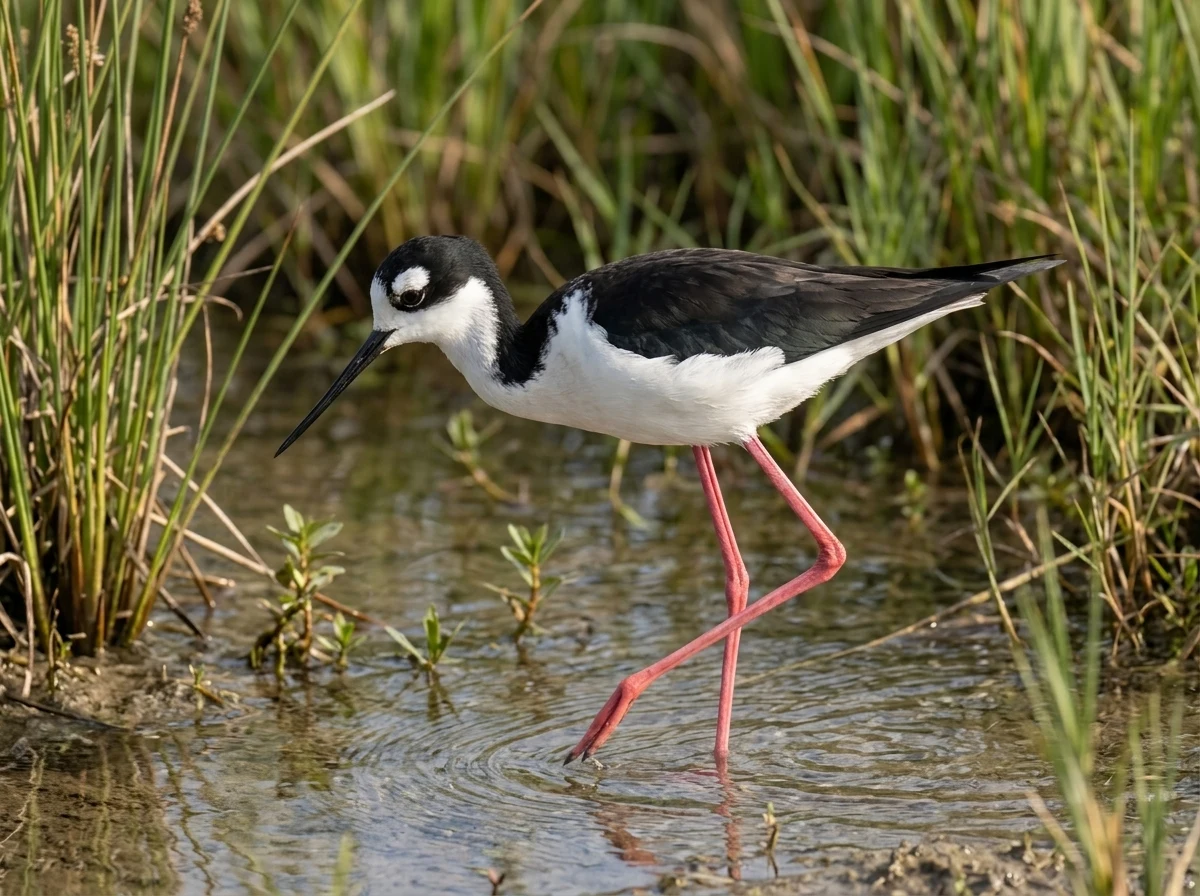
In the Puerto Rico Ornithological Society's official catalog, 'Viuda' on its own is not this bird: it is the Black-necked Stilt, a very long, pink-legged shorebird of lagoons and salt flats. The Viuda Colicinta appears in the same catalog as an 'Introduced' species, alongside the Orange-cheeked Waxbill (Veterano).
If you search for 'pájaro viuda' in Puerto Rico, think about habitat: a black-and-white bird wading in shallow water is the stilt (Viuda); a small bird with a ribbon tail in a grassy field is the Pin-tailed Whydah (Viuda Colicinta). The whydah is Least Concern on the IUCN Red List and is not on the DNER or federal threatened-species lists.
Linked profiles
The whydah and its grassland neighbors
Compare the whydah with its host, other introduced grassland finches, and the stilt that shares the 'viuda' name.
Sound archive
Hear its voice
Explore real songs and calls. The spectrogram turns each sound into a visual trace of time and frequency.
XC1037320Recording 1 of 3song

Play: song by Filippo Ceccolini
Choose another recording
Sound recorded by Filippo Ceccolini · XC1037320 · CC BY-NC-SA 4.0. Visualization by Stichting Xeno-canto voor Natuurgeluiden.
Every recording retains the creator, catalogue number, and license published by Xeno-canto. Metadata via GBIF ↗
01
What is a Pin-tailed Whydah?
The Pin-tailed Whydah (Vidua macroura) is a small African bird introduced to Puerto Rico, probably in the 1960s; the first reported sighting was in 1971. The breeding male is black and white with a red bill and a very long tail.
02
Is the Pin-tailed Whydah native to Puerto Rico?
No. It is native to Africa south of the Sahara and reached Puerto Rico through the pet trade. The Puerto Rico Ornithological Society's official catalog classifies it as an introduced species.
03
Does the Pin-tailed Whydah build a nest?
No. It is an obligate brood parasite: the female lays her eggs in other birds' nests. In Puerto Rico it mainly uses the nests of the Orange-cheeked Waxbill (Veterano), another introduced African finch.
04
Where can you see a Pin-tailed Whydah in Puerto Rico?
It is most common in the lowlands, in grasslands, lawns, and short-grass fields. The pastures and fence lines near La Parguera, in Lajas, are a well-known spot, and it has also established on Vieques.
05
Is the viuda colicinta the same as the viuda?
No. In Puerto Rico, 'Viuda' is the Black-necked Stilt, a lagoon shorebird. The Viuda Colicinta is a small introduced African grassland bird whose male has a long tail.
06
Is the Pin-tailed Whydah harmful?
In Puerto Rico it mainly parasitizes another introduced bird, the Orange-cheeked Waxbill. Researchers warn that it can switch to new hosts, as happened in California with the Scaly-breasted Munia, so it is worth documenting where and with which species it breeds.
Keep exploring
Connected routes
Sources and review
The evidence is one link away.
These sources support the editorial scope of this guide. Bird profiles also retain their own taxonomy, occurrence, and conservation references.
Reviewed:
01↗02↗03↗04↗05↗
Cornell Lab of Ornithology
Pin-tailed Whydah in Birds of the World
Breeding male and female plumage, probable 1960s introduction (apparently from Senegal), first reported sighting in 1971, and local status on the coastal plains.The Condor (American Ornithological Society)
The establishment threat of the Pin-tailed Whydah in North America and the Antilles
Obligate brood parasitism, more than 20 host species, introduction to Puerto Rico through the pet trade, and parasitism of Orange-cheeked Waxbill.USDA Forest Service, International Institute of Tropical Forestry
The Puerto Rico Breeding Bird Atlas (PDF)
Species accounts: distribution, habitat, record and hexagon counts, nesting months, nests, Pin-tailed Whydah parasitism of Orange-cheeked Waxbill, and share of protected habitat.Sociedad Ornitológica Puertorriqueña
Catalog of the Birds of Puerto Rico
Official local names: Guabairo (de Puerto Rico), Yaboa Común, Yaboa Real, Yaboa Americana, Garza Real, Martinete, Comeñame, Zorzal Pardo/Chucho, Zorzal Patirrojo, Viuda, Viuda Colicinta, and Veterano.Xeno-canto Foundation / GBIF
Xeno-canto recordings published through GBIF
Metadata, authorship, licenses, and catalogue records for field recordings used by the atlas.The atlas continues