 AI
AIBehavior guide
What Nectar Robbing Means in Birds
Robbing nectar is not the same as pollinating. Here is what it means, how to recognize it in the field, and how to compare two flower visitors in Puerto Rico.
Reviewed:Prepared with AI assistance and linked sources. Illustrations are not field photographs.
The short answer
Nectar robbing happens when a bird takes nectar from a flower without entering through the normal opening or touching the reproductive parts in the way that produces pollination. The most cited form is primary or active robbing: the bird pierces the base of the corolla tube to reach the nectar. Secondary robbing occurs when the bird uses a hole already made by another organism.
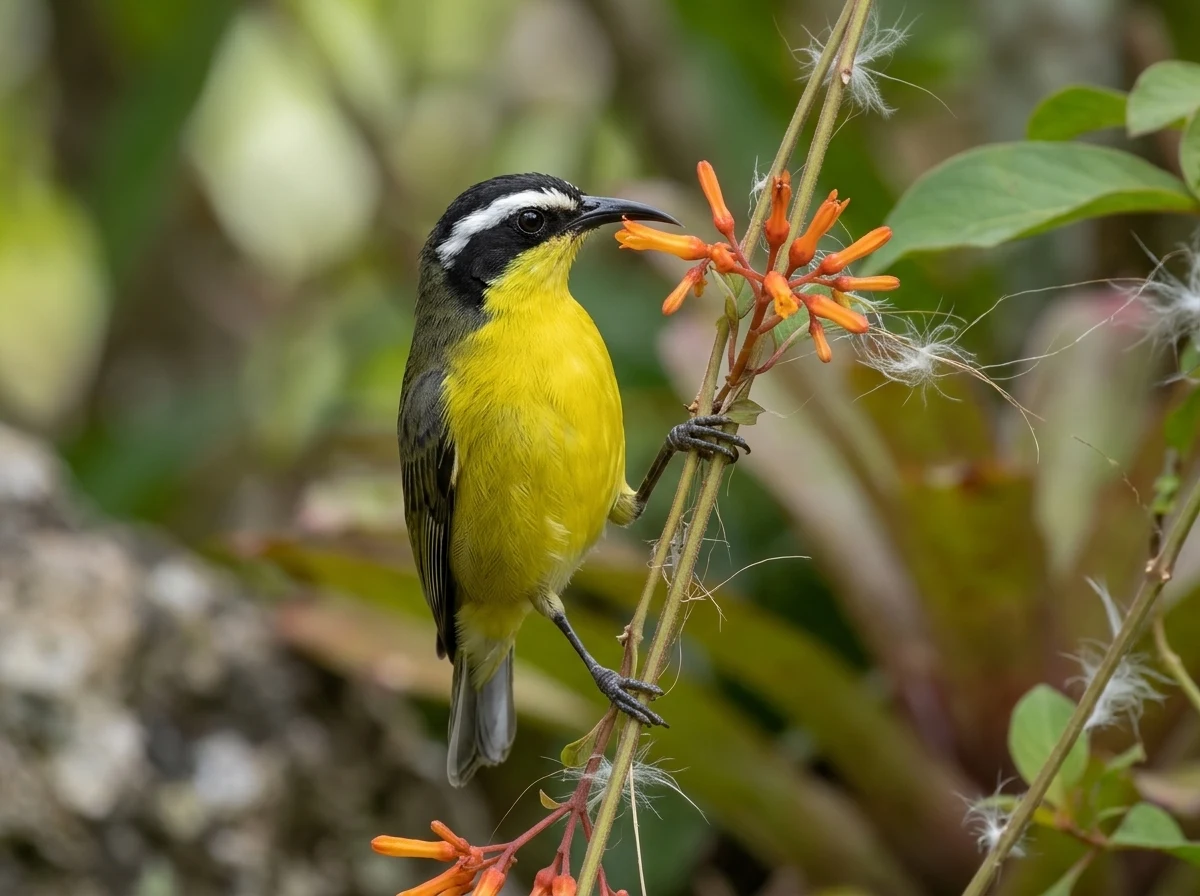
The key is not the bird species but the interaction. The same species can pollinate short flowers and rob long ones. So watch the flower, the bird's posture, and whether it contacts stamens or stigma. In Puerto Rico, the Bananaquit (Coereba flaveola) is documented as a nectar robber of flowers visited by the Puerto Rican Emerald, and the Puerto Rican Mango (Anthracothorax aurulentus) is a resident endemic nectarivore.
Behavior guide
Three ideas to remember
Perforar vs. entrarTwo routes to nectarPrimary robbing means piercing the corolla base; secondary robbing uses an existing hole.
No siempre es dañoThe effect depends on the flowerIf reproductive parts are not destroyed, robbing may not be negative for the plant.
Observa la florThe evidence is in the tubeLook for holes at the corolla base and the bird's feeding posture.
01
What counts as nectar robbing
Nectar robbing is defined by the route the visitor uses. In a legitimate visit, the bird inserts its bill through the flower opening and its head or body brushes the stamens and stigma, depositing or picking up pollen. In primary robbing, the bird pierces the base of the corolla tube and extracts nectar without passing through that route. In secondary robbing, it uses a hole made earlier by another animal.
Not every visit that looks like robbing is robbing. A short-billed bird may push its bill deeply into a dorsally open corolla and reach nectar without piercing anything. That is not primary robbing, but it can fail as pollination if it does not touch the reproductive parts. The distinction matters because the effect on the plant depends on contact with stamens and stigma, not only on whether the bird pierced the flower.
02
Comparison: morphological fit and outcome
A study in Costa Rica compared the Lesser Violetear (Colibri cyanotus) and the Slaty Flowerpiercer (Diglossa plumbea) at flowers of Lobelia laxiflora. In that study, the flowerpiercer did not pierce the flowers: it pushed its bill deeply into the dorsally open corolla tube, often from the side, reducing the effective corolla length to reach nectar. The hummingbird had a bill about 2.1 cm long that matched the 1.86 cm corolla tube; it visited male and female flowers equally and deposited pollen on its head. The flowerpiercer had a much shorter bill (mean exposed culmen 0.78 cm), perched instead of hovering, and preferred the lowest, mostly female flowers.
In that system, hummingbird visits produced 84.1 % fruit set. In the single-visit experiment, 18 flowers visited by the flowerpiercer produced no fruit; the flowerpiercer was a rare secondary visitor. The authors concluded that the flowerpiercer did not act as a pollinator in that population. This shows that nectar robbing is not a fixed label for a species: it depends on morphological fit and the bird's behavior at each flower.
03
How to recognize it in the field
Look at the flower first, not the bird. Long tubular corollas are frequent candidates. Examine the base of the tube in good light or with a hand lens: a small, clean hole at the base, often on the side, suggests primary robbing. Several holes on different flowers of the same plant suggest repeated visits. If the hole has dark or irregular edges, it may be old or enlarged by another visitor.
Then watch the posture. A bird that perches below or beside the flower and pushes its bill toward the base is likely robbing. A bird that hovers in front of the opening and inserts its bill through the center is likely a legitimate visitor. Note whether the head touches the stamens or stigma. That note turns a casual observation into useful pollination data.
04
A Puerto Rico observation exercise
Choose a flowering shrub or tree in your yard, garden, or park and spend 15 minutes watching without intervening. Use this concrete checklist: 1) Which bird species visits the flowers? 2) Does it hover or perch? 3) Does it insert its bill through the opening or push it toward the base? 4) Is there a visible hole at the corolla base? 5) Does the bird's head touch the stamens or stigma? 6) How many flowers does it visit per minute?
Repeat the exercise on two different days and compare. You do not need to identify every plant to species to practice; distinguishing long tubular flowers from open or short flowers is enough. If you see a Bananaquit, remember the source describes it as a nectar robber of flowers visited by the Puerto Rican Emerald and notes it pierces the base of long tubular corollas. If you see a Puerto Rican Mango, note whether it visits flowers legitimately or uses existing holes. Avoid playback and do not touch the flowers; quiet observation is enough.
05
Why it matters for plants
From the plant's perspective, nectar robbing is not necessarily negative if the reproductive parts are not destroyed. The Lobelia laxiflora study notes that robbing can reduce nectar quality and quantity and make flowers less attractive to territorial pollinators. That can increase visits by non-territorial pollinators that move among more plants and favor cross-pollination.
But robbing can also have direct effects. The authors cite cases of movement-induced self-pollination and accidental pollination when the bird touches stigmas and stamens while piercing. The practical conclusion is that the effect cannot be assumed: you have to observe contact with the reproductive parts and, when possible, the outcome in fruits or seeds.
Linked profiles
Related birds
Two Puerto Rico nectarivores that help you practice the difference between robbing nectar and pollinating.
AI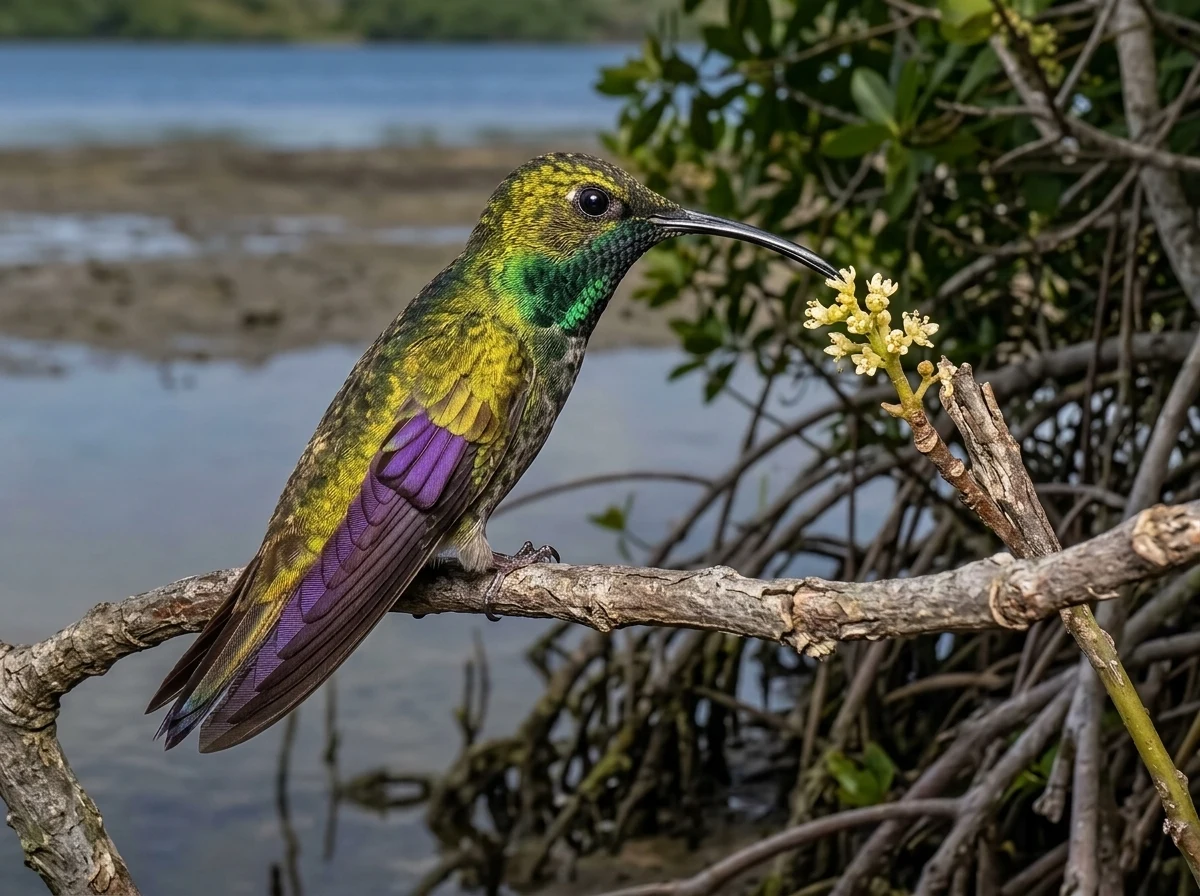 AI
AI01
Does nectar robbing always damage the flower?
Not necessarily. The source states that robbing is not necessarily negative for the plant if the reproductive parts are not destroyed. The effect depends on whether the bird touches stamens and stigma and whether the hole affects reproductive tissue.
02
Is the Bananaquit always a nectar robber?
No. The source describes it as a nectar robber of flowers visited by the Puerto Rican Emerald and notes it pierces the base of long tubular corollas. It also visits short flowers legitimately and eats insects, spiders, and fruit. The behavior depends on the flower.
03
How do I tell primary from secondary robbing?
Primary robbing is when the bird pierces the flower. Secondary robbing is when it uses a hole already made by another organism. In the field, a hole with fresh edges and the bird pushing its bill toward the base suggests primary robbing; an old or irregular hole suggests secondary.
04
Can I do this exercise in my yard?
Yes. The Bananaquit inhabits nearly all wooded and human-modified habitats, including gardens, and the Puerto Rican Mango uses forest edge, gardens, and coastal scrub. Watch without playback, do not touch the flowers, and note the bird's posture and contact with reproductive parts.
Keep exploring
Connected routes
Sources and review
The evidence is one link away.
These sources support the editorial scope of this guide. Bird profiles also retain their own taxonomy, occurrence, and conservation references.
Reviewed:
01↗02↗
PMC / Integrative Organismal Biology (peer-reviewed)
Pollination efficiency of hummingbirds and flowerpiercers at Lobelia laxiflora
Evidence for cited sections; consult the original document.Celebrate Urban Birds, Cornell Lab of Ornithology
Bananaquit
Evidence for cited sections; consult the original document.The atlas continues