 AI
AIHabitat guide
Why Dead Trees Matter to Birds
A standing dead tree is not a useless tree: it is shelter, pantry and carpentry workshop for birds.
Reviewed:Prepared with AI assistance and linked sources. Illustrations are not field photographs.
The tree that is still alive for birds
When a tree dies but remains standing, foresters call it a snag. At first glance it looks like a dry trunk, but for many birds it is one of the most valuable places in the forest. Snags enrich soil, sequester carbon, prevent erosion and provide habitat for a large part of the ecosystem's wildlife, including several bird species (c300-why-dead-trees-matter-to-birds-s1).
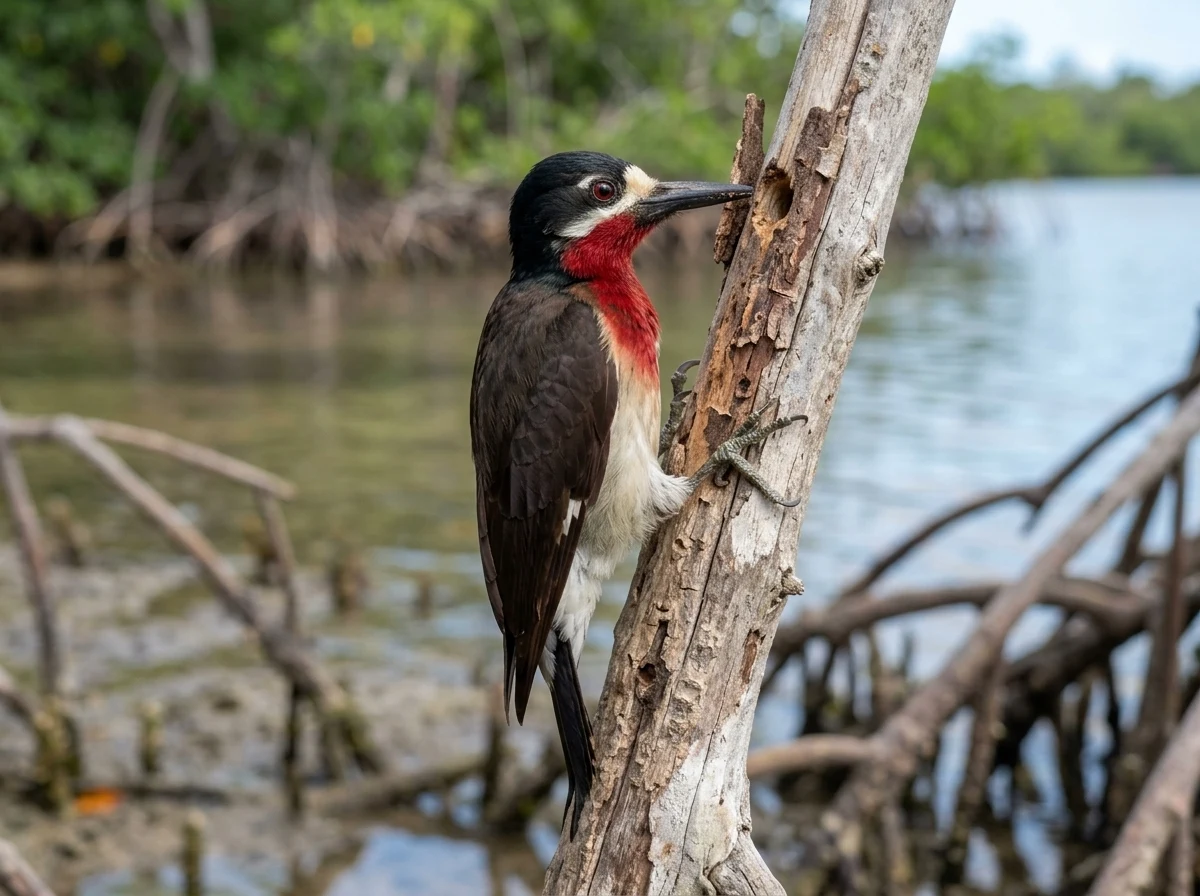
In Puerto Rico, the Puerto Rican Woodpecker (Melanerpes portoricensis) is the only resident woodpecker in the archipelago and a clear example of this relationship. It lives in dry and moist forests, mangroves, plantations, parks and gardens, and nests in tree cavities, stumps and poles (c300-why-dead-trees-matter-to-birds-s4). Understanding why dead trees matter helps interpret what we see in the field and make better decisions in yards and farms.
Habitat guide
Three key ideas
Hasta un tercioof wildlifeSnags can provide habitat for up to one-third of the ecosystem's wildlife, including birds (c300-why-dead-trees-matter-to-birds-s1).
Hasta 45%of birds depend on snagsIn some forests, up to 45% of bird species use snags for nesting, roosting, foraging or perching (c300-why-dead-trees-matter-to-birds-s1).
Carpinterokeystone speciesWoodpeckers are keystone species: their abandoned cavities serve other birds and mammals (c300-why-dead-trees-matter-to-birds-s2).
01
What a snag is and why it is not a useless tree
A snag is a dead or dying tree that remains standing. They come in many forms: dried by drought, disease, lightning, old age or fire. How long one lasts depends on species, size and local climate; some aspen and birch may stand for a decade, while a large conifer can last more than a century (c300-why-dead-trees-matter-to-birds-s1).
At every stage of decomposition, the snag benefits the ecosystem. Its softened wood makes cavity excavation easier, its insects feed insectivorous birds and its dry branches serve as perches. That is why a standing dead tree can be one of the most valuable trees in the forest (c300-why-dead-trees-matter-to-birds-s2).
02
The woodpecker as forest architect
Woodpeckers excavate cavities for nesting. A pair uses the hole for one season and carves a new one the following spring. But unlike most birds' nests, that cavity has a long useful life: it becomes a nest or roost for small owls, ducks, swifts, bluebirds, swallows, wrens and other animals (c300-why-dead-trees-matter-to-birds-s2).
That is why they are called keystone species. A dead tree, broken at the top and perforated with several cavities, can work like a multi-story building for wildlife. In Puerto Rico, the Puerto Rican Woodpecker is the only resident woodpecker and nests in tree cavities, stumps and poles (c300-why-dead-trees-matter-to-birds-s4). Its presence depends on suitable trees for excavation.
03
Food, perches and life cycles
Snags are not only for nesting. They are also pantries. Insects that colonize dead wood — bark beetles, wood borers and others — attract birds that feed on them. In ponderosa pine forests, woodpecker foraging is most intense during the first three years after a tree dies, when insects are abundant (c300-why-dead-trees-matter-to-birds-s3).
Dry branches also offer perches for hunting, watching or resting. In Florida, a study found that the probability of American Kestrel occupancy was 70% in plots with five snags per hectare, compared to 30% in plots with one snag (c300-why-dead-trees-matter-to-birds-s1). A single dead tree is not enough: many birds look for a neighborhood with several.
04
How to observe birds at dead trees without harming them
Birdwatching at snags requires patience and distance. Choose a standing dead tree visible from a trail or forest edge. Watch it for several minutes without getting too close: birds using cavities are sensitive to human presence near the nest. Use binoculars to scan the trunk for holes, cracks and excavation marks.
A simple procedure: first, scan the tree from top to bottom and note whether there are cavities, loose bark or broken branches. Second, wait quietly and record which birds perch, enter or leave. Third, repeat the visit at different times of day and in different seasons, because use of the tree changes with the birds' life cycle. Do not touch the tree or the cavities: its structure is fragile and may hold active nests.
You can use this checklist on your outings: is the tree standing? Does it have visible cavities? Are there insects or signs of foraging? Did you observe birds entering or leaving? Did you note the time and weather? These notes, repeated over time, help understand how snags are used in your area.
Linked profiles
The bird of this guide
The Puerto Rican Woodpecker is the only resident woodpecker in the archipelago and depends on cavities in trees, stumps and poles.
AI01
What exactly is a snag?
A snag is a dead or dying tree that remains standing. It may have died from drought, disease, lightning, old age or fire, and how long it lasts depends on species, size and local climate (c300-why-dead-trees-matter-to-birds-s1).
02
Why are woodpeckers important for other birds?
Because they excavate cavities that, once abandoned, serve as nests or roosts for other birds and mammals. That is why they are called keystone species (c300-why-dead-trees-matter-to-birds-s2).
03
How long does a dead tree take to become useful for nesting?
It depends on how it died. In ponderosa pine forests, trees killed by bark beetles may provide cavities from about five years after death, while girdled trees can take six to eight years (c300-why-dead-trees-matter-to-birds-s3).
04
Should I leave a dead tree in my yard?
If the tree does not pose a risk to people or property, leaving it standing can benefit birds. If it must be cut, consider leaving part of the trunk as a snag, because it will help woodpeckers and the species that depend on them (c300-why-dead-trees-matter-to-birds-s2). Safety always comes first; evaluate with a professional if the tree is near homes or roads.
05
Does the Puerto Rican Woodpecker use dead trees?
Yes. The Puerto Rican Woodpecker nests in tree cavities, stumps and poles, and lives in dry and moist forests, mangroves, plantations, parks and gardens (c300-why-dead-trees-matter-to-birds-s4). Standing dead trees are part of that set of substrates.
Keep exploring
Connected routes
Sources and review
The evidence is one link away.
These sources support the editorial scope of this guide. Bird profiles also retain their own taxonomy, occurrence, and conservation references.
Reviewed:
01↗02↗03↗04↗
Audubon
Dead Trees Support a Bounty of Birdlife, but Preserving Them Isn't Always Clear Cut
Evidence for cited sections; consult the original document.Audubon / BirdNote
Woodpeckers as Keystone Species
Evidence for cited sections; consult the original document.USDA Forest Service (Research & Development)
Woodpecker Snag Interactions
Evidence for cited sections; consult the original document.Birds of the World (Cornell Lab of Ornithology)
Breeding - Puerto Rican Woodpecker - Melanerpes portoricensis
Evidence for cited sections; consult the original document.The atlas continues