 AI
AIBehavior guide
Why Puerto Rican Todies Excavate Burrows
A direct answer about the Puerto Rican Tody's nesting burrow: what is known, what is not, and how to watch without interfering.
Reviewed:Prepared with AI assistance and linked sources. Illustrations are not field photographs.
The nest that is not in a tree
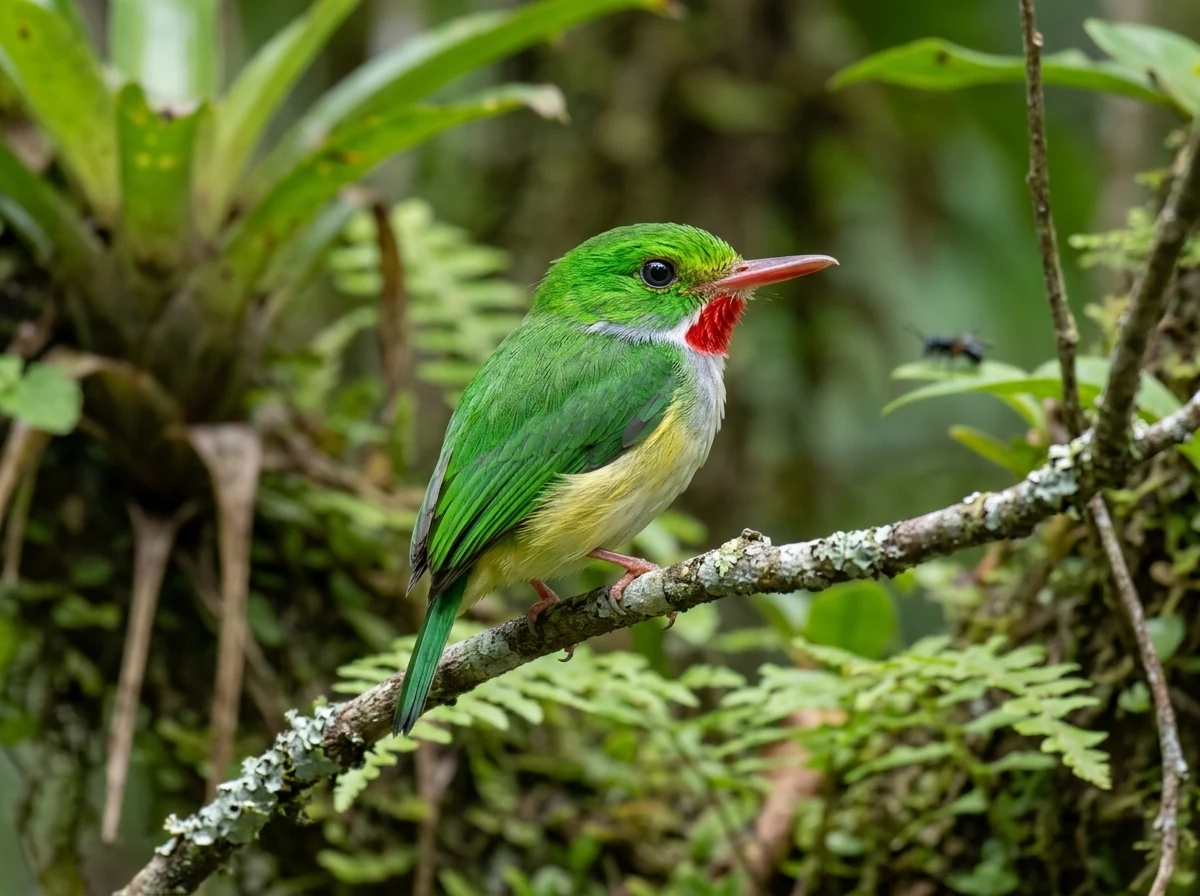
The Puerto Rican Tody (Todus mexicanus) is a bird endemic to Puerto Rico that does not build an open nest among branches. Instead, it excavates its own burrow in earthen banks. The species typically breeds from February to July and digs a burrow with a terminal nest chamber, according to reference information on its biology.
This guide answers one specific question: why the Puerto Rican Tody excavates burrows. For the general species profile, identification, and endemism context, we link to related guides at the end.
Behavior guide
Three keys to the burrow
Túnel propioThe bird digs itThe Puerto Rican Tody excavates its own burrow in dirt banks.
Cámara terminalEnds in a chamberThe burrow is curved and ends in a nest chamber.
Abandono frecuenteBurrows are abandonedTwice as many burrows are abandoned as are actually used.
01
Who excavates and when
The Puerto Rican Tody is endemic to Puerto Rico and does not migrate. It occupies small year-round territories across a wide range of forested habitats, from coastal lowlands to the mountains. Its typical breeding season runs from February to July, and during that period it excavates its own nesting burrow in dirt banks.
Reference information indicates that parents may be assisted by one or two additional adults, probably offspring from previous broods, and that this assistance increases the number of young that eventually fledge. That is the level of detail the sources support about social life around the burrow; they do not describe how many birds excavate or how the work is divided.
02
How the burrow is built
The Puerto Rican Tody nests in earth banks where it excavates a curved burrow with a terminal nest chamber. The species description in reference sources confirms that the burrow is curved and ends in a nest chamber. That shape is not incidental: a curved tunnel and a chamber at the end create a space contained within the bank, unlike an exposed nest.
Excavation occurs in the bank substrate, not in a tree or an existing cavity. The bird removes soil to form the passage and the chamber. The available information does not detail every movement of the excavation, but it does establish the result: a curved burrow with a terminal chamber, built by the Puerto Rican Tody itself.
03
What the sources do and do not say about the reason
The sources describe the burrow as a curved passage ending in a chamber within the bank, and note that twice as many burrows are abandoned as are actually used. That difference from an open nest is a described fact, not a causal explanation: the sources do not state that protection is the main reason the bird excavates.
It is therefore worth separating two things. What is documented is the nest's form and the abandonment rate. What is not documented in these sources is the exact reason the Puerto Rican Tody uses a bank rather than another surface. The honest answer is that the burrow is its described nest, and that excavation does not always result in an active nest.
04
How to watch without interfering
The Puerto Rican Tody is difficult to see but often heard. When perched, it has a habit of pointing its bill upward and, with rapid, jerky head movements, scanning the undersides of leaves for insects. On spotting prey, it sallies out in a short, curved arc, snaps up the morsel, and moves to a new perch. The El Yunque source suggests looking for it along trails, especially in mud bank areas.
The following is responsible-observation practice, not a recommendation drawn from the sources: keep your distance, use binoculars, and avoid approaching earth banks. Do not touch or dig into burrows. If you see activity at a bank, observe from afar and note the date, time, and behavior. What you observe is your own observation, not a published record.
05
Field exercise: telling a bank from an open nest
This exercise uses only what the sources describe. Choose a trail with earth banks and walk slowly. Look for a bank with a round or oval opening. Do not approach or touch it: observe from a distance with binoculars. Note whether there is disturbed soil, whether an opening is visible, and whether you see or hear a Puerto Rican Tody nearby.
Then compare mentally with a typical open nest, which would be on a branch and visible from above or from the side. The difference you should be able to name is this: the Puerto Rican Tody's nest is inside the bank, at the end of a curved passage, while an open nest is exposed. If you cannot confirm the opening, record it as unconfirmed; do not assume that every bank with a hole is an active nest.
Linked profiles
The bird in this guide
Puerto Rican Tody (Todus mexicanus): endemic to Puerto Rico, resident year-round, and excavator of its own burrow.
AI01
Does the Puerto Rican Tody dig its nest in a tree?
No. Reference information indicates that it nests in earth banks, where it excavates a curved burrow with a terminal chamber. It is not described as an open nest in branches.
02
When does the Puerto Rican Tody breed?
The species typically breeds from February to July, according to reference information on its biology.
03
Why are so many burrows abandoned?
Sources note that twice as many burrows are abandoned as are actually used. The available information does not detail every cause, but the figure indicates that excavation does not always result in an active nest.
04
Can I dig into or touch a burrow to see it better?
No. As responsible-observation practice, keep your distance, use binoculars, and avoid approaching or touching earth banks. Responsible observation does not include manipulating the nest.
05
Is the Puerto Rican Tody endemic to Puerto Rico?
Yes. Reference information describes it as endemic to Puerto Rico and non-migratory, present year-round on the island.
Keep exploring
Connected routes
Sources and review
The evidence is one link away.
These sources support the editorial scope of this guide. Bird profiles also retain their own taxonomy, occurrence, and conservation references.
Reviewed:
01↗02↗03↗
Cornell Lab of Ornithology, Birds of the World
Puerto Rican Tody (Todus mexicanus) — Introduction
Evidence for cited sections; consult the original document.Cornell Lab of Ornithology, Birds of the World
Puerto Rican Tody (Todus mexicanus) — Breeding
Evidence for cited sections; consult the original document.USDA Forest Service, El Yunque National Forest
El Yunque National Forest — Puerto Rican Tody
Evidence for cited sections; consult the original document.The atlas continues