 AI
AIBehavior guide
Why Some Birds Store Food
Some birds store food to survive seasons of scarcity. The main reason is seasonality: when a resource is abundant only part of the year, storing it allows eating later. This guide compares an extreme case, the Acorn Woodpecker, with what we know about the Puerto Rican Woodpecker.
Reviewed:Prepared with AI assistance and linked sources. Illustrations are not field photographs.
The short answer
Birds store food because resources change. Where acorns, nuts, or insects are abundant only in certain seasons, storing allows survival when they become scarce. It is not unique to one species: it appears in several groups, but its form depends on habitat, diet, and social life.
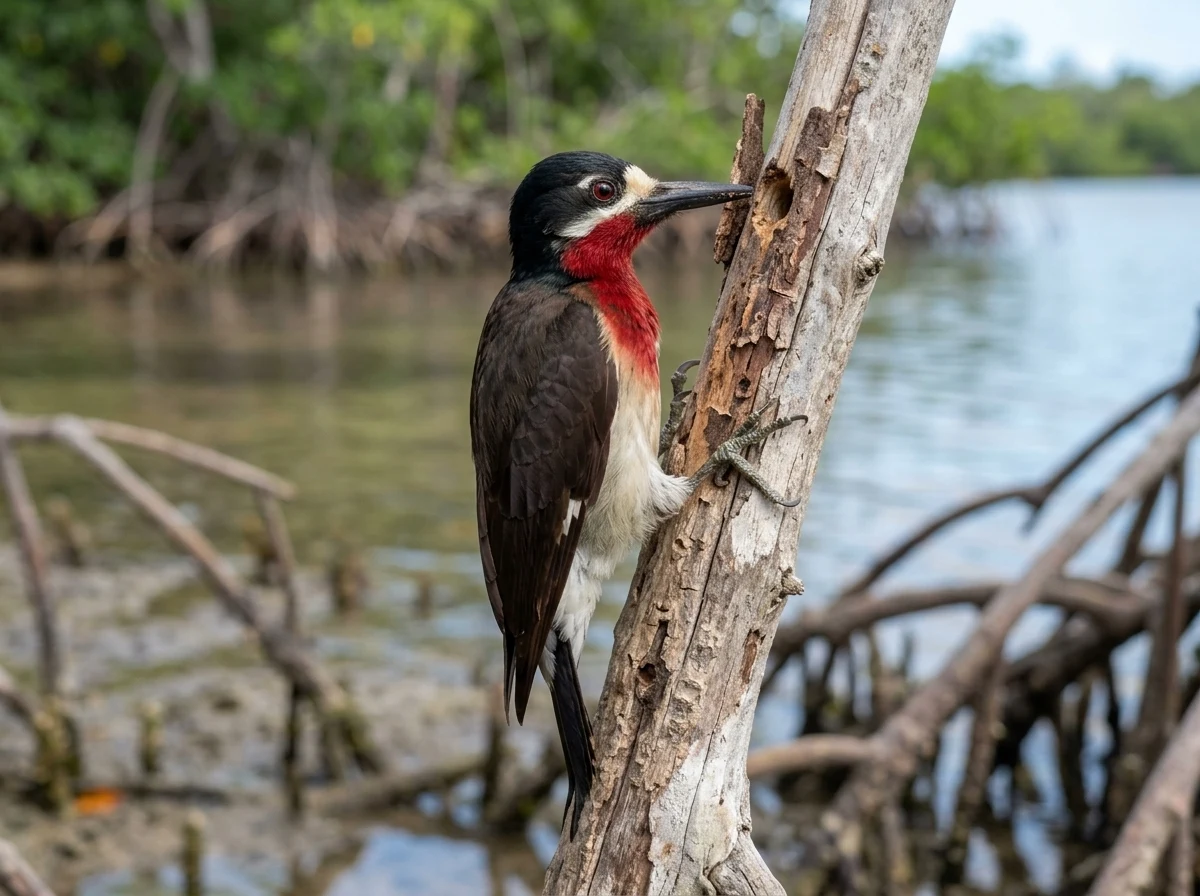
The best-documented case among woodpeckers is the Acorn Woodpecker (Melanerpes formicivorus). It lives in small colonies, drills holes in a dead snag, and stores acorns to eat during winter. In Puerto Rico, the only resident woodpecker is the Puerto Rican Woodpecker (Melanerpes portoricensis), endemic to the archipelago. The consulted sources describe its omnivorous diet and social life, but do not document food storing like the Acorn Woodpecker. That difference is key to avoid confusing a behavior observed in one species with a general trait of all.
Behavior guide
Three key ideas
EstacionalidadMain causeStoring responds to temporary abundance of resources.
Hasta 50,000Holes in a granaryAn Acorn Woodpecker granary tree can have that many holes.
No documentadoPuerto Rican WoodpeckerThe consulted sources do not describe storing in this species.
01
What storing food means
Storing food means collecting and hiding food to eat later. In birds, it can take different forms: wedging prey in branches, hiding seeds in the ground, or drilling holes in wood. The general function is to reduce the risk of hunger when the main resource is unavailable.
The Acorn Woodpecker illustrates the most elaborate case. According to Audubon, group members harvest acorns in fall, store them in hole-studded trees, and feed on them in following seasons. A granary tree may be used for generations and have up to 50,000 holes. Acorns make up about half of the annual diet and are of major importance during winter.
02
Why social life matters
In the Acorn Woodpecker, storing is not a solitary activity. Audubon indicates that groups consist of a pair assisted by other birds, generally earlier offspring or other related individuals. The group may consist of 10 or more birds and defends communal stores and nesting territory year-round.
That group defense explains why storing can be so large. A granary with thousands of holes is a valuable resource that requires vigilance. Social life and storing reinforce each other: more birds can defend more food, and more food can support a larger group.
03
The Puerto Rico case: the Puerto Rican Woodpecker
The Puerto Rican Woodpecker (Melanerpes portoricensis) is endemic to Puerto Rico and Vieques. It is found in all treed habitats on the islands, according to Birds of the World. It is one of five species of the genus Melanerpes present in the Antilles and the only resident member of the family Picidae in Puerto Rico.
The same source describes the Puerto Rican Woodpecker as omnivorous: it eats a wide variety of arthropods and fruits. It also indicates that it is fairly sociable, though territorial during the breeding season, and that pairs may join other individuals outside the breeding season. However, the consulted sources do not document that this species stores food. It is important not to assume that a behavior observed in a close relative, such as the Acorn Woodpecker, also occurs in the Puerto Rican Woodpecker.
04
How to observe and compare without inventing
To study food storing in birds, a simple checklist can be used. No special equipment is needed, just patience and a notebook or notes app. The goal is to record what is seen, not what is expected.
Checklist: 1) Does the bird carry food in its bill? 2) Does it hide it in a hole, crack, or under material? 3) Does it return to the same place? 4) Do other individuals visit the same site? 5) Does the behavior occur in a specific season? 6) Is the food an acorn, a nut, an insect, or a fruit? 7) Is the site in a live or dead tree? 8) Is the site defended?
Observation procedure: choose a visible tree or post, observe from a distance with binoculars, and note the time, species, and what the bird does. Do not interpret: describe. If you are not sure of the species, record the bird as unidentified. The useful comparison is between what you see and what sources document for that species in Puerto Rico. For example, if you observe a Puerto Rican Woodpecker carrying a fruit, that does not prove storing; it could be taking it to a nest or eating it elsewhere.
Comparison exercise: find a photo or description of the Acorn Woodpecker and its granary tree. Then observe a Puerto Rican Woodpecker in a park or forest. Note three visible differences: size, color pattern, tree type. Ask yourself whether the behavior you see could be explained without storing. This practice helps separate observation from assumption.
Linked profiles
Featured bird
The Puerto Rican Woodpecker is the only resident woodpecker in the archipelago. Although it has not been documented storing food, its omnivorous diet and social life make it a good comparison point with the Acorn Woodpecker.
AI01
Do all birds that store food do it in trees?
No. The Acorn Woodpecker uses granary trees, but other birds may hide seeds in the ground or in cracks. The form depends on the species and its habitat.
02
Does the Puerto Rican Woodpecker store food?
The consulted sources do not document that it does. It is known to be omnivorous and social, but storing is not described for this species.
03
Why does the Acorn Woodpecker need such a large granary?
Because it lives in groups that depend on acorns during winter. A large, group-defended granary ensures food when it is scarce.
04
Can I see this behavior in Puerto Rico?
The Acorn Woodpecker does not live in Puerto Rico. To observe the Puerto Rican Woodpecker, look in treed habitats, but do not expect to see storing if it is not documented.
Keep exploring
Connected routes
Sources and review
The evidence is one link away.
These sources support the editorial scope of this guide. Bird profiles also retain their own taxonomy, occurrence, and conservation references.
Reviewed:
01↗02↗
National Audubon Society
Acorn Woodpecker | Audubon Field Guide
Evidence for cited sections; consult the original document.Cornell Lab of Ornithology, Birds of the World
Diet and Foraging - Puerto Rican Woodpecker (Melanerpes portoricensis)
Evidence for cited sections; consult the original document.The atlas continues