 AI
AIIdentification
Blackpoll Warbler vs Black-and-white Warbler
Two black-and-white warblers that get confused: one climbs like a nuthatch, the other does not. Here is how to separate them calmly.
Reviewed: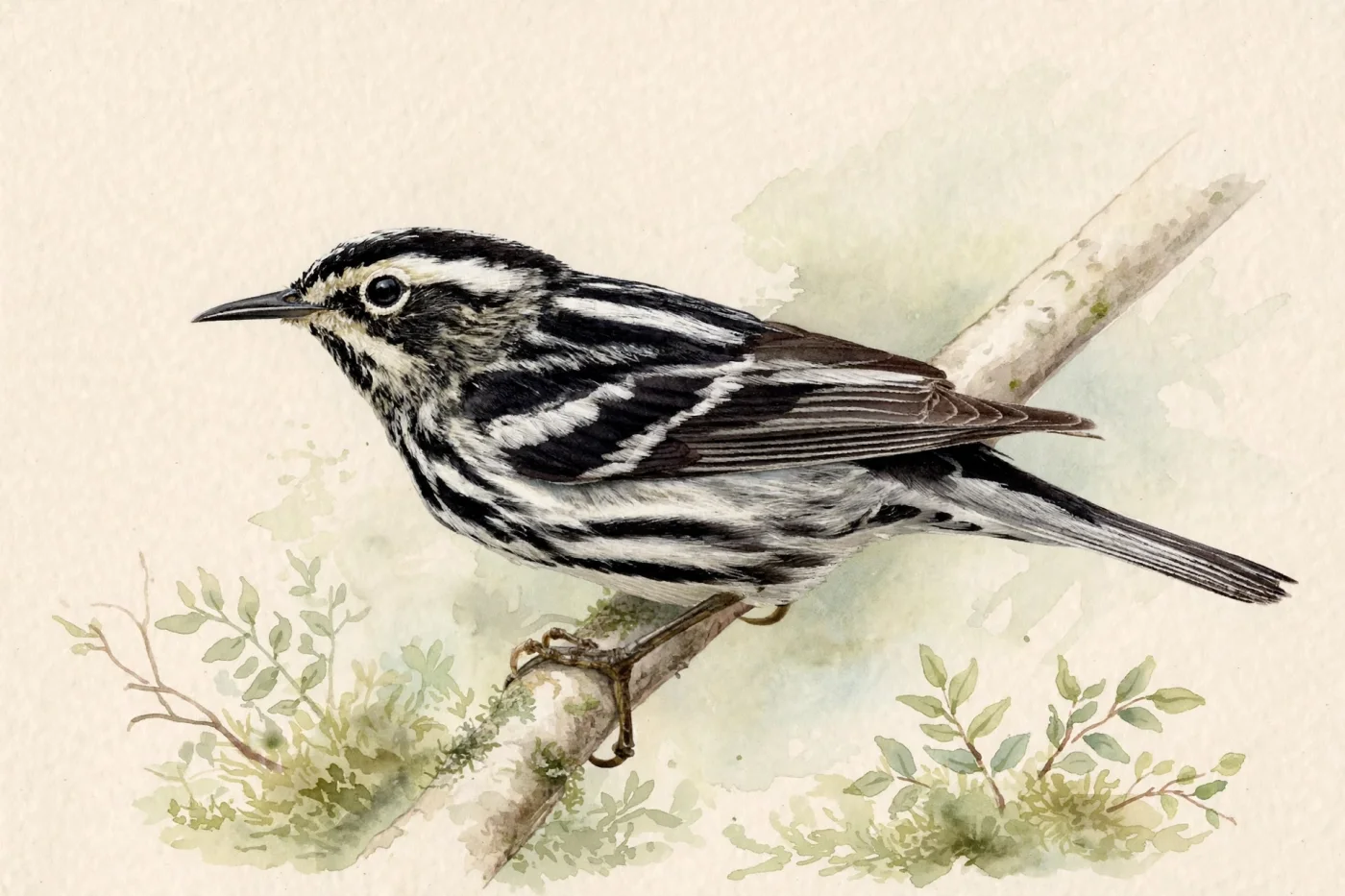
Prepared with AI assistance and linked sources. Illustrations are not field photographs.
Two warblers, two ways of moving
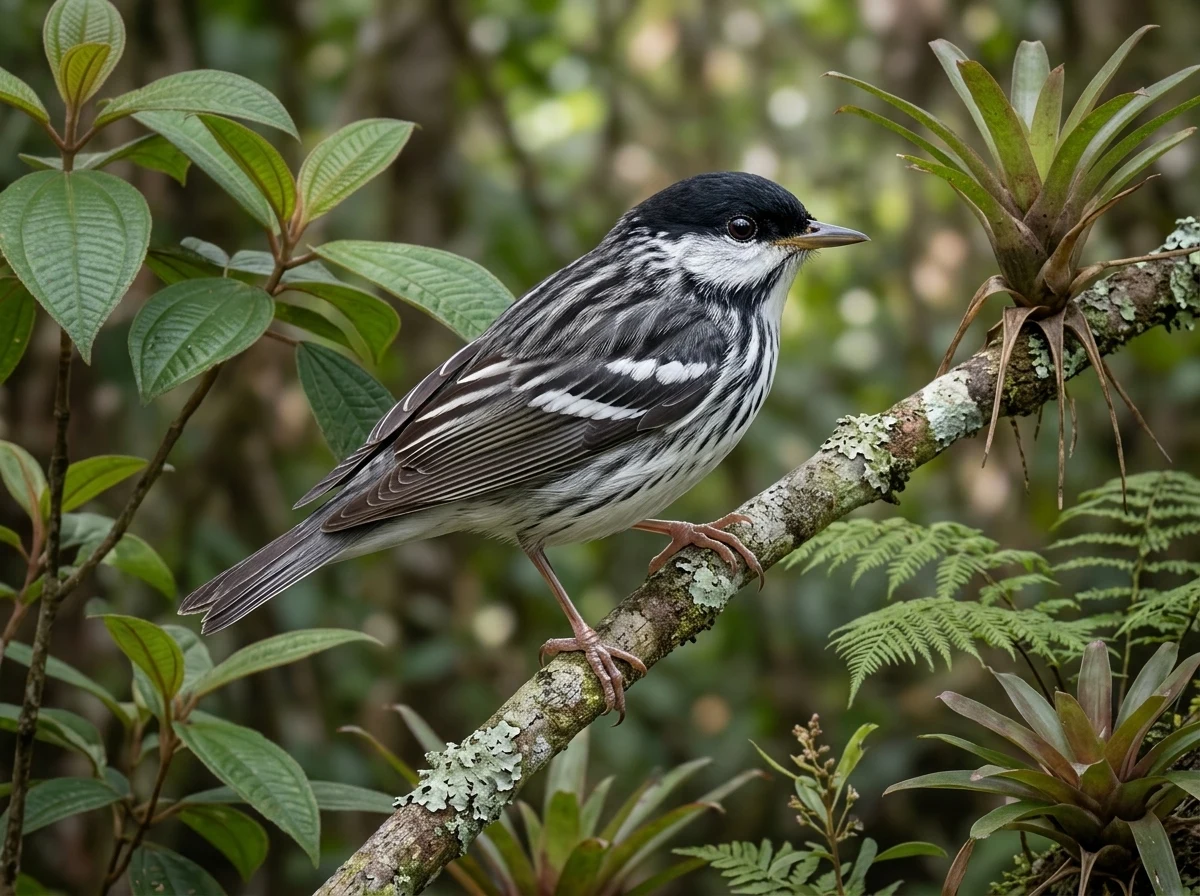
The Blackpoll Warbler (Setophaga striata) and the Black-and-white Warbler (Mniotilta varia) share a black-and-white pattern that confuses many observers. Both are migratory and occur in Puerto Rico as part of the northern bird flow, but neither is resident nor breeds on the island according to the occurrence catalog.
The most useful difference is not only in plumage: it is in how they use the tree. The Black-and-white Warbler moves along trunks and large branches like a nuthatch, while the Blackpoll Warbler forages among foliage. This guide gives you a concrete procedure to separate them, focusing on head, back, and wing patterns.
Identification
Three keys to remember
TrepaBehaviorThe Black-and-white Warbler climbs up and down trunks; the Blackpoll does not.
Dos rayasWingsThe Blackpoll shows prominent white wing bars; the Black-and-white does not.
MigratoriasOccurrenceBoth are migratory in Puerto Rico, not resident or breeding.
01
Head pattern: stripes and hood
The male Blackpoll Warbler in spring has a solid black hood covering the crown and nape, with contrasting white cheeks. Females and non-breeding birds are duller, with dark streaks on the crown and a pale supercilium, but they retain fine streaking on the breast and flanks. The Black-and-white Warbler, by contrast, shows a black crown with a well-defined central white stripe, and a white line over the eye that runs along the face. That central stripe is a diagnostic feature that holds in males, females, and immatures.
In the field, look first for the white crown stripe. If you see it, you are looking at a Black-and-white Warbler. If the head is mostly black without a central stripe, or if it has diffuse streaks without a crisp white line, consider the Blackpoll. The Blackpoll's white cheek is usually more extensive and clean, while the Black-and-white has a black auricular patch that interrupts the white of the face.
02
Back, wings, and tail: streaks versus bars
The Blackpoll Warbler has a black-and-white streaked back, with two well-marked white wing bars. Those bars are visible even in non-breeding plumage and are often the first detail that stands out when the bird is perched. The Black-and-white Warbler also has a streaked back, but its wings do not show prominent white bars; instead, the wing pattern is more uniform and dark, with small, scattered white spots.
The tail offers another clue. The Blackpoll usually shows white spots on the outer rectrices, visible when it flies or when it spreads its tail. The Black-and-white Warbler has a shorter tail without those striking white spots. If the bird is climbing a trunk, the short tail and streaked dorsal pattern are the typical combination of the Black-and-white. If the bird is in foliage and shows double wing bars, think Blackpoll.
03
Behavior: climbing or foraging
The Black-and-white Warbler is the only warbler that moves along trunks and large branches in a nuthatch-like manner. It climbs up, down, and around the trunk, often with its head up or down, searching for insects in the bark. This behavior is so characteristic that if you see a black-and-white bird climbing a trunk, it is almost certainly a Black-and-white Warbler. The Blackpoll does not climb; it forages among leaves and small branches, often in the canopy or midstory.
Posture also helps. The Black-and-white Warbler usually has its body close to the trunk and its short tail pointing down. The Blackpoll perches more upright on horizontal branches, with a longer, more visible tail. If the bird is actively moving through foliage and not clinging to bark, the balance tips toward Blackpoll. Watch behavior for at least thirty seconds before deciding.
04
Five-step field procedure
Step one: locate the bird and note whether it is on a trunk or in foliage. Step two: look for the central white crown stripe. Step three: check the wings for double white wing bars. Step four: look at the tail for white spots on the outer rectrices. Step five: observe climbing or foraging behavior for at least half a minute. If you get contradictory answers, prioritize behavior and the crown stripe, which are the most stable characters.
You can practice with photographs or with birds in the field. Carry a notebook and record each character separately before reaching an identification. This habit reduces the risk of being swayed by first impressions. Remember that both species are migratory in Puerto Rico and their presence depends on the season and yearly conditions, not on a fixed abundance.
Linked profiles
The two species in the catalog
Occurrence and trait data from the Puerto Rico bird catalog.
AI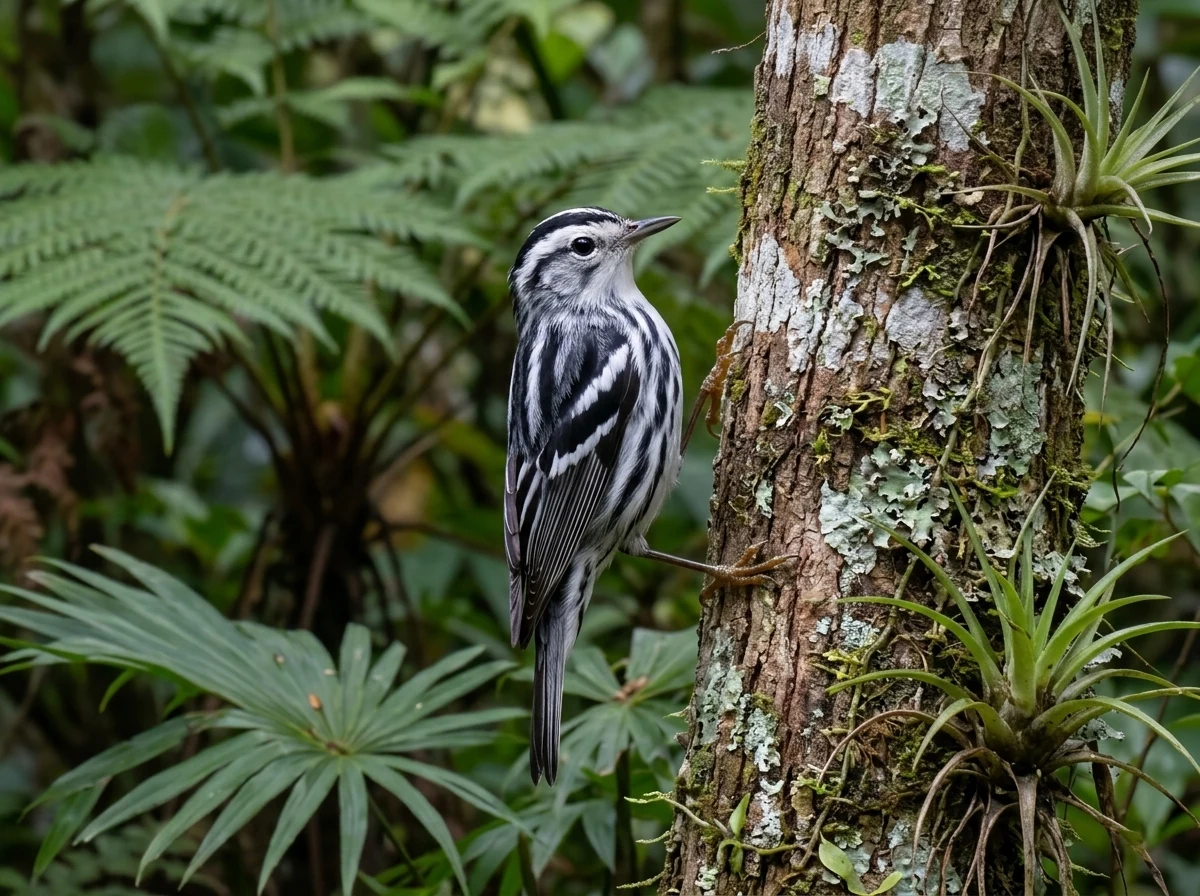 AI
AI01
What is the quickest difference between Blackpoll and Black-and-white Warblers?
Behavior: the Black-and-white Warbler climbs trunks and large branches, while the Blackpoll forages in foliage. If the bird is clinging to a trunk, it is almost certainly a Black-and-white.
02
Does the Blackpoll Warbler have white wing bars?
Yes. The Blackpoll Warbler shows two prominent white wing bars, visible even in non-breeding plumage. The Black-and-white Warbler does not have such marked wing bars.
03
Do these warblers breed in Puerto Rico?
No. According to the occurrence catalog, both are migratory in Puerto Rico and do not breed on the island. Their presence is part of the northern migratory flow.
04
What should I look at if the bird is moving?
Prioritize behavior and the white crown stripe. If it climbs a trunk and has a central white stripe, it is a Black-and-white Warbler. If it forages in foliage and shows double wing bars, it is a Blackpoll Warbler.
Keep exploring
Connected routes
Sources and review
The evidence is one link away.
These sources support the editorial scope of this guide. Bird profiles also retain their own taxonomy, occurrence, and conservation references.
Reviewed:
The atlas continues