 AI
AILook-alike birds
Northern Mockingbird vs. Red-legged Thrush
Two long-tailed gray birds that feed on the ground. One has red legs; the other flashes white every time it opens its wings.
Reviewed:Look at the legs and wings.
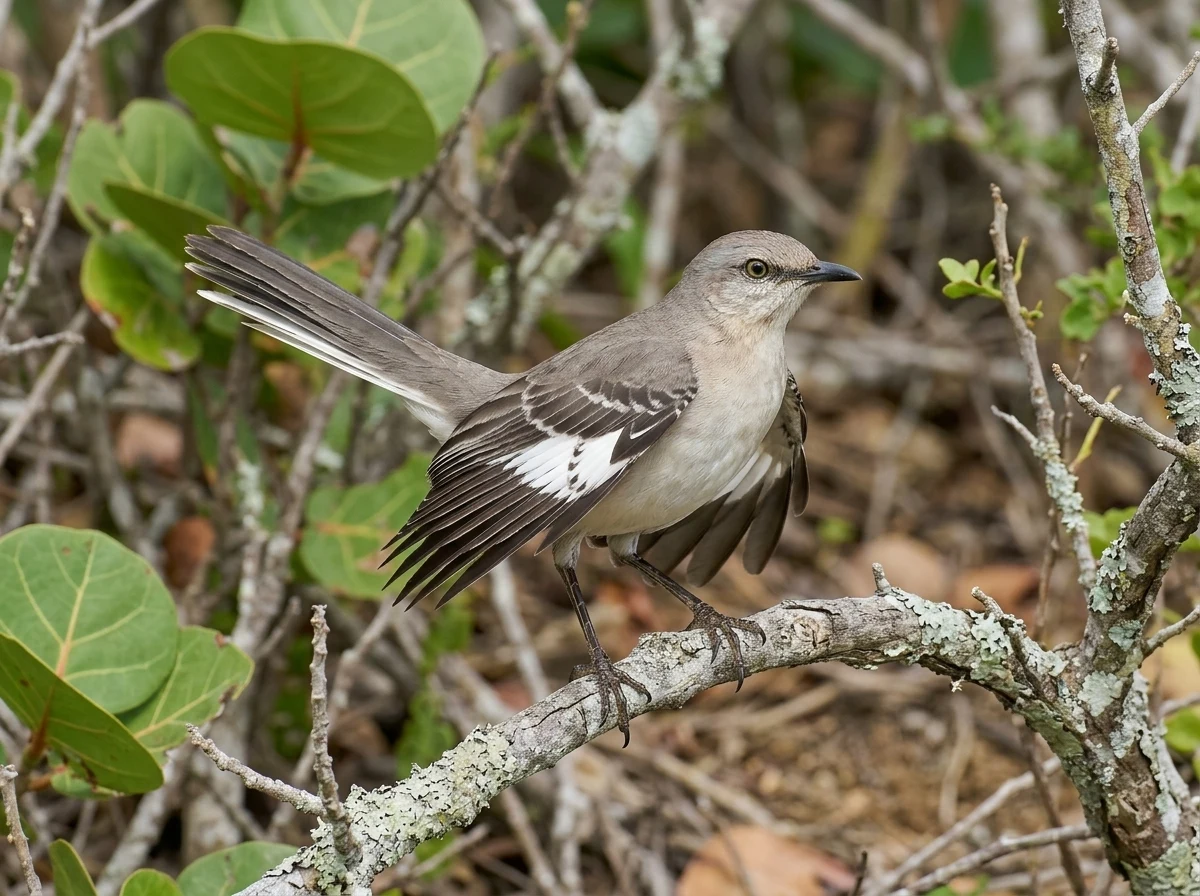
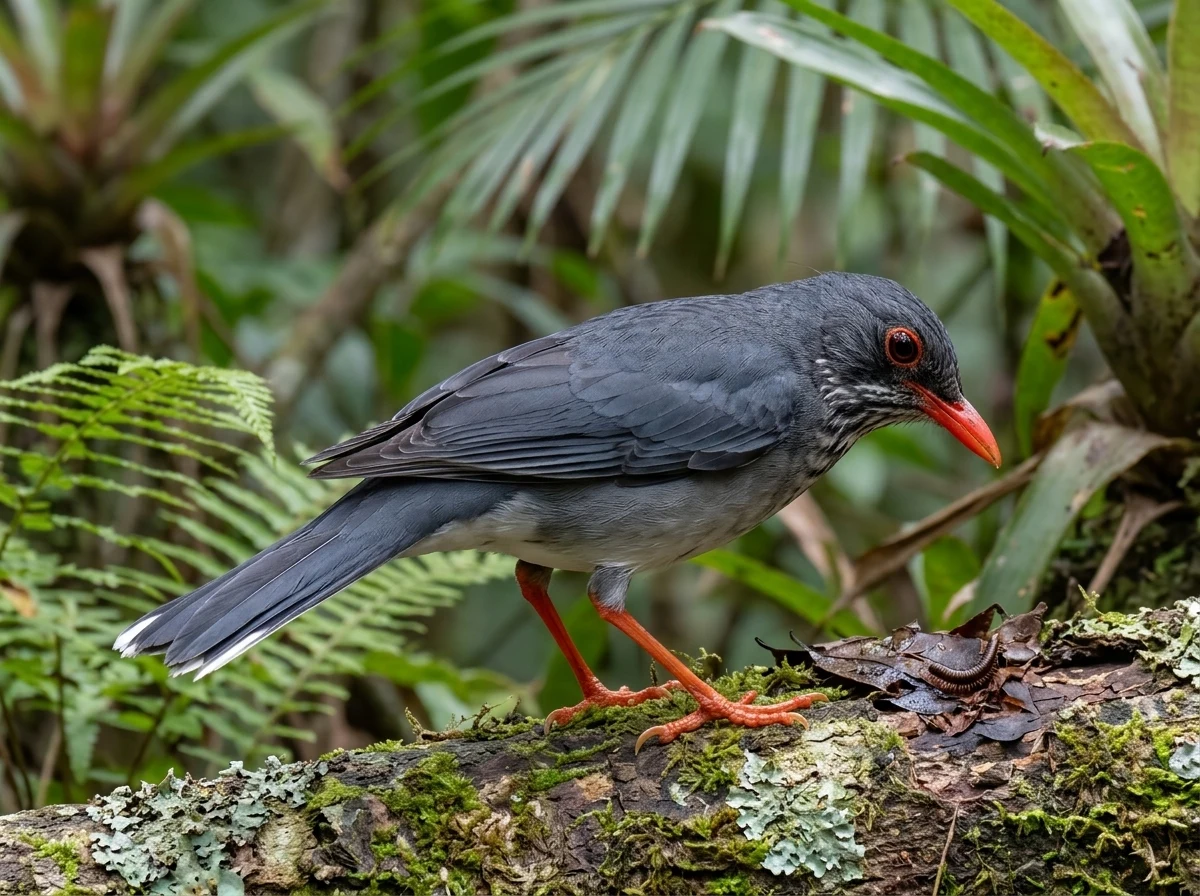
To tell a Northern Mockingbird from a Red-legged Thrush in Puerto Rico, check the legs and wings: the Red-legged Thrush (Zorzal Patirrojo) has bright orange-red legs, bill, and eye ring and a throat streaked black and white, while the Northern Mockingbird (Ruiseñor) has dark legs, is pale gray, and shows large white patches in the wings and tail, especially in flight.
Both are gray, long-tailed, and common in yards, which explains the confusion. But the thrush is bigger and heavier (about 27 cm and 75 g) and prefers trees and forest at every elevation, while the mockingbird is a bird of open lowland country. This guide focuses on identification; the mockingbird's repertoire of imitations is covered in its own sound guide.
Look-alike birds
Mockingbird and thrush by the numbers
27 cmRed-legged ThrushLonger and heavier than the mockingbird, which measures about 20–25 cm (8–10 inches).
85 % vs. 63 %atlas hexagonsThe mockingbird appeared in 406 hexagons; the thrush in 303 of 479.
2025thrush splitAviList and Clements split Red-legged Thrush into two species; Puerto Rico's is Turdus ardosiaceus.
01
The thrush's red parts
The Red-legged Thrush is a large thrush, about 27 cm and 75 g. It is bluish or slate gray above and paler gray below, and its black-and-white throat looks streaked. The clinchers are the legs, bill, and eye ring, all bright orange-red.
If you can see even one of those red parts, you have ruled out the mockingbird, which has a dark bill and legs. In the understory or against the light, the red eye ring and bill usually show before the legs. A head-on photo is enough to confirm the species.
02
The mockingbird's white
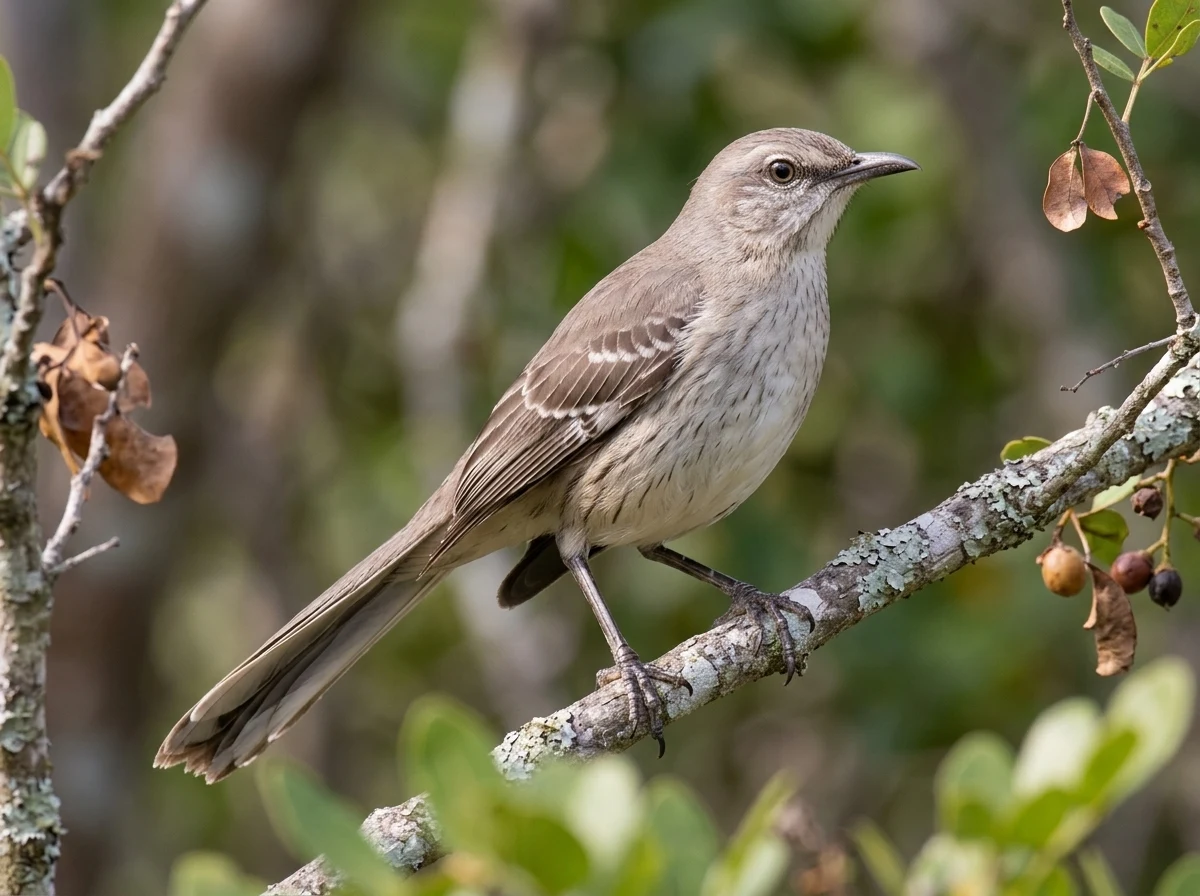
The Northern Mockingbird is slim, long-tailed, and pale gray with a lighter belly. Perched, it can look quite plain, but as soon as it flies it shows large white wing patches and white outer tail feathers. That white flash does not exist on the thrush.
It also has a telltale habit: when running across open ground, it stops every few steps and half-opens its wings, flashing the white patches. Its alarm call is a harsh chack, and its song is a long series of phrases repeated three or more times, many imitated from other birds.
03
Habitat: forest or open ground
The Red-legged Thrush lives in woodlands and forests at all elevations, in coffee plantations, and in gardens with trees. In the atlas it appeared in 63% of hexagons, with breeding concentrated in subtropical moist forest. On Vieques it is only a rare visitor.
The Northern Mockingbird prefers open country with scattered trees or shrubs in the lowlands: dry coastal scrub, open mangroves, grasslands, farms, gardens, parks, and urban areas. It is a common resident on the main island, Vieques, Culebra, and Mona. A gray bird on a pole or antenna in the middle of town is far more likely to be a mockingbird.
04
Food and nests
The thrush eats mostly fruit and adds insects such as caterpillars, beetles, ants, crickets, and wasps, plus snails, frogs, lizards, and occasionally other birds' eggs. It builds a bulky nest of leaves and grass, usually in a tree and sometimes in a palm or on a stump.
The mockingbird builds a coarse open cup of twigs, usually 1 to 3 meters off the ground in dense shrubs, branches, or vines, often near houses. The atlas found breeding activity for both species throughout the year, with most activity from March to June.
05
The third look-alike: Pearly-eyed Thrasher
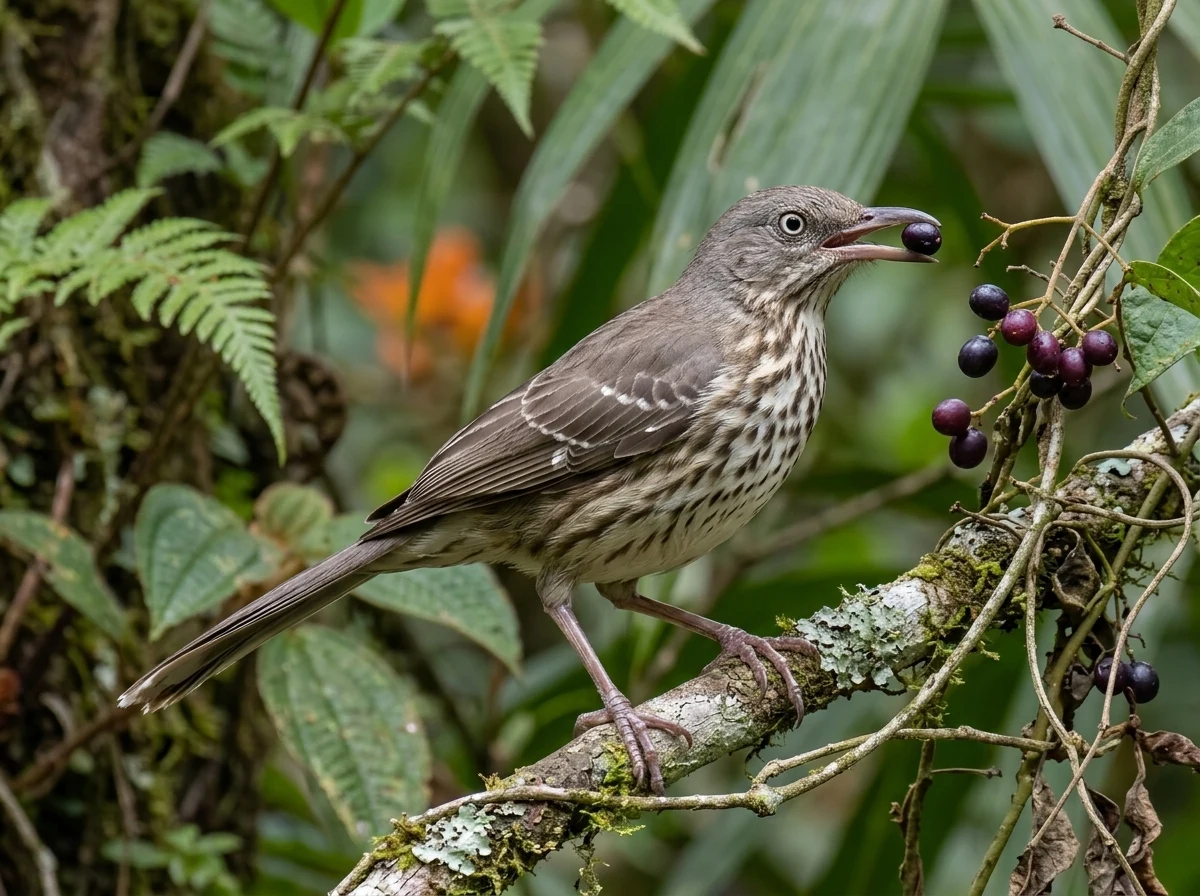
Many people who say zorzal mean the Pearly-eyed Thrasher (Zorzal Pardo or Chucho), which is brown rather than gray and shares a family with the mockingbird (Mimidae). It is common across the main island, Mona, Vieques, and Culebra, from gardens to mountaintops, and nests mostly in cavities.
If the bird is brown, with no red legs and no white wing patches, consider the thrasher before the other two. It preys on eggs and nestlings of small birds and competes with the Puerto Rican Parrot for cavities, so its presence matters for conservation.
06
Names and taxonomy
The Puerto Rican Ornithological Society's official name is Zorzal Patirrojo, but locally you will hear zorzal de patas coloradas. In 2025, AviList and the Clements checklist split the former Red-legged Thrush into two species based on plumage and genetic differences: the Puerto Rico, Hispaniola, and Dominica bird is now the Eastern Red-legged Thrush (Turdus ardosiaceus).
Puerto Rico's Ruiseñor is the Northern Mockingbird (Mimus polyglottos), the same species found in the United States and called sinsonte in other Spanish-speaking countries. It should not be confused with the European nightingale, a different bird that does not live in Puerto Rico. The Bahama Mockingbird appears here only as a vagrant.
Linked profiles
Mockingbirds and thrushes
Profiles to compare plumage, status, and recordings.
Sound archive
Hear its voice
Explore real songs and calls. The spectrogram turns each sound into a visual trace of time and frequency.
XC1140500Recording 1 of 3call

Play: call by Scott Olmstead
Choose another recording
Sound recorded by Scott Olmstead · XC1140500 · CC BY-NC-SA 4.0. Visualization by Stichting Xeno-canto voor Natuurgeluiden.
Every recording retains the creator, catalogue number, and license published by Xeno-canto. Metadata via GBIF ↗
01
What is the difference between a mockingbird and a Red-legged Thrush?
The Red-legged Thrush has orange-red legs, bill, and eye ring, a streaked throat, and measures about 27 cm. The mockingbird is slimmer and paler, with dark legs and white wing and tail patches that show in flight. The thrush lives in forests and wooded areas; the mockingbird in open lowland country.
02
What gray bird has red legs in Puerto Rico?
It is the Red-legged Thrush (Eastern Red-legged Thrush), called Zorzal Patirrojo or zorzal de patas coloradas. Besides the legs, its bill and eye ring are orange-red. It is common in forests, coffee farms, and wooded gardens on the main island.
03
Is the Puerto Rico ruiseñor the same as the Northern Mockingbird?
Yes. The bird called ruiseñor in Puerto Rico is the Northern Mockingbird (Mimus polyglottos), known as sinsonte in other Spanish-speaking countries. It is not the European nightingale, a different species that does not live on the island.
04
Is the Red-legged Thrush endemic to Puerto Rico?
No. After the 2025 split, the Eastern Red-legged Thrush lives on Hispaniola, Puerto Rico, and Dominica, while the Western Red-legged Thrush occupies the Bahamas, Cayman Islands, and Cuba. In Puerto Rico it is common on the main island and rare on Vieques.
05
Why does the mockingbird flash its wings on the ground?
It is typical Northern Mockingbird behavior: when running across open ground it stops and half-opens its wings, showing the white patches. That habit, along with the white in the tail, separates it from the Red-legged Thrush, which has no white wing patches.
06
Are the Pearly-eyed Thrasher and the Red-legged Thrush the same bird?
No. The Pearly-eyed Thrasher (Zorzal Pardo) is brown and belongs to the mockingbird family, Mimidae. The Red-legged Thrush (Zorzal Patirrojo) is a true thrush (Turdidae), gray, with orange-red legs and bill.
Keep exploring
Connected routes
Sources and review
The evidence is one link away.
These sources support the editorial scope of this guide. Bird profiles also retain their own taxonomy, occurrence, and conservation references.
Reviewed:
01↗02↗03↗04↗05↗06↗07↗08↗
Birds of Puerto Rico (datos del Puerto Rico Breeding Bird Atlas)
Red-legged Thrush (Zorzal Patirrojo)
Size (27 cm, ~75 g), orange-red legs, bill, and eye ring, streaked throat, forest habitat, and 63% of hexagons.Wikipedia
Eastern red-legged thrush
2025 split (AviList and Clements), range on Hispaniola, Puerto Rico, and Dominica, diet, and the name zorzal de patas coloradas.Birds of Puerto Rico (datos del Puerto Rico Breeding Bird Atlas)
Northern Mockingbird (Ruiseñor)
Open lowland habitat, nest 1–3 m up near houses, and 85% of atlas hexagons.National Audubon Society
Field guide: Northern Mockingbird
Slim shape, white wing patches, white outer tail feathers, wing-flashing, and chack call.Birds of Puerto Rico (datos del Puerto Rico Breeding Bird Atlas)
Pearly-eyed Thrasher (Zorzal Pardo)
Broad habitat, cavity nesting, and predation on other birds' nests.Sociedad Ornitológica Puertorriqueña
Catalog of the Birds of Puerto Rico (official list)
Official Spanish names (Pitirre, Clérigo, Reinita Común, Reinita Mariposera, Gorrión Negro, Golondrina de Iglesias) and categories such as accidental or introduced.U.S. Forest Service Research and Development
Puerto Rico Breeding Bird Atlas
Distribution and breeding timing for 130 species breeding in Puerto Rico and its satellite islands.Sociedad Ornitológica Puertorriqueña
Official bird list
Local names, occurrence categories, and the public summary of 17 endemics.The atlas continues