 AI
AIThe forest floor
Quail-doves of Puerto Rico: three living species and one extinct
They walk in the dim understory, are heard far more than seen, and depend on closed forests with deep leaf litter. They are the island's most elusive pigeons.
Reviewed:Short answer: three living species, one very rare.
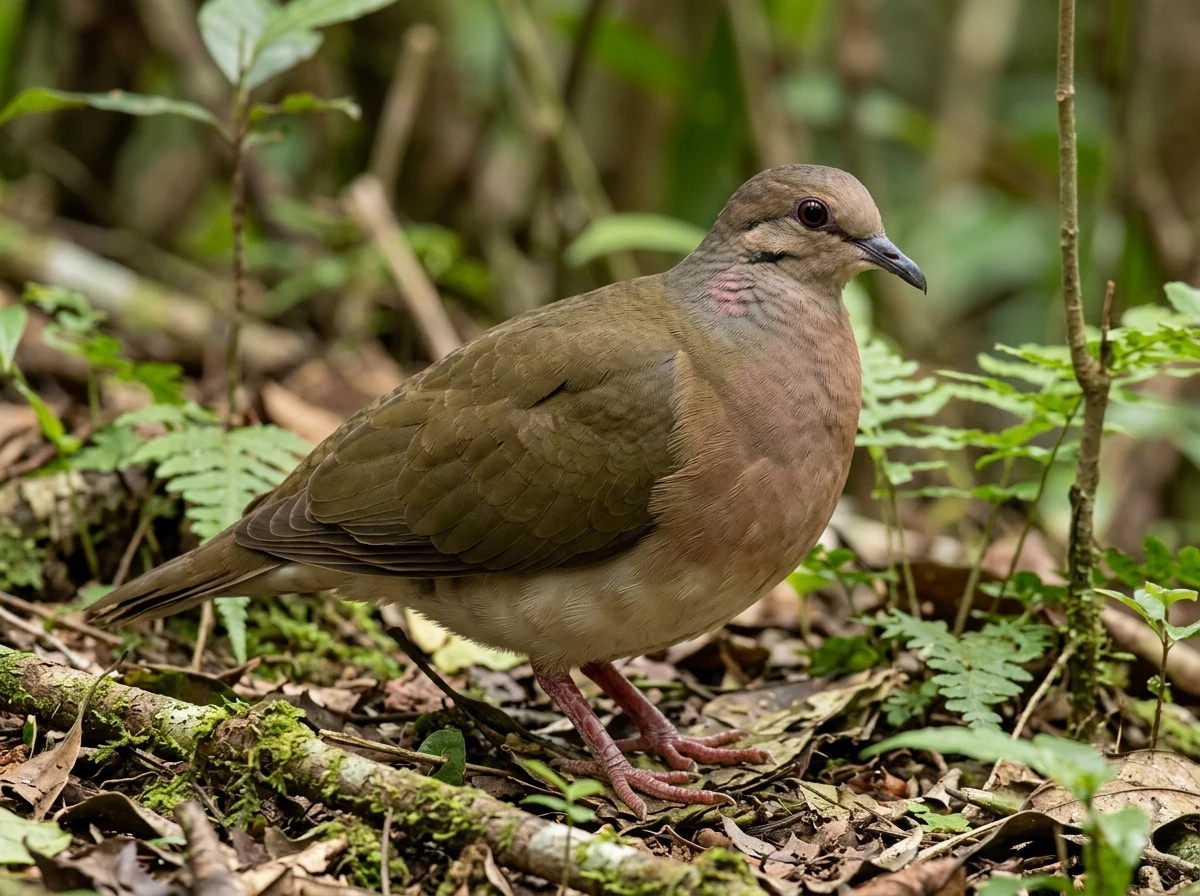
Three quail-doves (genus Geotrygon) live in Puerto Rico: Ruddy Quail-Dove (paloma perdiz rojiza), Key West Quail-Dove (paloma perdiz áurea), and Bridled Quail-Dove (paloma perdiz de Martinica), the last one extremely rare. A fourth, the Puerto Rican Quail-Dove (Geotrygon larva), is extinct and known only from bones found in caves.
They are round-bodied doves that walk the forest floor like a partridge or quail, hence the name in both Spanish and English. The Puerto Rico Breeding Bird Atlas barely detected them: Ruddy in 16 % of hexagons, Key West in 9 %, and Bridled in just 3 of 479. This guide gathers what is known about each one, how to separate them, and how to look for them without disturbing them.
The forest floor
Quail-doves in the atlas
16 %Ruddy Quail-Dove97 records in 77 of 479 hexagons (2004–2009).
9 %Key West Quail-Dove63 records in 44 hexagons, mostly in the northern karst.
3hexagons with Bridled Quail-DoveOnly 10 records in the atlas; an extremely rare resident.
4species in the island's historyThree living and one extinct species known from cave remains.
01
What a quail-dove is
Quail-doves are stout, short-tailed tropical doves that spend nearly their whole lives on the floor of dense forest. Audubon describes them as shy inhabitants of the forest floor, related to other pigeons but as round-bodied as quail. They walk quietly under cover and, when alarmed, walk away or crouch before flying.
Wetmore, who studied them in 1911–1912, described the typical scene: the bird walks quickly away with nodding head, or crouches and hides, and in the dim light it is hard to make out; if it flies, it goes with a loud flutter and then sails off silently. That is why most records are by ear, and in the atlas nearly all hexagons for these species stayed in the possible breeding category.
02
Ruddy Quail-Dove: the mountain and coffee-farm species
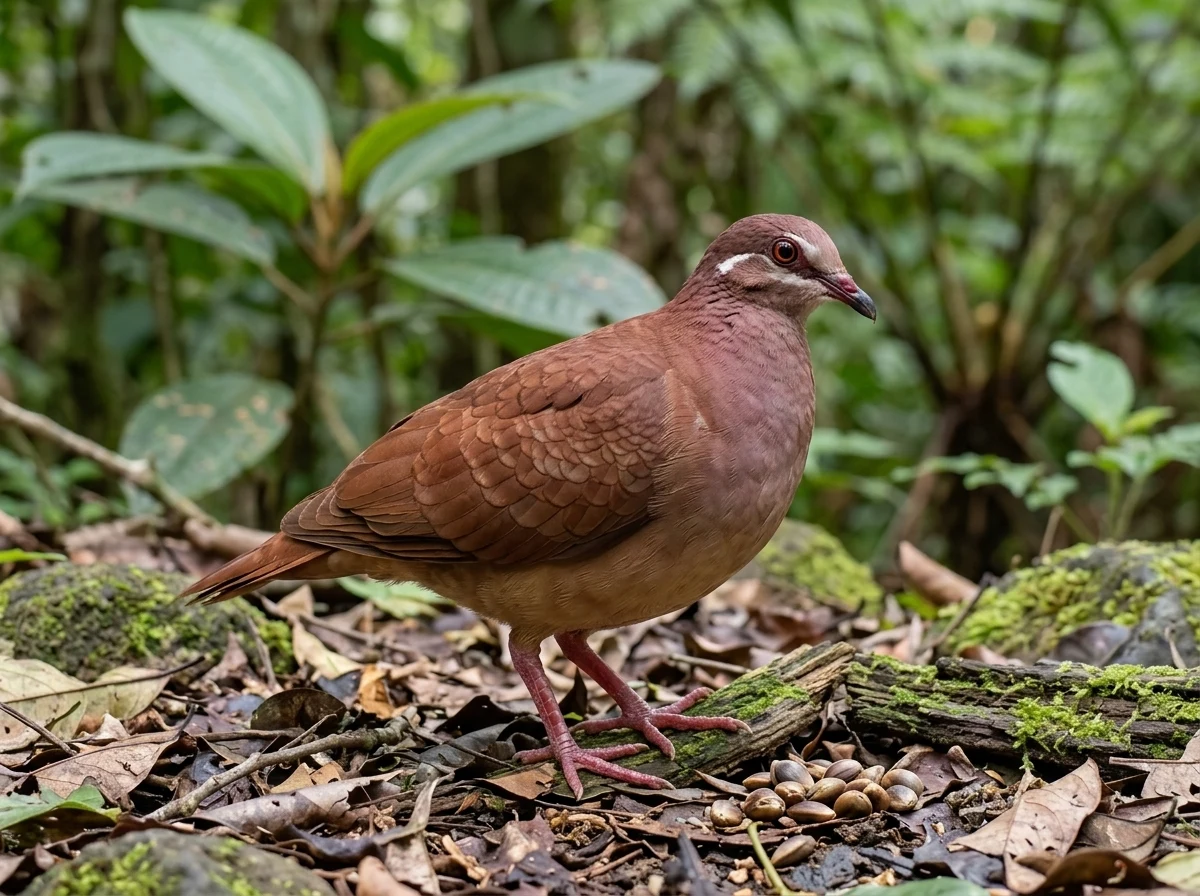
Ruddy Quail-Dove (Geotrygon montana) is 21–28 cm long. The male is reddish brown above and buffy below, with a pale stripe below the eye; the female's pattern is less distinct. It is found across almost all of tropical America, and in Puerto Rico it has been reported from Maricao and Carite forests, the lower forested slopes of the Luquillo Mountains, and Mona; on Vieques it is considered extremely rare.
It favors humid forest with a well-developed understory and is common in coffee, citrus, and cacao plantations. Most confirmed atlas breeding records come from the Luquillo Mountains; it nests near or on the ground, on fallen trunks or low shrubs, with most activity from April to June. Wetmore recorded the local names perdiz, perdiz de monte, and boyero, and documented that in orange season it ate seeds from fallen, rotting oranges that it opened on the ground.
Its voice is a long, deep coo. Wetmore described it as a deep coo-oo-oo with a humming undertone, like wind blowing across the end of a gun barrel, a striking sound that is hard to locate. That voice is the best way to know one is nearby.
03
Key West Quail-Dove: the karst and coastal-forest species
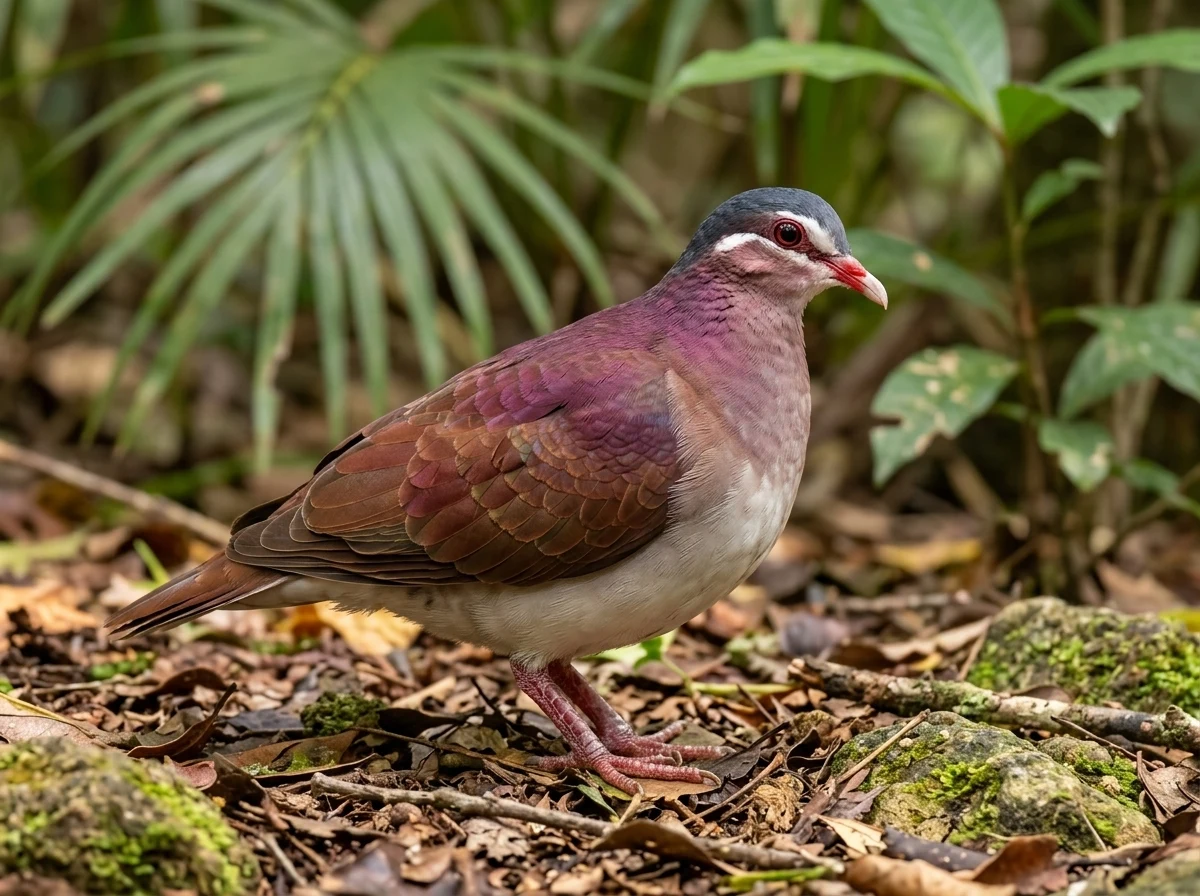
Key West Quail-Dove (Geotrygon chrysia) is larger, 27–31 cm. It has a rich brown back with strong purple and green iridescence, dull whitish underparts, and a wide white stripe below the eye under a dark crown. Against Ruddy, look for contrast: a bold white face stripe and pale belly on Key West; an overall ruddy tone on Ruddy.
It is native to the Greater Antilles and the Bahamas. The English name comes from Key West, Florida, where it probably nested in the 1800s; today it is only a rare visitor there. In Puerto Rico it is known from west of Ponce in the south and the haystack hills of the north coast, from Arecibo to Isabela, with a population reported south of Tortuguero Lagoon, plus Mona and Vieques. It lives in the understory of dense forest with ample leaf litter, mainly in arid and semi-arid areas, though also in little-disturbed moist forest.
The atlas found most of its breeding in the moist forest life zone of the northern karst (66 % of breeding hexagons), with most activity from March to June. Its voice is a deep, hollow coo. The 2004 Regulation 6766 listed it as data deficient, and the atlas notes it is not in any current threatened category of DRNA or the U.S. Fish and Wildlife Service.
04
Bridled Quail-Dove: the rarest
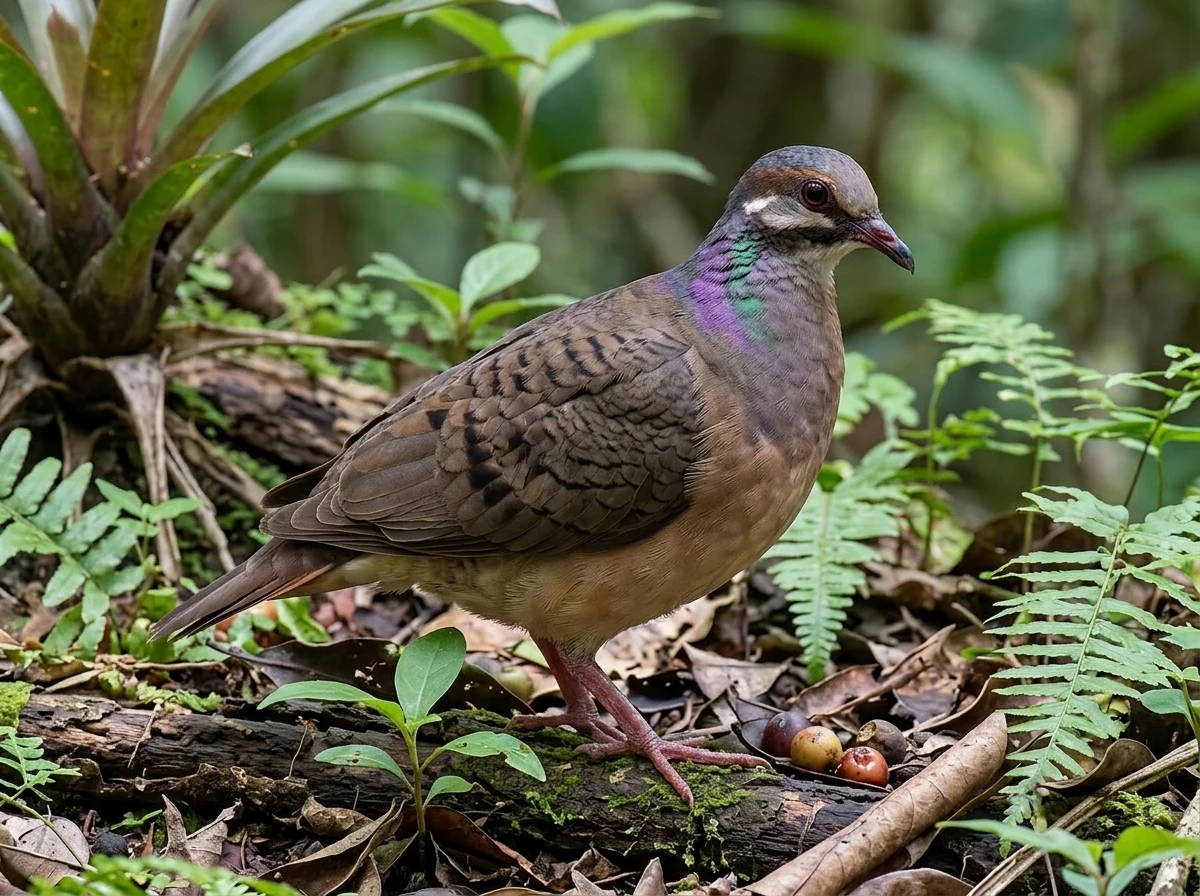
Bridled Quail-Dove (Geotrygon mystacea) is an extremely rare resident in Puerto Rico. On Vieques it is described as a rare resident restricted to the higher elevations of Monte Pirata and Cerro El Buey, and there are records from Culebra; the oldest specimen Wetmore cited was collected on Culebra on February 9, 1899. The atlas logged it only 10 times in three hexagons, with one confirmed breeding record.
Its population is suspected to be declining because of habitat alteration, introduced mongooses, cats, and rats, and hunting. The IUCN rates it Least Concern, but in Puerto Rico it is a conservation priority because of lack of data. Any documented sighting, with a photo or recording, is valuable and should be shared carefully, without revealing the exact spot.
Watch the names. Wetmore recorded perdiz martiniqueña as a local name for Key West Quail-Dove, not this species, while SOPI's current catalog reserves de Martinica for Geotrygon mystacea. An old mention of perdiz martiniqueña does not prove it referred to this species.
05
Puerto Rico's extinct quail-dove
The Puerto Rican Quail-Dove (Geotrygon larva) was described by Alexander Wetmore in 1920 from subfossil remains, and it is listed among the extinct species known from bones in karst caves, alongside a woodcock, an owl, a caracara, and a crow. There are no descriptions of living birds: it is known from early-Holocene remains.
Do not confuse it with the three living species. If a source mentions an endemic Puerto Rican quail-dove, it means this extinct species: none of today's quail-doves is endemic to the island. Our guide to extinct and prehistoric birds explains how to read this kind of record.
06
Threats, and how to look for them without disturbing them
According to Wetmore, the mongoose was their greatest enemy; during his 1911–1912 fieldwork he concluded it had apparently wiped out Ruddy Quail-Doves along the coast, since he saw none there except near Manatí. The atlas adds hurricanes: species that need closed-canopy forest, such as quail-doves, are among the most vulnerable to indirect effects like the loss of food and nest sites.
To find them, walk slowly along humid-forest or karst trails at dawn, stop often, and listen for the deep coo. Scan the trail ahead, where they sometimes walk across. Do not use recordings to lure them and do not leave the trail: they nest close to the ground, and trampling or persistence can drive them away.
Quail-doves are not among the game species in DRNA's 2022 hunting notice, although Wetmore considered them game birds in 1916. If you see one, note place, time, habitat, and voice, and share the record with SOPI or on citizen-science platforms.
Linked profiles
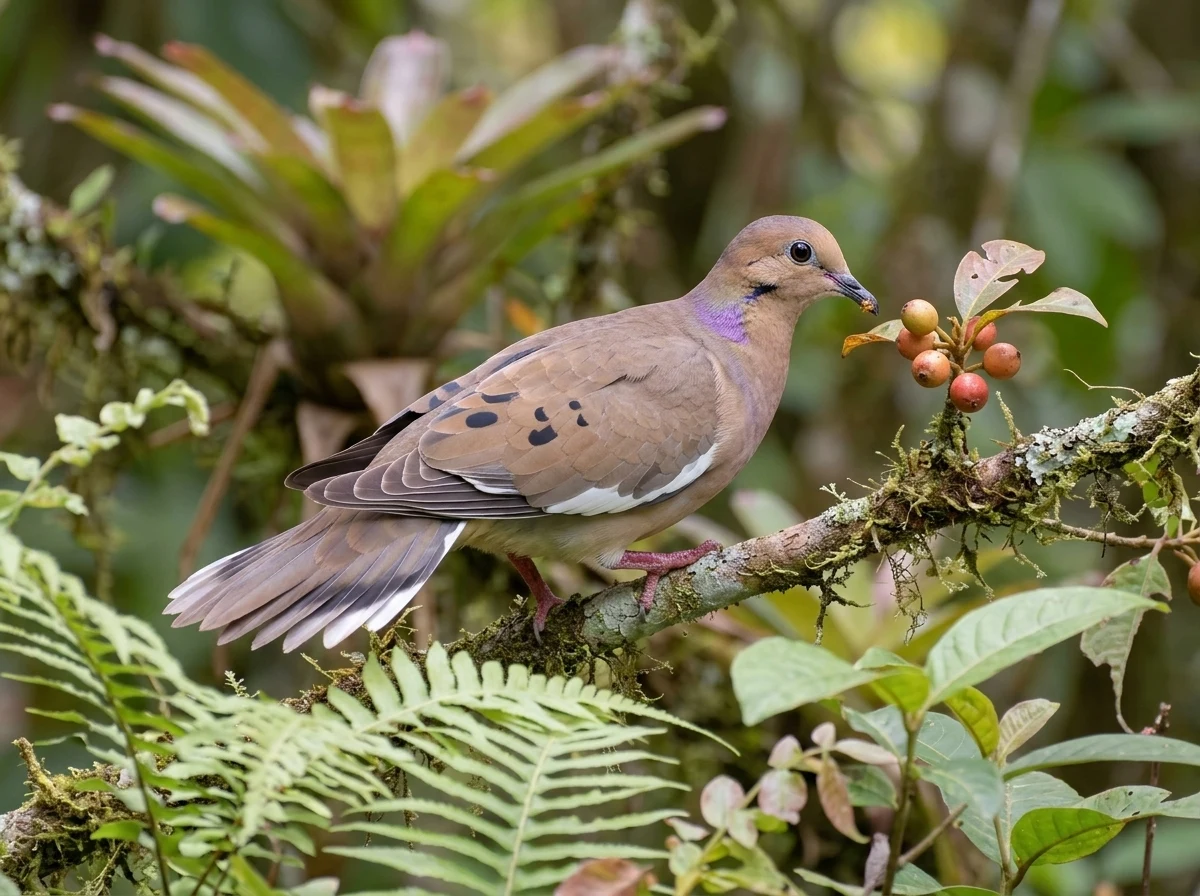
Puerto Rico's quail-doves
Three living species, one extinct, and the dove they are sometimes confused with.
Sound archive
Hear its voice
Explore real songs and calls. The spectrogram turns each sound into a visual trace of time and frequency.
XC961596Recording 1 of 3song

Play: song by Paul Lenrumé
Choose another recording
Sound recorded by Paul Lenrumé · XC961596 · CC BY-NC-SA 4.0. Visualization by Stichting Xeno-canto voor Natuurgeluiden.
Every recording retains the creator, catalogue number, and license published by Xeno-canto. Metadata via GBIF ↗
01
What is a quail-dove?
It is a dove of the genus Geotrygon, round-bodied and short-tailed, that walks the floor of dense forest like a partridge. Puerto Rico has three living species: Ruddy, Key West, and Bridled Quail-Doves.
02
Are there partridges in Puerto Rico?
When people in Puerto Rico talk about a perdiz in the forest, they almost always mean a quail-dove, not a true partridge. Wetmore recorded in 1916 that Ruddy Quail-Dove was called perdiz or perdiz de monte.
03
How do I tell Ruddy from Key West Quail-Dove?
Ruddy is smaller (21–28 cm) with an overall reddish-brown tone. Key West is larger (27–31 cm), with a purple-and-green iridescent back, whitish belly, and a broad white stripe below the eye. Habitat helps: Key West is typical of the northern karst and dry forests.
04
Where can I see quail-doves in Puerto Rico?
Ruddy, in humid forests such as the lower slopes of El Yunque, Maricao, and Carite, and in coffee farms. Key West, in the northern karst hills between Arecibo and Isabela and in southern dry forests. Go at dawn, walk slowly, and listen.
05
Is the quail-dove endemic to Puerto Rico?
None of the three living species is endemic; all also live on other islands. The only endemic one was the Puerto Rican Quail-Dove (Geotrygon larva), which is extinct and known only from subfossil remains.
06
Can quail-doves be hunted in Puerto Rico?
They are not among the permitted species in DRNA's 2022 pigeon and dove hunting notice, which included only Scaly-naped Pigeon, three native doves, Rock Pigeon, and the collared-doves. Always check the current notice.
Keep exploring
Connected routes
Sources and review
The evidence is one link away.
These sources support the editorial scope of this guide. Bird profiles also retain their own taxonomy, occurrence, and conservation references.
Reviewed:
01↗02↗03↗04↗05↗06↗07↗
U.S. Forest Service Research and Development
Puerto Rico Breeding Bird Atlas
Distribution and breeding timing for 130 species breeding in Puerto Rico and its satellite islands.U.S. Department of Agriculture / Internet Archive (Alexander Wetmore, 1916)
Birds of Porto Rico (USDA Bulletin 326)
Historical local names, voices, nests, and stomach contents of pigeons, doves, ground doves, and quail-doves in the early 20th century.National Audubon Society
Ruddy Quail-Dove field guide
Length, ruddy plumage, pale facial stripe, sex differences, and voice of Ruddy Quail-Dove.National Audubon Society
Key West Quail-Dove field guide
Length, iridescence, white stripe below the eye, voice, and behavior of Key West Quail-Dove.Acta Científica 16 (Lugo y colaboradores, 2002) / U.S. Forest Service
The Puerto Rico karst: a vital resource
Lists the extinct quail-dove (Geotrygon larva, Wetmore 1920) among fauna known from remains in karst caves.Sociedad Ornitológica Puertorriqueña (SOPI)
Catalog of the Birds of Puerto Rico
Official Spanish names, SEO/CPO Spanish names, and English names for the 13 pigeons and doves in the catalog (list completed February 2007).Departamento de Recursos Naturales y Ambientales de Puerto Rico
Public notice: 2022 pigeon and dove hunting season
Game species, daily and possession limits, treatment of Rock Pigeon and collared-doves, and closed areas that protect Plain Pigeon.The atlas continues