 AI
AIIdentification
Scaly-naped Pigeon vs White-crowned Pigeon
Two large Caribbean pigeons that can overlap in Puerto Rico. Learn to separate them using visible characters and ecological context, without relying on luck.
Reviewed:Prepared with AI assistance and linked sources. Illustrations are not field photographs.
Two pigeons, two strategies
The Scaly-naped Pigeon (Patagioenas squamosa) and the White-crowned Pigeon (Patagioenas leucocephala) are large Caribbean columbids that appear on Puerto Rico's bird list. The Scaly-naped Pigeon is associated with forests and is often seen in forested habitats, while the White-crowned Pigeon is linked to mangroves, coastal forest, dry forest, and offshore cays. That habitat difference is an identification clue, not an absolute rule.
This article answers a specific question: what should you look at so you do not confuse them? The answer combines field marks, habitat context, and behavior. It does not replace a general pigeon and dove guide, but it gives you a clear procedure for the moment you see them.
Identification
Three keys to remember
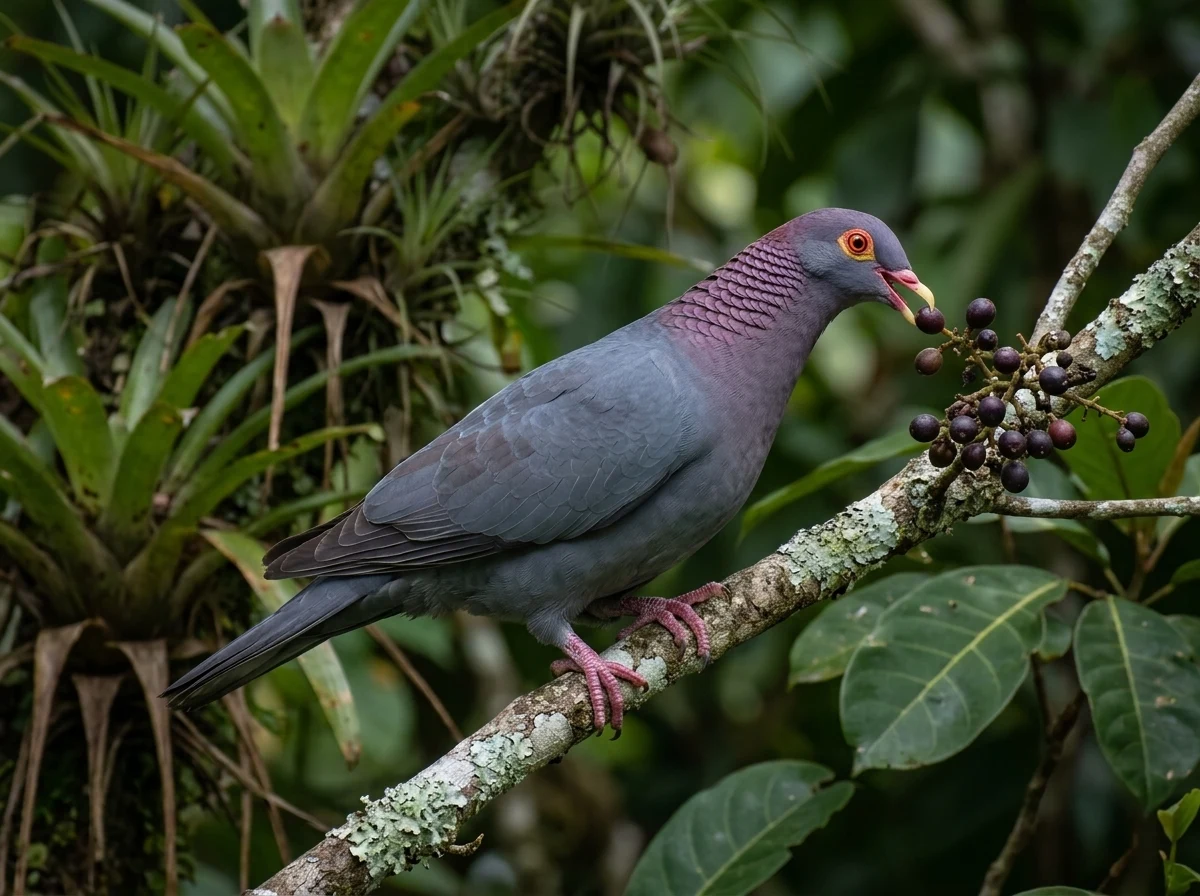
Nuca escamadaScaly-naped Pigeon markThe Scaly-naped Pigeon shows purple-red plumage with pale, scaly edges to the nape feathers.
Corona blancaWhite-crowned Pigeon markThe White-crowned Pigeon is recognized by its white crown, the character that gives it its name in Spanish and English.
HábitatEcological contextThe Scaly-naped Pigeon is associated with forests; the White-crowned Pigeon with mangroves, coastal forest, dry forest, and cays. Use it as a clue, not proof.
01
What the sources say about each species
The Scaly-naped Pigeon is a monotypic species described by Baptista and colleagues in Birds of the World. The source describes it as common and widespread throughout the Caribbean except Jamaica and the Bahamas, where it does not occur. It is large and distinctive within its range, with purple-red plumage and pale, scaly edges to the nape feathers. It is associated with a variety of forested habitats at most elevations, and is generally most common in intact primary lowland and montane forest, though it can also be seen along forest edge and secondary forest. Its movements are poorly understood, but extralimital records from the Florida Keys suggest at least some movement.
The White-crowned Pigeon is described as a fruit- and seed-eating species in the family Columbidae, found primarily in the Caribbean. In the local catalog, its primary habitat is listed as mangrove, coastal forest, dry forest, and offshore cays. The BirdsCaribbean and ARCI source, with participation from the Puerto Rico Department of Natural and Environmental Resources, presents a satellite-tracking study of 16 tagged White-crowned Pigeons. The initial finding was that they are more resident and less nomadic than expected, with point-to-point migration. Birds tagged in Florida did not migrate to the Bahamas, and those that wintered in Cuba had higher apparent survival than those wintering in Florida.
02
Direct comparison: what to look at and in what order
First, look at the head and nape. The White-crowned Pigeon has a white crown that contrasts with the rest of the head. The Scaly-naped Pigeon does not have a white crown; its distinctive feature is on the nape, where the feathers show pale edges that produce a scaly effect over purple-red plumage. In poor light, the white crown may appear as a pale patch, but the Scaly-naped Pigeon's scaly pattern is subtler and concentrated on the nape.
Second, assess habitat and landscape structure. The Scaly-naped Pigeon is associated with forests, most often intact primary lowland and montane forest, though it also uses edges and secondary forest. The White-crowned Pigeon is associated with mangroves, coastal forest, dry forest, and cays. If you are in a coastal mangrove or on a cay, the contextual probability favors the White-crowned Pigeon; if you are in interior or montane forest, it favors the Scaly-naped Pigeon. Do not turn that probability into a definitive identification: use the visible marks.
Third, consider behavior and movement. The White-crowned Pigeon can be colonial and gregarious, and the satellite-tracking study indicates more residency and point-to-point migration than expected. The Scaly-naped Pigeon has poorly understood movements, with extralimital records suggesting at least some displacement. Neither of these observations replaces a good view of the head and nape.
03
Field checklist and observation procedure
Before heading out, prepare a short list. Include: binoculars, a bird guide or app, a notebook or phone notes, and a clear idea of the two key characters: white crown versus scaly nape. If you are going to a mangrove or cay, note the time and light conditions; if you are going to interior or montane forest, note the forest type and approximate elevation. You do not need to record data you cannot support.
In the field, follow this procedure. First, locate the bird and observe the entire head, not just the bill. Second, determine whether there is a continuous white crown or whether the pale pattern is on the nape with scaly edges. Third, describe the overall plumage color: purple-red in the Scaly-naped Pigeon; in the White-crowned Pigeon, the emphasis is on the white crown. Fourth, record the habitat: mangrove, coastal forest, dry forest, cay, interior forest, or montane forest. Fifth, if the bird flies, note whether it was alone or in a group. Sixth, if you cannot see the head clearly, leave the identification as "unidentified large pigeon" and keep observing. An honest record is better than a forced identification.
As an exercise, choose one outing and practice only the head character. Do not try to identify every pigeon; focus on separating "white crown" from "scaly nape." At the end, compare your notes with the source descriptions. This exercise trains the eye for the most useful character and reduces reliance on habitat as the only clue.
04
Common mistakes and how to avoid them
A common mistake is identifying by habitat without seeing the bird. The Scaly-naped Pigeon is associated with forests and the White-crowned Pigeon with mangroves and coasts, but that does not mean they never overlap. Use habitat as a clue and confirm with the head. Another mistake is trusting a single mark in poor light. The white crown may look like a pale patch, and the scaly nape may disappear if the bird is backlit. If you do not see the pattern, do not invent it.
It is also worth avoiding generalizations about abundance. The sources describe the Scaly-naped Pigeon as common and widespread throughout the Caribbean except Jamaica and the Bahamas, but that does not authorize saying it is abundant in every Puerto Rico locality. The White-crowned Pigeon appears on Puerto Rico's bird list and the satellite-tracking study included participation from the Puerto Rico DNER, but that does not turn every sighting into proof of local residency. To record birds, use eBird or another citizen-science platform and document what you saw.
Linked profiles
The two species in the catalog
Profiles for the Scaly-naped Pigeon and White-crowned Pigeon with their names, habitat, and status according to the local catalog.
AI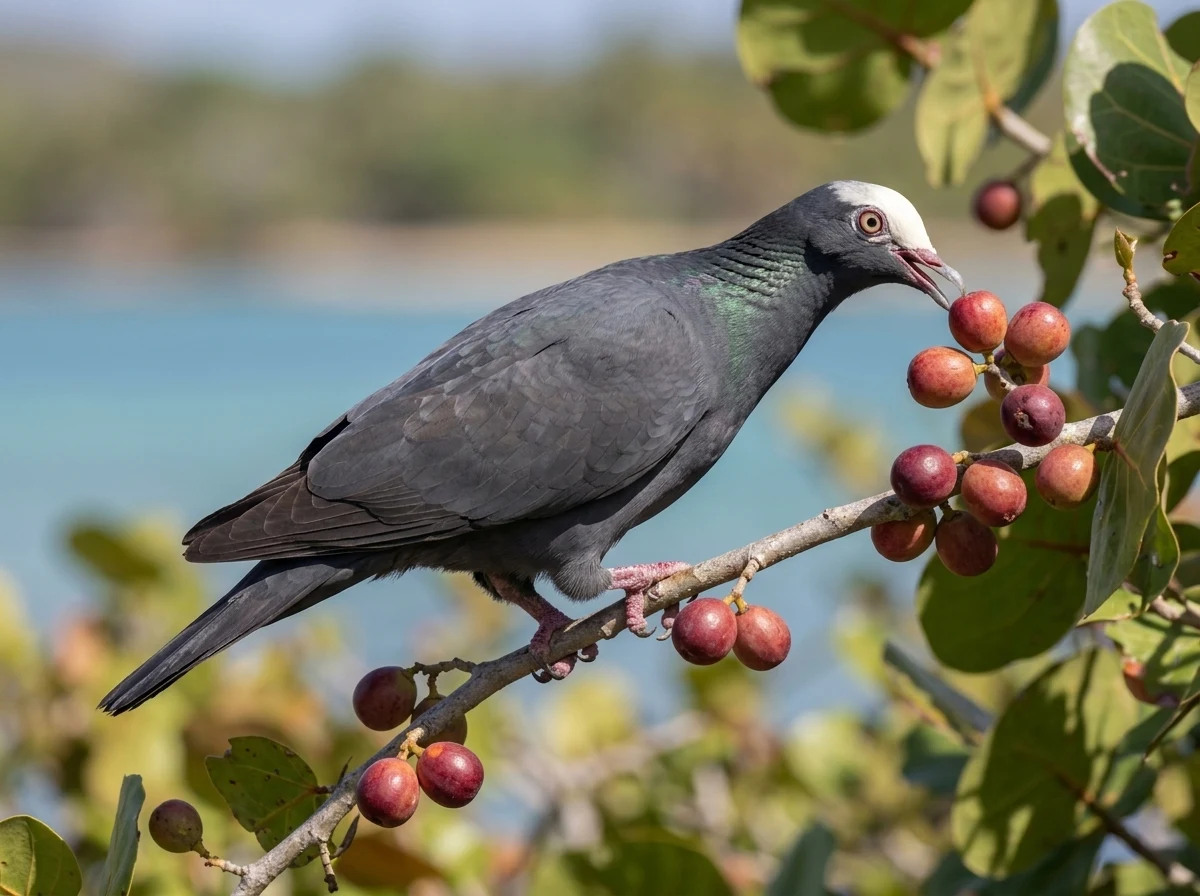 AI
AI01
What is the fastest difference between the Scaly-naped Pigeon and the White-crowned Pigeon?
The head. The White-crowned Pigeon has a white crown; the Scaly-naped Pigeon does not, and its distinctive mark is the nape with pale, scaly edges over purple-red plumage.
02
Can I identify them by habitat alone?
No. Habitat is a clue: the Scaly-naped Pigeon is associated with forests and the White-crowned Pigeon with mangroves, coastal forest, dry forest, and cays. Always confirm with visible head and nape marks.
03
Is the White-crowned Pigeon a resident in Puerto Rico?
The local catalog marks it as resident, breeder, and migrant or vagrant, with a review note about the current genus. The satellite-tracking source included participation from the Puerto Rico DNER, but that does not turn every sighting into proof of local residency.
04
What should I do if I cannot see the head well?
Record the bird as "unidentified large pigeon" and note the habitat, time, and whether it was alone or in a group. Do not force an identification without visible evidence.
05
Where can I learn more about Puerto Rico's pigeons and doves?
See the general pigeon and dove guide, the Scaly-naped Pigeon guide, and the dove versus pigeon guide. This article focuses on the direct comparison between these two species.
Keep exploring
Connected routes
Sources and review
The evidence is one link away.
These sources support the editorial scope of this guide. Bird profiles also retain their own taxonomy, occurrence, and conservation references.
Reviewed:
01↗02↗
Cornell Lab of Ornithology (Birds of the World)
Scaly-naped Pigeon Patagioenas squamosa
Evidence for cited sections; consult the original document.BirdsCaribbean / Avian Research and Conservation Institute (with Puerto Rico DNER)
A snapshot of the range-wide movements of White-crowned Pigeons tracked by satellite
Evidence for cited sections; consult the original document.The atlas continues