 AI
AIThe big forest pigeon
Scaly-naped Pigeon in Puerto Rico: how to identify it and where to see it
It is the native pigeon most often heard in the mountains, the most hunted, and the one most confused because of its name. Here is everything that separates it from the plaza pigeon and the Eurasian Collared-Dove.
Reviewed:Short answer: a large, native forest pigeon.
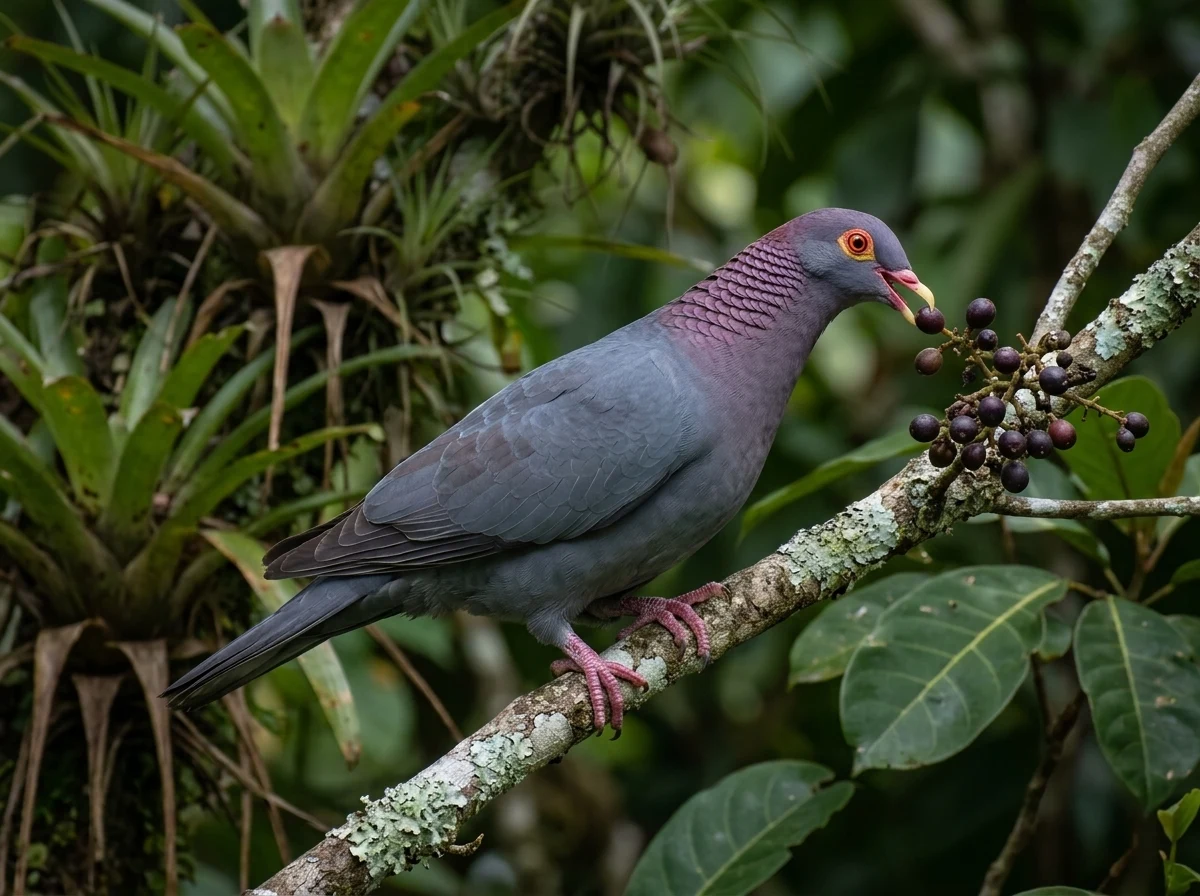
The Scaly-naped Pigeon (Patagioenas squamosa), called paloma turca in Puerto Rico, is a large slate-gray pigeon with a wine-colored head and neck and cream-edged nape feathers that look like scales. It is native to the Caribbean, lives year-round in Puerto Rico, and breeds here; it did not come from Turkey and is not the tórtola turca, which is a different, introduced species.
In the Puerto Rico Breeding Bird Atlas, built from SOPI volunteer data collected from 2004 through 2009, it turned up in 325 of 479 hexagons, about two-thirds of the archipelago. It is most abundant in the moist and wet life zones but comes down to parks and neighborhoods when fruit is available. This guide covers only this species: field marks, voice, nesting, diet, hunting, and the name confusion behind so many searches.
The big forest pigeon
Scaly-naped Pigeon by the numbers
68 %of atlas hexagons653 records in 325 of 479 hexagons (2004–2009 atlas).
262,899pigeons on averageEstimated April–June population size, 1986–2012 (Rivera-Milán and colleagues).
5per hunter per day (2022)Daily limit in DRNA's 2022 hunting notice; possession limit 15.
1–2eggs per clutchWetmore found nests with a single white egg on El Yunque.
01
Field marks: how to recognize a Scaly-naped Pigeon
Start with size and overall color: it is a big pigeon, roughly the size of a plaza pigeon (our catalog profiles average about 310 grams against about 350 for Rock Pigeon), but dark and uniform, slate gray, with the head, neck, and breast a wine or reddish-purple tone. Up close, the nape feathers have pale cream edges that create the scaled pattern behind both its English and Latin names (squamosa).
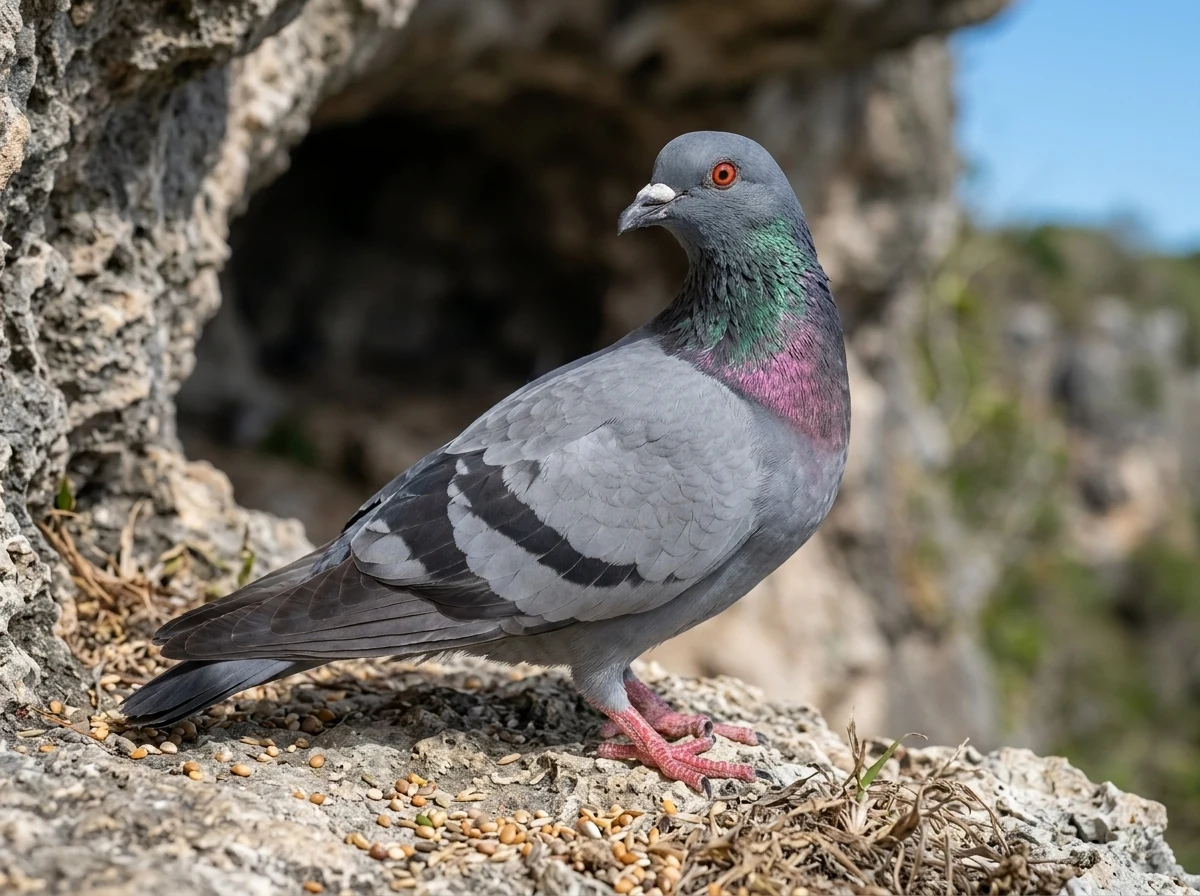
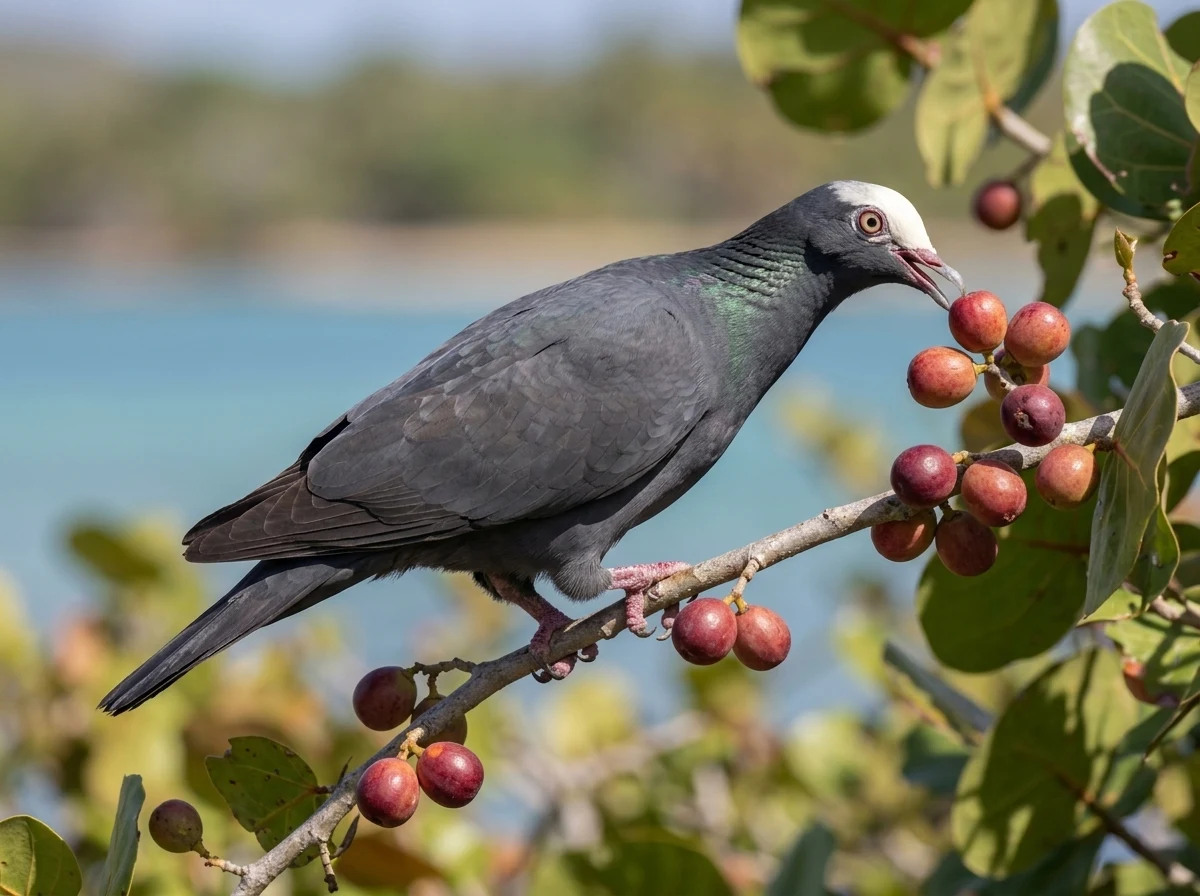
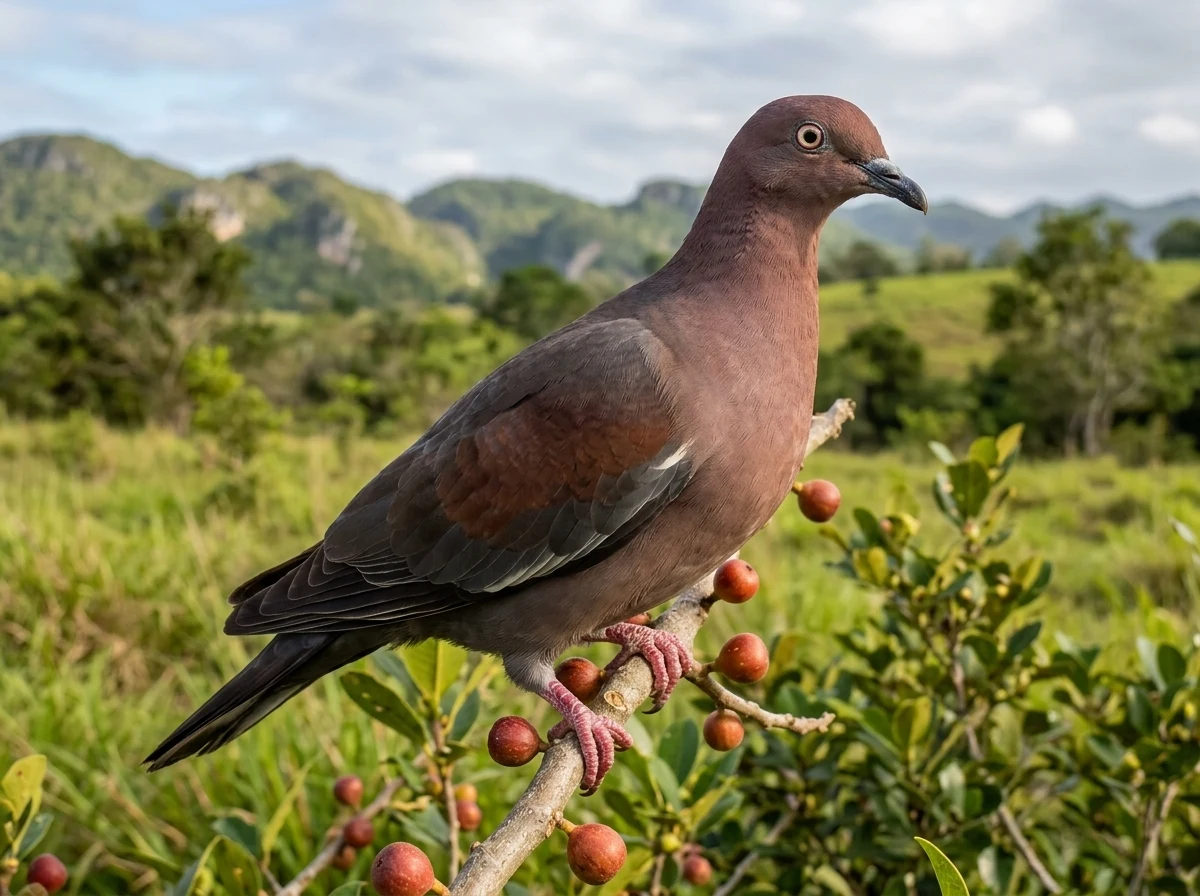
What it lacks matters as much as what it has. The wild-type Rock Pigeon of cities shows a white rump and two black wing bars; the Scaly-naped Pigeon has neither. The adult White-crowned Pigeon is dark with a white crown and is tied to mangroves and coastal forest. Plain Pigeon, an endangered species, is rare and concentrated in east-central Puerto Rico around Cidra, so a big pigeon at El Yunque or Maricao will almost never be a Plain Pigeon. If you see a large, dark pigeon with no white on the body over the canopy of a wet forest, Scaly-naped is the first candidate.
In poor light the wine color disappears and the bird looks simply gray. Then rely on silhouette, habitat, behavior (it usually perches high, alone or in small groups, and flushes with strong wingbeats), and voice. A photo that shows the nape settles almost any doubt.
02
Paloma turca is not tórtola turca: the name tangle
SOPI's Catalog of the Birds of Puerto Rico uses Paloma Turca as the official local name for Patagioenas squamosa. In Spain and elsewhere in the Spanish-speaking world the same species is Paloma Isleña, the name recommended by the Spanish Ornithological Society and the Pan-Hispanic Committee on bird names. A search for paloma isleña and one for paloma turca de Puerto Rico are about the same bird.
The catch is that the same catalog calls Streptopelia decaocto, the Eurasian Collared-Dove, Tórtola Turca: a pale, sandy dove with a black half-collar on the nape, native to Asia and Europe and introduced to Puerto Rico. The breeding bird atlas calls it Tórtola Collarina, and this site lists it as Tórtola Collarina Euroasiática. If someone says they saw a turca in a suburban yard on the south coast, ask whether it had a black collar: it was probably the dove.
We found no documented explanation in the sources reviewed for why the native species is called turca in Puerto Rico, so we do not repeat folk explanations here. What is clear is that the name says nothing about origin: the Scaly-naped Pigeon is Caribbean and already carried that name on the island when Alexander Wetmore did his island fieldwork between December 1911 and September 1912.
03
Where and when to see it in Puerto Rico
The atlas describes it as a common to fairly common resident on Puerto Rico, the Virgin Islands, and other Lesser Antilles, plus the mountain forests of Hispaniola. Here it occurs across the main island and on Mona, Desecheo, Culebra, and Vieques, where it is a fairly common resident. It favors humid forests, coffee farms, and parks, and systematic surveys cited by the atlas show it is most abundant in the moist and wet life zones.
To see it reliably, visit mountain forests early in the morning or late in the afternoon, when pigeons move between roosts and fruiting trees. Wetmore found it in great numbers on El Yunque, circling high near the old Hacienda Catalina in the evening; the featured recording on this site comes from Maricao State Forest. In the San Juan metro area it shows up when palms and other park trees are fruiting.
It is not a migrant. In the early 20th century many hunters believed it only passed through, an idea Wetmore disproved by finding active nests on El Yunque in March. Local numbers do shift with fruit supply, and Wetmore already noted movement between islands, as on Desecheo, where numbers varied greatly from season to season.
04
Nest, eggs, and breeding season
The Scaly-naped Pigeon builds a flimsy stick nest in a tree or shrub, sometimes on a palm frond or a bromeliad. Wetmore described three nests on El Yunque about 15 feet up, on horizontal limbs or on debris piled on large air plants; one held a single white egg. Our catalog profiles give clutches of one or two eggs.
The atlas found breeding activity year-round, with most records from March to June and a peak in June, after the rainy season begins. Rivera-Milán's studies cited by the atlas indicate that on Puerto Rico and its satellite islands, pigeon and dove nesting runs from February to September, with the highest nest density in April–June. That is why the hunting season opens after the breeding peak.
05
What it eats: a fruit pigeon
It is a fruit eater. The ten stomachs Wetmore examined held only plant matter: palm fruits (including the sierra palm), wild figs, moral (Cordia), jagua (Genipa americana), guaraguao (Trichilia), and other forest fruits, plus the occasional tender leaf. It swallows fruit whole, even hard-pitted fruit, and its muscular gizzard crushes it.
That diet ties it to fruiting trees and explains why it enters parks and yards with palms. It also makes the species sensitive to hurricanes: the atlas explains that land birds relying on fruit, nectar, or seeds are the most vulnerable to a hurricane's indirect effects, such as the loss of food and nest sites.
06
Hunting and population: the key game pigeon
The Scaly-naped Pigeon is a regulated game species. DRNA's notice for the 2022 season allowed hunting Friday through Monday and on holidays between September 3 and October 31, with a limit of 5 Scaly-naped Pigeons per hunter per day and 15 in possession, plus a hunting license and a $30 stamp. Dates and limits are published every year, so always confirm the current DRNA notice before going out.
A study by Frank Rivera-Milán and colleagues (2014) estimated an average population of 262,899 pigeons in April–June from 1986 to 2012 and an average harvest of 40,760 birds per season from 1986 to 2011. The 2008–2011 harvest was 2.1 times the maximum sustainable yield, and the authors projected about 216,000 pigeons for 2014, warning that more restrictive rules might be needed.
Globally the IUCN rates it Least Concern, and it is not in any threatened category of DRNA or the U.S. Fish and Wildlife Service. Even so, the atlas notes that its population trend is described as decreasing. Being common does not make it inexhaustible.
07
Its voice: the loud coo of the mountains
Wetmore described the usual call as a loud, strongly accented who hoo hoo, and another deeper, burry hoo-o-o-o with a throaty rattle that startles when it comes from directly overhead. In practice you will often hear it before you see it, because it hides remarkably well in foliage: Wetmore counted 25 or 30 pigeons roosting in a single tree without them being obvious.
Always compare with recordings from known places. The species profile on this site includes Xeno-canto audio and a spectrogram recorded at Maricao; play them beside the Zenaida Dove's softer, more rhythmic coo to train your ear.
Linked profiles
Scaly-naped Pigeon and its lookalikes
Open each profile to compare plumage, habitat, status, and sounds.
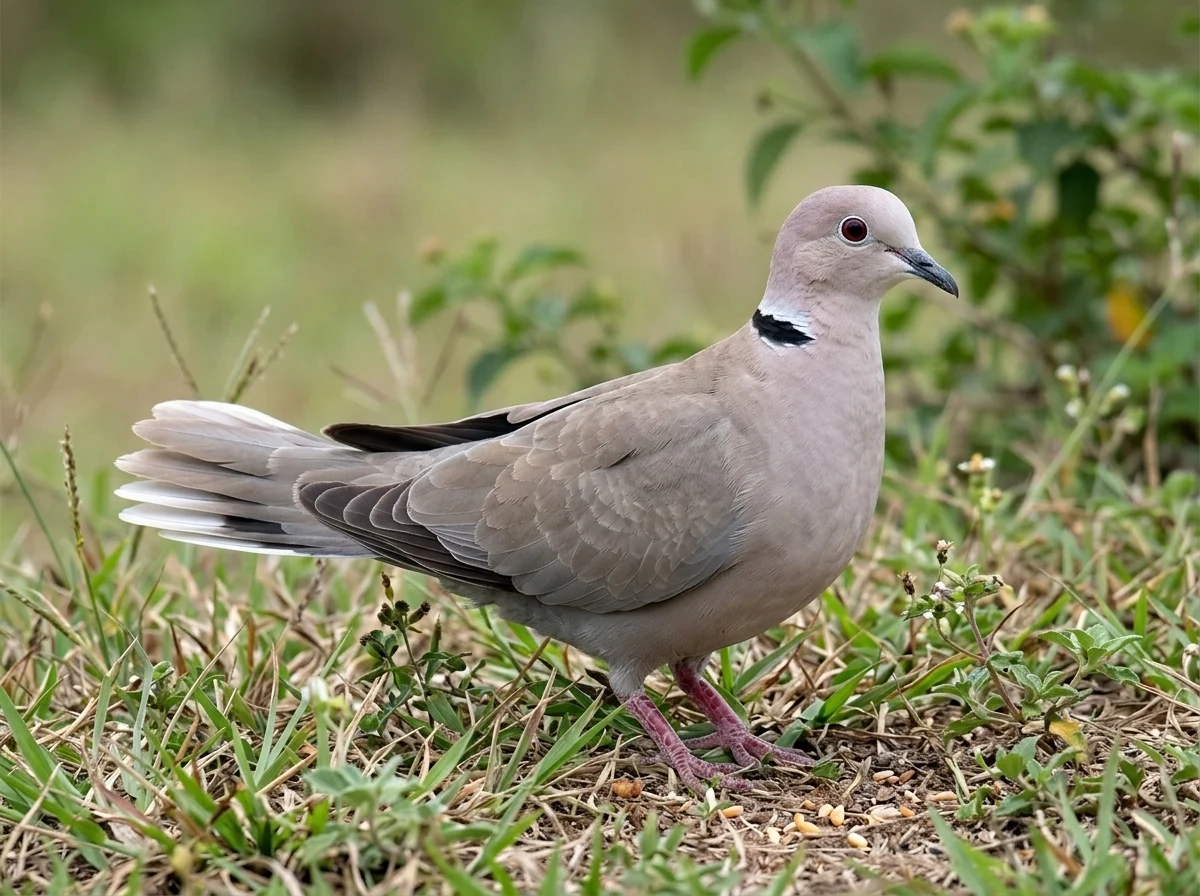
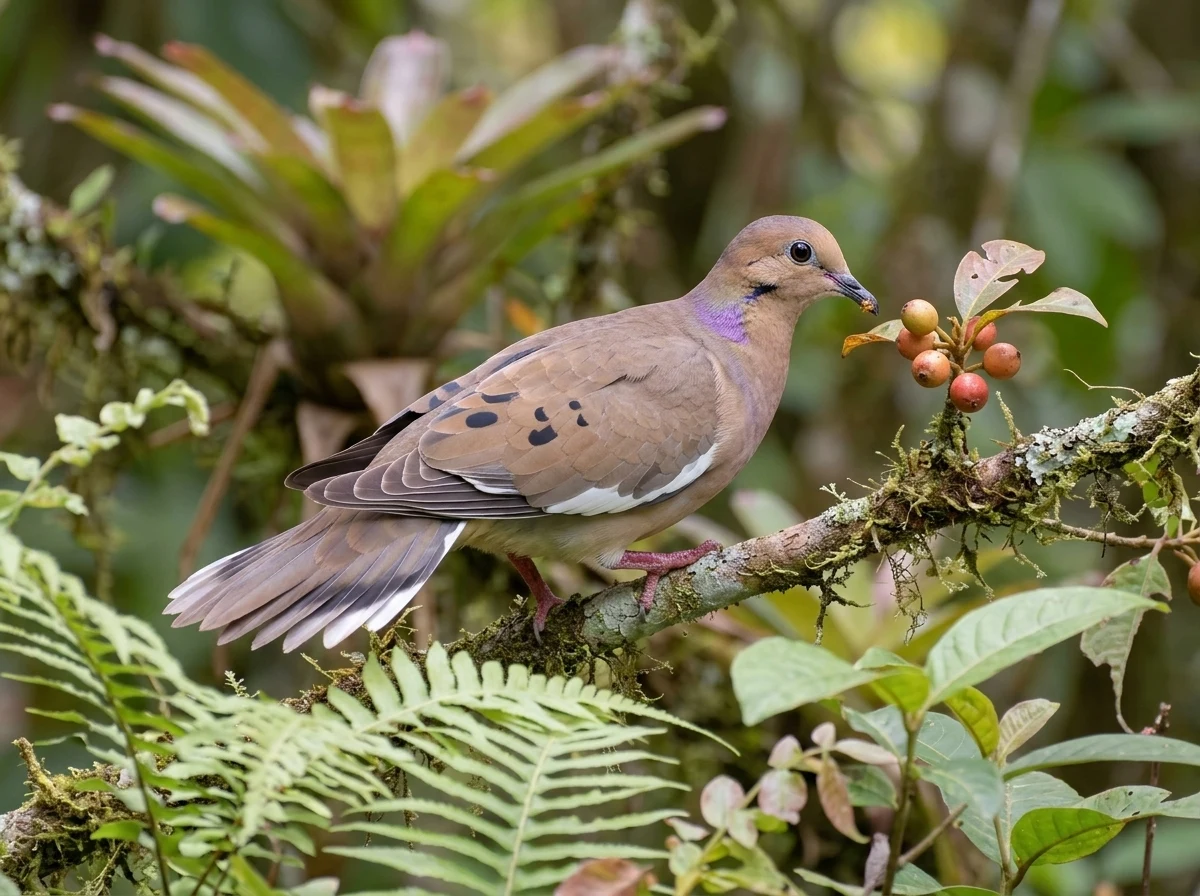
Sound archive
Hear its voice
Explore real songs and calls. The spectrogram turns each sound into a visual trace of time and frequency.
XC173663Recording 1 of 3song

Play: song by Eric DeFonso
Choose another recording
Sound recorded by Eric DeFonso · XC173663 · CC BY-NC-SA 4.0. Visualization by Stichting Xeno-canto voor Natuurgeluiden.
Every recording retains the creator, catalogue number, and license published by Xeno-canto. Metadata via GBIF ↗
01
Why is it called paloma turca?
It is the traditional local name and the official name in SOPI's catalog, but it does not indicate origin: the species is native to the Caribbean. We found no documented explanation for the name. Elsewhere in Spanish it is called paloma isleña.
02
Is the Scaly-naped Pigeon native to Puerto Rico?
Yes. It is native, resident year-round, and breeds on Puerto Rico and its islands. Its range is limited to the West Indies and a few islands off Venezuela; it is neither migratory nor introduced.
03
What is the difference between a Scaly-naped Pigeon and a Rock Pigeon?
The Scaly-naped Pigeon is dark slate gray with a wine-red neck and scaly nape, and lives in forests. The wild-type Rock Pigeon of plazas has a white rump and two black wing bars and lives around buildings.
04
Can you hunt Scaly-naped Pigeons in Puerto Rico?
Yes, only with a hunting license, the pigeon-and-dove stamp, and during the season DRNA publishes. In 2022 the limit was 5 per hunter per day and 15 in possession. Rules change every year, so check the current notice.
05
What does the Scaly-naped Pigeon eat?
Mainly wild fruit: palm fruits, wild figs, moral, jagua, and other forest fruits, which it swallows whole. It does not depend on crops or grain.
06
Where can I see Scaly-naped Pigeons in Puerto Rico?
In humid mountain forests such as El Yunque and Maricao, in coffee farms, and in parks with palms or fruiting trees. Look early or near dusk, when they fly between roosts and feeding trees, and listen for the loud coo.
Keep exploring
Connected routes
Sources and review
The evidence is one link away.
These sources support the editorial scope of this guide. Bird profiles also retain their own taxonomy, occurrence, and conservation references.
Reviewed:
01↗02↗03↗04↗05↗06↗07↗08↗09↗
U.S. Forest Service Research and Development
Puerto Rico Breeding Bird Atlas
Distribution and breeding timing for 130 species breeding in Puerto Rico and its satellite islands.Sociedad Ornitológica Puertorriqueña (SOPI)
Catalog of the Birds of Puerto Rico
Official Spanish names, SEO/CPO Spanish names, and English names for the 13 pigeons and doves in the catalog (list completed February 2007).U.S. Department of Agriculture / Internet Archive (Alexander Wetmore, 1916)
Birds of Porto Rico (USDA Bulletin 326)
Historical local names, voices, nests, and stomach contents of pigeons, doves, ground doves, and quail-doves in the early 20th century.Birds of the World / Cornell Lab of Ornithology
Scaly-naped Pigeon: introduction
Caribbean range, plumage with pale-edged nape feathers, forest habitats, and conservation status.Ciencia Puerto Rico (resumen de Rivera-Milán y colaboradores, 2014, Journal of Wildlife Management)
Protecting the scaly-naped pigeon
Estimated population size, hunter harvest, and maximum sustainable yield of Scaly-naped Pigeon in Puerto Rico.Departamento de Recursos Naturales y Ambientales de Puerto Rico
Public notice: 2022 pigeon and dove hunting season
Game species, daily and possession limits, treatment of Rock Pigeon and collared-doves, and closed areas that protect Plain Pigeon.National Audubon Society
Rock Pigeon field guide
Size, wild-type field marks, color variation, nests, incubation, crop milk, and origin of Rock Pigeon.National Audubon Society
Eurasian Collared-Dove field guide
Black collar, white in the tail, voice, and Caribbean spread of Eurasian Collared-Dove.Xeno-canto Foundation / GBIF
Xeno-canto recordings published through GBIF
Metadata, authorship, licenses, and catalogue records for field recordings used by the atlas.The atlas continues