 AI
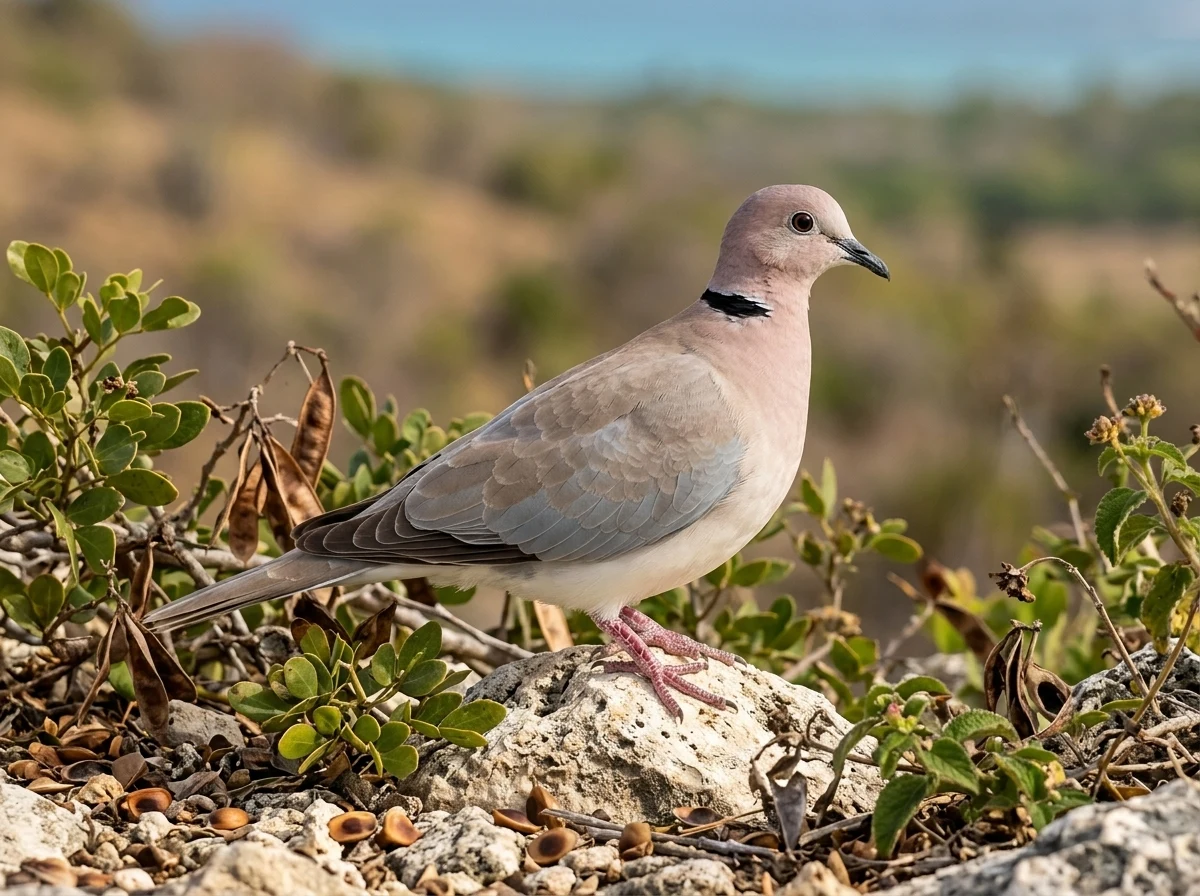
AIAI reconstruction created with Nano Banana 2 · 1K, grounded in the profile’s documented taxonomy, habitat, natural-history sources, and an open-license visual reference when available. It is an interpretive image, not documentary evidence. Image policy →
African Collared-Dove
Tórtola Collarina Africana
Streptopelia roseogrisea
The African collared dove (Streptopelia roseogrisea) is a small dove found in the Sahel, northern parts of the Horn of Africa and southwestern Arabia. Although it lives in arid lands, it is found around water sources. This bird is typically around 26 cm (10 in) in length and 130–166 g weight. Its upper body, from shoulders to tail, is a pale greyish brown, though the wing edge has a bluish tinge. The flight feathers are darker, and nearly black. The head, neck and breast are pinkish shading to white on the chin and belly. There is no sexual dimorphism. Two subspecies are currently accepted, though the genetic difference is minimal and the species may be better considered monotypic. Streptopelia roseogrisea roseogrisea — nominate subspecies; across Africa in the Sahel region just south of the Sahara Desert east to north-central Sudan Streptopelia roseogrisea arabica (Neumann, 1904) — northeast Sudan to Eritrea and Somalia, and southwestern Arabia; slightly darker than nominate The African collared dove is the wild ancestor of the domestic Barbary dove; some in the past have suggested that the Eurasian collared dove (Streptopelia decaocto) may also have been involved, but there is only minimal evidence to support this. The African collared dove is able to interbreed with the Barbary dove, and it is thought that the increase in the range of colours of Barbary doves available that occurred in the later 20th century was the result of the importation of African collared doves into the United States for interbreeding. It has a diet of grass seeds and other plants. They would also eat berries, insects, and snails.
Sound archive
Hear its voice
Explore real songs and calls. The spectrogram turns each sound into a visual trace of time and frequency.

Play: call by Barry Edmonston
Choose another recording
Sound recorded by Barry Edmonston · XC793994 · CC BY-NC-SA 4.0. Visualization by Stichting Xeno-canto voor Natuurgeluiden.
Every recording retains the creator, catalogue number, and license published by Xeno-canto. Metadata via GBIF ↗
Island profile
About the African Collared-Dove
This atlas includes African Collared-Dove (Streptopelia roseogrisea) with atlas status “Introduced” within scope “Avibase inferred core 380.” Global trait data associate it primarily with shrub; consult the linked records to resolve its Puerto Rico habitat use.
Conservation
Least Concern
IUCN LC
- Global IUCN
- LC
- Puerto Rico DNER
- No current listing in source crosswalk
- Federal ESA
- No current listing in source crosswalk
- Critical habitat
- Not identified in source crosswalk
Natural history
How it lives
- Habitat
- shrublands
- Elevation
- 0–1000 m
- Nest
- Cup / bowl · Shrub / bush / vine; Tree
- Clutch
- 1–2 eggs
- Social behavior
- Social / flocking; Pairs / family groups; Singly and pairs
Keep exploring
This bird belongs to 5 paths through the atlas.
Guides featuring this bird
Follow this record beyond the profile.
Identification, sound, place, and explanatory guides connecting this species to larger questions.
Related in the atlas
Where to fly next
Connected by taxonomy, habitat, occurrence, and conservation.
 AI
AI AI
AI AI
AI AI
AI AI
AI AI
AI
Evidence trail