 AI
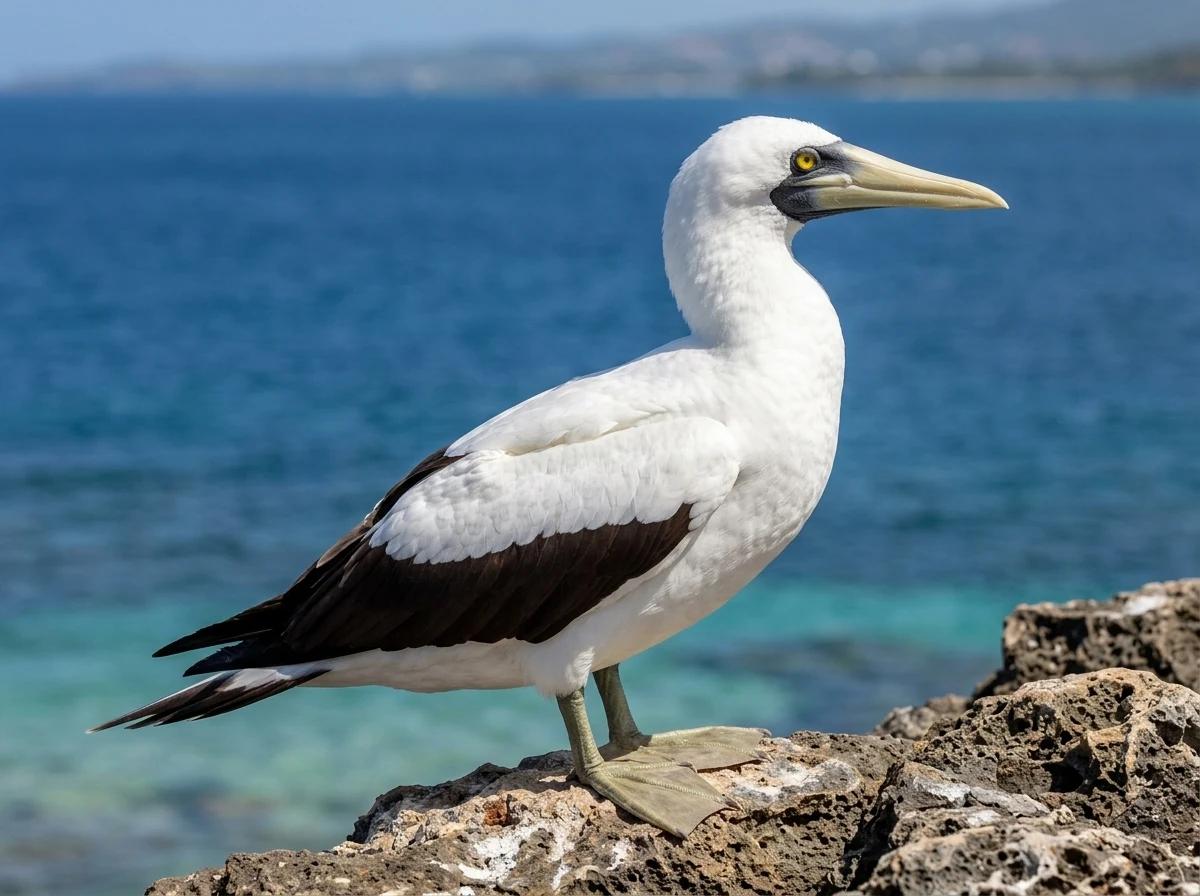
AIAI reconstruction created with Nano Banana 2 · 1K, grounded in the profile’s documented taxonomy, habitat, natural-history sources, and an open-license visual reference when available. It is an interpretive image, not documentary evidence. Image policy →
Masked Booby
Bobo Enmascarado
Sula dactylatra
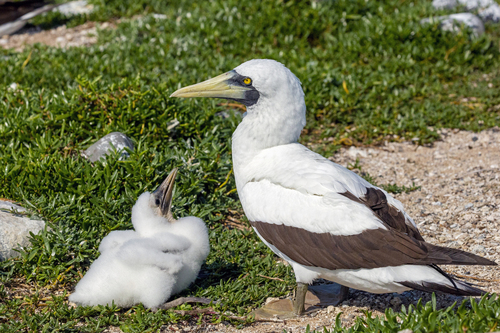
The masked booby (Sula dactylatra), also called the masked gannet or the blue-faced booby, is a large seabird of the booby and gannet family, Sulidae. First described by the French naturalist René-Primevère Lesson in 1831, the masked booby is one of six species of booby in the genus Sula. It has a typical sulid body shape, with a long pointed yellowish bill, long neck, aerodynamic body, long slender wings and pointed tail. The adult is bright white with black wings, a black tail and a dark face mask; at 75–85 cm (30–33 in) long, it is the largest species of booby. The sexes have similar plumage. This species ranges across tropical oceans, except in the eastern Atlantic and eastern Pacific. In the latter, it is replaced by the Nazca booby (Sula granti), which was formerly regarded as a subspecies of masked booby. Nesting takes place in colonies, generally on islands and atolls far from the mainland and close to deep water required for foraging. Territorial when breeding, the masked booby performs agonistic displays to defend its nest. Potential and mated pairs engage in courtship and greeting displays. The female lays two chalky white eggs in a shallow depression on flat ground away from vegetation. The chicks are born featherless, but are soon covered in white down. The second chick born generally does not survive and is killed by its elder sibling. These birds are spectacular plunge divers, plunging into the ocean at high speed in search of prey—mainly flying fish. The species faces few threats; although its population is declining, it is considered to be a least-concern species by the International Union for Conservation of Nature (IUCN).
Sound archive
Hear its voice
Explore real songs and calls. The spectrogram turns each sound into a visual trace of time and frequency.

Play: alarm call by Alán Palacios
Choose another recording
Sound recorded by Alán Palacios · XC730159 · CC BY-NC-SA 4.0. Visualization by Stichting Xeno-canto voor Natuurgeluiden.
Every recording retains the creator, catalogue number, and license published by Xeno-canto. Metadata via GBIF ↗
Island profile
About the Masked Booby
This atlas includes Masked Booby (Sula dactylatra) with atlas status “Native / natural occurrence” within scope “Avibase inferred core 380.” Puerto Rico context sources associate it with Pelagic waters; offshore nesting islands.
Conservation
Least Concern
IUCN LC; DNER VU
- Global IUCN
- LC
- Puerto Rico DNER
- VU
- Federal ESA
- No current listing in source crosswalk
- Critical habitat
- Not identified in source crosswalk
Natural history
How it lives
- Habitat
- Pelagic waters; offshore nesting islands
- Elevation
- 0–0 m
- Nest
- Scrape · Ground; Rock
- Clutch
- 1–2 eggs
- Social behavior
- Colonial
Keep exploring
This bird belongs to 8 paths through the atlas.
Guides featuring this bird
Follow this record beyond the profile.
Identification, sound, place, and explanatory guides connecting this species to larger questions.
Related in the atlas
Where to fly next
Connected by taxonomy, habitat, occurrence, and conservation.
 AI
AI AI
AI AI
AI AI
AI AI
AI AI
AI
Evidence trail
Sources, media & further reading
Research note: Commonwealth VU in cited 2026 compilation