 AI
AILook-alike birds
Bananaquit vs. Adelaide's Warbler
Both are small, gray above, yellow below, and pale-browed. One is the island's everyday backyard bird; the other is a Puerto Rico endemic.
Reviewed:Start with the throat and the bill.
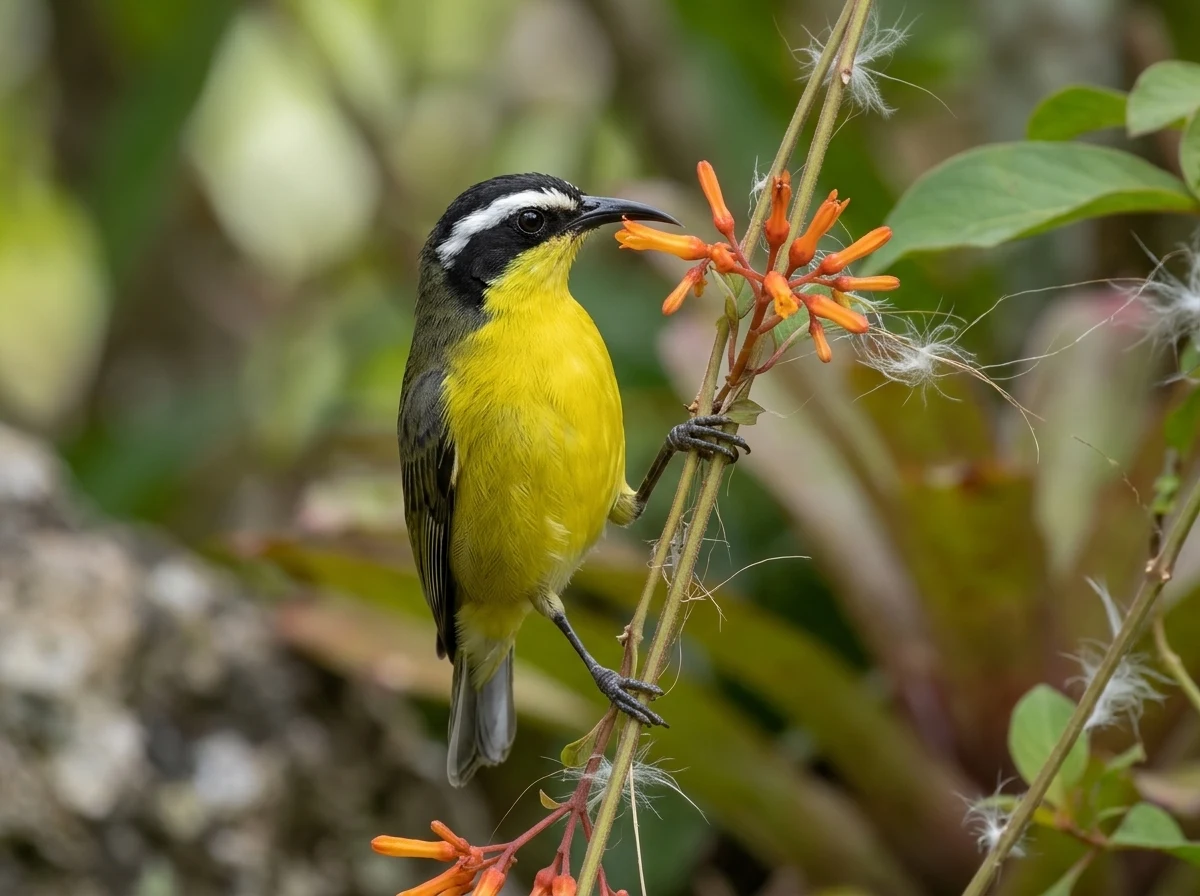
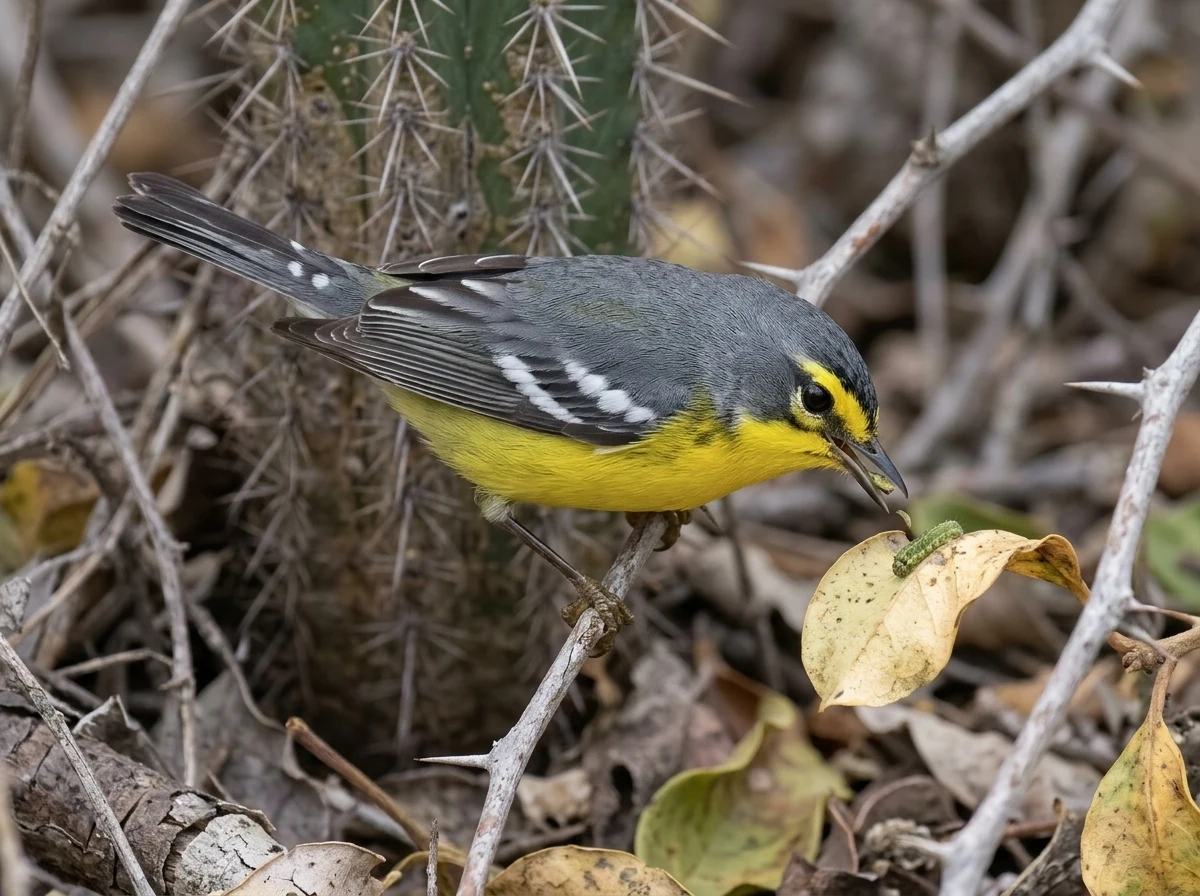
The fastest way to tell a Bananaquit from an Adelaide's Warbler is the throat: on Adelaide's Warbler (Reinita Mariposera) the yellow starts at the chin and covers the throat and breast, while the Bananaquit (Reinita Común) has a pale gray throat and the yellow begins on the breast. The Bananaquit also has the black, curved bill of a nectar feeder, and Adelaide's shows two white wing bars.
The shared Spanish name, reinita, drives the confusion, but they are not close relatives. Adelaide's Warbler (Setophaga adelaidae) is a true wood-warbler in the family Parulidae and is endemic to Puerto Rico and Vieques. The Bananaquit (Coereba flaveola) belongs to the tanager family, Thraupidae, and lives across most of the Caribbean and tropical America.
Look-alike birds
Two reinitas, two stories
12.5 cmAdelaide's WarblerSlightly longer than a Bananaquit, which measures about 10–13 cm depending on subspecies.
87 %hexagons with BananaquitOne of the most widespread birds in the atlas: 418 of 479 hexagons.
1endemicOnly Adelaide's is endemic; the Bananaquit is native and widespread.
01
The face: similar eyebrows, different throats
The Bananaquit has a black or very dark crown and face sides and a long, bold white eyebrow. Below, the throat is pale gray; bright yellow appears on the breast and belly. That pale throat is the quickest separating mark.
Adelaide's Warbler also has a pale eyebrow, but it is yellow in front of the eye and turns white behind it, with a white arc below the eye and a slate-gray crown with a thin black stripe. From chin to breast it is lemon-yellow, the belly is paler yellow, and the undertail coverts are white.
02
Bill, wings, and tail
The Bananaquit's bill is black, pointed, and down-curved, adapted for nectar; its tongue ends in a long paddle-shaped tip. On the dark wing it has a small white spot on the flight feathers, and the rump is yellow, which shows when it flies away.
Adelaide's Warbler has the fine bill of an insect-eating warbler, without the Bananaquit's curve. Its wings show two white bars formed by the tips of the coverts, and the dark tail has white on the three outer feathers on each side, visible when it fans the tail while moving through branches.
03
What they eat and how they move
The Bananaquit lives on nectar and fruit. It hangs upside down from flowers, pierces fruit to drink the juice, and sometimes pierces a flower from the side to rob nectar without pollinating it. It also eats small insects and competes with hummingbirds at flowers and feeders.
Adelaide's Warbler hunts insects and other arthropods, gleaning at least half its prey from leaves, from ground level up to about 10 meters. It joins mixed flocks with other warblers and Puerto Rican Todies. If the bird is buried in a flower or at a feeder, it is almost certainly a Bananaquit.
04
Where to look for each
The Bananaquit occurs across almost all of Puerto Rico and its satellite islands, from urban gardens to forest edges, though it is rare on the highest peaks and in the driest lowlands. It appears to be absent from Mona, Monito, and Desecheo. In the atlas it appeared in 87% of hexagons.
Adelaide's Warbler is endemic to the main island and Vieques. It is characteristic of the southern dry forests, such as Guánica State Forest, and also lives in the northern karst and in secondary forests. It is a year-round resident, so a June sighting is as valid as a January one.
05
Voice and nests
Adelaide's Warbler sings a loud trill that varies in pitch and speed; each individual can have more than 20 song variants. Its calls include a quiet, high pip, bursts of a harsh chit, and a chip. That repeated trill from dry-forest foliage is often the first clue before you see the bird.
The Bananaquit builds a spherical nest of grass and fibers with a side entrance, and makes new nests throughout the year. The atlas found breeding activity year-round, peaking from March to June. A round nest with a side door hanging in a backyard shrub almost always belongs to a Bananaquit.
06
Juveniles and other yellow birds
Juveniles complicate the throat rule. A young Bananaquit is duller and may have a yellowish eyebrow and throat, so check for the curved bill and the white wing spot. A young Adelaide's Warbler lacks head markings, is brownish-gray above, and has paler yellow; the wing bars still help.
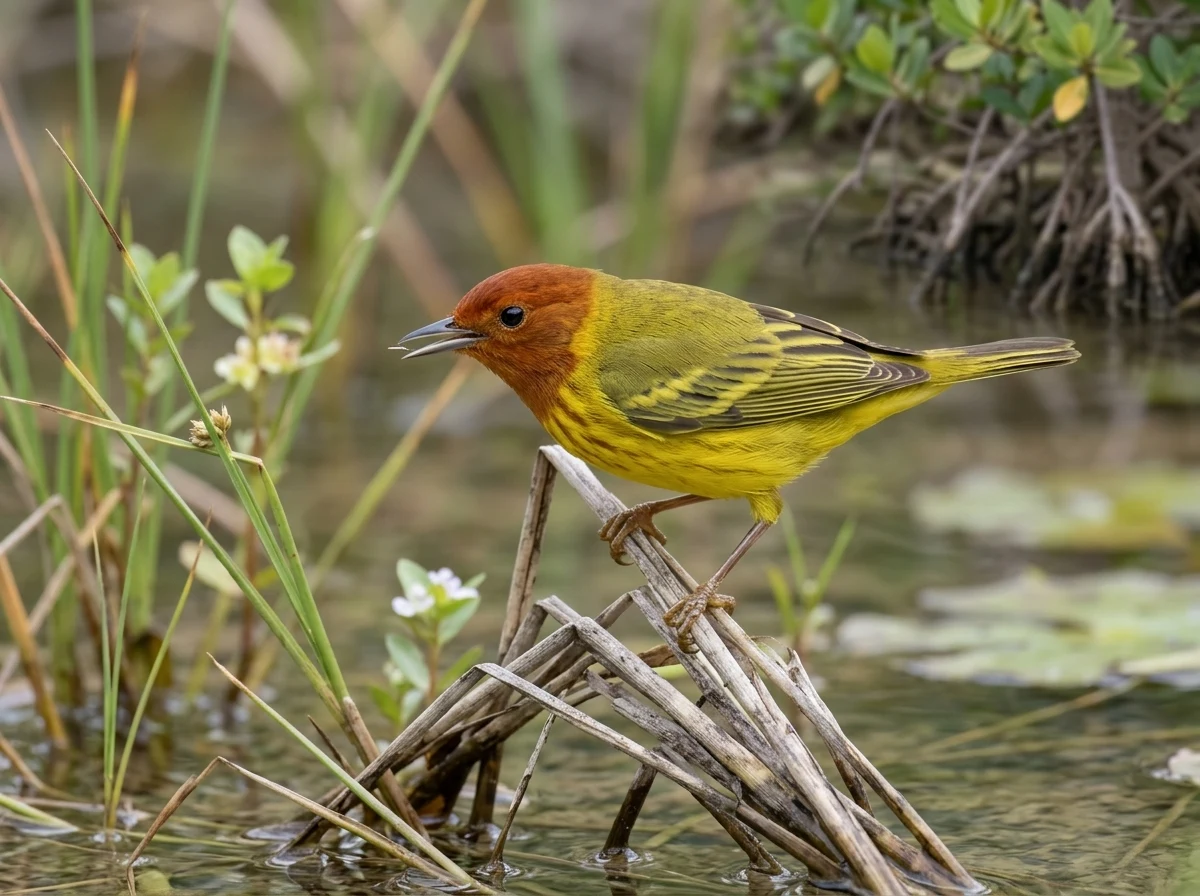
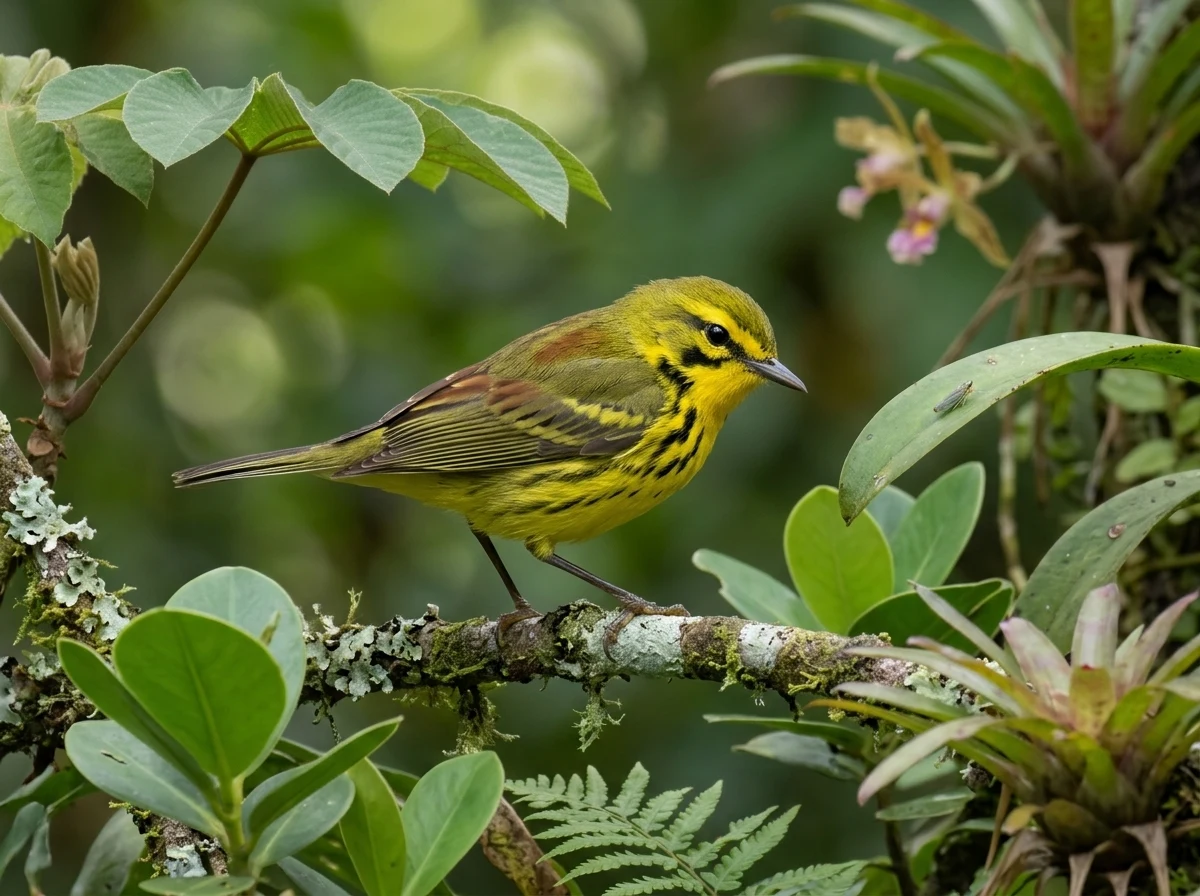
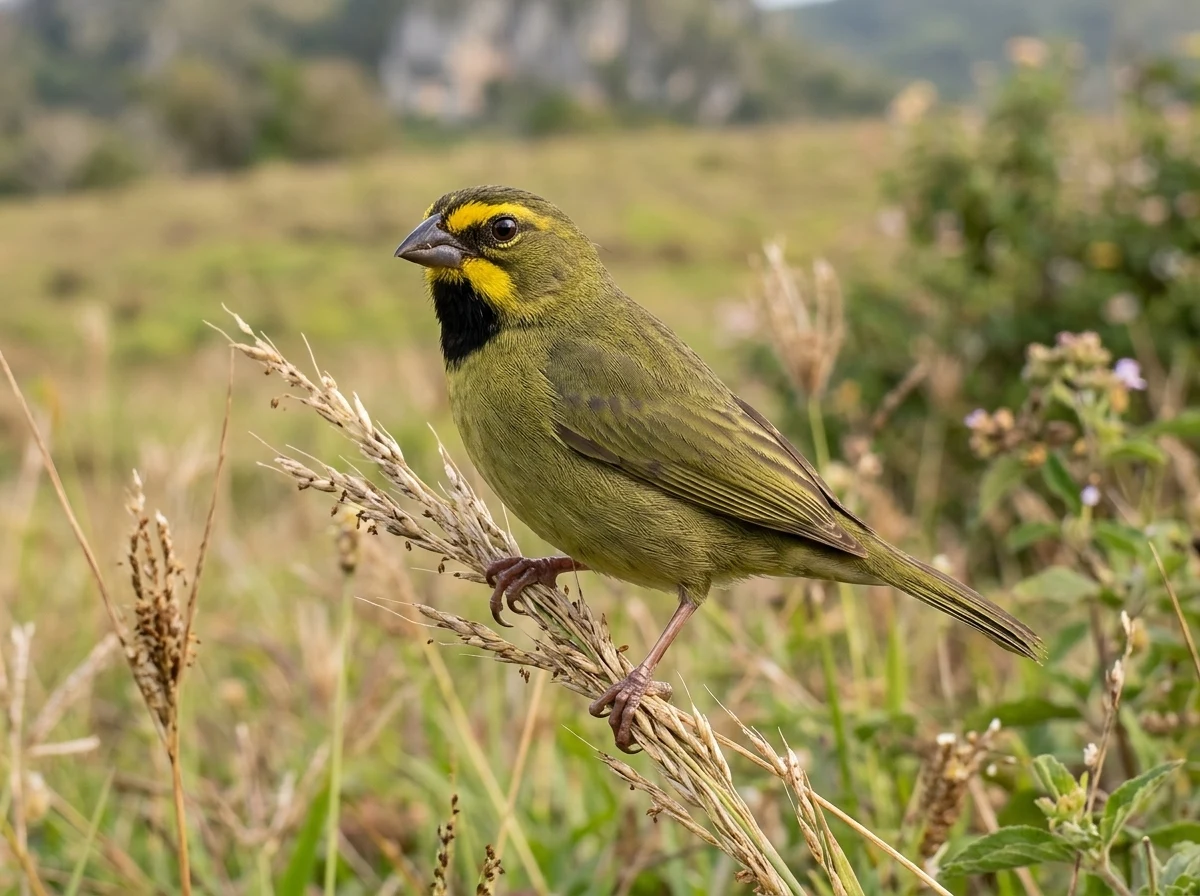
Other yellow birds join the confusion. The Yellow Warbler (Canario de Mangle) lives in mangroves and coastal scrub, mainly on the south coast. The migrant Prairie Warbler (Reinita Galana) is olive above and yellow below and bobs its tail constantly. If you see olive and yellow in a grassy field, also consider a Yellow-faced Grassquit.
Linked profiles
Reinitas and look-alikes
Compare photos and recordings of each species.
Sound archive
Hear its voice
Explore real songs and calls. The spectrogram turns each sound into a visual trace of time and frequency.
XC793968Recording 1 of 3call

Play: call by Barry Edmonston
Choose another recording
Sound recorded by Barry Edmonston · XC793968 · CC BY-NC-SA 4.0. Visualization by Stichting Xeno-canto voor Natuurgeluiden.
Every recording retains the creator, catalogue number, and license published by Xeno-canto. Metadata via GBIF ↗
01
What is the difference between a Bananaquit and an Adelaide's Warbler?
The Bananaquit has a pale gray throat, white eyebrow, curved black bill, and a white wing spot. Adelaide's Warbler has a lemon-yellow throat and breast, two white wing bars, white in the tail, and a fine, uncurved bill. The Bananaquit drinks nectar; Adelaide's hunts insects in foliage.
02
Is Adelaide's Warbler endemic to Puerto Rico?
Yes. Adelaide's Warbler (Setophaga adelaidae) is endemic to Puerto Rico and Vieques. The Barbuda and St. Lucia populations were once treated as part of the same species, but taxonomic systems began treating them as separate species in 2000.
03
Is the Bananaquit a warbler?
Not strictly. Although it is called Reinita Común in Puerto Rico, the Bananaquit belongs to the tanager family (Thraupidae), not the true wood-warblers (Parulidae). Its classification was uncertain for years until genetic studies placed it with the tanagers.
04
Where can I see Adelaide's Warbler in Puerto Rico?
Look in the southern dry forests, such as Guánica State Forest, and also in the northern karst and secondary forests. It is a year-round resident, and its loud, variable trill usually gives it away before you see it.
05
What small yellow and black bird visits my feeder in Puerto Rico?
It is almost always the Bananaquit, or Reinita Común: small, dark above, yellow below, with a white eyebrow and curved bill. It is very common in yards and competes with hummingbirds for nectar and sugar water.
06
What does a Bananaquit nest look like?
It is a ball of grass and fibers with a side entrance, placed in shrubs or trees. Bananaquits build new nests throughout the year, and in Puerto Rico nesting is most intense from March to June.
Keep exploring
Connected routes
Sources and review
The evidence is one link away.
These sources support the editorial scope of this guide. Bird profiles also retain their own taxonomy, occurrence, and conservation references.
Reviewed:
01↗02↗03↗04↗05↗06↗07↗08↗
Wikipedia
Bananaquit
Size, white eyebrow, yellow rump, curved bill, nectar robbing, and spherical nest with a side entrance.Celebrate Urban Birds / Cornell Lab of Ornithology
Focal species: Bananaquit
Pale throat, white wing spot, head-down foraging, and competition with hummingbirds.Wikipedia
Adelaide's warbler
Plumage (yellow throat, two wing bars, white in tail), Puerto Rico and Vieques range, foraging, and song.Birds of Puerto Rico (datos del Puerto Rico Breeding Bird Atlas)
Bananaquit (Reinita Común)
Puerto Rico distribution, absence from Mona, Monito, and Desecheo, year-round nesting, and 87% of atlas hexagons.Sociedad Ornitológica Puertorriqueña
Catalog of the Birds of Puerto Rico (official list)
Official Spanish names (Pitirre, Clérigo, Reinita Común, Reinita Mariposera, Gorrión Negro, Golondrina de Iglesias) and categories such as accidental or introduced.U.S. Forest Service Research and Development
Puerto Rico Breeding Bird Atlas
Distribution and breeding timing for 130 species breeding in Puerto Rico and its satellite islands.Xeno-canto Foundation / GBIF
Xeno-canto recordings published through GBIF
Metadata, authorship, licenses, and catalogue records for field recordings used by the atlas.Birds of Puerto Rico (datos del Puerto Rico Breeding Bird Atlas)
Yellow-faced Grassquit (Gorrión Barba Amarilla)
Male's yellow marks, grassy habitat, dome-shaped nest, and 66% of hexagons.The atlas continues