 AI
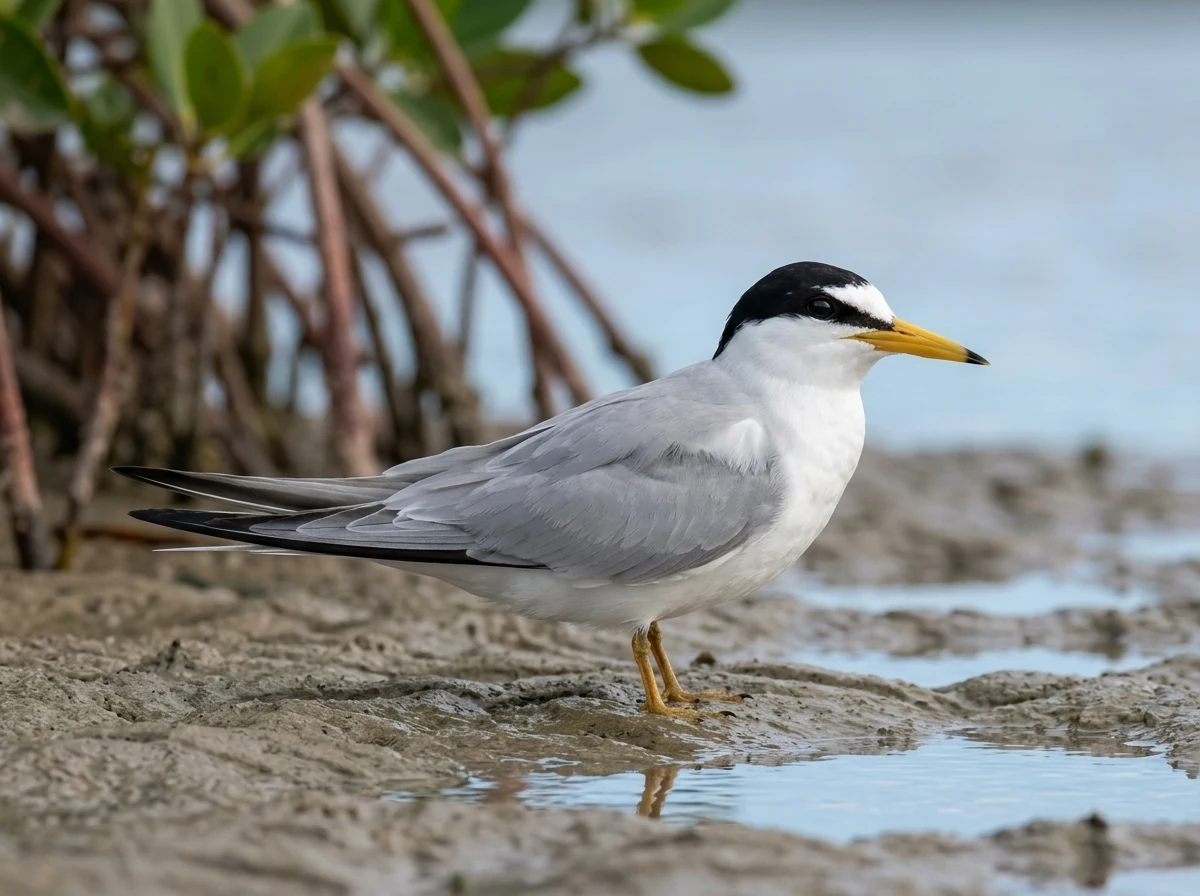
AIAI reconstruction created with Nano Banana 2 · 1K, grounded in the profile’s documented taxonomy, habitat, natural-history sources, and an open-license visual reference when available. It is an interpretive image, not documentary evidence. Image policy →
Least Tern
Charrán Mínimo
Sternula antillarum
The least tern (Sternula antillarum) is a species of tern that breeds in North America and locally in northern South America. It is closely related to, and was formerly often considered conspecific with, the little tern of the Old World. Other close relatives include the yellow-billed tern and Peruvian tern, both from South America. It is a small tern, 22–24 cm (8.7–9.4 in) long, with a wingspan of 50 cm (20 in), and weighing 39–52 g (1.4–1.8 oz). The upper parts are a fairly uniform pale gray, and the underparts white. The head is white, with a black cap and line through the eye to the base of the bill, and a small white forehead patch above the bill; in winter, the white forehead is more extensive, with a smaller and less sharply defined black cap. The bill is yellow with a small black tip in summer, all blackish in winter. The legs are yellowish. The wings are mostly pale gray, but with conspicuous black markings on their outermost primaries. It flies over water with fast, jerky wingbeats and a distinctive hunchback appearance, with the bill pointing slightly downward. It is migratory, wintering in Central America, the Caribbean and northern South America. Many spend their whole first year in their wintering area. It has occurred as a vagrant to Europe, with one record in Great Britain and one in Ireland. It differs from the little tern mainly in that its rump and tail are gray, not white, and it has a different, more squeaking call; from the yellow-billed tern in being paler gray above and having a black tip to the bill; and from the Peruvian tern in being paler gray above and white (not pale gray) below and having a shorter black tip to the bill.
Sound archive
Hear its voice
Explore real songs and calls. The spectrogram turns each sound into a visual trace of time and frequency.

Play: call by Paul Driver
Choose another recording
Sound recorded by Paul Driver · XC1027109 · CC BY-NC-SA 4.0. Visualization by Stichting Xeno-canto voor Natuurgeluiden.
Every recording retains the creator, catalogue number, and license published by Xeno-canto. Metadata via GBIF ↗
Island profile
About the Least Tern
This atlas includes Least Tern (Sternula antillarum) with atlas status “Native / natural occurrence” within scope “Avibase inferred core 380.” Puerto Rico context sources associate it with Sandy beaches; salt flats; coastal cays.
Conservation
Least Concern
IUCN LC; DNER VU
- Global IUCN
- LC
- Puerto Rico DNER
- VU
- Federal ESA
- No current listing in source crosswalk
- Critical habitat
- Not identified in source crosswalk
Natural history
How it lives
- Habitat
- Sandy beaches; salt flats; coastal cays
- Elevation
- 0–500 m
- Nest
- Scrape · Ground
- Clutch
- 1–3 eggs
- Social behavior
- Colonial; Solitary
Keep exploring
This bird belongs to 8 paths through the atlas.
Guides featuring this bird
Follow this record beyond the profile.
Identification, sound, place, and explanatory guides connecting this species to larger questions.
See all related guides (1)
Related in the atlas
Where to fly next
Connected by taxonomy, habitat, occurrence, and conservation.
 AI
AI AI
AI AI
AI AI
AI AI
AI AI
AI

Evidence trail
Sources, media & further reading
Research note: Current genus Sternula; 2004 regulation uses Sterna