 AI
AILook-alike birds
Grassquits and Sparrows of Puerto Rico
In Puerto Rico, gorrión names birds from five different families. The two little grassquits of lawns and roadsides are the commonest and the most confused.
Reviewed:One name, many birds.
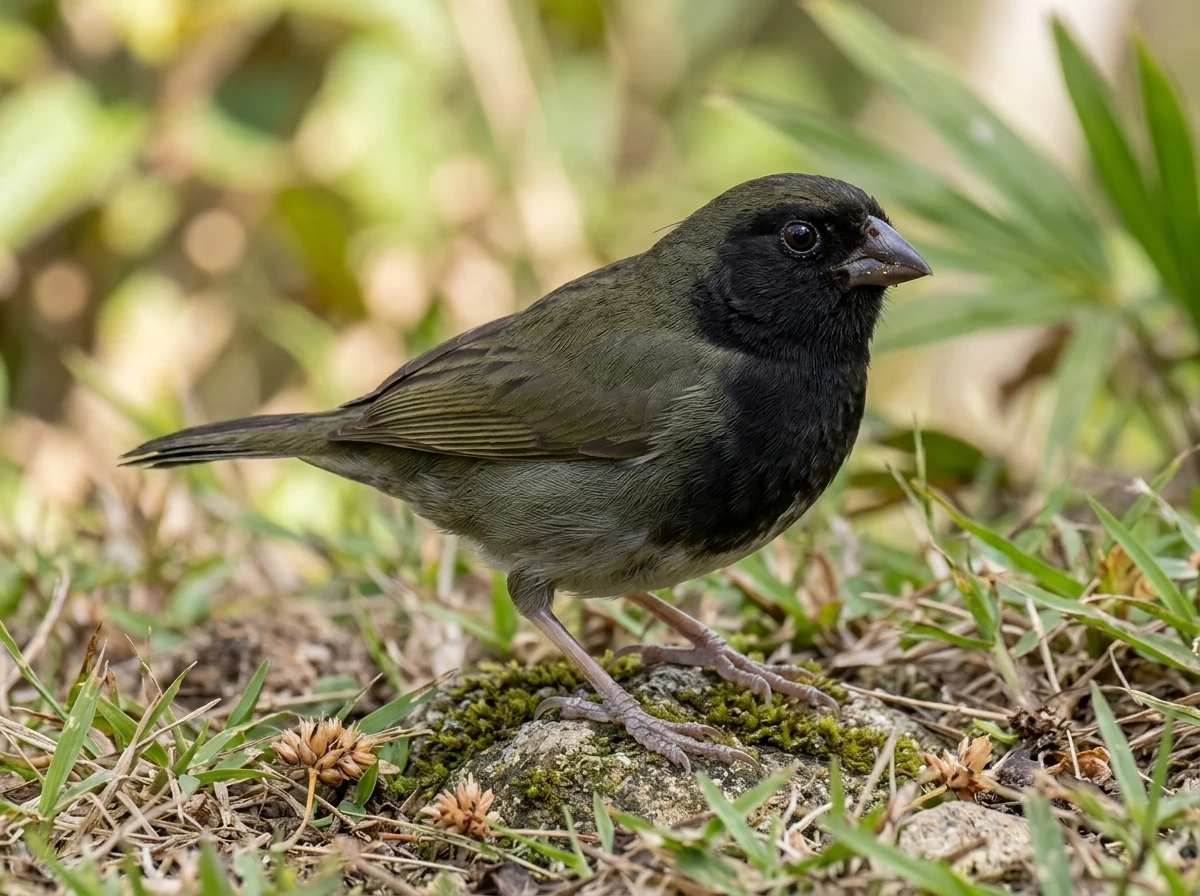
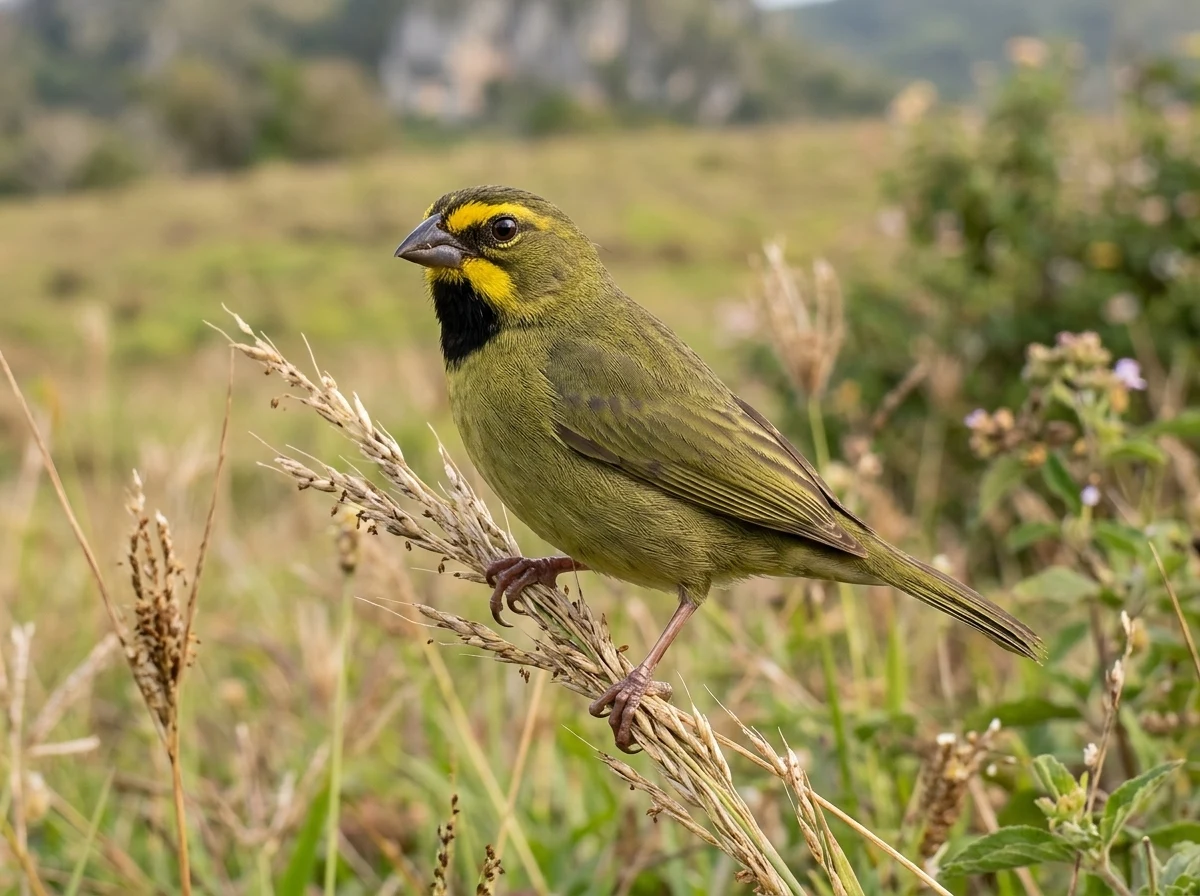
Puerto Rico's gorrión negro is the Black-faced Grassquit (Melanospiza bicolor): a bird of about 10 cm with a black conical bill, a black head and breast on the male, and an olive-green back. It differs from the Yellow-faced Grassquit (Gorrión Barba Amarilla), whose male has a bright yellow throat, eyebrow, and spot below the eye. Females of both are dull olive and much harder to separate.
In Puerto Rico the word gorrión covers very different birds: grassquits from the tanager family, the introduced House Sparrow, the Grasshopper Sparrow of pastures, the migrant Indigo Bunting (Gorrión Azul), and several introduced finches from the pet trade. This guide sorts that group by bill, face, size, and habitat, and clarifies which are native and which were introduced.
Look-alike birds
The grassquits in the atlas
~10 cmboth grassquitsBlack-faced and Yellow-faced Grassquits measure about 10 cm and weigh about 10 g.
84 % vs. 66 %atlas hexagonsBlack-faced Grassquit appeared in 400 of 479 hexagons; Yellow-faced in 316.
5families called gorriónThraupidae, Passeridae, Passerellidae, Cardinalidae, and Estrildidae.
01
Males: black face or yellow beard
The male Black-faced Grassquit has a black head, throat, and breast, with an olive-green back, wings, and tail and a short, conical black bill. It has no yellow at all. Seen at a distance on a roadside, it looks like a dark little bird with a greenish back.
The male Yellow-faced Grassquit also has a black face and breast and an olive back, but with three bright yellow marks: the throat, an eyebrow, and a spot below the eye. The rest of the underparts is grayish olive. Its conical bill is a bit sharper than that of other seedeaters.
02
Females and juveniles: the real challenge
The female Black-faced Grassquit is almost entirely dull olive, somewhat browner or grayer below and whiter on the belly. The female Yellow-faced Grassquit is olive above and pale gray below with dark breast smudges, and its yellow face pattern is much weaker and may be almost invisible.
Look for any trace of yellow on the eyebrow or throat: if present, lean toward Yellow-faced. If not, the best clue is the male with her, since both species often travel in pairs or small groups. A lone female without a clear face photo can stay recorded as grassquit sp.
03
Habitat, songs, and nests
The Black-faced Grassquit is common in urban areas and open spots with grass and shrubs: gardens, road edges, and forest clearings. It lives on the main island, Culebra, and Vieques. Its song is an emphatic buzz, often followed by a louder one, and the male sings while vibrating his wings and drifting down in a short display flight.
The Yellow-faced Grassquit prefers open grassy areas from the lowlands into the mountains, plus marshy spots and roadsides with tall grass. Its song is a series of thin, rapid trills often heard only at close range. Both build globular grass nests near the ground, and the atlas found nesting year-round with a peak in May.
04
The Puerto Rican Bullfinch: the big endemic look-alike
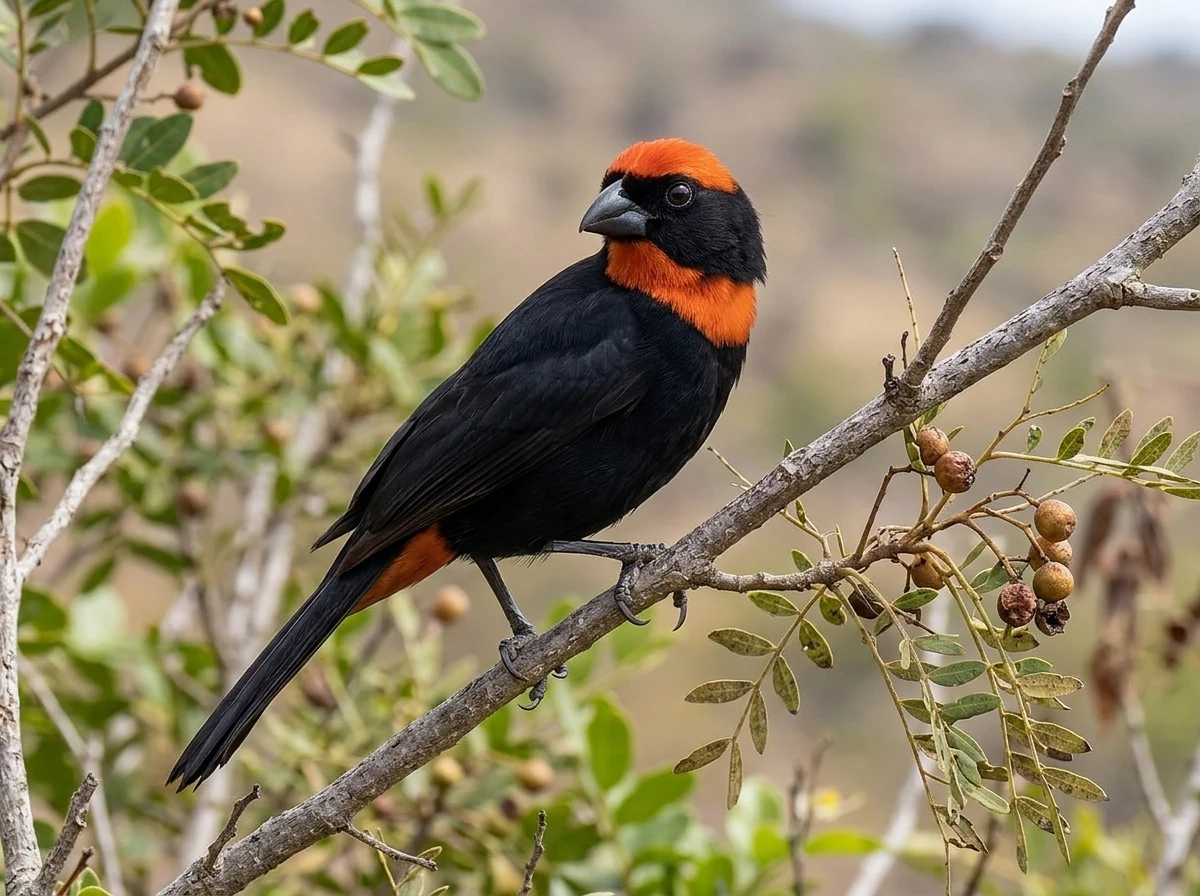
A thick-billed black bird in the forest may be the Puerto Rican Bullfinch (Comeñame), but it is far bigger than the grassquits: 17 to 19 cm and about 32 g. It is black with orange marks above the eyes, on the throat, and under the base of the tail. It is endemic to Puerto Rico.
It lives in forests at all elevations, coffee plantations, and dry coastal thickets, and is rare in mangroves. It is absent from the far eastern end of the main island, Vieques, and Culebra. If the bird is on an urban lawn and half that size, it is a grassquit; if it is in the forest, with orange on the throat and under the tail, it is a bullfinch.
05
The gorriones that are not grassquits
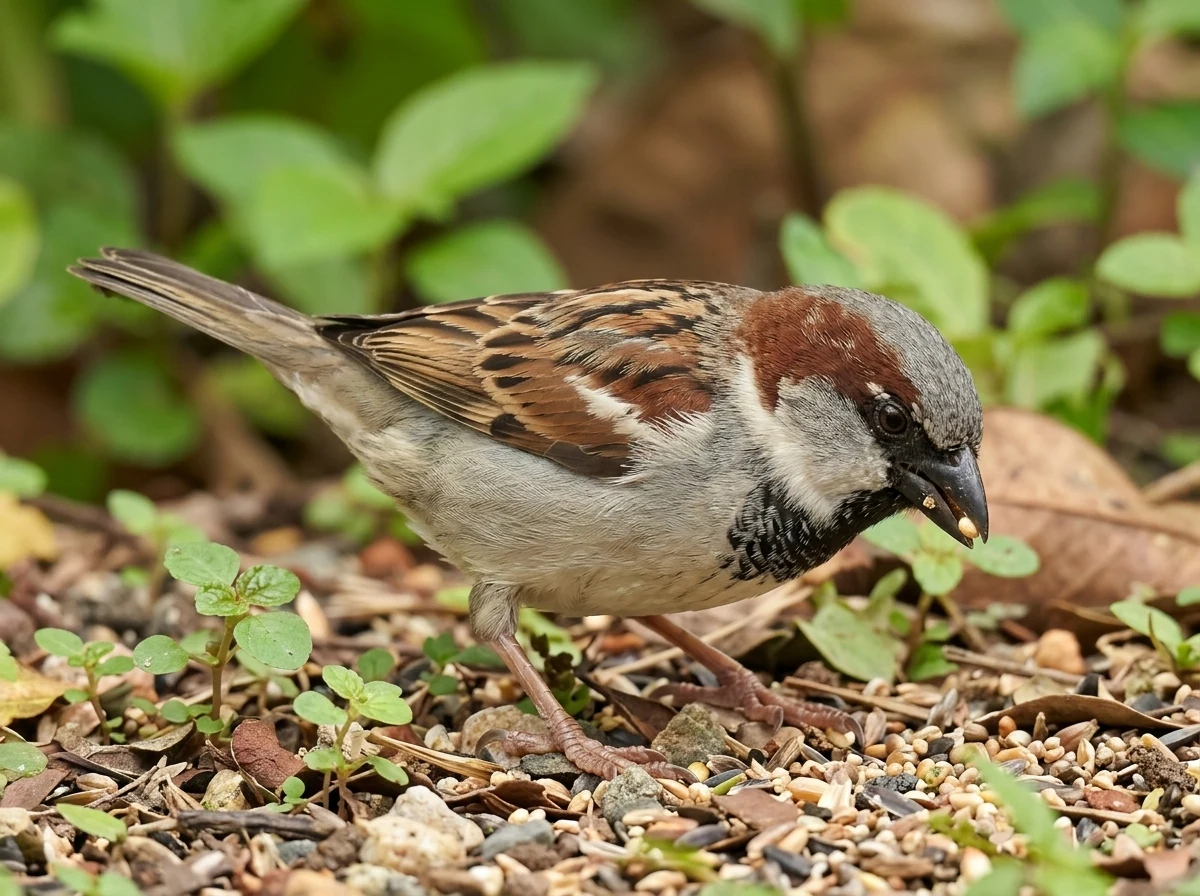
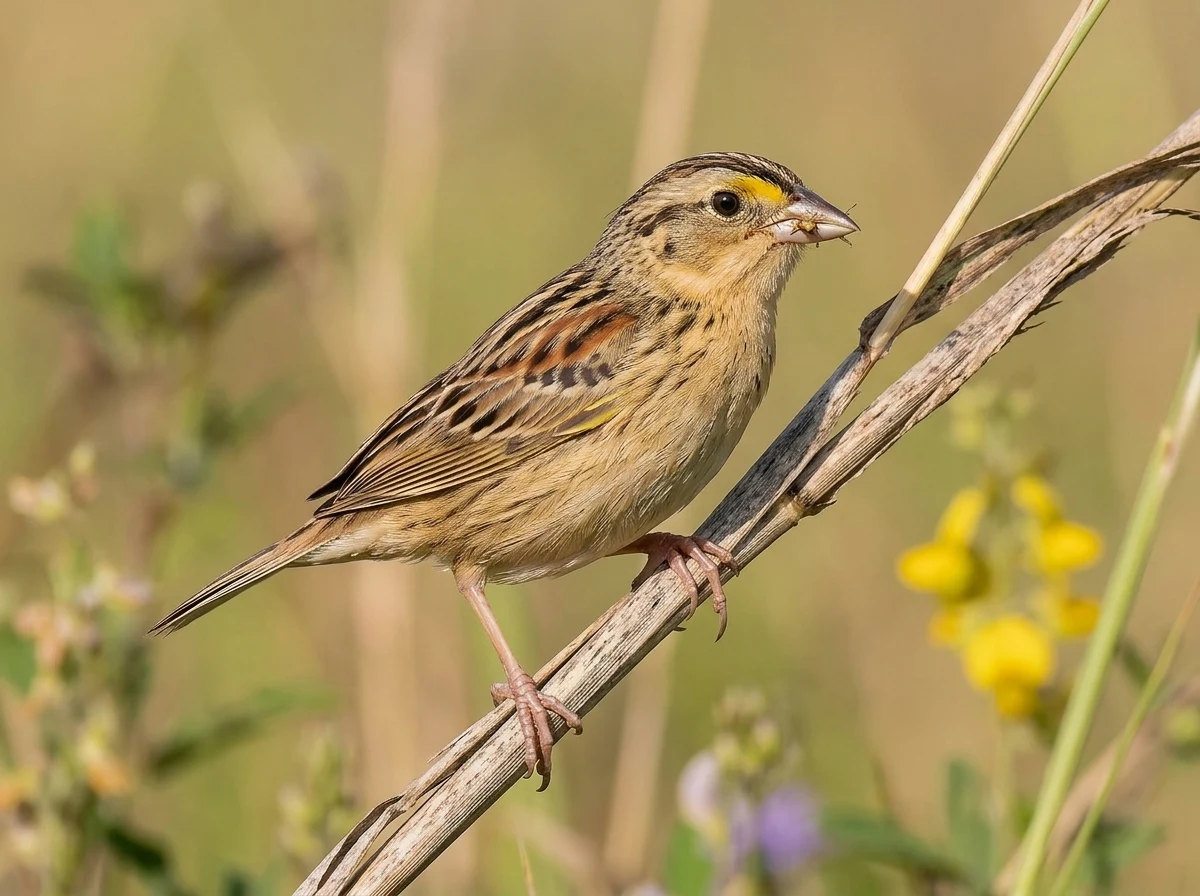
The House Sparrow (Gorrión Doméstico) is introduced, measures about 16 cm, and lives in urban areas; the male combines black, white, and brown, and the female is brown and gray. The Grasshopper Sparrow (Gorrión Chicharra) is a native resident of grasslands and tall-grass pastures, streaked brown, with a buzzy song that recalls a grasshopper.
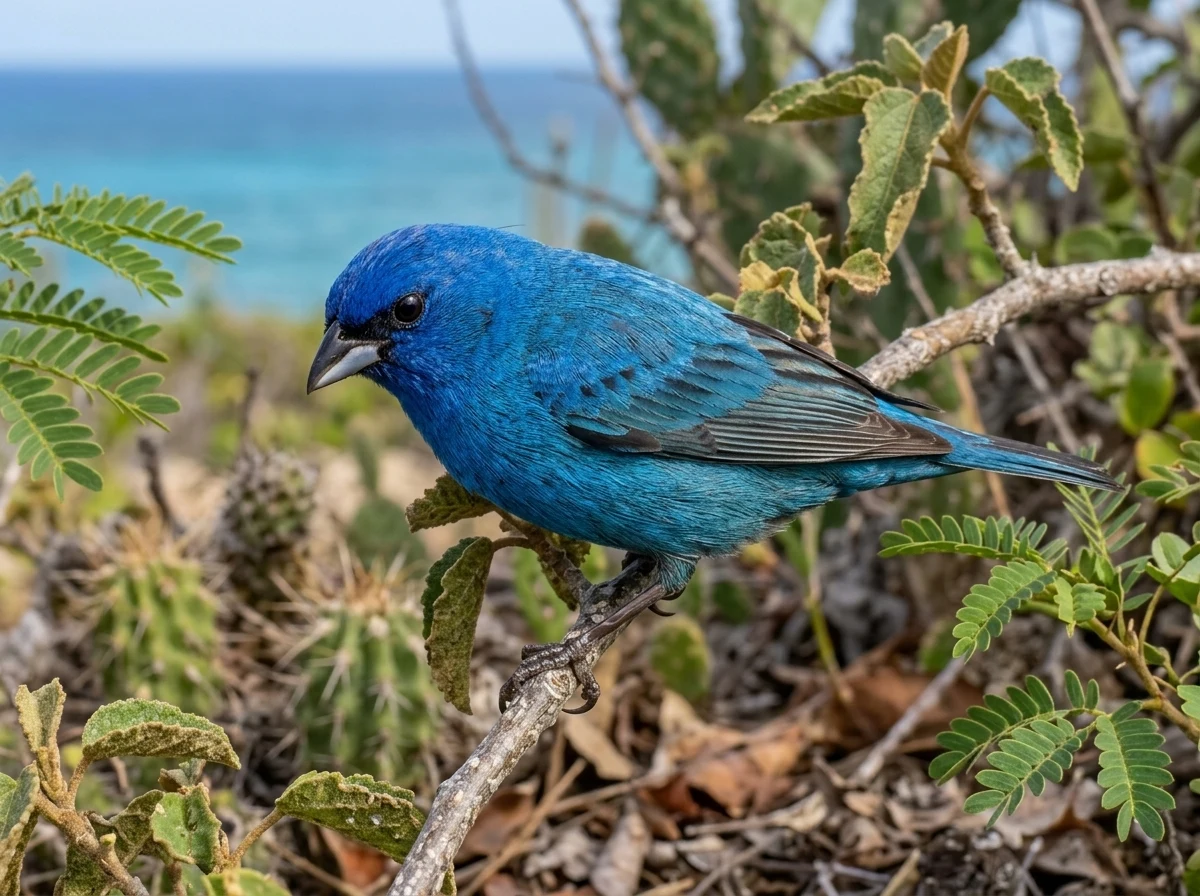
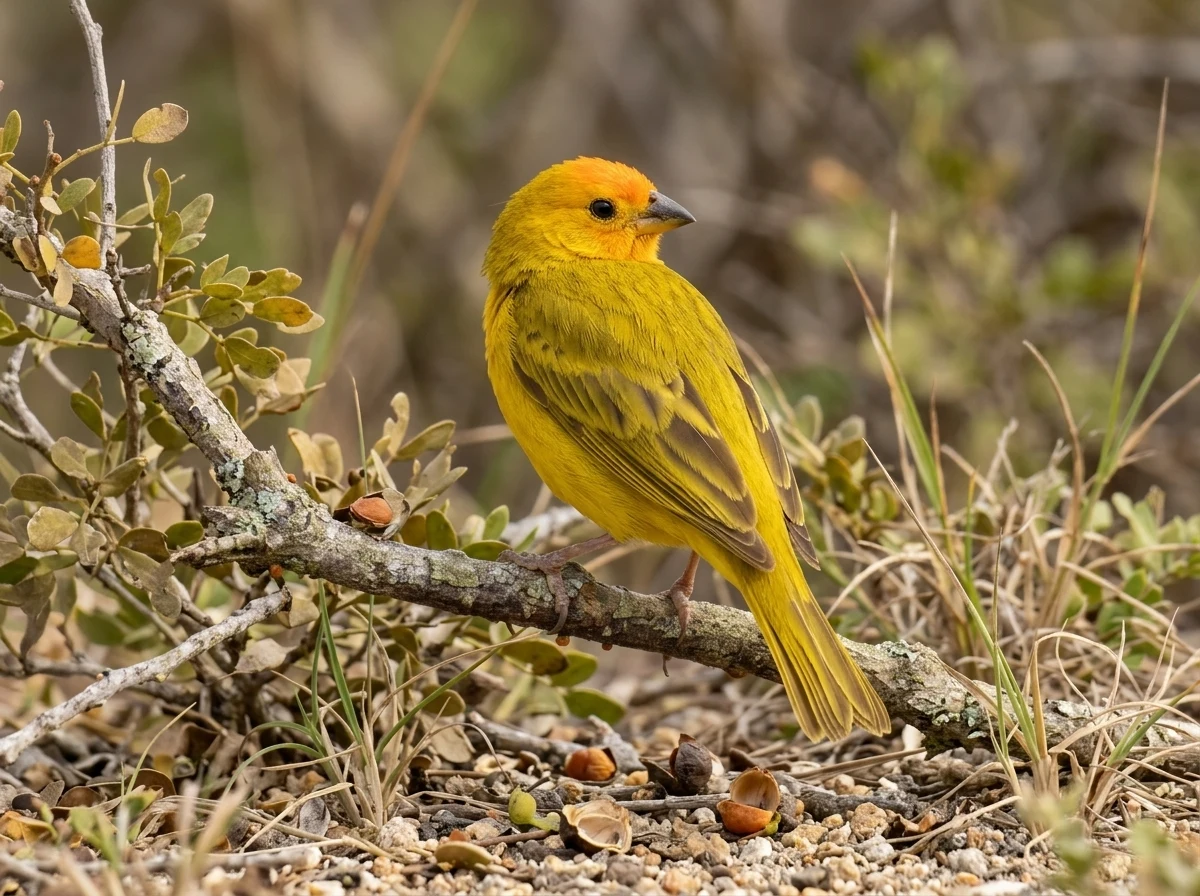
The Gorrión Azul is the Indigo Bunting, a North American migrant that winters in the Caribbean; the male is blue in breeding season, but females and males in winter plumage are brown with a blue tinge on the tail. The Saffron Finch (Gorrión Azafrán), yellow with an orange crown, was introduced through the pet trade in the 1960s and lives mainly on the north coast, from San Juan to Arecibo.
06
Introduced finches from the pet trade
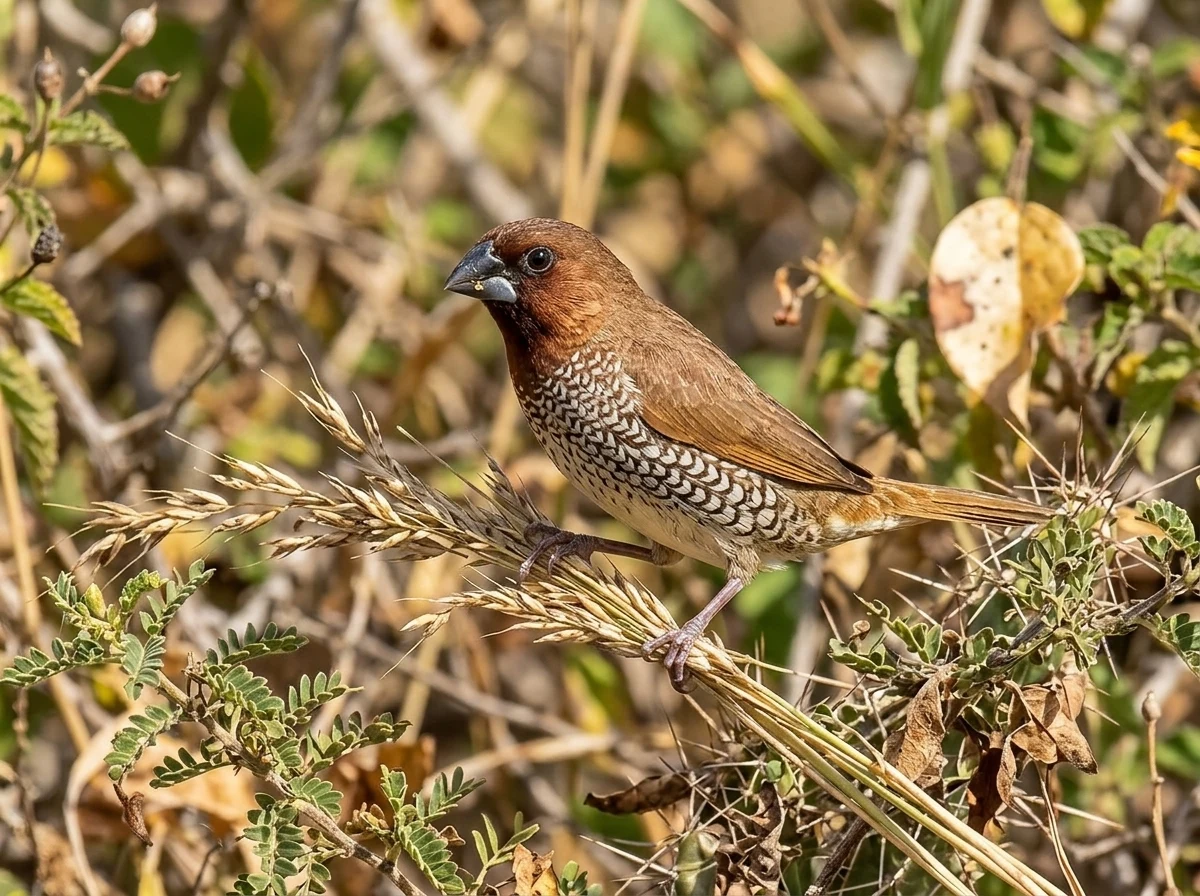
The official catalog also uses gorrión for several introduced estrildid finches: Scaly-breasted Munia (Gorrión Canela), Indian Silverbill (Gorrión Picoplata), and Java Sparrow (Gorrión Arrocero). All have thick conical bills, and the Scaly-breasted Munia, the most widespread (52% of atlas hexagons), uses lowland grassy areas, sugarcane borders, road edges, and parks.
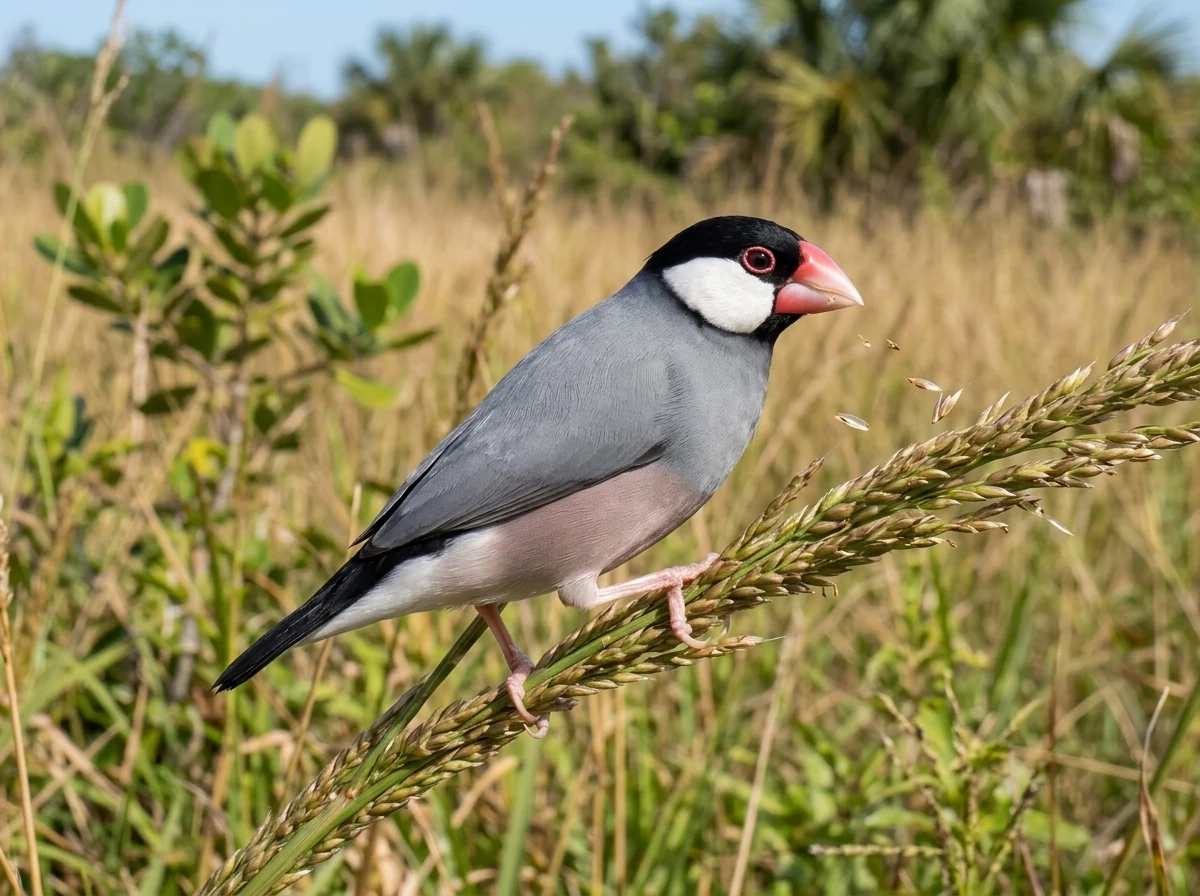
To avoid confusing them with the native grassquits, check bill and pattern: grassquits have a small black bill and a black or yellow-marked face, while Scaly-breasted Munia is brown with scale-like marks on the breast and belly, and Java Sparrow is gray with a black head, white cheeks, and a thick red bill. If a bird fits none of these, check the introduced-species list before assuming a rarity.
Linked profiles
Grassquits, sparrows, and look-alikes
Native, endemic, and introduced birds that share one local name.
Sound archive
Hear its voice
Explore real songs and calls. The spectrogram turns each sound into a visual trace of time and frequency.
XC962731Recording 1 of 3song

Play: song by Hans Matheve
Choose another recording
Sound recorded by Hans Matheve · XC962731 · CC BY-NC-ND 4.0. Visualization by Stichting Xeno-canto voor Natuurgeluiden.
Every recording retains the creator, catalogue number, and license published by Xeno-canto. Metadata via GBIF ↗
01
What is the gorrión negro in Puerto Rico?
It is the Black-faced Grassquit (Melanospiza bicolor), a native bird of about 10 cm with a black conical bill. The male has a black head and breast and an olive-green back; the female is dull olive. It is common in gardens, road edges, and grassy areas across the island.
02
How do you tell a Black-faced Grassquit from a Yellow-faced Grassquit?
The male Yellow-faced Grassquit has a bright yellow throat, eyebrow, and spot below the eye; the Black-faced Grassquit has no yellow. Females are similar, but the Yellow-faced female may show a faint trace of yellow on the face and dark smudges on the breast.
03
Is the Puerto Rican Bullfinch a sparrow?
Not strictly. The Puerto Rican Bullfinch is a large seed-eating tanager endemic to Puerto Rico. It measures 17–19 cm, nearly twice a Black-faced Grassquit, and is black with orange marks on the brow, throat, and under the tail.
04
What is the gorrión azul in Puerto Rico?
The Gorrión Azul is the Indigo Bunting, a North American migrant that winters in the Caribbean. The breeding male is deep blue; females and winter males are brown with a blue tinge on the tail.
05
Is the House Sparrow native to Puerto Rico?
No. The House Sparrow is native to Eurasia and North Africa and was introduced to the West Indies. In Puerto Rico it is locally common in urban areas and has spread across the coastal plain; it also occurs on Vieques, Culebra, and Mona.
06
Are there native sparrows in Puerto Rico?
Yes. The Grasshopper Sparrow is a native grassland resident, and both grassquits, Black-faced and Yellow-faced, are native as well. By contrast, the House Sparrow, Saffron Finch, and estrildid finches such as the Scaly-breasted Munia are introduced.
Keep exploring
Connected routes
Sources and review
The evidence is one link away.
These sources support the editorial scope of this guide. Bird profiles also retain their own taxonomy, occurrence, and conservation references.
Reviewed:
01↗02↗03↗04↗05↗06↗07↗08↗09↗10↗11↗12↗
Birds of Puerto Rico (datos del Puerto Rico Breeding Bird Atlas)
Black-faced Grassquit (Gorrión Negro)
Size (~10 cm), male and female plumage, residence on Puerto Rico, Culebra, and Vieques, and 84% of hexagons.Birds of Puerto Rico (datos del Puerto Rico Breeding Bird Atlas)
Yellow-faced Grassquit (Gorrión Barba Amarilla)
Male's yellow marks, grassy habitat, dome-shaped nest, and 66% of hexagons.Birds of Puerto Rico (datos del Puerto Rico Breeding Bird Atlas)
Puerto Rican Bullfinch (Comeñame)
A 17–19 cm endemic, black with orange marks, absent from the far east and Vieques.Birds of Puerto Rico (datos del Puerto Rico Breeding Bird Atlas)
House Sparrow (Gorrión Doméstico)
An introduced, urban 16 cm species; male with black, white, and brown.Birds of Puerto Rico (datos del Puerto Rico Breeding Bird Atlas)
Grasshopper Sparrow (Gorrión Chicharra)
Grassland resident with a buzzy, grasshopper-like song.Sociedad Ornitológica Puertorriqueña
Catalog of the Birds of Puerto Rico (official list)
Official Spanish names (Pitirre, Clérigo, Reinita Común, Reinita Mariposera, Gorrión Negro, Golondrina de Iglesias) and categories such as accidental or introduced.U.S. Forest Service Research and Development
Puerto Rico Breeding Bird Atlas
Distribution and breeding timing for 130 species breeding in Puerto Rico and its satellite islands.Wikipedia
Black-faced grassquit
Buzzy song, aerial display, globular nest, and ground foraging.Wikipedia
Yellow-faced grassquit
Female with faint yellow face, thin trilled song, and wing-vibrating courtship.National Audubon Society
Field guide: Indigo Bunting
Blue breeding male, brown females and nonbreeding males, and wintering in the Caribbean.Birds of Puerto Rico (datos del Puerto Rico Breeding Bird Atlas)
Saffron Finch (Gorrión Azafrán)
Introduced via the pet trade in the 1960s; north coast from San Juan to Arecibo.Sociedad Ornitológica Puertorriqueña
Official bird list
Local names, occurrence categories, and the public summary of 17 endemics.The atlas continues