 AI
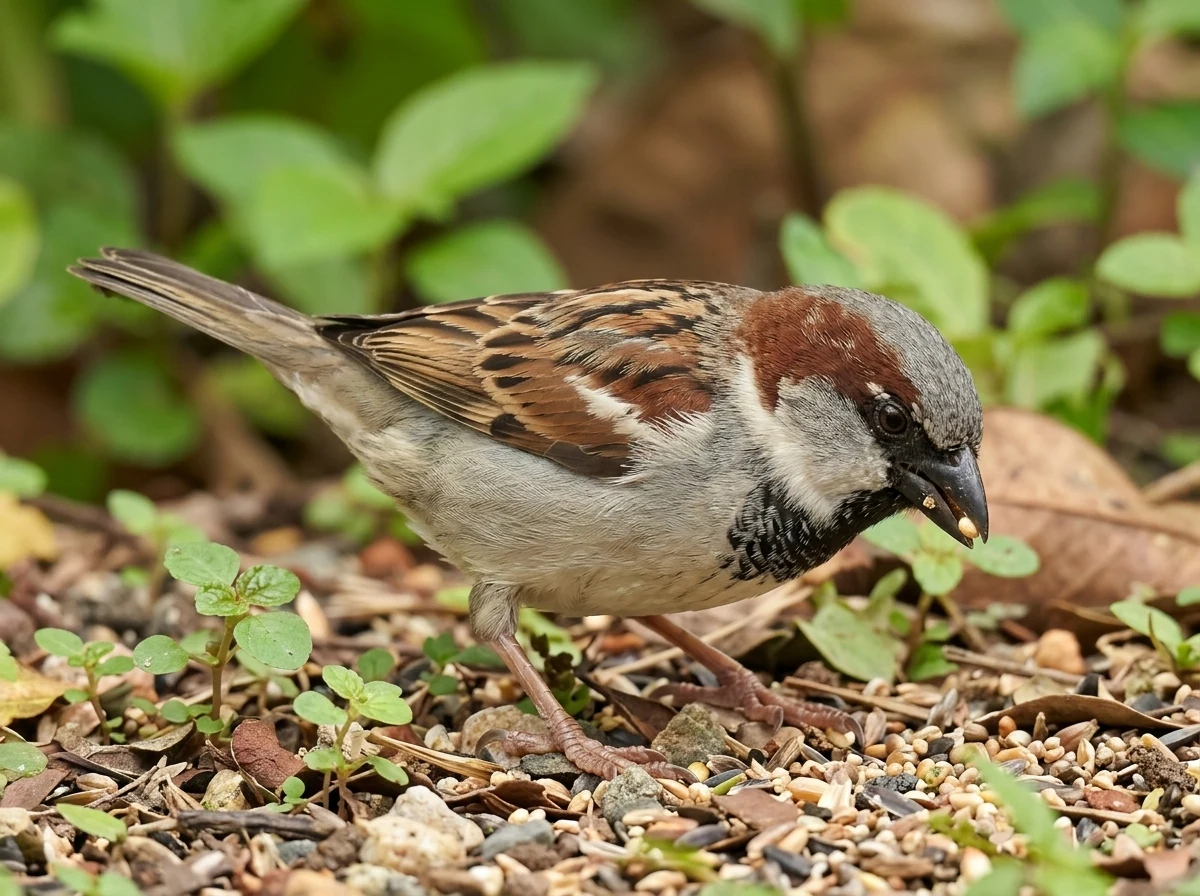
AIAI reconstruction created with Nano Banana 2 · 1K, grounded in the profile’s documented taxonomy, habitat, natural-history sources, and an open-license visual reference when available. It is an interpretive image, not documentary evidence. Image policy →
House Sparrow
Gorrión Doméstico
Passer domesticus
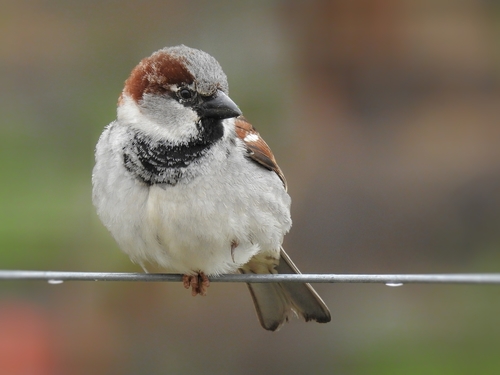
The house sparrow (Passer domesticus) is a bird of the sparrow family Passeridae, found in most parts of the world. It is a small bird that has a typical length of 16 cm (6.3 in) and a mass of 24–39.5 g (0.85–1.39 oz). Females and young birds are coloured pale brown and grey, and males have brighter black, white, and brown markings. One of about 25 species in the genus Passer, the house sparrow is native to most of Europe, the Mediterranean Basin, and a large part of Asia. Its intentional or accidental introductions to many regions, including parts of Australasia, Africa, and the Americas, make it the most widely distributed wild bird. The house sparrow is strongly associated with human habitation, and can live in urban or rural settings. Though found in widely varied habitats and climates, it typically avoids extensive woodlands, grasslands, polar regions, and hot, dry deserts far away from human development. For sustenance, the house sparrow routinely feeds at home and public bird feeding stations, but naturally feeds on the seeds of grains, flowering plants and weeds. However, it is an opportunistic, omnivorous eater, and commonly catches invertebrates such as insects and their larvae, caterpillars, and many other natural foods. Because of its numbers, ubiquity, and association with human settlements, the house sparrow is culturally prominent. It is extensively, and usually unsuccessfully, persecuted as an agricultural pest. It has also often been kept as a pet, as well as being a food item and a symbol of lust, sexual potency, commonness, and vulgarity. Though it is widespread and abundant, its numbers have declined in some areas. The bird's conservation status is listed as least concern on the IUCN Red List.
Sound archive
Hear its voice
Explore real songs and calls. The spectrogram turns each sound into a visual trace of time and frequency.

Play: song by Olivier SWIFT
Choose another recording
Sound recorded by Olivier SWIFT · XC1082761 · CC BY-NC-SA 4.0. Visualization by Stichting Xeno-canto voor Natuurgeluiden.
Every recording retains the creator, catalogue number, and license published by Xeno-canto. Metadata via GBIF ↗
Island profile
About the House Sparrow
This atlas includes House Sparrow (Passer domesticus) with atlas status “Introduced” within scope “Avibase inferred core 380.” Global trait data associate it primarily with artificial; consult the linked records to resolve its Puerto Rico habitat use.
Conservation
Least Concern
IUCN LC
- Global IUCN
- LC
- Puerto Rico DNER
- No current listing in source crosswalk
- Federal ESA
- No current listing in source crosswalk
- Critical habitat
- Not identified in source crosswalk
Natural history
How it lives
- Habitat
- towns-and-gardens
- Elevation
- 0–4600 m
- Nest
- Tree cavity; Sphere / globular; Crevice · Building; Rock; Tree; Ground
- Clutch
- 1–8 eggs
- Social behavior
- Not resolved
Keep exploring
This bird belongs to 5 paths through the atlas.
Guides featuring this bird
Follow this record beyond the profile.
Identification, sound, place, and explanatory guides connecting this species to larger questions.
See all related guides (8)
Related in the atlas
Where to fly next
Connected by taxonomy, habitat, occurrence, and conservation.
 AI
AI AI
AI AI
AI AI
AI AI
AI AI
AI
Evidence trail