 AI
AICaribbean parrots
The Hispaniolan Parrot in Puerto Rico
A close relative of the Iguaca, the Hispaniolan Parrot helped raise Puerto Rican Parrots in captivity, but its wild presence on the island is scarce and poorly documented.
Reviewed:Short answer: the Iguaca's cousin, not a native
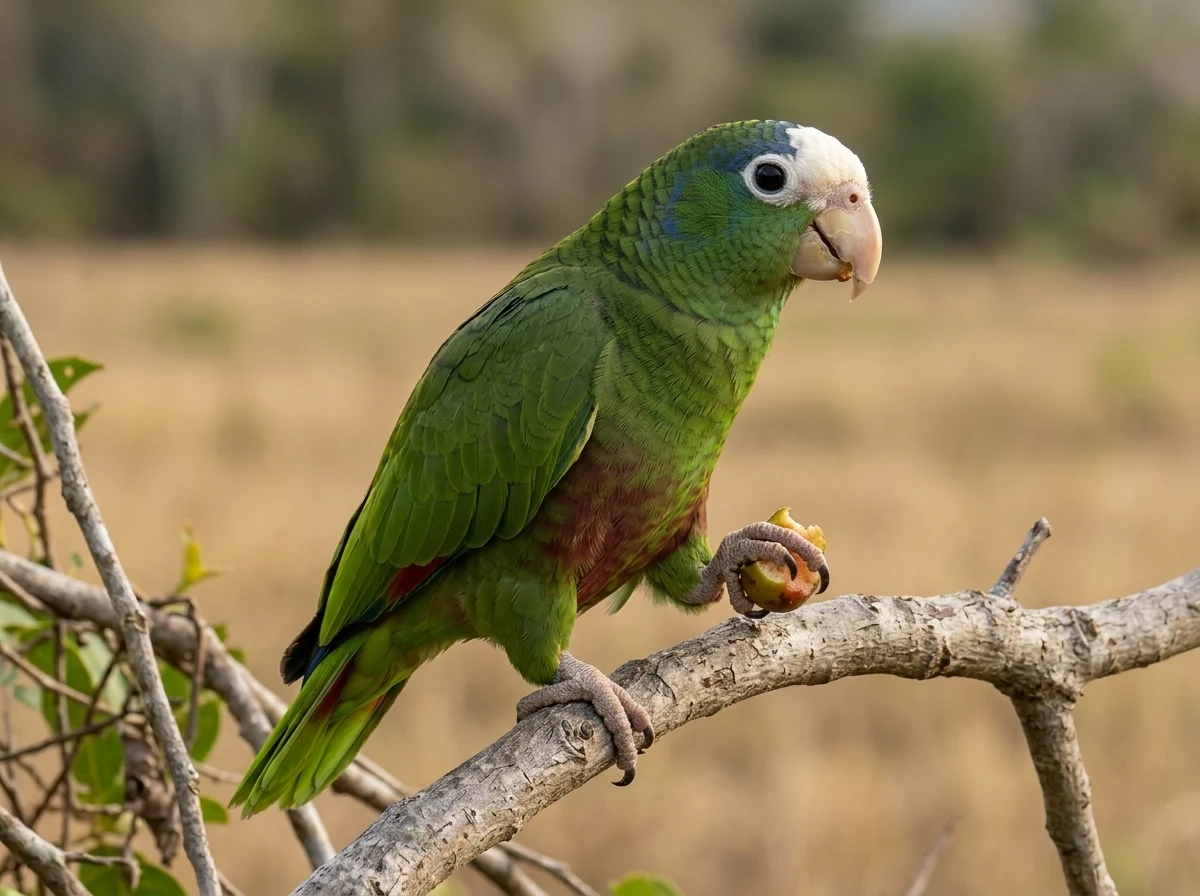
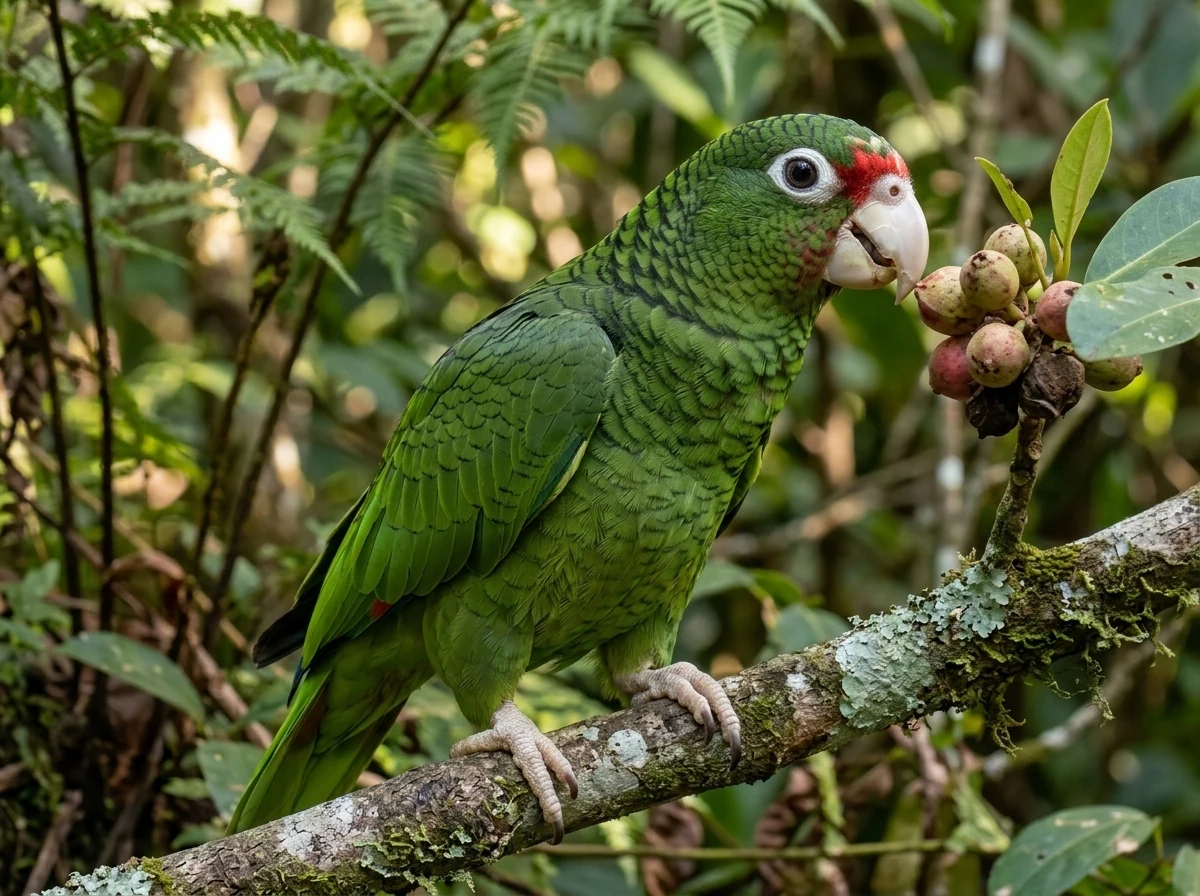
The Hispaniolan Parrot (Hispaniolan Amazon, Amazona ventralis, called cotorra dominicana in Puerto Rico) is endemic to Hispaniola—the Dominican Republic and Haiti—and appears on the Puerto Rico list as an introduced species, not a native one. It differs from the Puerto Rican Parrot, or Iguaca, by its white forehead, dark ear patch, and maroon belly patch; the Iguaca shows a narrow red forehead band and a green belly.
Most people searching for this bird have seen a green parrot, own one as a pet, or heard that the species played a role in saving the Iguaca. All three questions have answers, but they should be kept apart: identification, aviary history, and wild status are different issues. This guide summarizes what the records show and where the uncertainty lies.
Caribbean parrots
The Hispaniolan Parrot in numbers
28 cmApproximate lengthNearly the same size as the Iguaca (28–30 cm); size does not separate them.
VUGlobal status (IUCN)Vulnerable in its native range on Hispaniola.
1990Río Abajo Aviary begins breedingFounded on using the Hispaniolan Parrot as a surrogate parent.
C0–C3Invasion stage in PRA wide range in Falcón and Tremblay (2018): it is unclear whether it sustains itself in the wild.
01
How to recognize the Hispaniolan Parrot
The Hispaniolan Parrot is a medium-sized amazon, about 28 centimeters long, with a green body, a pale bill, and a white eye-ring. The marks that separate it from other amazons are the white forehead, a dark ear patch, and a maroon patch on the belly. In flight it shows blue in the primary feathers.
The Iguaca shares the green body, white eye-ring, and blue in the wing, so overall color is not enough. Check the forehead first: red and narrow on the Iguaca, white on the Hispaniolan. Then look at the belly: green on the Iguaca, with a maroon patch on the Hispaniolan. One side view of the head and one of the belly usually settle the identification.
02
An unexpected ally of the Iguaca
The Hispaniolan Parrot has its own place in Puerto Rican conservation history. According to Kirkpatrick (1994), the Luquillo Aviary kept Hispaniolan Parrots as surrogates from the early 1980s, and the Río Abajo Aviary, which began breeding birds in August 1990, was founded on the principle of using this species to incubate eggs and raise Iguaca chicks.
Hispaniolan Parrots also let aviculturists practice husbandry and breeding techniques before using them on the endangered species. Between 1991 and 1994, fertile Hispaniolan pairs at Río Abajo rose from 6 to 9 and their fledglings from 6 to 23. By 1994, the aviary had produced its first Iguaca fledglings. This history explains why Hispaniolan Parrots are linked to the program, but it does not mean they were released to form wild populations in Puerto Rico.
03
Does it live in the wild in Puerto Rico?
The honest answer is: very little, if at all. The study by Falcón and Tremblay (2018), which reviewed literature, eBird, citizen science, and field surveys, placed the Hispaniolan Parrot in an invasion range of C0–C3. In their scheme, that spans released birds that do not survive long through to a self-sustaining population—in other words, the data did not support calling it established.
Recent citizen science points the same way. In September 2026, iNaturalist showed a single Amazona ventralis observation from Puerto Rico, from 2017 and not research grade. So if you see a white-fronted parrot flying free, the prudent course is to document it with photos and treat it as a possible escape, not as proof of an established flock.
04
Other green parrots that cause confusion
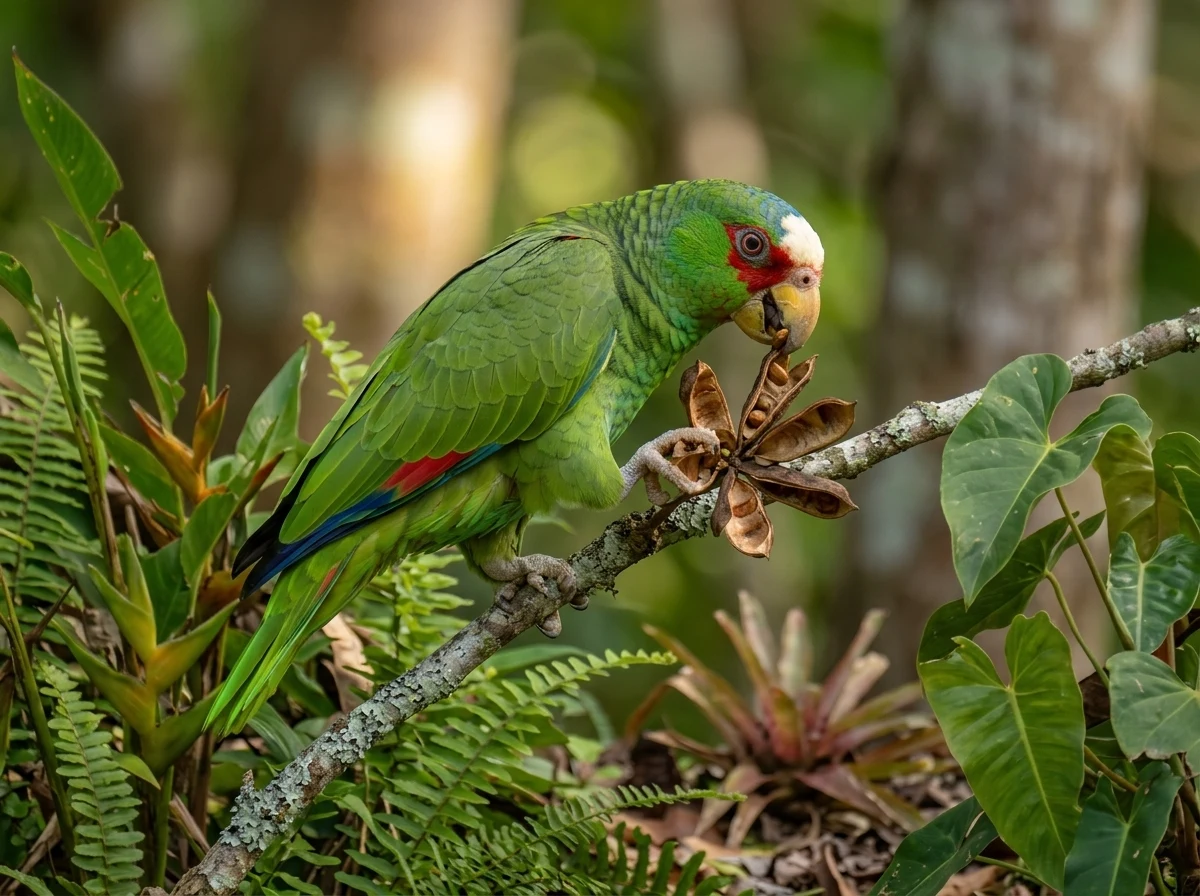
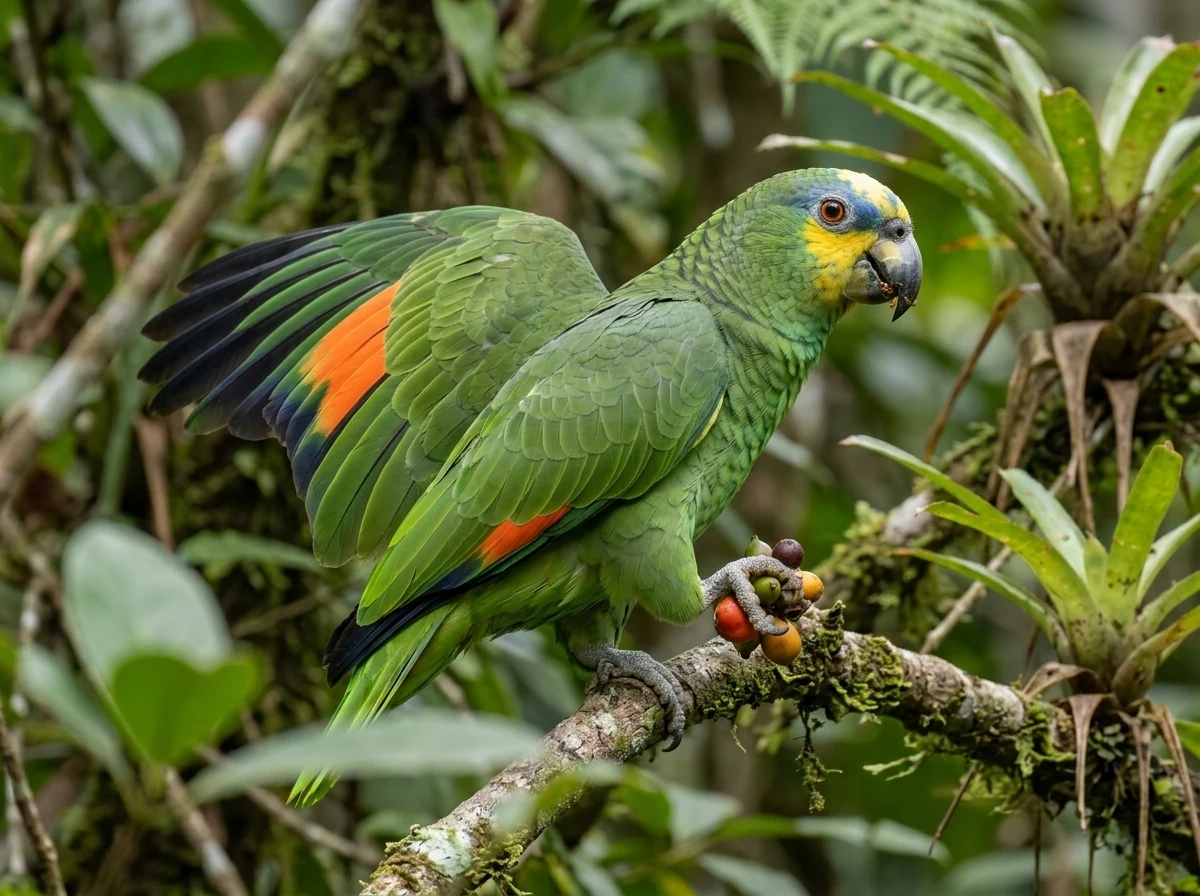
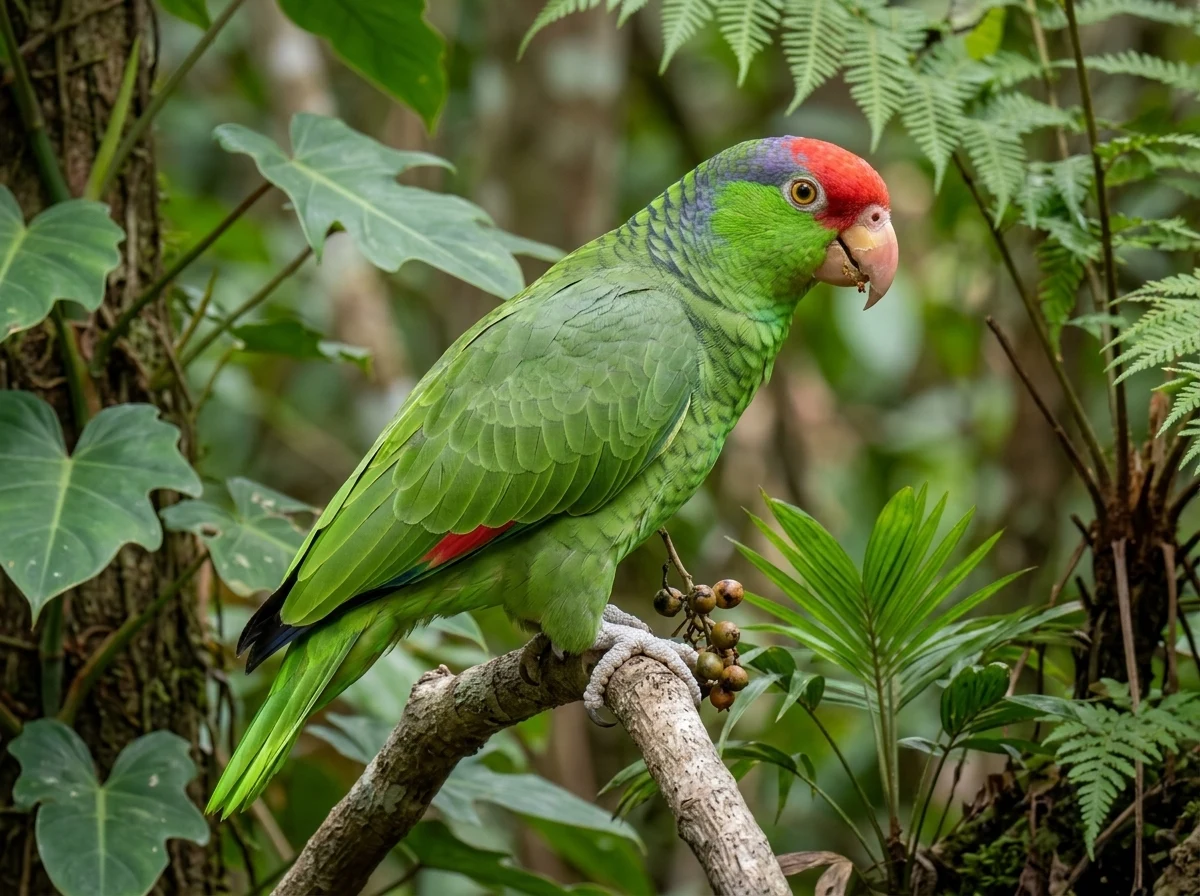
Puerto Rico has several introduced amazons. The Orange-winged Amazon (Amazona amazonica) shows yellow and blue on the face and orange in the wing; the Red-crowned Amazon (Amazona viridigenalis) has a red crown and has been documented around Salinas and Mayagüez; the White-fronted Amazon (Amazona albifrons) also has a white forehead, but with red around the eye, and it is smaller.
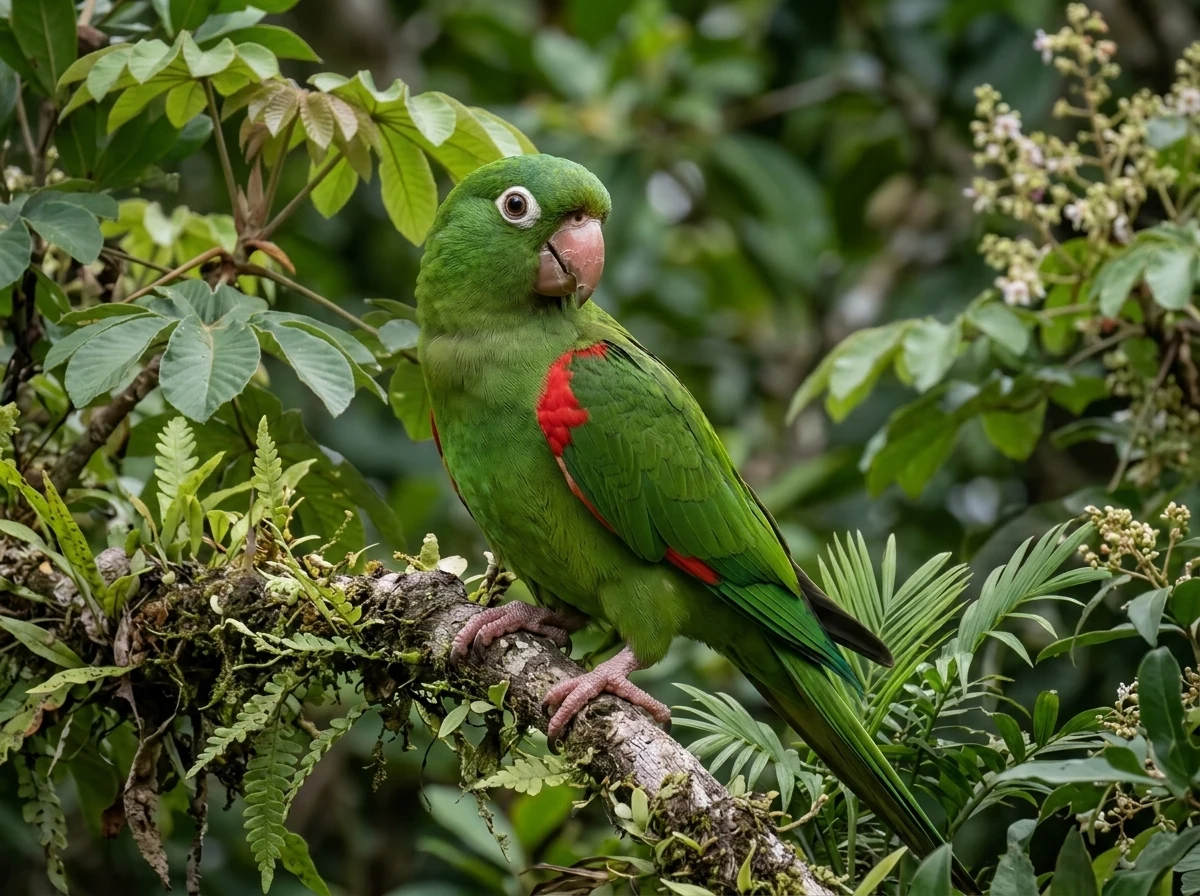
With the Hispaniolan Parrot, the usual trap is the White-fronted Amazon, which Falcón and Tremblay placed in Mayagüez with very few recent individuals. If you see a white forehead, look for red around the eye (White-fronted) or a maroon belly patch (Hispaniolan). Also avoid confusing it with the Hispaniolan Parakeet (Psittacara chloropterus), a long, pointed-tailed parakeet that is also from Hispaniola.
05
Pets, escapes, and responsibility
Falcón and Tremblay found that at least 85% of the psittacines present in Puerto Rico are offered in the pet trade and that most introduced species arrived that way. For the Hispaniolan Parrot, the same study listed its presence in the local trade as unknown, so it should not be assumed to be common in stores.
If you own a parrot, do not release it: psittacines can carry diseases and parasites, and the same study warns that hybridization between introduced amazons and the Iguaca, while unlikely today, is a future possibility. If you find an escaped parrot, photograph it and share it through eBird or iNaturalist; those records are what make it possible to measure whether a species becomes established.
Linked profiles
The Hispaniolan Parrot and its lookalikes
Compare forehead, belly, and face before naming a green parrot.
Sound archive
Hear its voice
Explore real songs and calls. The spectrogram turns each sound into a visual trace of time and frequency.
XC438071Recording 1 of 3call

Play: call by George Wagner
Choose another recording
Sound recorded by George Wagner · XC438071 · CC BY-NC-SA 4.0. Visualization by Stichting Xeno-canto voor Natuurgeluiden.
Every recording retains the creator, catalogue number, and license published by Xeno-canto. Metadata via GBIF ↗
01
What is the Hispaniolan Parrot?
It is the Hispaniolan Amazon (Amazona ventralis), an amazon parrot endemic to the Dominican Republic and Haiti and listed as Vulnerable by the IUCN. It is about 28 cm long, green, with a white forehead, dark ear patch, and maroon belly patch. In Puerto Rico it is an introduced species.
02
What is the difference between the Puerto Rican and Hispaniolan parrots?
The Puerto Rican Parrot, or Iguaca, has a red forehead band and a green belly; the Hispaniolan has a white forehead, a dark ear patch, and a maroon belly patch. Both are about 28 cm long with a white eye-ring, so check the forehead and belly.
03
Are there wild Hispaniolan Parrots in Puerto Rico?
There is no solid evidence of an established population. Falcón and Tremblay (2018) gave it an uncertain invasion stage (C0–C3), and in 2026 iNaturalist showed only one observation on the island. A free-flying bird should be treated as a possible escape.
04
Why were Hispaniolan Parrots part of the Iguaca program?
Because it is a close relative and was more plentiful. The Luquillo and Río Abajo aviaries used it as a surrogate parent to incubate and raise Puerto Rican Parrot chicks and to test techniques before using them on the endangered species.
05
What should I do if I see a white-fronted parrot flying free?
Photograph the head in profile and the belly, note municipality, date, and whether it was alone or in a group, and upload the record to eBird or iNaturalist. Look for red around the eye (White-fronted Amazon) or a maroon belly patch (Hispaniolan). Do not try to catch it.
Keep exploring
Connected routes
Sources and review
The evidence is one link away.
These sources support the editorial scope of this guide. Bird profiles also retain their own taxonomy, occurrence, and conservation references.
Reviewed:
01↗02↗03↗04↗05↗
Proceedings of the Southeastern Association of Fish and Wildlife Agencies (Kirkpatrick 1994)
The decline, recovery, and captive management potential of the Puerto Rican Parrot
Early program history, use of the Hispaniolan Parrot as a surrogate in the Luquillo and Río Abajo aviaries, and historical Iguaca counts.PeerJ (Falcón & Tremblay 2018), via PubMed Central
From the cage to the wild: introductions of Psittaciformes to Puerto Rico
Inventory of 46 psittacines, invasion stage per species, eBird trends, history of White-winged and Monk Parakeets, macaws in San Juan and Orocovis, and Hurricane María effects.iNaturalist
Amazona ventralis observations in Puerto Rico
September 2026 check of how few public Hispaniolan Parrot observations exist for Puerto Rico.U.S. Fish and Wildlife Service
Puerto Rican Parrot recovery information
Current recovery context and the populations at Río Abajo and El Yunque.Sociedad Ornitológica Puertorriqueña
Official bird list
Local names, occurrence categories, and the public summary of 17 endemics.The atlas continues