 AI
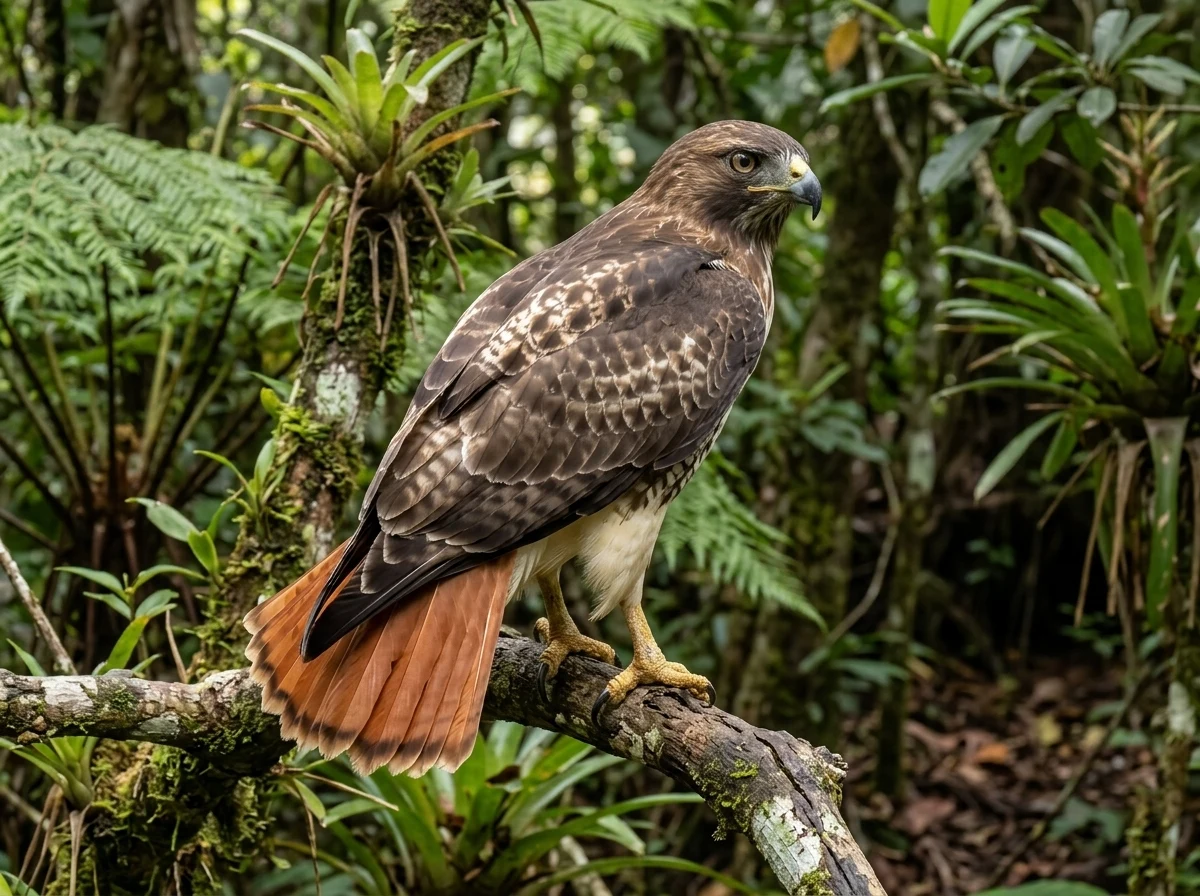
AIAI reconstruction created with Nano Banana 2 · 1K, grounded in the profile’s documented taxonomy, habitat, natural-history sources, and an open-license visual reference when available. It is an interpretive image, not documentary evidence. Image policy →
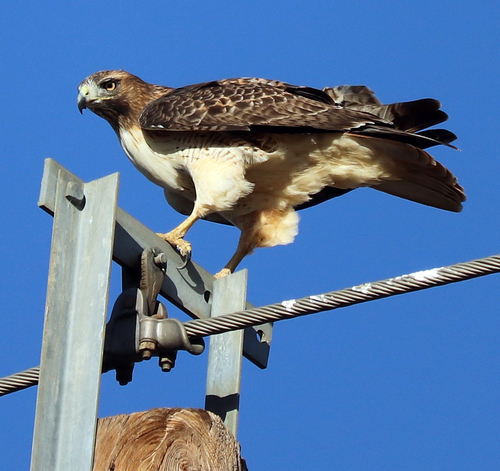
Red-tailed Hawk
Guaraguao Colirrojo
Buteo jamaicensis
The red-tailed hawk (Buteo jamaicensis) is a bird of prey and one of the most common hawks in North America. In the United States, it is one of three species colloquially known as the "chickenhawk". The red-tailed hawk breeds throughout most of the continent, from western Alaska and northern Canada to as far south as Panama and the West Indies. The red-tailed hawk occupies a wide range of habitats and altitudes, including deserts, grasslands, coniferous and deciduous forests, agricultural fields, and urban areas. It is absent in areas of unbroken forest and in the high arctic. It is legally protected in Canada, Mexico, and the United States by the Migratory Bird Treaty. The red-tailed hawk is one of the largest members of the genus Buteo in North America, typically weighing from 690 to 1,600 g (1.5 to 3.5 lb) and measuring 45–65 cm (18–26 in) in length, with a wingspan from 110–145 cm (43–57 in). Females are about 25% heavier than males. It has a stocky body with broad wings and can be distinguished from other North American hawks by the eponymous tail, which is uniformly brick-red above and light buff-orange below. The species feeds on a wide range of small animals, such as rodents, birds, and reptiles. Pairs stay together for life, taking a new mate only when the original mate dies. The pair constructs a stick nest in a high tree, in which a clutch of one to three eggs is laid. The 14 recognized subspecies vary in appearance and range. The subspecies Harlan's hawk (B. j. harlani) is sometimes considered a separate species (B. harlani). Because they are so common and easily trained as capable hunters, most hawks captured for falconry in the United States are red-tailed hawks. The feathers and other parts of the red-tailed hawk are considered sacred to many American indigenous people.
Sound archive
Hear its voice
Explore real songs and calls. The spectrogram turns each sound into a visual trace of time and frequency.

Play: flight call by GABRIEL LEITE
Choose another recording
Sound recorded by GABRIEL LEITE · XC998695 · CC BY-NC-SA 4.0. Visualization by Stichting Xeno-canto voor Natuurgeluiden.
Every recording retains the creator, catalogue number, and license published by Xeno-canto. Metadata via GBIF ↗
Island profile
About the Red-tailed Hawk
This atlas includes Red-tailed Hawk (Buteo jamaicensis) with atlas status “Native / natural occurrence” within scope “Avibase inferred core 380.” Global trait data associate it primarily with woodland; consult the linked records to resolve its Puerto Rico habitat use.
Conservation
Least Concern
IUCN LC
- Global IUCN
- LC
- Puerto Rico DNER
- No current listing in source crosswalk
- Federal ESA
- No current listing in source crosswalk
- Critical habitat
- Not identified in source crosswalk
Natural history
How it lives
- Habitat
- forests
- Elevation
- 0–2700 m
- Nest
- Building; Pole; Rock; Tree
- Clutch
- 2–4 eggs
- Social behavior
- Solitary
For kids and families
Turn this bird into your own artwork
Download a clean, print-ready coloring page, learn one quick fact, and color this Puerto Rico bird.
Keep exploring
This bird belongs to 4 paths through the atlas.
Guides featuring this bird
Follow this record beyond the profile.
Identification, sound, place, and explanatory guides connecting this species to larger questions.
See all related guides (20)
- Puerto Rico's endangered forest hawks
- Recovery of Iguaca
- Build a Bird Food Web with Puerto Rico Birds
- Bird Track and Sign Detective
- Bird Math: Wingspan and Weight Comparisons
- Turkey Vulture in Puerto Rico: What It Is and How to Recognize It
- Turkey Vulture vs. Red-tailed Hawk: Telling Them Apart in Flight
- Found an injured owl or bird in Puerto Rico? What to do
- Peregrine Falcon in Puerto Rico
- Osprey in Puerto Rico
- Birds Circling in the Sky in Puerto Rico: A Silhouette Guide
- Are there eagles in Puerto Rico?
- Puerto Rican Plain Pigeon: Status and Recovery
- Raptors
- Birds in Puerto Rican culture
- Red-tailed Hawk in Puerto Rico
- Birds of Toro Negro State Forest
- Large birds of Puerto Rico
- Red birds
- Birds of the UPR Botanical Garden
Related in the atlas
Where to fly next
Connected by taxonomy, habitat, occurrence, and conservation.
 AI
AI AI
AI AI
AI AI
AI AI
AI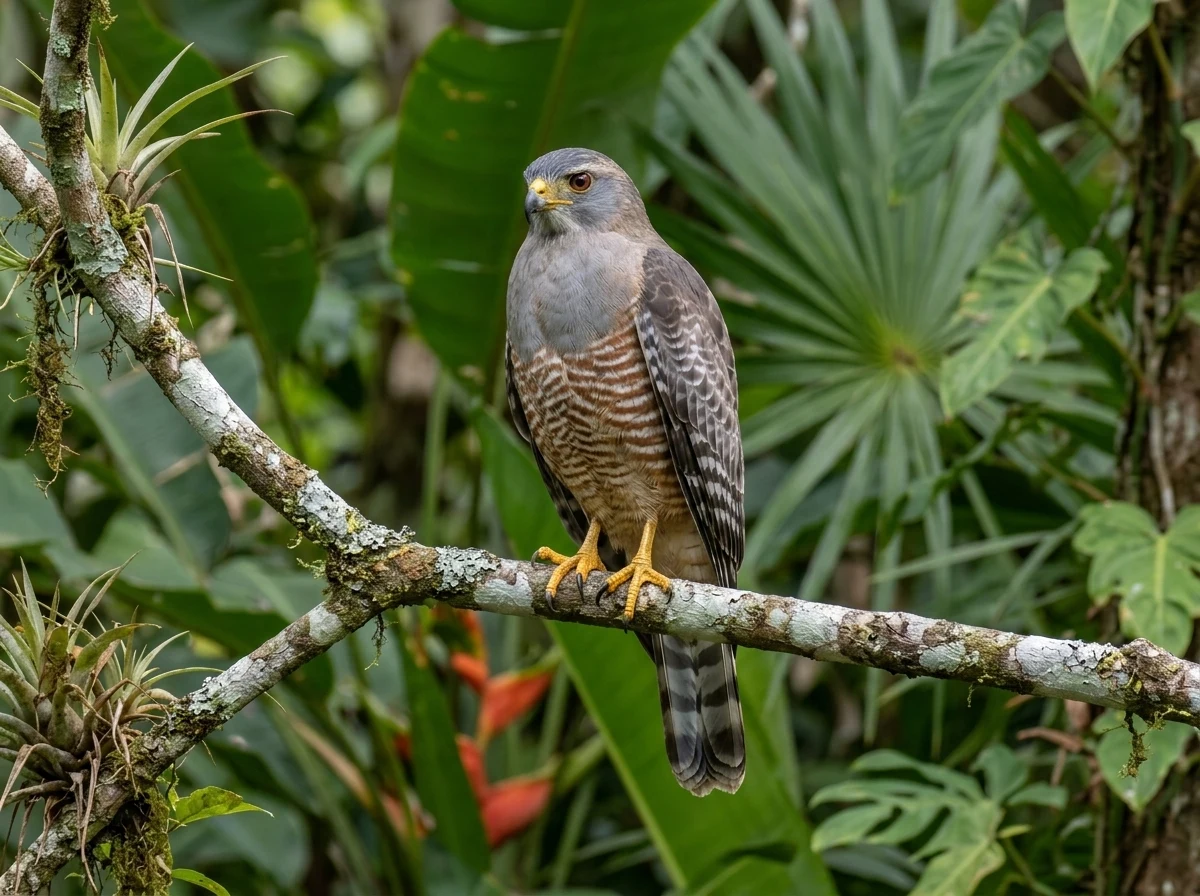 AI
AI
Evidence trail